India’s Supply Chain Opportunity
Relevance: GS2 - Groupings & Agreements Involving India and/or Affecting India's InterestsGovernment Policies & Interventions; GS3 - Growth & Development
(Source: Indian Express, 09/14/2023)
Click here for Daily Current Affairs
Why in the news?
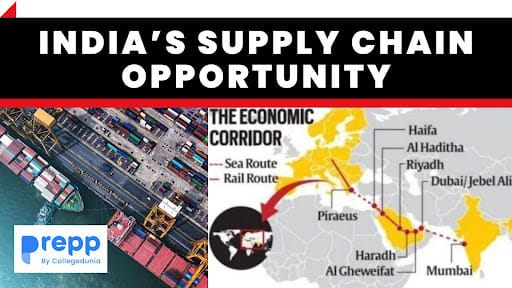
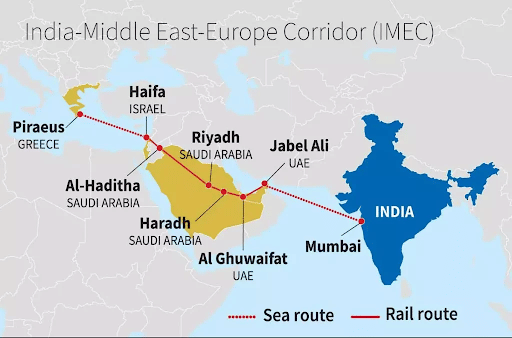
- India's recent announcement of the India-Middle East-Europe Economic Corridor (IMEC) at the G20 Leaders' Summit establishes India as a key hub in Asian global supply chains.
- This is significant amid the efforts to cut dependence on China-centric global supply chains.
- A Global Operations Benchmarking survey had earlier revealed that 87.9% of the CEOs surveyed are looking at India as their primary alternative to China.
Table of Contents
- What are Supply Chains?
- Why are Global Supply Chains moving from China?
- Why is India considered an attractive supply chain hub?
- Recommendations for India - Learning from China’s Experience
- What can be India's Strategic Role in South Asia?
- Some Government Initiatives to Push India’s Supply Chain
- Conclusion
- FAQs
- MCQs
What are Supply Chains?
- Supply chains, also known as global production networks, production fragmentation, or global value chains, involve the strategic placement of different production stages (like design, manufacturing, assembly, marketing, and services) in a way that optimizes cost-effectiveness.
- Global supply chains have been the dominant model for industrial production since the 1980s and have played a significant role in shaping the course and nature of globalization and regionalization.
- The shift from localized and regional production to a global supply chain model has been a gradual process spanning the past century.
- These global supply chains are prevalent in a wide range of industries, including both simple ones like textiles, food processing, and consumer goods, and more complex sectors such as automotive, aerospace, machinery, electronics, and pharmaceuticals.
Why are Global Supply Chains moving from China?
- Pre-pandemic shift: Prior to the onset of the Covid-19 pandemic, western companies had started to reduce their dependence on China as a primary sourcing destination, and its attractiveness among Western buyers was diminishing.
- Several factors contributed to this shift, including rising labor costs, supply chain bottlenecks within China, and concerns among investors about increased regulatory constraints on foreign firms.
- Declining rate: The global risks of supply chains concentrated in mainland China and Hong Kong. Exports from these two regions, which collectively account for 20% of global intermediate goods exports, experienced significant year-on-year declines of 15% and 27% respectively in the last quarter of 2022.
- Declining rates of other countries: Similarly, shipments from the US, which accounted for 8.1% of world exports of intermediate goods, fell by 3% while those of Japan, with 4% share, fell by 13%.
- This downturn, compounded by internal risks within China and the ongoing trade tensions between China and the US, is compelling multinational corporations to reassess their global sourcing strategies.
- Some production stages in Chinese supply chains, particularly the labour-intensive ones, were moving to lower-cost locations.
Why is India considered an attractive supply chain hub?
- Cost Competitiveness: India offers a large pool of skilled and semi-skilled labor at competitive wages, making it an attractive destination for manufacturing and assembly operations. The Indian government has implemented various fiscal incentives and schemes to encourage foreign investment, such as the Make in India initiative, which provides tax benefits and other incentives to manufacturers.
- Infrastructure Development: India has been investing in improving its transportation and logistics infrastructure, including the development of ports, roads, and railways, reducing the cost and time of moving goods within the country.
- Technology Transfer and Value Addition: India has been attracting foreign companies willing to transfer technology, allowing for the development of high-tech manufacturing capabilities and creating value-adding jobs. This can be seen in the:
- Ramped-up manufacturing of iPhones in the country,
- Early technology transfer in the product cycle of the technologically advanced Mercedes Benz EQS to India, and
- Foxconn Technology Group developing a chip-making fabrication plant in Gujarat.
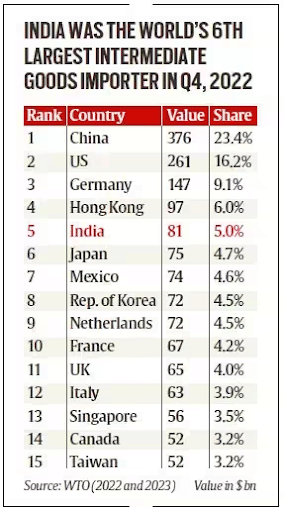
- Geopolitical and Economic Factors: The World Trade Organisation (WTO) lists India as the fifth largest importer of intermediate goods in 2022 Q4 with a 5% share, suggesting that supply chain pessimism on India may be altering since the pandemic.
- Trade Policy and Bilateral Agreements:
- UAE-India Comprehensive Economic Partnership Agreement
- Australia-India Free Trade Agreement
- UK-India and EU-India FTAs
Recommendations for India - Learning from China’s Experience
- Export-Oriented FDI Promotion: India should prioritize attracting foreign direct investment (FDI) with a focus on export-oriented manufacturing. This involves maintaining an open-door policy for FDI, offering competitive fiscal incentives, and creating modern special economic zones through public-private partnerships. Additionally, streamlining tax, customs, and business administration processes through digitalization and pursuing high-quality free trade deals are crucial.
- Local Business Strategies: Local firms require strategic planning to enter global supply chains. Large companies possess advantages such as economies of scale, access to foreign tech, and greater marketing resources. Strategies like mergers, acquisitions, alliances with multinationals, and investments in domestic technological capabilities are recommended.
- Caution with State Intervention: India should exercise caution when emulating China's state interventionist approach, as it carries a risk of government failure and cronyism. However, India can consider aspects like targeting multinationals in strategically advantageous industries, improving coordination between central and state governments, and investing in higher education in STEM fields.
What can be India's Strategic Role in South Asia?
- Opportunity for South Asian Industrialization: India has a unique historical opportunity to foster industrialization across South Asia, resulting in regional stability, job growth, and reduced susceptibility to Chinese influence.
- Leveraging Market-led Spillovers: India can facilitate the spread of its supply chains to neighboring countries like Bangladesh and Sri Lanka through outward foreign investment in labor-intensive manufacturing, creating a natural transmission channel for economic development.
- Harnessing India's Startup Ecosystem: India's vibrant startup culture, robust venture capital financing, and fintech capabilities can attract young entrepreneurs from other South Asian nations, fostering innovation and collaboration.
- Policy Initiatives for Regional Supply Chains:
- Make in South Asia Programme: India can extend its successful "Make in India" initiative to create a "Make in South Asia" program. This would involve offering fiscal incentives to Indian manufacturers to expand operations into neighboring countries, particularly in industries such as food processing, textiles, apparel, and automotive manufacturing.
- Bilateral FTAs: India should prioritize the negotiation of comprehensive bilateral Free Trade Agreements (FTAs) with Bangladesh and upgrade the Indo-Sri Lanka FTA. These agreements will support rules-based trade and investment, facilitating greater integration into regional supply chains centered around India as the assembly hub.
- Global Integration and "Neighborhood First" Approach: By creating channels for economic cooperation within South Asia, India can position itself as a valuable partner in global supply chains, particularly with the opening of new supply chain opportunities, such as those with the United States. This aligns with India's "Neighborhood First" policy, strengthening its position in the global market.
Some Government Initiatives to Push India’s Supply Chain
- The Indian government has introduced several key initiatives to boost various sectors, such as the Production Linked Incentive (PLI) schemes for automotive, electronics, and medical devices, aimed at attracting both multinational and domestic manufacturers.
- Initiatives like the PM Gati Shakti Plan and the National Logistics Policy aim to enhance infrastructure and reduce logistics costs from 13-14% of GDP to less than 8%.
- To excel in managing complex supply chains, India is fostering collaboration, innovation, and entrepreneurship, particularly empowering MSMEs to serve the diverse population. Initiatives like Unified Payments Interface (UPI) and Open Network for Digital Commerce (ONDC) encourage digital payments and e-commerce for small-scale businesses.
About IMEC
|
Conclusion
- The current global geopolitical landscape has opened a distinctive window of opportunity for India to establish itself as a significant player in the global supply chain, capitalizing on the 'China plus one' strategy.
- In spite of the formidable obstacles presented by the pandemic, India has demonstrated remarkable resilience and has emerged as a favored destination for international corporations seeking to diversify their supply chain networks.
- Having achieved its highest-ever ranking at 38th place in the World Bank's Logistics Performance Index, India is well-positioned to assume a prominent role in the global supply chain arena.
(*Click this link to read prelims specific weekly current affairs articles)
FAQs
Question: What are Supply Chains?
Answer:
Supply chains, also known as global production networks, production fragmentation, or global value chains, involve the strategic placement of different production stages (like design, manufacturing, assembly, marketing, and services) in a way that optimizes cost-effectiveness.
Question: What is Make in India?
Answer:
Make in India is a national initiative aimed at promoting domestic and foreign investment to transform India into a global manufacturing hub.
Question: What is India-Middle East-Europe Economic Corridor (IMEC)?
Answer:
India-Middle East-Europe Economic Corridor (IMEC) is a planned economic corridor that aims to bolster economic development by fostering connectivity and economic integration between Asia, the Arabian Gulf, and Europe.
UPSC Mains Practice Question:
|
MCQ
Question: Consider the following statements: (UPSC 2023)
Statement I: India accounts for 3.2% of global export of goods.
Statement II: Many local companies and some foreign companies operating in India have taken advantage of India’s Production-linked Incentive’ scheme.
Which one of the following is correct in respect of the above statements?
(a) Both Statement-I and Statement-II are correct and Statement-ll is the correct explanation for Statement-I.
(b) Both Statement-I and Statement-II are correct and Statement-l is not the correct explanation for Statement-I.
(c) Statement-l is correct but Statement-II is incorrect.
(d) Statement-I is incorrect but Statement-II is correct.
Answer: (d) See the Explanation
- According to the latest available data (Economic Survey 2022-23), India accounts for 1.8% of global exports of goods and 4% of global exports of services. Therefore, the assertion that India accounts for 3.2% of global exports of goods is not accurate. Hence, statement 1 is not correct.
- The Production Linked Incentive (PLI) scheme is a performance-linked incentive program offered to companies based on their incremental sales resulting from products manufactured within domestic facilities. Its primary objective is to stimulate the manufacturing sector and reduce India's dependence on imports. Hence, statement 2 is correct.
Therefore, option (d) is the correct answer.
Question: What is/are the recent policy initiative(s)of Government of India to promote the growth of manufacturing sector? (UPSC 2012)
- Setting up of National Investment and Manufacturing Zones
- Providing the benefit of ‘single window clearance’
- Establishing the Technology Acquisition and Development Fund
Select the correct answer using the codes given below:
(a) 1 only
(b) 2 and 3 only
(c) 1 and 3 only
(d) 1, 2 and 3
Answer: (d) See the Explanation
- The National Investment and Manufacturing Zone is a novel concept integral to the National Manufacturing Policy, 2011. This policy serves as a strategic framework applicable to designated zones aimed at promoting manufacturing. Hence, option 1 is correct.
- The introduction of a 'single window clearance' system is a significant step to reduce bureaucratic hurdles and enhance the ease of doing business in the country, thus facilitating investments. Hence, option 2 is correct.
- The Technology Acquisition and Development Fund (TADF) is a novel initiative launched under the National Manufacturing Policy. It is designed to support Micro, Small, and Medium Enterprises (MSMEs) in acquiring Clean, Green, and Energy-Efficient Technologies, including technology, customized products, specialized services, patents, and industrial designs available both in India and globally. Hence, option 3 is correct.
Therefore, option (d) is the correct answer.
Download the PREPP App and attempt FREE IAS Exam Mock Tests and get complete study material!

Full Test - 04: UPSC CSE Prelims CSAT (Paper-II)
Full Test - 03: UPSC CSE Prelims CSAT (Paper-II)
UPSC CSE Prelims 2026 GS Paper 1 Question Paper (24-May-2026)
UPSC CSE Prelims 2026 CSAT Paper 2 Question Paper (24-May-2026)

17 February 2025 | The Hindu Must Read Articles | Current Affairs

16 February 2026 | The Hindu Must Read Articles | Current Affairs

13 February 2026 | The Hindu Must Read Articles | Current Affairs









Comments