Six Of 9 Planetary Boundaries Have Been Breached Because Of Human Activities: Study
Relevance: GS3 -Conservation, environmental pollution and degradation, environmental impact assessment, Disaster and disaster management.
(Source: Down To Earth, 09/14/2023)
Click here for Daily Current Affairs
Why in the news?
- Recently, a study published in the Science Advances journal revealed that six of the nine planetary boundaries necessary to maintain Earth’s stability and resilience have been breached due to human activities.
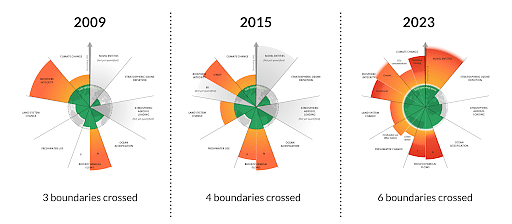
- The planetary boundaries framework was launched in 2009 to define the environmental limits within which humanity can safely operate.
Table of Contents
What does the report say about planetary boundaries?
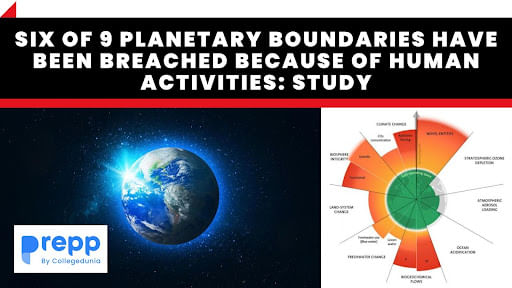
- According to the report, the earth has breached six planetary boundaries:
- Climate change
- Biosphere integrity i.e. the genetic diversity and energy available to ecosystems
- Land system change
- Freshwater change i.e. changes across the entire water cycle
- Biogeochemical flows or nutrient cycles
- Novel entities such as microplastics, endocrine disruptors, and organic pollutants.
- Other boundaries:
- Ocean acidification
- Atmospheric aerosol loading
- Stratospheric ozone depletion
- According to the report, the breaching of individual boundaries does not mean there is an immediate risk of disaste.
- However, this raises the risk of dramatic and irreversible changes to the overall environment and human civilisation.
Process
- It is the third iteration of the Planetary boundaries framework, which was conducted by scientists from 29 countries using computer simulations.
- The researchers first identified the processes in the Earth’s ecosystem that are crucial to maintain favourable conditions for humans over the last 12,000 years, which is characterized by stable and warm planetary conditions.
- They assessed how humans are changing these processes and conditions and identified the scale at which human activities raise the risk of irreversible changes in the Earth’s environmental conditions.
What are the findings of the report?
- Human activity caused a breach in the earth’s safe climate and land system in 1988.
- Climate change and human activity have increased the risk of systemic disruption.
Climate change boundary
- Researchers set boundaries for atmospheric carbon dioxide concentration and radiative forcing at 350 ppm and 1 Wm−2, respectively.
- However, the present values (417 ppm & 2.91 Wm−2) have exceeded these boundaries.
Land system change boundary
- Global area of forested land as a percentage of original forest cover boundary was estimated at 75%.
- The current value (60%) is outside the safe limits.
Biosphere integrity boundary
- The two aspects of biosphere integrity are species extintions and net primary production (energy available to the ecosystem).
- The boundary for biosphere integrity was set at less than 10 extinctions per million species-years.
- However, calculations revealed that the actual rate was greater than 100 extinctions per million species-years .
- Around one million out of the 8 million plant and animal species are threatened by extinction with around 10% of the genetic diversity of animals and plants having been eliminated over the last 150 years.
- According to the study, human appropriated 30% of the energy that was available to support biodiversity before the Industrial Revolution.
Freshwater change boundary
- The planetary boundary for freshwater includes blue water (surface and groundwater) and green water (available water for plants) were estimated as 10.2% and 11.1% respectively.
- Human impacts on blue and green water were calculated to be 18.2% and 15.8% respectively, which is higher than the safe limit.
- According to the study, this boundary was breached in 1905 and 1929.
Biogeochemical flows boundary
- The boundaries for nutrient flows were fixed at 11 teragrams for Phosphorus and 62 Tg for Nitrogen.
- The study found nutrient flows to be around 22.6 Tg and 190 Tg respectively at present.
- This is likely to affect biodiversity and water quality and climate change.
- Reactive nitrogen, which includes oxides of nitrogen (NOx), ammonia (NH3), and nitrous oxide (N2O) can worsen climate change through the production of potent greenhouse gases.
Novel entities boundary
- The planetary boundaries for novel entities was set at zero.
- This boundary has been violated as a result of the introduction of microplastics, endocrine disruptors, and organic pollutants into the environment.
Other boundary conditions
- Stratospheric ozone depletion, aerosol loading and ocean acidification were found to be within the planetary boundary.
- However, the study revealed that there is an increasing risk of aerosol loading and ocean acidification exceeding their boundaries.
- Stratospheric Ozone: The study stated that the ozone layer planetary boundary was transgressed in the 1990s but has now returned to within safe operating limits as a result of global pacts such as the Montreal Protocol.
What are the recommendations made by the researchers?
- Global cooperation: The study highlights the impact of international cooperation and environmental protection and the progress made on ozone layer protection.
- Greater cooperation on mutual interests through a common framework will help achieve targets in other areas as well.
- Circular Economy: It also advocates for the implementation of a circular economy which reflects the circular approach in nature.
- Sustainable Waste Management: The study also advocates for the need to impose limits on waste dumping which is a major threat to the air, land, and water.
Conclusion
- It is clear that the breach of planetary boundaries poses a significant risk to the Earth's stability.
- The framework must be suitably updated in order to reflect the changing environment and climate goals.
- A sustainable and circular economy implemented through global cooperation is necessary to protect the environment.
(*Click this link to read prelims specific weekly current affairs articles)
FAQs
Question: What is the planetary boundaries framework?
Answer:
The framework was launched in 2009 to define the environmental conditions that must necessarily be followed for civilization to continue. They are crucial limits within which humanity must operate to maintain Earth's stability. It has nine boundaries - climate change, biodiversity loss, ocean acidification, ozone depletion, atmospheric aerosol pollution, freshwater use, biogeochemical flows, land-system change, and release of novel chemicals.
Question: What is net primary production?
Answer:
It is the difference between the amount of carbon produced through photosynthesis and the amount of energy that is used for respiration.
Question: What are aerosols?
Answer:
Aerosols are minute particles from combustion processes, biomass burning, and plant/microbial materials suspended in the air. They are known to impact climate.
UPSC Mains Practice Question:
|
MCQs
Question: Climate Action Tracker” which monitors the emission reduction pledges of different countries is a :
(a) Database created by coalition of research organisations
(b) Wing of “International Panel of Climate Change”
(c) Committee under “United Nations Framework Convention on Climate Change”
(d) Agency promoted and financed by United Nations Environment Programme and World Bank
Answer: (a) See the Explanation
- The Climate Action Tracker is an independent scientific analysis produced by two research organizations (Climate Analytics and New Climate Institute) tracking climate action since 2009.
- It monitors 32 countries, accounting for more than 80 percent of global emissions.
- It tracks government climate action and measures it against the globally agreed Paris Agreement aim of “holding warming well below 2°C, and pursuing efforts to limit warming to 1.5°C.”
Therefore, option (a) is the correct answer.
Question: Which one of the following statements best describes the term ‘Social Cost of Carbon’? It is a measure, in monetary value, of the (UPSC CSE 2020)
(a) long-term damage done by a tonne of CO2, emissions in a given year
(b) requirement of fossil fuels for a country to provide goods and services to its citizens, based on the burning of those fuels
(c) efforts put in by a climate refugee to adapt to live in a new place
(d) contribution of an individual person to the carbon footprint on the planet Earth
Answer: (a) See the Explanation
- It is a monetary assessment of the economic damages caused by the emission of one additional tonne of CO2 in a given year.
- It helps policymakers understand the economic implications of decisions and policies relating to emissions.
- Country-level social costs of carbon for India is estimated at around $86 per tonne of CO2.
Therefore, option (a) is the correct answer.
Download the PREPP App and attempt FREE IAS Exam Mock Tests and get complete study material!

Full Test - 04: UPSC CSE Prelims CSAT (Paper-II)
Full Test - 03: UPSC CSE Prelims CSAT (Paper-II)
UPSC CSE Prelims 2026 GS Paper 1 Question Paper (24-May-2026)
UPSC CSE Prelims 2026 CSAT Paper 2 Question Paper (24-May-2026)

17 February 2025 | The Hindu Must Read Articles | Current Affairs

16 February 2026 | The Hindu Must Read Articles | Current Affairs

13 February 2026 | The Hindu Must Read Articles | Current Affairs









Comments