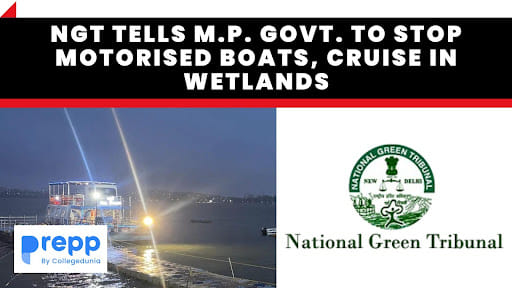
NGT Tells M.P. Govt. To Stop Motorised Boats, Cruise In Wetlands
Relevance: GS3 - Conservation, environmental pollution and degradation, environmental impact assessment; Prelims
(Source: The Hindu, 09/14/2023)
Click here for Daily Current Affairs
Why in the news?
- Recently, the National Green Tribunal (NGT) has prohibited the Madhya Pradesh government from using cruise boats or any types of motorized boats on Bhopal Lake expressing deep concern over significant damage to water bodies, particularly the Bhoj wetland.
- This decision stems from the recognition that water bodies are meant for the welfare of the public, and the government is obligated to safeguard them.
Table of Contents
What is the issue?
- An environmentalist's application led to the NGT's recent order, citing severe damage to the "Bhoj Wetland" and other water bodies due to the operation of motorized and cruise boats.
- Pollution Concerns: Allegations suggest that small cruise vessels act as floating colonies, causing pollution by discharging sewage, wastewater, and contaminants into water bodies. Mid-sized cruise ships are reported to consume 150 tonnes of fuel daily, contributing to toxic waste dumping in water.
- Bhopal Master Plan 2005: The plan emphasized the fundamental use of the Upper Lake for drinking water, prohibiting recreational activities due to their potential adverse effects on water quality. Despite this, the Madhya Pradesh Tourism Board initiated cruises in various water bodies, including the river Narmada and its tributaries.
- Illegal Operation at Ramsar Site: The NGT's order explicitly declares the operation of cruise vessels and motor-propelled boats in the Bhoj Wetland, a Ramsar site, as illegal. Ramsar designation signifies international importance for wetlands, as per the Convention of Wetlands signed in 1971.
About Bhoj Wetland
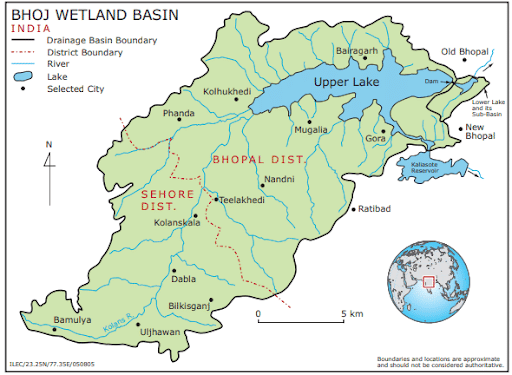
- It is located in the city of Bhopal, Madhya Pradesh.
- The wetland is also a Ramsar site with international importance.
- It has two lakes, Upper lake, also called Bhojtal and Lower Lake or Chhota Talaab.
- Historical origin: The Upper Lake, one of the oldest and most expensive man-made lakes in central India, was ingeniously crafted by King Bhoj during the 11th century. The king achieved this feat by constructing an earthen dam across the Kolans River.
- International recognition: In 2002, the Bhoj wetland garnered international recognition when it was designated a wetland of global importance under the Ramsar Convention of 1971.
Significance of Bhoj Wetland
- The Upper Lake, spanning approximately 31 kilometers, holds significant importance as a vital source of drinking water for the city of Bhopal. This essential water body sustains the livelihoods of around 1.2 million residents in the area.
- Environmental Significance: It plays a crucial role in shaping the local climate, fostering diverse vegetation, and impacting both groundwater depletion and contamination in the surrounding region.
- Rich Aquatic Ecosystem: This pristine lake boasts an impressive array of over 15 fish species, as well as hosting several vulnerable creatures, including turtles, amphibians, and various aquatic invertebrates.
- Migratory Bird Sanctuary: This wetland is a sanctuary for more than 2,500 migratory birds hailing from around the globe. They visit regularly for breeding and the dispersion of seeds, thereby contributing significantly to the maintenance of biodiversity along their migratory routes.
What do you mean by wetlands?
- Wetlands are regions where water plays a fundamental role in shaping the environment and supporting the plant and animal species found there.
- These areas exist where the water table is either at or very close to the land's surface, or where the land is submerged under shallow water.
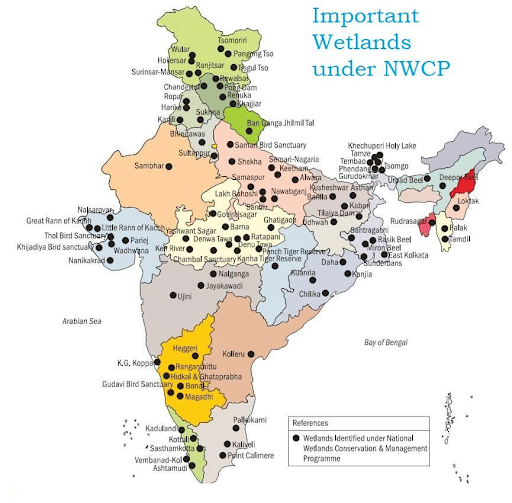
- India has the largest network of wetlands and Ramsar sites in South Asia, with 49 sites totaling 10,93,636 hectares as of February 2022.
- There are a total of 27,403 wetlands in India, with 23,444 inland wetlands and 3,959 coastal wetlands.
- Wetlands cover around 4.63 percent of India's land area, with paddy cultivation accounting for 70% of that.
About NGT
|
(*Click this link to read prelims specific weekly current affairs articles)
FAQs
Question: What is a Wetland Ecosystem?
Answer:
Wetland ecosystems are transitional zones between terrestrial and aquatic ecosystems (Ecotone). The wetlands are generally classified into coastal and inland wetlands on the location of the area and natural and man-made wetlands on the basis of the nature of formation.
Question: Which state in India has the most Ramsar Sites?
Answer:
The state of Uttar Pradesh has the most Ramsar Sites in India. There are ten Indian Wetlands in the area.
Question: What is the National Green Tribunal?
Answer:
The National Green Tribunal (NGT) was established by the NGT Act of 2010 on October 18, 2010 as a specialized body to handle any environmental disputes, including multi-disciplinary issues. It succeeded the National Environment Appellate Authority.
MCQ
Question: Consider the following pairs: (UPSC 2022)
| Wetland/Lake | Location |
|---|---|
| Hokera Wetland | Punjab |
| Renuka Wetland | Himachal Pradesh |
| Rudrasagar Lake | Tripura |
| Sasthamkotta Lake | Tamil Nadu |
How many pairs given above are correctly matched?
(a) Only one pair
(b) Only two pairs
(c) Only three pairs
(d) All four pairs
Answer: (b) See the Explanation
- It is located at the northwest Himalayan biogeopgraphic province of Kashmir, back of the snow-draped Pir Panchal. Hence, pair 1 is not correctly matched.
- Renuka Wetland is located in Himachal Pradesh. It is a natural wetland with freshwater springs and inland subterranean karst formations. Hence, pair 2 is correctly matched.
- Rudrasagar Lake, also known as Twijilikma, is a lake located in Melaghar, Tripura, India. The Government of India's Ministry of Environment and Forest has identified Rudrasagar as one of the wetlands of National Importance for conservation and sustainable use based on its bio-diversity and socio economic importance. Hence, pair 3 is correctly matched.
- Sasthamcotta Lake or Sasthamkotta Lake, also categorized as a wetland, is the largest fresh water lake in Kerala. Sasthamkotta lake is also known as the Queen of Lakes. Hence, pair 4 is not correctly matched.
Therefore, option (b) is the correct answer.
Question: With reference to the wetlands of India, consider the following statements : (UPSC 2012)
- The country’s total geographical area under the category of wetlands is recorded more in Gujarat as compared to other States.
- In India, the total geographical area of coastal wetlands is larger than that of wetlands.
Which of the statements given above is/are correct?
(a) 1 only
(b) 2 only
(c) Both 1 and 2
(d) Neither 1 nor 2
Answer: (a) See the Explanation
- The country’s total geographical area under the category of wetlands is recorded more in Gujarat as compared to other States. Hence, statement 1 is correct.
- India contains a total of 27,403 wetlands, including 23,444 inland wetlands and 3,959 coastal wetlands. However, the coastal wetlands cover a larger area than the interior wetlands, covering an estimated 6,750 square kilometers. Hence, statement 2 is not correct.
Therefore, option (a) is the correct answer.
Download the PREPP App and attempt FREE IAS Exam Mock Tests and get complete study material!

Full Test - 04: UPSC CSE Prelims CSAT (Paper-II)
Full Test - 03: UPSC CSE Prelims CSAT (Paper-II)
UPSC CSE Prelims 2026 GS Paper 1 Question Paper (24-May-2026)
UPSC CSE Prelims 2026 CSAT Paper 2 Question Paper (24-May-2026)

17 February 2025 | The Hindu Must Read Articles | Current Affairs

16 February 2026 | The Hindu Must Read Articles | Current Affairs

13 February 2026 | The Hindu Must Read Articles | Current Affairs









Comments