Supreme Court Information A Click Away As It Joins National Judicial Data Grid
Relevance: GS2 - Important aspects of governance, transparency and accountability, e-governance
(Source: The Hindu, 09/15/2023)
Click here for Daily Current Affairs
Why in the news?
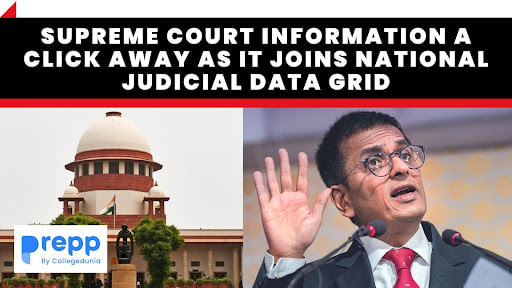
- Recently, Chief Justice of India DY Chandrachud announced that the Supreme Court has been linked to the National Judicial Data Grid (NJDG), a repository of data relating to pendency of cases and disposal rate of courts right from the taluka level to the national level.
- This step would further transparency in the judiciary and enhance the justice delivery system in the country.
- NJDG is recognized as a significant innovation under the ease of doing business initiative of the Government.
- In the top court, as of 2023, there is a pendency of 64,854 registered cases and 15,490 unregistered cases, which are awaiting clearance by the Registry.
- Previously, the Supreme Court was not part of the NJDG, a repository tracking court case pendency and disposal, limited to high courts in India.
Table of Contents
About National Judicial Data Grid (NJDG)
- It is a comprehensive national portal that serves as a centralized repository for real-time information and data concerning all legal cases, both pending and disposed of, across the entire judicial landscape of India.
- This encompassing database not only includes data from the High Courts but also extends to the district and Taluka Courts, and it has recently been expanded to cover the Supreme Court of India as well.
- The NJDG was built as part of Phase II of the e-Courts project, which is a Centrally Sponsored Scheme.
- It was jointly developed through a collaborative effort between the National Informatics Centre and the in-house IT team of the Supreme Court.
- Objective: The primary objective of this initiative was to revolutionize the accessibility, analysis, and utilization of legal data, marking a significant step towards modernizing the Indian judicial system.
How does the NJDG ensure transparency?
- Open Data Policy: It ensures transparency through the implementation of the Supreme Court's "open data policy." This policy promotes real-time data access related to case pendency in courts across India.
- Real-time Data Access: One of the key transparency measures is providing real-time data access to the public. Users can access up-to-date information about the institution, disposal, and pendency of cases in various categories, including type, year, stage, and forum.
- Detailed Information: The NJDG offers detailed information about cases, including their type, year of filing, current stage, and the specific forum where they are being heard. This level of detail allows for a comprehensive understanding of the legal landscape.
- Categorization and Sorting: Users can categorize and sort the data according to their preferences. They have the flexibility to arrange the information by case type, year, stage, or forum, making it easier to analyze and interpret the data.
- Informative Graphs: To enhance transparency and facilitate data analysis, the NJDG provides informative graphs that offer insights into case trends. These visual representations help users understand the impact of vacation periods and track case statistics more effectively.
Importance of the National Judicial Data Grid (NJDG)
- Transparency and Accountability: NJDG has introduced unprecedented transparency into the Indian judicial system by providing access to data on cases instituted, pending, and disposed of across all tiers of the judiciary.
- Enhanced Efficiency: With NJDG, the judiciary can efficiently manage and track the progress of cases. This contributes to the expeditious disposal of cases and reduces delays in the legal process.
- Improved Coordination: NJDG fosters increased coordination among different levels of the Indian judiciary. By centralizing case data, it streamlines communication and collaboration between courts and legal professionals.
- Informed Decision Making: The availability of comprehensive case-related statistics and data allows judges, lawyers, and policymakers to make informed decisions. It aids in identifying trends, issues, and areas needing reform.
- Optimal Resource Deployment: NJDG helps in the optimal deployment of judicial resources and manpower. It allows for a data-driven approach to resource allocation, ensuring that courts have the necessary staff and infrastructure to handle their caseloads efficiently.
- Single Source of Data: It serves as a single, authoritative source of data on the Indian judicial system. This simplifies data access and eliminates the need to rely on multiple fragmented sources, ensuring data consistency and accuracy.
- Research Opportunities: It offers vast potential for high-quality research work in the field of law and judicial studies. Researchers can leverage the comprehensive dataset to analyze trends, outcomes, and areas for reform. It opens doors for evidence-based research that can contribute to the enhancement of the Indian legal system.
About the eCourts Mission Mode Project
Major Initiatives Launched under the Project
|
(*Click this link to read prelims specific weekly current affairs articles)
FAQs
Question: What is NJDG?
Answer:
It is a comprehensive national portal that serves as a centralized repository for real-time information and data concerning all legal cases, both pending and disposed of, across the entire judicial landscape of India.
Question: What is the e-Courts Project?
Answer:
The e-Courts Project is an initiative launched by the Government of India to computerize the functioning of district and subordinate courts in the country. The project aims to provide an efficient and transparent system of justice delivery by leveraging technology.
MCQ
Question: With reference to the Indian judiciary, consider the following statements: (UPSC 2021)
- Any retired judge of the Supreme Court of India can be called back to sit and act as a Supreme Court judge by the Chief Justice of India with the prior permission of the President of India.
- A High Court in India has the power to review its own judgement as the Supreme Court does.
Which of the statements given above is/are correct?
(a) 1 only
(b) 2 only
(c) Both 1 and 2
(d) Neither I nor 2
Answer: (c) See the Explanation
- The Chief Justice of India can appoint a retired Supreme Court or high court judge with consent from the President and the appointee, granting them Supreme Court powers and allowances. Hence, statement 1 is correct.
- The Supreme Court and high courts can review and amend their own judgments, not bound by previous decisions for the sake of justice or community welfare. Hence, statement 2 is correct.
Therefore, option (c) is the correct answer.
Download the PREPP App and attempt FREE IAS Exam Mock Tests and get complete study material!

Full Test - 04: UPSC CSE Prelims CSAT (Paper-II)
Full Test - 03: UPSC CSE Prelims CSAT (Paper-II)
UPSC CSE Prelims 2026 GS Paper 1 Question Paper (24-May-2026)
UPSC CSE Prelims 2026 CSAT Paper 2 Question Paper (24-May-2026)

17 February 2025 | The Hindu Must Read Articles | Current Affairs

16 February 2026 | The Hindu Must Read Articles | Current Affairs

13 February 2026 | The Hindu Must Read Articles | Current Affairs









Comments