Expanding The Indian Economy, The Green Way
Relevance: GS3 - Conservation, environmental pollution and degradation, environmental impact assessment. GS2 - Government policies and interventions for development in various sectors and issues arising out of their design and implementation.
(Source: Indian Express, 09/15/2023)
Click here for Daily Current Affairs
Why in the news?
- This article discusses the implications of a carbon trading system and its potential benefits for the Indian economy.
- The Union government recently notified the draft framework for the Indian Carbon Credit Scheme 2023 and tasked the Bureau of Energy Efficiency under the Ministry of Power to develop the Carbon Trading Scheme in cooperation with the Ministry of Environment, Forest & Climate Change.
Table of Contents
What is carbon trading?
- Carbon trading refers to the buying and selling of credits allowing a business or other entity to emit a specific amount of CO2 or other greenhouse gases.
- The mechanism of carbon trading was introduced through the Kyoto Protocol.
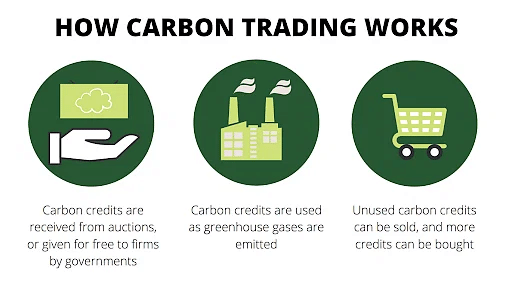
Working
- In a carbon trading mechanism, the government determines the number of permits and then issues these permits to businesses based on criteria like the amount of output produced by a firm.
- After receiving the permits, the company can then trade them on the open market.
- Companies that intend to produce more emissions to purchase additional licenses and those that decrease their emissions to sell their extra credits on the market.
Why is carbon trading necessary?
- India's economic development faces a dual challenge as it must meet the aspirations of its growing population while also addressing challenges like climate change and carbon emissions reduction.
- Carbon credits offer a potential solution to combat climate change in the form of temporary licenses that permit organizations to emit a specific amount of CO2 emissions in a given year.
- Governments, investors, consumers, and stakeholders have become more conscious of their carbon footprints and the necessity to control them due to the increasing global temperatures and rising GHG emissions.
Indian Carbon Market
- The Government of India has initiated the Indian Carbon Market (ICM) to establish a national framework for pricing GHG emissions through carbon credit certificates.
- The ICM will mobilize investments and enable India to lower the emissions intensity of the country’s GDP by 45% by 2030(compared to 2005 levels).
- Objective: Decarbonise the Indian economy by pricing GHG emissions through the trading of Carbon Credit Certificates.
- The Carbon Credit Trading Scheme will cover transition efforts in potential energy sectors.
- Voluntary mechanism to encourage GHG reduction from non-obligated sectors will be developed.
- Methodologies to estimate carbon emissions reductions and removals from various projects will be developed
- Monitoring, Reporting, and Verification (MRV) guidelines for the emissions scheme will also be developed.
- A comprehensive institutional and governance structure will be established.
- Upskilling and capacity building of all entities will be undertaken.
Advantages of carbon trading networks
- Global commitments: This will allow the country to align its actions with its global climate commitments.
- Energy transition: Carbon credit trading has the potential to accelerate the transition to cleaner energy sources, particularly in high-energy consumption sectors.
- India already has an energy savings-linked market mechanism.
- Climate goals: Carbon credit trading will align with sector-specific emissions targets and climate goals, promoting sustainable growth.
- The government would be able to develop GHG emissions intensity targets and benchmarks in sync with the domestic emissions trajectory and the climate goals.
- Flexibility: The ICM will offer flexibility to companies in hard-to-abate segments to enhance their GHG emission efforts in the form of carbon market credits.
- The ICM will help decarbonize the commercial and industrial segments and help achieve the Union government’s target of achieving net zero by 2070.
- Fund generation: It will help attract finance and technology investments in sustainable projects that can generate carbon credits.
- The ICM can effectively channel a majority of the funds required for the low-carbon transition.
- It will enable the creation of a competitive market that can incentivize the adoption of low-cost options in carbon credit-generating sustainable projects.
- Behavioral change: The draft notification will help generate more awareness, and consequently innovation across hard-to-abate industries.
- The penalties and incentives offered will have a direct impact on industries.
- Businesses will factor in national and international implications such as carbon-related tariffs, for example, Carbon Border Adjustment Mechanism (CBAM), as a key criterion in their strategic decisions.
- This will subsequently encourage investments in these sectors and encourage the shifting of business and manufacturing towards low carbon footprint practices.
Challenges
- Sectoral challenges: Decarbonization avenues are limited for some industrial companies and segments such as cement, chemicals, iron and steel production, and non-ferrous metals.
- These sectors would find it more expensive to implement decarbonization strategies as compared to sectors such as transport, power generation, etc.
- However, these sectors are mandated to meet emission reduction goals under local laws or in-house policies as they are some of the biggest contributors to universal GHG emissions.
- Issues with the guidelines: The draft notification issued by the Union government does not have any provisions related to the procedures, regulations, or guidelines for the functioning of carbon markets.
- This responsibility has been vested with a National Steering Committee chaired by the Secretary, Ministry of Power.
- Complex nature of trade: It is challenging to predict and model the impact of international trade given the interdependent and complex nature of trade.
- Therefore, governments would have to create regulatory authorities to oversee the carbon credit market and develop systems to ensure its smooth functioning.
- Implementation: It is difficult to develop a market for goods such as CO2 that have no intrinsic worth.
- Some experts have claimed that carbon trading distracts from focusing on urgent needs such as phasing out fossil fuels and the clean-energy transition.
- It includes a number of abstract concepts, mathematical formulae, and technical details which make it difficult for common people to understand its worth and implications.
- Politics: Political involvement in carbon trading schemes could lead to an excess of permits and affect the working of the scheme.
- This is evident in the working of the EU ETS, the largest carbon trading scheme in the world, as permits were given away for free, leading to ineffective emission reductions.
Conclusion
- The vibrant carbon trading mechanism is a critical tool for India to balance economic growth with environmental sustainability.
- Industry leaders specializing in carbon management and clean energy can facilitate India's transition to a net-zero future by promoting cleaner technologies and switching from fossil fuels or legacy technologies.
- A well-designed, competitive carbon market mechanism would enable the reduction of GHG emissions at the least cost and encourage the adoption of clean technologies, in a growing economy like India.
(*Click this link to read prelims specific weekly current affairs articles)
FAQs
Question: What is the Carbon Border Adjustment Mechanism?
Answer:
The Carbon Border Adjustment Mechanism (CBAM) is a climate law introduced by the European Union (EU) that is designed to address carbon leakage. It aims to create a level playing field for EU industries through the imposition of carbon-related costs on imports of certain products. It is part of the “Fit for 55 in 2030 package", according to which, the EU aims to reduce greenhouse gas emissions by at least 55% by 2030 compared to 1990 levels.
Question: What is the Kyoto Protocol?
Answer:
The Kyoto Protocol is an extension to the United Nations Framework Convention on Climate Change(1992). It aims to reduce greenhouse gas emissions and applies to 6 greenhouse gases - carbon dioxide, methane, nitrous oxide, hydrofluorocarbons, perfluorocarbons, and sulfur hexafluoride. It is based on the principle of common but differentiated responsibilities and is legally binding with 192 countries as members. Canada, Andorra, The U.S.A., and South Sudan are not members of the Protocol.
UPSC Mains Practice Question:
|
MCQs
Question: The “Common Carbon Metric” supported by UNEP, has been developed for (UPSC CSE 2021)
(a) Assessing the carbon footprint of building operations around the world
(b) Enabling commercial farming entities around the world to enter carbon emission trading
(c) Enabling governments to assess the overall carbon footprint caused by their countries
(d) Assessing the overall carbon footprint caused by the use of fossil fuels by the world in a unit of time
Answer: (a) See the Explanation
- The Common Carbon Metric is a protocol that has been developed by the United Nations Environment Program’s Sustainable Buildings & Climate Initiative (UNEP-SBCI) to measure energy use and report GHG emissions from Building Operations.
- It aims to support the reduction in greenhouse gas (GHG) emissions through an accurate measurement of improvements made in ensuring energy efficiency in building operations.
Therefore, option (a) is the correct answer.
Question: Which of the following are some important pollutants released by the steel industry in India?
- Oxides of sulphur
- Oxides of nitrogen
- Carbon monoxide
- Carbon dioxide
Select the correct answer using the code given below: (UPSC CSE 2014)
(a) 1, 3 and 4 only
(b) 2 and 3 only
(c) 1 and 4 only
(d) 1, 2, 3 and 4
Answer: (d) See the Explanation
- The major pollutants released by the steel industry include gases such as CO, CO2, SOx, and NOx.
- Oxides of sulfur and nitrogen are produced as a result of the use of coal in the process of making steel.
- Coke reacts with iron ore, releasing iron and generating CO and CO2 gases.
Therefore, option (d) is the correct answer.
Download the PREPP App and attempt FREE IAS Exam Mock Tests and get complete study material!

Full Test - 04: UPSC CSE Prelims CSAT (Paper-II)
Full Test - 03: UPSC CSE Prelims CSAT (Paper-II)
UPSC CSE Prelims 2026 GS Paper 1 Question Paper (24-May-2026)
UPSC CSE Prelims 2026 CSAT Paper 2 Question Paper (24-May-2026)

17 February 2025 | The Hindu Must Read Articles | Current Affairs

16 February 2026 | The Hindu Must Read Articles | Current Affairs

13 February 2026 | The Hindu Must Read Articles | Current Affairs









Comments