Rubber Board To Increase Area Under Rubber In Northeast
Relevance: GS3 - Major crops-cropping patterns in various parts of the country, - different types of irrigation and irrigation systems storage, transport and marketing of agricultural produce and issues and related constraints; e-technology in the aid of farmers. Issues related to direct and indirect farm subsidies and minimum support prices; GS2 - Statutory, regulatory and various quasi-judicial bodies.
(Source: The Hindu, 09/14/2023)
Click here for Daily Current Affairs
Why in the news?
Recently, the Rubber Board in association with the Central government and the Automotive Tyre Manufacturers’ Association is planning to extend rubber cultivation to Northeast India.
Table of Contents
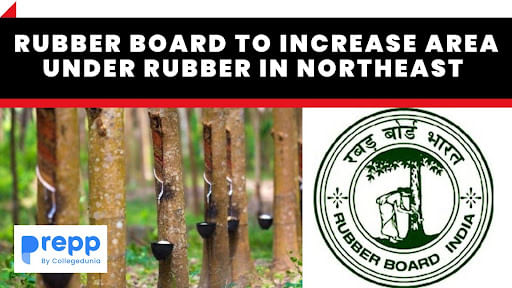
Expansion of Rubber in the Northeast
- The Rubber Board was implementing a project to bring 2 lakh hectares in northeast India under rubber cultivation.
- The northeastern states currently account for 18% of the country’s total production of rubber.
- According to experts, if the project is successful the share of the northeastern states will increase to 32%.
- Area of implementation: Arunachal Pradesh, Assam, Manipur, Meghalaya, Mizoram, Nagaland, Tripura and West Bengal.
- The project was initiated in 2021 and will be implemented over a five-year period.
- According to officials, there was scope for cultivating around 4 lakh hectares of rubber in the northeast, but the project was limited to 2 lakh hectares due to the risk of landslides and other environmental challenges in the region.
Status
- Around 27,000 hectares were covered in FY22-23 and about 40,000 hectares are expected to be covered in the present year.
- The remaining areas would be brought under rubber cultivation in the next two years.
- Tyre manufacturers were investing around ₹1000 crores in the project.
Significance of the project
- Raw Materials Availability
- Rubber is a strategic raw material that can be used in various industries such as medical devices, surgical gloves, aircraft and car tires, pacifiers, clothes, toys, etc.
- It is therefore necessary for India to increase the domestic production of rubber in line with the goal of Aatmanirbharta and self-reliance.
- Quality:
- The project also aims to enhance the quality of rubber produced in the country.
- It highlights the need to develop model smokehouses and upgrade existing smokehouses.
- Regional Development:
- The project also focuses on training and skill development in the region including requisite infrastructure.
- Farmers and tappers in the region will be provided special training on the best practices and technologies in rubber cultivation.
- Countering Militancy:
- Recently, the Union Minister of Commerce and Industry claimed that rubber cultivation had helped counter militancy and insurgency in the region.
- Previously, militants who surrendered were integrated through rubber cultivation in Assam and Tripura.
Introduction of Rubber in Northeast India
- In India, rubber plantations were first set up in 1895 on Kerala’s hill slopes but commercial-scale rubber cultivation was introduced in 1902.
- In the 1960s rubber cultivation was begun in the Northeast by the forest department.
- Reasons for the introduction of rubber in the region:
- Opportunities for long-term employment and land rights for locals
- The aspirations of the landless tribals could not be sufficiently met through the shifting cultivation that was practiced there.
- The region is agro-climatically suitable for rubber cultivation.
- Rubber was economically profitable and would contribute to the development of the region.
What is a Rubber crop?
- Rubber is an elastic solid that is obtained from the latex of tropical trees including Hevea brasiliensis.
- Hevea brasiliensis is a quick-growing tall tree that reaches 20-30 meters in height.
- It yields latex 5-7 years after planting.
- Area under cultivation in India: There are 8.5 lakh hectares under rubber cultivation in India.
- Almost 5 lakh hectares are in Kerala and Kanyakumari, and 1 lakh hectares are in Tripura.
- Uses:
- Manufacturing automotive parts, safety gear, gardening appliances and other industrial products.
- Exports and imports:
- Germany, Brazil, the U.S.A., and Italy are the largest importers of Indian rubber.
- India, the second largest importer of rubber in the world after the U.S.A., imports most of its natural rubber from Indonesia, Vietnam, and Thailand.
Conditions of Growth
- Climate: Hot and humid climate with temperatures of 20 to 34°C
- Humidity of around 80%, 2000 hours of sunshine, and absence of strong winds
- Dry spells and low temperatures are dangerous for rubber cultivation.
- Rainfall: Annual rainfall of over 200 cm which is well distributed throughout the year (at least 100 days).
- Daily rainfall followed by a strong sun is beneficial.
- Soils: Well-drained and well-weathered soils like lateritic, alluvial, sedimentary, and nonlateritic red soils are suitable.
- Deep well-drained loamy soils on hill slopes at 300 to 450 meters above sea level.
- Rubber plantations are usually not found above 700m above sea level as the yield declines with an increase in elevation.
Challenges
- Falling rubber prices: The prices of rubber have fallen discouraging rubber producers from expanding cultivation, leading to the abandonment of plantations.
- High labor costs: Rubber cultivation involves labor-intensive activities like tapping which require skilled workers.
- However, the rising labor charges amid falling rubber prices have made cultivation financially unviable.
- Import competition: Rubber imports are usually available at lower prices than domestic rubber, further discouraging domestic production.
- Production-consumption gap: The production of rubber in India is insufficient to meet the rising demand for natural rubber.
- The tire industry is the major consumer of rubber in the country.
- Climate change: Climate change-induced changes in the weather pose significant challenges to rubber farming.
- This is particularly severe in traditional cultivation areas like Kerala which are vulnerable to climate change.
- Lack of technology: The lack of technological advancements in the industry and the hesitance of farmers to adopt advanced technologies has impacted the productivity and competitiveness of the industry.
- Land conversion and fragmentation: As a result of the non-viability of rubber, plantations are being sold or converted for other purposes.
- This has led to the fragmentation of rubber holdings.
Government initiatives
- Rubber Plantation Development Scheme: It was launched to support the development of rubber plantations by providing financial assistance to farmers
- Rubber Group Planting Scheme: Under the scheme, the government provides financial incentives to form rubber farmer groups and societies.
- National Rubber Policy 2019: The policy consists of provisions aimed at supporting the natural rubber production sector and the entire rubber value chain.
- The government has permitted 100% Foreign Direct Investment (FDI) in Rubber Plantations.
Rubber Board
Structure
Functions
|
(*Click this link to read prelims specific weekly current affairs articles)
FAQs
Question: What is natural rubber?
Answer:
Natural rubber is a polymer of isoprene, an organic compound. The milky latex extracted from the Hevea brasiliensis, a deciduous tree, is the primary source of natural rubber.
Question: What is the climate of Northeast India?
Answer:
North East India experiences a wet climate and receives rainfall for the majority of the year.
UPSC Mains Practice Question:
|
MCQs
Question: Which one of the following groups of plants were domesticated in the ‘New World’ and introduced into the ‘Old World’? (UPSC CSE 2019)
(a) Tobacco, cocoa, and rubber
(b) Tobacco, cotton, and rubber
(c) Cotton, coffee and sugarcane
(d) Rubber, coffee, and wheat
Answer: (a) See the Explanation
- The New World refers to the Americas and the Old World refers to Europe, Africa, and Asia.
- The most prominent crops from the New World countries include rubber, tobacco, sunflower, cocoa, cashew, cotton, yam, and fruits such as papaya, pineapple, and guava.
- Tobacco, cocoa, and rubber were all introduced into the Old World by European settlers through the process of Colombian exchange while cotton and wheat were present in India from the early ages.
Therefore, option (a) is the correct answer.
Question: Match List-I with List-II and select the correct answer using the code given below the Lists: (UPSC CSE 2008)
List-I (Board) List-II (Headquarters)
- Coffee Board 1. Bengaluru
- Rubber Board 2. Guntur
(c) Tea Board 3. Kottayam
(d) Tobacco Board 4. Kolkata
Codes:
(a) A-2; B-4; C-3;D-1
(b) A-1; B-3; C-4; D-2
(c) A-2; B-3; C-4; D-1
(d) A-1; B-4; C-3; D-2
Answer: (b) See the Explanation
- Coffee Board - Bengaluru
- Rubber Board - Kottayam
- Tea Board - Kolkata
- Tobacco Board - Guntur
Therefore, option (b) is the correct answer.
Download the PREPP App and attempt FREE IAS Exam Mock Tests and get complete study material!

Full Test - 04: UPSC CSE Prelims CSAT (Paper-II)
Full Test - 03: UPSC CSE Prelims CSAT (Paper-II)
UPSC CSE Prelims 2026 GS Paper 1 Question Paper (24-May-2026)
UPSC CSE Prelims 2026 CSAT Paper 2 Question Paper (24-May-2026)

17 February 2025 | The Hindu Must Read Articles | Current Affairs

16 February 2026 | The Hindu Must Read Articles | Current Affairs

13 February 2026 | The Hindu Must Read Articles | Current Affairs









Comments