Women's Bill In The Works Again
Relevance: GS1 - Role of Women, GS2 - Government policies and interventions for development in various sectors and issues arising out of their design and implementation; Indian Constitutional Amendments; Issues relating to development and management of Social Sector/Services
(Source: Indian Express, 09/19/2023)
Click here for Daily Current Affairs
Why in the news?
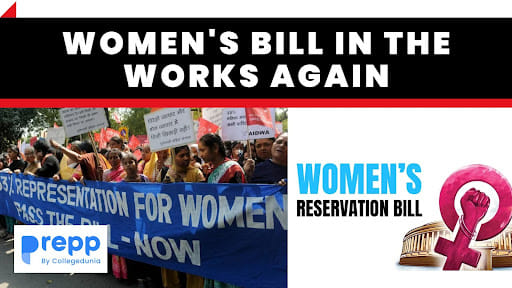
Recently, the Women's Reservation Bill that seeks to provide a 33% quota for women in Lok Sabha and state legislative assemblies has been introduced in the Lok Sabha.
Table of Contents
What is the Women’s Reservation Bill?
- The Constitution 108th Amendment Bill, 2008 seeks to reserve one-third (33%) of the total number of seats in state legislative Assemblies and Parliament for women.
- The bill has proposed that the reservation would continue for a period of 15 years and there will be a quota for SC/STs within the reserved seats for women.
- Reserved seats may be allotted by rotation to different constituencies in the state or union territory.
How did the Women Reservation Bill keep lapsing through its journey?
- The Women’s Reservation Bill was first introduced in the Lok Sabha as the 81st Amendment Bill by then prime minister HD Deve Gowda’s-led United Front government on 12 September, 1996.
- But the bill failed to get passed by the lower house as the Lok Sabha was dissolved.
- After two years, the Atal Bihari Vajpayee-led National Democratic Alliance (NDA) government introduced the Bill in the 12th Lok Sabha. But the bill did not receive adequate support, and lapsed once more.
- It was subsequently reintroduced in 1999, 2002, and 2003 by the Vajpayee government but did not muster the support required to become law.
- In 2010, the UPA government managed to get the bill passed in the Upper House but couldn’t bring it into the Lok Sabha under pressure from allies.
Status in India
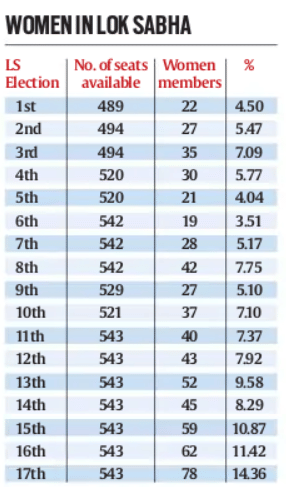
- According to Government data, it states that women MPs account for nearly 15% of Lok Sabha strength while their representation is below 10% in many State Assemblies.
- In a research conducted by the Inter-Parliamentary Union, earlier this year, India was ranked 149th out of 193 nations in terms of the percentage of women who serve in the lower house of parliament.
- India ranks low in terms of women's political representation, standing at 143rd out of 187 countries.
- Gender Gap Report: India has ranked 127 out of 146 countries in terms of gender parity in the World Economic Forum's annual Gender Gap Report for 2023.
- On political empowerment, India has registered 25.3% parity, with women representing 15.1% of parliamentarians, which is the highest for the country since the inaugural report in 2006.
Why is the bill needed?
- The representation of half of the population in the parliament and state assembly is not up to the mark.
- In the present Lok Sabha, 78 women members were elected which account for less than 15% of the total strength of 543.
- In Rajya Sabha also, women's representation is about 14%, according to the data shared by the government with Parliament in December, 2022.
- Several state assemblies have less than 10% women representation, including Andhra Pradesh, Arunachal Pradesh, Assam, Goa, Gujarat, Himachal Pradesh, Karnataka, Kerala, Madhya Pradesh, Maharashtra, Manipur, Meghalaya, Odisha, Sikkim, Tamil Nadu, Telangana, Tripura and Puducherry.
- According to the government data of December 2022, Bihar, Haryana, Punjab, Rajasthan, Uttrakhand, Uttar Pradesh and Delhi had 10-12% women MLAs.
- Chattisgarh, West Bengal and Jharkhand led the charts with 14.44%, 13.7% and 12.35% women MLAs, respectively.
Significance of the Women's Reservation Bill
- Development of nation: Women should have a greater presence in politics if India is to develop on par with other nations.
- Better implementation: According to the American Economic Association, countries with a higher proportion of women in national parliaments are more likely to pass and implement gender-sensitive legislation.
- Increased female participation: According to a 2010 Harvard Kennedy School study, female representation in village councils increased female participation and responsiveness to issues such as drinking water, infrastructure, sanitation, and roads.
Examples of role played by women
- Women were instrumental in India's struggle for independence, actively participating in organizing protests, leading marches, and promoting awareness.
- Women also made significant contributions to the country's political landscape.
- Three of India's most populous states, namely West Bengal, Tamil Nadu, and Uttar Pradesh, were governed by female Chief Ministers.
- Furthermore, in the realm of national politics, Sushma Swaraj held the position of Leader of the Opposition in the Lok Sabha, while Sonia Gandhi served as both the President of the Congress Party and the Chairperson of the United Progressive Alliance.
- During this period, India also witnessed the historic appointment of its first female President, Pratibha Patil.
Constitutional Status
- The fundamental rights of men and women are guaranteed by Part III of the Constitution.
- The Directive Principles of State Policy ensure economic empowerment by mandating maternity leave, humane working conditions, and equal pay for equal work performed by men and women.
- Political equality and the right to vote are guaranteed by Articles 325 and 326 of the Constitution.
- Women's reservation in Panchayats: In 1992, the 73rd and 74th amendments to the Constitution mandated that one-third of the seats in municipal and Panchayati Raj Institutions (PRIs) be set aside for women. The goal of the amendment was to increase women’s participation in grass-root decision-making.
(*Click this link to read prelims specific weekly current affairs articles)
FAQs
Question: What is the Women’s Reservation Bill?
Answer:
The Constitution 108th Amendment Bill, 2008 seeks to reserve one-third (33%) of the total number of seats in state legislative Assemblies and Parliament for women.
Question: What is the rank of India in the Gender Gap Report?
Answer:
India has ranked 127 out of 146 countries in terms of gender parity in the World Economic Forum's annual Gender Gap Report for 2023. On political empowerment, India has registered 25.3% parity, with women representing 15.1% of parliamentarians, which is the highest for the country since the inaugural report in 2006.
UPSC Mains Practice Question:
|
MCQ
Question: In India, the first Municipal Corporation was set up in which one among the following? (UPSC 2009)
(a) Calcutta
(b) Madras
(c) Bombay
(d) Delhi
Answer: (b) See the Explanation
The first municipal corporation was set up in India in 1687 at Madras preceding the Bombay and Delhi municipal corporations.
Therefore, option (b) is correct.
Download the PREPP App and attempt FREE IAS Exam Mock Tests and get complete study material!

Full Test - 04: UPSC CSE Prelims CSAT (Paper-II)
Full Test - 03: UPSC CSE Prelims CSAT (Paper-II)
UPSC CSE Prelims 2026 GS Paper 1 Question Paper (24-May-2026)
UPSC CSE Prelims 2026 CSAT Paper 2 Question Paper (24-May-2026)

17 February 2025 | The Hindu Must Read Articles | Current Affairs

16 February 2026 | The Hindu Must Read Articles | Current Affairs

13 February 2026 | The Hindu Must Read Articles | Current Affairs









Comments