Ridding India Of Food Insecurity
Relevance: GS2 - Issues relating to development and management of Social Sector/Services relating to Health, Issues relating to poverty and hunger. GS3 - Major crops-cropping patterns in various parts of the country, - different types of irrigation and irrigation systems storage, transport and marketing of agricultural produce and issues and related constraints; e-technology in the aid of farmers. Issues related to direct and indirect farm subsidies and minimum support prices; Public Distribution System- objectives, functioning, limitations, revamping; issues of buffer stocks and food security; Land reforms in India.
(Source: The Hindu, 09/12/2023 )
Click here for Daily Current Affairs
Why in the news?
- Recently, food price inflation rose 11% annually in July 2023, the highest in a decade, making it difficult for sections of the population to access nutritious food.
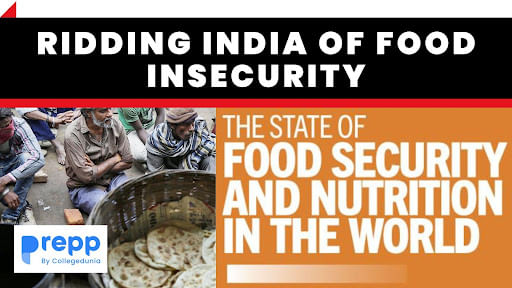
- According to the ‘State of Food Security and Nutrition in the World’ prepared by the Food and Agriculture Organization (FAO), 74% of the population in India could not afford a healthy diet in 2021.
- According to the Global Food Security Index 2022, India has a prevalence of undernutrition of 16.3%.
Table of Contents
Trends in the affordability of healthy diets
- There has been a rise in food prices in India in most years since 2019 despite India being one of the fastest-growing economies in the world in this period.
- According to the State of Food Security and Nutrition in the World report, nearly one billion of India’s 1.4 billion population were not able to afford a healthy diet.
- This indicates a shrinking ability of a substantial portion of Indian households to finance their nutritional requirements and obtain healthy and nutritious food.
- Study in Mumbai:
- Between 2018 and 2023, the price of making a thaali at home increased by 65% while the average wage of a manual worker rose by 38% and that of a salaried worker by 28% in the same period.
- This has highlighted the rising disparity between rising food costs and wage increases and the impact of reduced purchasing power on food consumption.
- Anaemia Prevalence and Food Affordability
- According to the National Family Health Survey, there has been a rise in the prevalence of anemia between 2019 and 2021.
- Over 50% of adult women are estimated to be anemic.
- This has been attributed to nutrient deficiency and reinforced the FAO's findings.
- Assuming that the FAO has overestimated numbers by 100%, India would still have 500 million people in this category, which is more than the population of all the countries of the world other than China.
Need for Economic Policy Intervention
- Ineffectiveness of Macroeconomic Policy: Macroeconomic policies have primarily aimed at controlling inflation and ensuring access to a healthy diet.
- However, they have proven to be inadequate in addressing the supply-side factors of food inflation.
- The inflation rate has been higher than the target rate for four years with the RBI’s approach of “inflation targeting” - contracting output when the inflation rate rises being unsuccessful.
- Rethinking Food Price Management: This has necessitated the need for alternative strategies to stabilize food costs as central banks are unable to handle the issue.
- Therefore, supply-side interventions are required to ensure that food is produced at a steady price by raising the yield.
The significance of the Green Revolution
Historical Success of the Green Revolution
- In the 1960s, India transitioned from a food importer to a self-sufficient nation through its Green Revolution.
- The supply-side interventions initiated by the government such as providing farmers with HYVs, cheap credit, and assured prices through procurement allowed the country to counter the extreme food shortage following two successive droughts.
Learning from Past Mistakes
- This experience must be used to control food prices in the present through supply-side initiatives.
- However, lessons must be learned from the shortcomings of the Green Revolution such as the overreliance on chemical fertilizers and the neglect of protein-rich pulse crops in favor of cereals like rice and wheat.
Second Agricultural Revolution
- The first Green Revolution succeeded in its specific agenda to make India self-sufficient in food, but without paying any attention to the cost of producing food.
- Need for a Second Revolution: A new agricultural revolution focused on reducing production costs while boosting yields is necessary to address rising food prices.
- India has the potential to increase agricultural yield, which is presently lower than in East Asia.
- Policies such as procurement prices, cash transfers, Public Distribution systems, and priority lending by public sector banks are insufficient.
What initiatives can be taken?
- Implementing a mission-mode strategy to contain food prices requires interventions in irrigation expansion, land leasing, agricultural research, and extension services.
- Expansion of area under irrigation: The increased public expenditure on irrigation has not resulted in an increase in irrigated area.
- This may be due to the wastage of water or the diversion of funds.
- Leasing of land: The capacity for productivity-enhancing capital investment has been lowered as a result of the fragmentation of small land holdings.
- One solution to this problem is the leasing of land.
- Agricultural research: It is necessary to support and encourage India’s public agricultural research institutes which played a significant role in increasing agricultural production in the 1960s.
- Extension: The gram sevak played a crucial role in the dissemination of best practices among villagers.
- However, this role has declined and must be revived.
- These initiatives should be harmonized into a programme that guarantees the manifold increase of protein production in which India is severely deficient.
- Pulses are the main source of protein for most Indians.
The Role of States
- States have a pivotal role to play in the enhancement of agricultural productivity enhancement.
- A spirit of cooperative federalism must be developed as part of which the central and state governments work in tandem to ensure food security.
- States must also work to raise agricultural productivity instead of merely relying on food allocations to their Public Distribution System from the central pool.
- A non-ideological approach must be approached at both the central and state levels to effectively address the food affordability crisis.
- In order to ensure permanent access to a healthy diet for all, policymakers must consider ecological sustainability when formulating policies for reducing food prices, improving agricultural productivity, and ensuring access to food products.
Conclusion
Restructuring economic policies and reviving the spirit of the Green Revolution will help India effectively tackle the challenge of food price inflation and consequently ensure the accessibility of nutritious food for its citizens.
To know more about Food Security, click the link.
(*Click this link to read prelims specific weekly current affairs articles)
FAQs
Question: What is food security?
Answer:
Food security is a situation in which sufficient food is available for everyone in the country, if everyone has the means to purchase food of acceptable quality, and if there are no barriers to access. The fundamental right to life enshrined in Article 21 of the Constitution can be interpreted to include the right to live with human dignity, which may include the right to food and other basic necessities.
Question: What are HYV seeds?
Answer:
High-yielding variety Seeds (HYV seeds) are of better quality and are a better option for surplus and healthy production of crops. They are resistant to insects and diseases and have a high-yielding capacity. They played a significant role in the Green Revolution of India.
UPSC Mains Practice Question:
|
MCQs
Question: In India, which of the following can be considered as public investment in agriculture?
- Fixing Minimum Support Price for agricultural produce of all crops
- Computerization of Primary Agricultural Credit Societies
- Social Capital Development
- Free electricity supply to farmers
- Waiver of agricultural loans by the banking system
- Setting up of cold storage facilities by the governments.
Select the correct answer using the code given below:(UPSC CSE 2020)
(a) 1, 2 and 5 only
(b) 1, 3, 4 and 5 only
(c) 2, 3 and 6 only
(d) 1, 2, 3, 4, 5 and 6
Answer: (c) See the Explanation
- Free supply of electricity to farmers and fixed Minimum Support Price for all agricultural produce are subsidies and cannot be considered public investment in agriculture. Hence statements 1 and 4 are incorrect.
- Waiver of agricultural loans is a concession or support measure, and cannot be treated as public investment. Hence statement 5 is incorrect.
- Computerization of Primary Agricultural Credit Societies, development of social capital, and establishment of cold storage facilities are public investments that will help improve agricultural productivity. Hence statements 2, 3 and 6 are correct.
Therefore, option (c) is the correct answer.
Question: Priority Sector Lending by banks in India constitutes the lending to (UPSC CSE 2013)
(a) Agriculture
(b) Micro and small enterprises
(c) Weaker sections
(d) All of the above
Answer: (d) See the Explanation
- The Priority Sector refers to the sectors of the economy which lack timely and adequate credit.
- So the RBI has directed banks to provide a specified portion of the bank’s lending to these specific sectors in order to ensure the all-round development of the economy.
- Priority sector lending includes lending to agriculture, micro and small enterprises, microcredit, education, housing, and weaker sections.
Therefore, option (d) is the correct answer.
Download the PREPP App and attempt FREE IAS Exam Mock Tests and get complete study material!

Full Test - 04: UPSC CSE Prelims CSAT (Paper-II)
Full Test - 03: UPSC CSE Prelims CSAT (Paper-II)
UPSC CSE Prelims 2026 GS Paper 1 Question Paper (24-May-2026)
UPSC CSE Prelims 2026 CSAT Paper 2 Question Paper (24-May-2026)

17 February 2025 | The Hindu Must Read Articles | Current Affairs

16 February 2026 | The Hindu Must Read Articles | Current Affairs

13 February 2026 | The Hindu Must Read Articles | Current Affairs









Comments