Climate Change Has Transformed Pearl Millet Cultivation Zones In India
Relevance: GS3 - Major crops-cropping patterns in various parts of the country, - different types of irrigation and irrigation systems storage, transport and marketing of agricultural produce and issues and related constraints; Food Security
(Source: Down to Earth, 09/12/2023)
Click here for Daily Current Affairs
Why in the news?
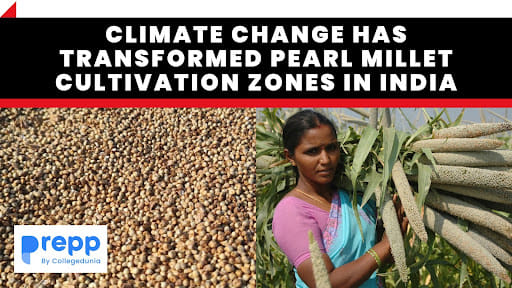
- Recently, a study by the International Crops Research Institute for the Semi-arid Tropics (ICRISAT) and the Indian Council of Agricultural Research - All India Coordinated Research Project on Pearl Millet (ICAR-AICRP) revealed that climate change has shifted India’s core pearl millet (bajra) production zone from arid regions in Rajasthan to eastern Rajasthan and Haryana .
- India is the largest producer of millet in the world and accounts for 20% of global production and 80% of Asia’s production.
- In India, the production value of pearl millet was 9.62 million metric tons in the financial year 2021-2022.
Table of Contents
Key findings of the study
- Shifted production zone: The core production zone shifted from arid regions in Rajasthan to eastern Rajasthan and Haryana between 1998 and 2017.
- Climate change impact: This shift has been attributed to increased rainfall triggered by human-induced climate change.
- Zone classification: India classifies pearl millet cultivation zones based on rainfall patterns and soil types.
- Zone ‘A1’:The arid regions of Rajasthan, which receive less than 400 millimetres (mm) of rainfall, are categorised as Zone ‘A1’.
- Zone ‘A’: Semi-arid regions in north and central India, including southern Rajasthan, Haryana, Gujarat and Uttar Pradesh, which receive more than 400 mm of rainfall per year, form Zone ‘A’.
- Zone ‘B’: Semi-arid regions with heavy soils in southern India and central western India with over 400 mm of rainfall from Zone B.
- The study revised Zone 'A' into three subzones: 'G' (Gujarat), 'AE1' (eastern Rajasthan and Haryana), and 'AE2' (Uttar Pradesh and Madhya Pradesh).
- AE1 became India's core pearl millet production area, experiencing a 46 kg/ha increase in production (1,694 kg/ha) due to increased rainfall and technological investments.
- AE2 saw a production increase of 1,860 kg/ha attributed to moderate rainfall rise (7 mm/year) and had lower pearl millet prices compared to A1.
- Zone 'G': The G zone is experiencing more rainfall due to climate changes, which may lead farmers to shift towards cash crops and limit pearl millet cultivation to the summer season.
What is Millet?
- It is a collective term referring to a number of small-seeded annual grasses that are cultivated as grain crops, primarily on marginal lands in dry areas in temperate, subtropical and tropical regions.
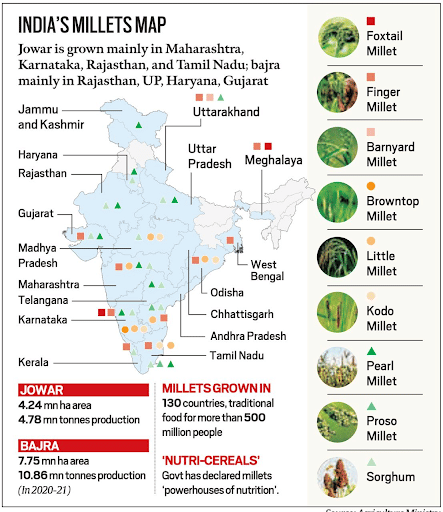
- Some of the common millets available in India are Ragi (Finger millet), Jowar (Sorghum), Sama (Little millet), Bajra (Pearl millet), and Variga (Proso millet).
- Global Distribution: India, Nigeria and China are the largest producers of millets in the world, accounting for more than 55% of the global production.
- About Pearl Millet:
- Pearl millet, scientifically known as Pennisetum glaucum, is a robust cereal grain recognized by its common name, bajra.
- This hardy crop thrives in environments with limited water resources, making it a staple in the arid and semi-arid regions of both India and Africa.
- Its grains are small and spherical, typically displaying a light yellow to whitish hue.
Significance of Millets
- Nutritional content: It is valued for its nutritional content, boasting essential nutrients like protein, fiber, and various micronutrients.
- Food security: Millets aid in the prevention of numerous non-communicable lifestyle diseases such as diabetes, hypertension, and cardiovascular disease and are considered to be a potential choice or solution to lessen the negative effects of rising malnutrition and to improve the food and nutrition security of the nation.
- Drought-resistant: Millets are drought-resistant, require less water and can grow in poor soil conditions. This makes them a suitable food crop for areas with unpredictable weather patterns and water scarcity.
- Resistant to climate change: Due to their adaptability to a wide range of temperatures and moisture regimes as well as their low input requirements, millets are resistant to climate change.
- Increased yields for smallholder farmers: Millets are well-suited for smallholder farmers, including rural women, because they are relatively low-cost to grow and require less investment in terms of inputs like fertilizers and pesticides.
Concerns Regarding Millet Production and Consumption
- Inadequate consumer awareness: Despite growing recognition of the health benefits associated with millets, a substantial portion of consumers in India remain unfamiliar with these grains and lack knowledge on how to prepare and incorporate them into their diets.
- Changing consumer preferences: Shifting consumer preferences towards processed and refined foods have led to lower demand for traditional millet products.
- Lack of processing and storage infrastructure: There is a lack of processing and storage infrastructure for millets, which makes it difficult for farmers to process and package their produce.
- Limited market access: Millet farmers often face limited market access, particularly in remote and rural areas. This can lead to low prices and limited demand for their produce.
- Low productivity: Millet productivity in India is often low due to a lack of access to quality seeds, fertilizers, and other inputs. This can limit the ability of farmers to scale up production and meet market demand.
- Adverse effects of climate change: Climate change is increasingly affecting millet production in India, particularly in regions already prone to droughts and extreme weather conditions.
Initiatives for Millets Production in India
- National Millets Mission (NMM) was initiated in 2007 with the primary objective of boosting millet production and consumption in India.
- Price Support Scheme (PSS): Under the NMM, the government offers financial support to farmers engaged in millet cultivation. This assistance serves to incentivize and sustain millet farming practices across the country.
- Development of Value-Added Products: The mission actively encourages the production of value-added products derived from millets. This strategy aims to diversify the range of millet-based offerings in the market, thereby stimulating increased demand and consumption of millets.
- Promotion of Millets in Public Distribution System (PDS): The government has integrated millets into the Public Distribution System to make these nutritious grains readily accessible and affordable to a wider population.
- Advancement of Organic Farming: The government is promoting organic farming of millets to increase the production and consumption of organic millets.
- Millet Village scheme: It is a special scheme by Kerala Government to promote the cultivation of cereals such as millet, ragi, bajra and maize.
(*Click this link to read prelims specific weekly current affairs articles)
UPSC Mains Practice Question:
|
MCQ
Question: Among the following, which one is the least water-efficient crop? (UPSC 2021)
(a) Sugarcane
(b) Sunflower
(c) Pearl Millet
(d) Red gram
Answer: (a) See the Explanation
Sugarcane is the least water-efficient crop. Sugarcane requires a lot of water for its growth and irrigation, and it is estimated that it takes around 2000 to 2500 liters of water to produce 1 kg of sugarcane. In comparison, pearl millet, sunflower, and red gram are relatively more water-efficient crops.
Therefore, option (a) is the correct answer.
Download the PREPP App and attempt FREE IAS Exam Mock Tests and get complete study material!

Full Test - 04: UPSC CSE Prelims CSAT (Paper-II)
Full Test - 03: UPSC CSE Prelims CSAT (Paper-II)
UPSC CSE Prelims 2026 GS Paper 1 Question Paper (24-May-2026)
UPSC CSE Prelims 2026 CSAT Paper 2 Question Paper (24-May-2026)

17 February 2025 | The Hindu Must Read Articles | Current Affairs

16 February 2026 | The Hindu Must Read Articles | Current Affairs

13 February 2026 | The Hindu Must Read Articles | Current Affairs









Comments