Saudi Arabia One Of India's Most Important Strategic Partners: PM Modi
Relevance: GS2 - Bilateral, regional and global groupings and agreements involving India and/or affecting India’s interests.
(Source: The Hindu, 09/12/2023)
Click here for Daily Current Affairs
Why in the news?
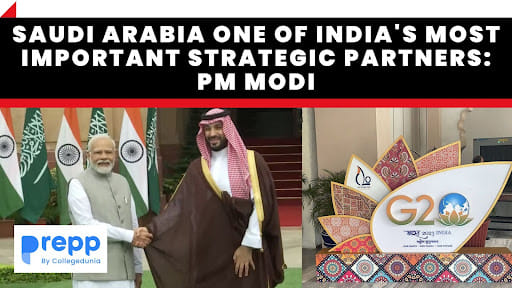
- This article discusses India's growing strategic ties with Saudi Arabia amid the recent visit of Crown Prince Mohammed Bin Salman.
- Recently, Prime Minister Narendra Modi launched the India-Middle East-Europe Economic Corridor at the G-20 Summit in New Delhi.
Table of Contents
Highlights of the visit of the Crown Prince
- Joint task force: Indian Prime Minister Narendra Modi and Crown Prince of Saudi Arabia Mohammad Bin Salman agreed to set up a joint task force to speed up the implementation of the West Coast refinery project.
- It is a trilateral project between ARAMCO, ADNOC, and Indian companies for which $50 billion has been already budgeted.
- The joint task force will help identify and channel the $100 billion investment that was promised by Saudi Arabia, of which $50 billion was for the refinery.
- A monitoring committee will also be set up to ensure the refinery project remains on the fast track.
- India-Saudi Strategic Partnership Council (SPC): Prime Minister Modi and the Crown Prince co-chaired the first meeting of the India-Saudi Strategic Partnership Council.
- The SPC was set up in 2019, making India the fourth country after the UK, France, and China to have an SPC with Saudi Arabia.
- It has two main pillars - the Political, Security, Social and Cultural Committee and the Committee on Economy and Investments.
- India-GCC Free Trade Agreement (FTA): The two sides agreed to work on the Free Trade Agreement between India and the Gulf Cooperation Council countries.
- The GCC is India’s largest trading bloc.
- India-Middle East-Europe Economic Corridor: The Corridor project, which was unveiled at the G-20 Summit, aims to establish connectivity across India, West Asia, and Europe by leveraging railway and shipping routes.
- Members: India, the U.S.A., Saudi Arabia, the U.A.E., France, Germany, Italy, and the EU.
- Energy partnership: India and Saudi Arabia agreed to upgrade their relationship in the energy sector to a comprehensive energy partnership.
- In 2019, Saudi Arabia pledged to invest $100 billion into the energy project.
- Agreements: The two sides sealed 8 different agreements including
- An agreement between the Central Vigilance Commission of India and the Saudi Oversight and Anti-Corruption Authority
- An agreement between the Saudi and Indian Exim Banks.
- An agreement between the National Institute of Technology of India and the Saline Water Conversion Corporation of Saudi Arabia
- An agreement between the National Archives of India and the King Abdulaziz Foundation of Saudi Arabia for greater collaboration in archival research.
- Joint statement:
- Saudi Arabia assured India that it would be a reliable partner and exporter of crude oil supplies.
- Both delegations welcomed the expansion of the private sector and investment partnerships in the agricultural and food industries.
- Strengthened cooperation in defense and anti-terror sectors and committed to preventing access to missiles and drones to carry out terror attacks.
- The two sides recognized the reforms in Saudi Arabia and discussed plans to strengthen bilateral tourism.
- Yemen: Saudi Arabia expressed its gratitude to India for its humanitarian assistance to the war-affected people of Yemen.
- Afghanistan: The two countries reiterated the need for a government in Afghanistan that will represent all spectrums of the Afghan people.
India-Saudi Arabia relations
- Diplomatic relations between the two countries were established in 1947.
- In 2006, the Delhi Declaration was signed during the visit of King Abdullah to India.
- Economic:
- Saudi Arabia is India’s fourth-largest trade partner with bilateral trade valued at $52.75 billion in 2022-23
- Indian imports from Saudi Arabia were worth $34.01 billion and exports to Saudi Arabia were worth $8.76 billion in FY21-22.
- Saudi Arabia accounted for 4.14% of India’s total trade in FY 2021-22.
- Energy:
- Saudi Arabia is the third largest supplier of oil after Russia and Iraq.
- In the 2023-24 period, India has imported around 600,000 barrels of oil per day.
- Military exercises:
- In 2021, India and Saudi Arabia initiated the first naval exercise between the two countries, Al-Mohed Al-Hindi Exercise.
- People-People ties:
- Indians make up the largest diaspora in Saudi Arabia.
- Another component of the people-to-people ties between the two countries is the Haj pilgrimage.
India-Middle East- Europe Corridor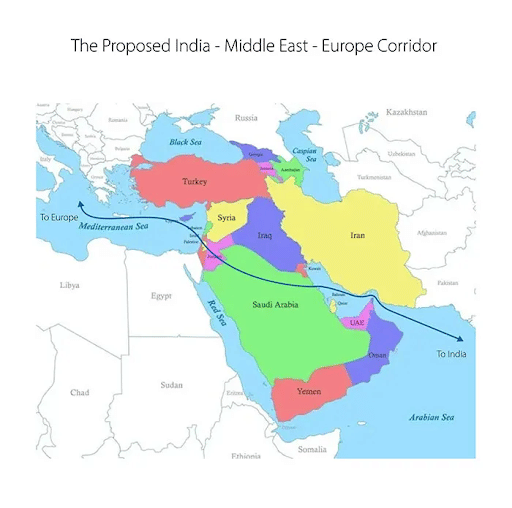
Significance
|
(*Click this link to read prelims specific weekly current affairs articles)
FAQs
Question: What is the Partnership for Global Infrastructure Investment (PGII)?
Answer:
The PGII is a values-driven, high-impact, and transparent infrastructure partnership to meet the enormous infrastructure needs of low and middle-income countries. It has four pillars - climate security, digital technology, gender equality, and global health infrastructure. It is considered to be an alternative to the Belt and Road Initiative.
Question: What is an FTA?
Answer:
A Free Trade Agreement (FTA) is an arrangement or a treaty between countries to remove trade barriers and facilitate trade. It deals with the determination of the tariffs and duties imposed on imports and the reduction of trade barriers, thereby strengthening bilateral or multilateral trade relations.
UPSC Mains Practice Question:
|
MCQs
Question: In which one of the following groups are all four countries members of G20? (UPSC CSE 2020)
(a) Argentina, Mexico, South Africa and Turkey
(b) Australia, Canada, Malaysia, and New Zealand
(c) Brazil, Iran, Saudi Arabia, and Vietnam
(d) Indonesia, Japan, Singapore, and South Korea
Answer: (a) See the Explanation
- The G-20 is an informal group of 19 countries and the European Union, with representatives of the International Monetary Fund and the World Bank.
- Its members include Argentina, Australia, Brazil, Canada, China, France, Germany, India, Indonesia, Italy, Japan, Mexico, Republic of Korea, Russia, Saudi Arabia, South Africa, Turkey, the United Kingdom, the United States and the European Union (EU).
- Singapore, Vietnam, and Malaysia are not members of the G-20.
Therefore, option (a) is the correct answer.
Question: Which of the following is not a member of ‘Gulf Cooperation Council’? (UPSC 2016)
(a) Iran
(b) Saudi Arabia
(c) Oman
(d) Kuwait
Answer: (a) See the Explanation
- The Gulf Cooperation Council (GCC) is a union of six countries in the Gulf region.
- Members of the GCC are Saudi Arabia, the UAE, Qatar, Kuwait, Oman and Bahrain.
Therefore, option (a) is the correct answer.
Download the PREPP App and attempt FREE IAS Exam Mock Tests and get complete study material!

Full Test - 04: UPSC CSE Prelims CSAT (Paper-II)
Full Test - 03: UPSC CSE Prelims CSAT (Paper-II)
UPSC CSE Prelims 2026 GS Paper 1 Question Paper (24-May-2026)
UPSC CSE Prelims 2026 CSAT Paper 2 Question Paper (24-May-2026)

17 February 2025 | The Hindu Must Read Articles | Current Affairs

16 February 2026 | The Hindu Must Read Articles | Current Affairs

13 February 2026 | The Hindu Must Read Articles | Current Affairs









Comments