Mega Food Parks - Agriculture Notes
Mega Food Park was launched in 2008-09 to give a significant boost to the food processing sector by adding value and reducing food waste at each stage of the supply chain, with a particular emphasis on perishables. In the country, the Mega Food Park Scheme is being implemented by the Ministry of Food Processing Industries. Mega Food Parks develop modern infrastructure facilities for food processing along the value chain from farm to market, with strong forward and backward linkages, using a cluster-based approach. It establishes a mechanism to bring farmers, processors, and retailers together and connect agricultural production to the market to maximize value addition, reduce waste, and increase farmers' income. In this article, we will discuss Mega Food Parks which will be helpful for UPSC exam preparation.
|
Table of Contents |
What is the Mega Food Park Scheme?
- The Mega Food Park Scheme aims to provide a mechanism to link agricultural production to the market by bringing together farmers, processors, and retailers in order to maximise value addition, minimise waste, increase farmer income, and create job opportunities, particularly in the rural sector.
- The Mega Food Park Scheme is based on the "Cluster" approach and envisions the development of cutting-edge support infrastructure in a well-defined agri/horticultural zone for the establishment of modern food processing units in the park's industrial plots with a well-established supply chain.
- Mega food parks typically include supply chain infrastructure such as collection centres, primary processing centres, central processing centres, cold chain, and between 25 and 30 fully developed plots for entrepreneurs to establish food processing units.
- The Mega Food Park project is being carried out by a Special Purpose Vehicle (SPV), which is a Body Corporate registered under the Companies Act.
- The state government, state government entities, and cooperatives are not required to form a separate SPV to carry out the Mega Food Park project.
- The funds are released to the SPVs if the Scheme Guidelines are met.
|
|
|
|---|---|
| Pradhan Mantri Kisan Sampada Yojana | Operation Greens |
| Targeted Public Distribution System (TPDS) | Food security |
Objectives of Mega Food Parks
- To build modern infrastructure for the country's food processing units.
- To ensure the value addition of agricultural products such as dairy, fisheries, and so on.
- To establish a long-term raw material supply chain for each cluster.
- To make it easier to incorporate cutting-edge technology.
- To meet the needs of small and micro food processing enterprises by providing plug-and-play capabilities.
- To provide an institutional mechanism for producers, processors, and retailers to collaborate in order to build the supply chain.
- To provide a mechanism for connecting agricultural production to the market by bringing together farmers, processors, and retailers in order to maximize value addition, minimize waste, increase farmer income, and create job opportunities, particularly in the rural sector.
Mega Food Park - Project Components
- Collection Centers and Primary Processing Centers (PPCs): These components include cleaning, grading, sorting, and packing facilities, dry warehouses, specialized cold stores with pre-cooling chambers and ripening chambers, reefer vans, mobile pre-coolers, and mobile collection vans, among other things.
- Central Processing Centers (CPC): This includes common facilities such as testing laboratories, cleaning, grading, sorting, and packing facilities, dry warehouses, specialized storage facilities such as controlled atmosphere chambers, pressure ventilators, variable humidity stores, pre-cooling chambers, and ripening chambers.
- Cold chain infrastructure includes reefer vans, packaging units, irradiation facilities, steam sterilisation units, steam generation units, food incubation cum development centres, etc.
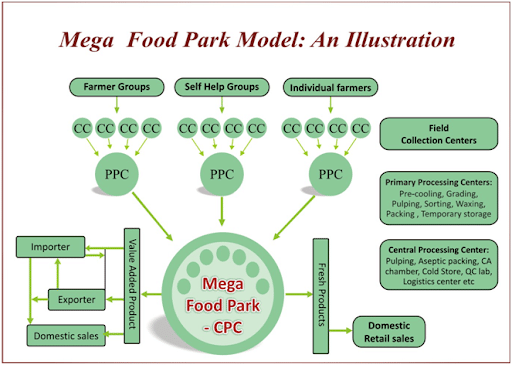
Components of Mega Food Park
Mega Food Park - Assistance and Grants
- The Scheme will provide a capital grant of 50% of the eligible project cost in general areas and 75% of the eligible project cost in difficult and hilly areas, i.e. The North East Region, which includes Sikkim, J&K, Himachal Pradesh, Uttarakhand, and ITDP-notified states, is limited to a maximum of Rs. 50 crore per project.
- The Ministry appoints a Program Management Agency (PMA) to provide management, capacity building, coordination, and monitoring support in order to expedite project implementation.
- The scheme's grant-in-aid is distributed in four instalments of 30%, 30%, 20%, and 20%, subject to other scheme parameters.
List of Operational Mega Food Parks
- Srini Mega Food Park in Chittoor, Andhra Pradesh
- Godavari Mega Aqua Park in West Godavari, Andhra Pradesh
- North East Mega Food Park, Nalbari, Assam
- Indus Best Mega Food Park, Raipur, Chhattisgarh
- Gujarat Agro Mega Food Park, Surat, Gujarat
- Cremica Mega Food Park, Una, Himachal Pradesh
- Integrated Mega Food Park, Tumkur, Karnataka
- Kerala Industrial Infrastructure Development Corporation (KINFRA) Mega Food Park, Palakkad, Kerala
- Indus Mega Food Park, Khargoan, Madhya Pradesh
- Avantee Mega Food Park, Dewas, Madhya Pradesh
- Paithan Mega Food Park, Aurangabad, Maharashtra
- Satara Mega Food Park, Satara, Maharashtra
- Zoram Mega Food Park, Kolasib, Mizoram
- MITS Mega Food Park, Rayagada, Odisha
- International Mega Food Park, Fazilka, Punjab
- Sukhjit Mega Food Park, Kapurthala, Punjab
- Greentech Mega Food Park, Ajmer, Rajasthan
- Smart Agro Mega Food Park, Nizamabad, Telangana
- Tripura Mega Food Park, West Tripura, Tripura
- Patanjali Food and Herbal Park, Haridwar, Uttarakhand
- Himalayan Mega Food Park, Udham Singh Nagar, Uttarakhand
- Jangipur Bengal Mega Food Park, Murshidabad, West Bengal
Conclusion
The central government contributes up to Rs. 50 crore to each Mega Food Park (MFP) project. The MFP project is carried out by a Special Purpose Vehicle (SPV), which is a legal entity registered under the Companies Act of 2013. An SPV is a subsidiary company formed to carry out a specific business purpose or activity. There are currently 22 Mega Food Parks in operation. It is consistent with the Government of India's 'Make in India' and 'Atma Nirbhar Bharat' visions.
FAQs
Q1: What are Mega Food Parks?
Answer: Mega Food Parks are large-scale infrastructure projects initiated by the Government of India under the Ministry of Food Processing Industries (MOFPI) to promote food processing and enhance the value-added products in the food sector. These parks are designed to bring together food processing units, supporting industries, and logistics under one umbrella to improve the efficiency and competitiveness of the food processing industry. The scheme aims to create modern infrastructure, increase production, and provide employment opportunities in the food processing sector.
Q2: What is the main objective of the Mega Food Parks Scheme?
Answer: The primary objective of the Mega Food Parks Scheme is to boost the food processing industry by providing world-class infrastructure. This initiative aims to reduce wastage of agricultural produce, enhance the shelf life of processed food, create employment opportunities, and promote rural development. The scheme also focuses on improving the income of farmers by linking them to modern food processing units, ensuring higher value realization from agricultural produce.
Q3: How do Mega Food Parks benefit farmers?
Answer: Mega Food Parks benefit farmers by providing them with direct access to food processing units, which help reduce post-harvest losses and increase the shelf life of their produce. The parks enable farmers to get better prices for their crops by offering a streamlined supply chain from farm to market. These parks also facilitate the creation of contract farming opportunities, where farmers are assured of consistent demand for their produce, thus ensuring better returns.
Q4: What are the key components of a Mega Food Park?
Answer: A Mega Food Park typically consists of the following key components:
- Core processing area: where food processing units are set up to transform raw agricultural products into value-added food products.
- Logistics and warehousing: facilities for the storage, transportation, and distribution of food products.
- Quality control and testing laboratories: to ensure that the processed food meets international quality standards.
- Cold storage and refrigeration facilities: to preserve perishable food items.
- Common infrastructure: such as roads, water supply, power, and waste management systems, which are essential to the park's functioning.
Q5: What is the role of the government in promoting Mega Food Parks?
Answer: The Government of India plays a key role in promoting Mega Food Parks by providing financial assistance, facilitating land acquisition, and offering subsidies for infrastructure development. Under the scheme, the government provides up to 50% of the total project cost for infrastructure development, which includes the creation of roads, utilities, and common facilities. The government also encourages private investment and public-private partnerships to ensure the success of these food parks.
MCQs
- Which ministry is responsible for implementing the Mega Food Parks Scheme?
A) Ministry of Agriculture
B) Ministry of Food Processing Industries
C) Ministry of Rural Development
D) Ministry of Commerce and Industry
Answer: (B) See the Explanation
- What is one of the primary benefits of setting up Mega Food Parks in rural areas?
A) Enhances urban migration
B) Increases rural employment and reduces agricultural wastage
C) Reduces urban food prices
D) Promotes non-food industries
Answer: (B) See the Explanation
- Which of the following is NOT a key component of a Mega Food Park?
A) Core processing area
B) Logistics and warehousing facilities
C) Pharmaceutical manufacturing units
D) Cold storage facilities
Answer: (C) See the Explanation
- How much financial assistance does the government provide for setting up infrastructure in Mega Food Parks?
A) 25% of the total project cost
B) 50% of the total project cost
C) 75% of the total project cost
D) 100% of the total project cost
Answer: (B) See the Explanation
- What is the target benefit of creating Mega Food Parks for the food processing industry?
A) Reducing agricultural exports
B) Promoting food wastage
C) Reducing post-harvest losses and enhancing the shelf life of food products
D) Creating dependency on foreign food imports
Answer: (C) See the Explanation
GS Mains Questions and Model Answers
Q1: Analyze the impact of Mega Food Parks on the rural economy and farmers' income.
Answer: Mega Food Parks play a transformative role in the rural economy by enhancing the value-added production of agricultural commodities. They enable farmers to directly link their produce with food processing industries, ensuring better prices and reducing wastage. The establishment of such parks creates a seamless supply chain, from farm to market, improving income generation for farmers. Additionally, it opens new avenues for contract farming and provides farmers with access to modern technologies, thus increasing their productivity and income. The development of rural infrastructure, such as roads, electricity, and storage facilities, also contributes to rural development, creating jobs and boosting local economies.
Q2: What are the challenges in implementing the Mega Food Parks Scheme and how can they be addressed?
Answer: The implementation of the Mega Food Parks Scheme faces several challenges, including issues related to land acquisition, inadequate infrastructure, and limited private investment. Land acquisition can be a time-consuming and costly process, hindering the timely completion of projects. In some cases, local resistance and regulatory issues complicate land procurement. To address these challenges, the government can facilitate land acquisition by providing clear policies, streamlining regulatory procedures, and offering incentives for private sector participation. Additionally, creating robust public-private partnerships and ensuring continuous funding for infrastructure development can address the infrastructural and financial challenges.
Q3: Evaluate the role of Mega Food Parks in achieving the goals of the "Make in India" initiative.
Answer: Mega Food Parks contribute to the "Make in India" initiative by fostering domestic manufacturing in the food processing sector. These parks provide the necessary infrastructure for large-scale food production, which can help India reduce food imports and improve the country's export competitiveness. By enhancing food processing capabilities and promoting value-added products, Mega Food Parks also create a more sustainable and resilient food processing industry. The scheme contributes to the "Make in India" goals by boosting domestic manufacturing, improving the food supply chain, and creating jobs, ultimately strengthening India's position in the global food market.
Previous Year Questions on Mega Food Parks
1. UPSC CSE 2020
Question: "Examine the potential of Mega Food Parks in promoting agro-processing industries in India."
Answer: Mega Food Parks have immense potential in promoting agro-processing industries by providing modern infrastructure and facilitating a strong linkage between agriculture and food processing. These parks help reduce post-harvest losses, improve the shelf life of agricultural products, and increase the value-added products from raw agricultural goods. This promotes job creation, rural development, and enhances the competitiveness of Indian agro-processing industries in the global market.
2. UPSC CSE 2019
Question: "Discuss the role of Mega Food Parks in enhancing food security and rural development in India."
Answer: Mega Food Parks play a crucial role in enhancing food security by reducing food wastage, improving food availability, and stabilizing the food supply chain. By linking farmers to modern food processing units, these parks ensure better prices and reduce post-harvest losses. They also contribute to rural development by generating employment opportunities and improving infrastructure, which boosts local economies and helps in the overall socio-economic development of rural areas.
Download the PREPP App and attempt FREE IAS Exam Mock Tests and get complete study material!

Full Test - 04: UPSC CSE Prelims CSAT (Paper-II)
Full Test - 03: UPSC CSE Prelims CSAT (Paper-II)
UPSC CSE Prelims 2026 GS Paper 1 Question Paper (24-May-2026)
UPSC CSE Prelims 2026 CSAT Paper 2 Question Paper (24-May-2026)

17 February 2025 | The Hindu Must Read Articles | Current Affairs

16 February 2026 | The Hindu Must Read Articles | Current Affairs

13 February 2026 | The Hindu Must Read Articles | Current Affairs









Comments