Pradhan Mantri Kisan Sampada Yojana - Agriculture Notes
The Pradhan Mantri Kisan SAMPADA Yojana is a central government scheme launched by the Ministry of Food Processing Industries (MoFPI). PM Kisan Sampada Yojana is a comprehensive package that will result in the development of modern infrastructure and efficient supply chain management from farm gate to retail outlet. It will not only help to boost the growth of the country's food processing sector, but it will also help to provide better returns to farmers and is a big step towards doubling farmers' income, creating huge employment opportunities, especially in rural areas, reducing wastage of agricultural produce, increasing the processing level, and enhancing the export of processed foods. In this article, we will discuss Pradhan Mantri Kisan Sampada Yojana which will be helpful for UPSC exam preparation.
|
Table of Contents |
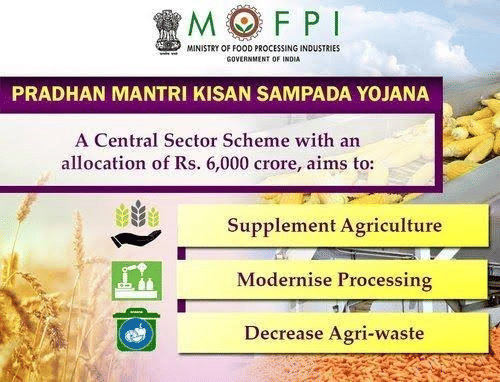
Pradhan Mantri Kisan SAMPADA Yojana
What is Pradhan Mantri Kisan Sampada Yojana?
- The Government of India (GOI) has approved a new Central Sector Scheme - SAMPADA (Scheme for Agro-Marine Processing and Development of Agro-Processing Clusters) in May 2017 with a budget of Rs. 6,000 crore for the fiscal year 2016-20, which corresponds to the 14th Finance Commission cycle.
- The programme is now known as the "Pradhan Mantri Kisan Sampada Yojana (PMKSY)."
- By 2019-20, the PM Kisan SAMPADA Yojana is expected to leverage Rs. 31,400 crore in investment for the handling of 334 lakh MT agro-produce valued at Rs. 1,04,125 crore, benefiting 20 lakh farmers and generating 5,30,500 direct/indirect jobs in the country.
- The Government of India (GOI) has now approved the continuation of the Central Sector Scheme - PM Kisan SAMPADA Yojana with a Rs. 4600 crore allocation until 31.03.2026, which coincides with the 15th Finance Commission cycle.
- The component schemes of Mega Food Park, Creation of Backward and Forward Linkages, Human Resource & Institution - Promotional Activities, Skill Development & HACCP, a component of Food Safety and Quality Assurance Infrastructure, and Skill Development & HACCP, a component of Food Safety and Quality Assurance Infrastructure were discontinued in the 15th FC cycle with the provision of committed liability.
- By 2025-26, the PM Kisan SAMPADA Yojana is expected to leverage an investment of Rs. 11,095.93 crore, benefiting 28,49,945 farmers and creating 5,44,432 direct/indirect jobs in the country.
- Capital subsidies in the form of grants-in-aid ranging from 35% to 75% of the eligible project cost are provided to investors under the various schemes for undertaking infrastructure, logistic projects, and the establishment of food processing units in the country under PMKSY.
|
|
|
|---|---|
| Operation Greens | Mega Food Parks |
| Targeted Public Distribution System (TPDS) | Food security |
Schemes Implemented under PM Kisan Sampada Yojana
- Mega Food Parks (Now discontinued)
- Integrated Cold Chain and Value Addition Infrastructure
- Creation/expansion of Food Processing and Preservation Capabilities (Unit Scheme)
- Infrastructure for Agro-processing Clusters
- Creation of Backward and Forward Connections (Now discontinued)
- Food safety and quality assurance Infrastructure
- Human Resources and Institutions - Research & Development
- Operation Greens
Pradhan Mantri Kisan Sampada Yojana - Objectives
- The goal is to supplement agriculture.
- To develop processing and preservation capabilities.
- To modernise and expand existing food processing units in order to increase the level of processing.
- To add value while reducing waste.
Impact of Pradhan Mantri Kisan Sampada Yojana
- The Ministry of Food Processing Industries (MOFPI) has approved the construction of 42 Mega Food Parks and 236 Integrated Cold Chains in order to build a modern infrastructure for food processing along the value chain from farm to market.
- Steps are being taken to boost the food processing sector in order to meet the goal of reducing post-harvest waste and losses to zero, if possible.
- The scheme intends to identify agro clusters and provide subsidies to them so that food products can be transferred seamlessly from production centres to the market.
- SAMPADA aims to complete the supply chain by modernising and expanding existing food processing units, creating processing and preservation capacities, and so on.
Conclusion
PM Kisan Sampada Yojana is a comprehensive package designed to revitalise India's food processing sector. The scheme will benefit farmers by increasing their income, creating job opportunities, encouraging the export of processed foods, and reducing food waste. Other measures taken by the government include allowing 100% FDI in trading, including e-commerce, in respect of food products manufactured in India, in order to boost the food processing sector.
FAQs
Question: What were the key reasons for the rise of militant nationalism in India between 1905 and 1909?
Answer: The rise of militant nationalism was fueled by dissatisfaction with the moderate approach of the Indian National Congress. Key factors included the partition of Bengal (1905), the repressive policies of the British, and the demand for self-rule. This period witnessed the emergence of revolutionary leaders and activities aimed at promoting direct confrontation with British rule.
Question: How did the partition of Bengal contribute to the growth of militant nationalism?
Answer: The partition of Bengal in 1905, aimed at dividing and ruling by creating religious divisions, led to widespread resentment. The decision was seen as an attempt to weaken the unity of the Indian nationalist movement. It sparked mass protests, boycotts, and eventually gave rise to militant nationalism as a direct response to British policies.
Question: Who were some of the key leaders of militant nationalism during 1905-1909?
Answer: Key leaders included Bal Gangadhar Tilak, who advocated for Swaraj (self-rule) and used the press and public gatherings to mobilize support. Bipin Chandra Pal and Lala Lajpat Rai were also prominent figures in this period. These leaders promoted direct action, including protests and boycotts, and sometimes resorted to revolutionary methods.
Question: What was the significance of the 'Swadeshi Movement' during the militant nationalist phase?
Answer: The Swadeshi Movement (1905) was a direct response to the partition of Bengal. It emphasized the boycott of British goods and the promotion of indigenous industries. This movement laid the foundation for a larger nationalist mobilization, fostering unity among various sections of society and spreading revolutionary ideas across India.
Question: How did the British respond to the rise of militant nationalism in India?
Answer: The British responded with repressive measures, including the suppression of protests, arrests of nationalist leaders, and the enactment of laws to curb revolutionary activities. They also used the divide-and-rule strategy, trying to deepen religious divisions and create a rift between Hindus and Muslims to neutralize the nationalist movement.
MCQs
1. What was the primary objective behind the partition of Bengal in 1905?
A) To encourage the growth of nationalism
B) To weaken the nationalist movement by dividing the population along religious lines
C) To reduce the administrative burden on the British Raj
D) To promote economic development in Bengal
Answer: (B) See the Explanation
Explanation: The partition of Bengal was a deliberate attempt by the British to divide the population along religious lines, weaken the nationalist movement, and prevent the unity of Hindus and Muslims. This policy led to widespread resentment and a rise in militant nationalism.
2. Who among the following was NOT a key figure in the militant nationalist movement of 1905-1909?
A) Lala Lajpat Rai
B) Bipin Chandra Pal
C) Jawaharlal Nehru
D) Bal Gangadhar Tilak
Answer: (C) See the Explanation
Explanation: Jawaharlal Nehru was not directly involved in the militant nationalist phase of the early 20th century. Leaders like Lala Lajpat Rai, Bipin Chandra Pal, and Bal Gangadhar Tilak were at the forefront of this movement.
3. The Swadeshi Movement was a response to:
A) The First World War
B) The partition of Bengal
C) The Indian Rebellion of 1857
D) The Jallianwala Bagh massacre
Answer: (B) See the Explanation
Explanation: The Swadeshi Movement, initiated in 1905, was a response to the partition of Bengal. It aimed at boycotting British goods and promoting the use of Indian-made products as a form of resistance against British colonial policies.
4. Who coined the famous slogan "Swaraj is my birthright"?
A) Bipin Chandra Pal
B) Bal Gangadhar Tilak
C) Lala Lajpat Rai
D) Subhas Chandra Bose
Answer: (B) See the Explanation
Explanation: The slogan "Swaraj is my birthright" was coined by Bal Gangadhar Tilak. He was a leading figure in the militant nationalist movement and played a crucial role in the struggle for self-rule.
5. Which of the following events directly contributed to the rise of militant nationalism in India?
A) The enactment of the Rowlatt Act
B) The non-cooperation movement
C) The partition of Bengal
D) The Salt March
Answer: (C) See the Explanation
Explanation: The partition of Bengal in 1905 was a key event that led to the rise of militant nationalism. It united people across India in opposition to British policies and sparked the Swadeshi Movement and the formation of revolutionary groups.
GS Mains Questions and Model Answers
Q1: Critically analyze the impact of the partition of Bengal (1905) on the Indian Nationalist movement. How did it contribute to the rise of militant nationalism?
Answer: The partition of Bengal was a major turning point in Indian history. It aimed to divide the province along religious lines, with the intention of weakening the nationalist movement. This move united people across India in opposition to British rule, leading to widespread protests and the formation of revolutionary groups. The Swadeshi Movement, which called for boycotts of British goods, became the symbol of resistance. The partition fueled the growth of militant nationalism, with leaders like Bal Gangadhar Tilak and Bipin Chandra Pal advocating for direct action and self-rule. The divide-and-rule strategy of the British had the unintended consequence of strengthening Indian unity and nationalism, accelerating the demand for independence.
Q2: How did the period 1905-1909 shape the social and political landscape of India? Discuss the role of militant nationalism during this period.
Answer: The period from 1905 to 1909 was critical in shaping India’s political and social landscape. The rise of militant nationalism during this phase was a reaction to the British policies of divide and rule, particularly the partition of Bengal. Leaders like Tilak and Bipin Chandra Pal pushed for a more assertive approach, moving away from the moderate tactics of the Congress. The Swadeshi Movement and revolutionary activities gained momentum during this time, leading to the foundation of a more radical form of nationalism. This period also saw the use of cultural revivalism and the idea of self-rule gaining prominence, setting the stage for future independence movements. The militant phase shifted the focus from constitutional reforms to a direct confrontation with colonial authority.
Q3: Examine the role of revolutionary activities and organizations in the militant nationalist phase (1905-1909). How did they contribute to the national struggle for independence?
Answer: Revolutionary activities played a significant role in the militant nationalist phase of Indian history. Organizations like the Anushilan Samiti and Jugantar promoted the idea of armed struggle against British colonialism. The aim was to awaken the masses and instill a sense of pride and nationalism through direct action. These groups carried out bombings, assassinations, and other forms of resistance, targeting British officials and collaborators. While they did not achieve immediate success in overthrowing British rule, their efforts kept the flame of resistance alive and inspired future generations of freedom fighters. The revolutionary activities highlighted the failure of the British to provide any meaningful political reforms and contributed to the radicalization of the Indian struggle for independence.
Previous Year Questions on Pradhan Mantri Kisan Sampada Yojana
1. UPSC CSE Prelims 2022:
Question: In which of the following events did the Indian National Congress demand the cancellation of the partition of Bengal?
A) The Swadeshi Movement
B) The Non-Cooperation Movement
C) The Quit India Movement
D) The Civil Disobedience Movement
Answer: (A)
Explanation: The Swadeshi Movement, which emerged after the partition of Bengal in 1905, was a direct response to the British decision. The movement advocated for boycotting British goods and demanded the cancellation of the partition.
2. UPSC CSE Mains 2020 (GS Paper 1):
Question: "How did the partition of Bengal and the subsequent Swadeshi Movement influence the course of Indian nationalism?"
Answer: The partition of Bengal in 1905 created widespread discontent among Indians and united them across religious lines. The Swadeshi Movement, which began as a protest against this decision, called for a boycott of British goods and a revival of indigenous industries. This movement brought radical leaders to the forefront, emphasized direct action, and inspired future nationalist struggles. It marked a shift from constitutional methods to more assertive, militant forms of resistance against British colonial rule.
Download the PREPP App and attempt FREE IAS Exam Mock Tests and get complete study material!

Full Test - 04: UPSC CSE Prelims CSAT (Paper-II)
Full Test - 03: UPSC CSE Prelims CSAT (Paper-II)
UPSC CSE Prelims 2026 CSAT Paper 2 Question Paper (24-May-2026)
UPSC CSE Prelims 2026 GS Paper 1 Question Paper (24-May-2026)

17 February 2025 | The Hindu Must Read Articles | Current Affairs

16 February 2026 | The Hindu Must Read Articles | Current Affairs

13 February 2026 | The Hindu Must Read Articles | Current Affairs









Comments