Integrated Cold Chain and Value Addition Infrastructure - Agriculture Notes
The "Integrated Cold Chain and Value Addition Infrastructure" is to provide continuous integrated cold chain and preservation infrastructure from the farm gate to the consumer. This scheme will connect producers to food processors and markets via a well-equipped supply chain and cold chain, ensuring farmers' fair prices and year-round availability of food products to consumers. Partnership/Proprietorship Firms, Companies, Corporations, Cooperatives, Self Help Groups (SHGs), Farmer Producer Organizations (FPOs), NGOs, Central/State PSUs, and others can set up an integrated cold chain project if they meet the eligibility requirements of the scheme guidelines. In this article, we will discuss Integrated Cold Chain and Value Addition Infrastructure which will be helpful for UPSC exam preparation.
|
Table of Contents |
What is Integrated Cold Chain and Value Addition Infrastructure?
- This scheme covers the creation of infrastructure facilities along the entire supply chain viz. pre-cooling, weighing, sorting, grading, waxing facilities at farm level, multi-product/multi-temperature cold storage, CA storage, packing facility, IQF, blast freezing in the distribution hub, and reefer vans, mobile cooling units for facilitating distribution of non-horticulture, horticulture, fish/marine(except shrimp), dairy, meat and poultry.
- The scheme allows for project planning flexibility, with a particular emphasis on the establishment of cold chain infrastructure at the farm level.
- The scheme is under implemented since 2008.
- Ministry of Food Processing Industries is implementing the Central Sector Scheme for Integrated Cold Chain and Value Addition Infrastructure.
- It will provide financial assistance in the form of grant-in-aid up to a maximum of Rs. 10 crores per project is provided for setting up the cold chain infrastructure in the country.
Components of the Scheme
- Farm-level infrastructure: Weighing, sorting, grading, waxing, packing, pre-cooling, Control Atmosphere (CA)/ Modified Atmosphere (MA) cold storage, normal storage, and Individual Quick Freezing (IQF) will be available at the farm level and centers.
- Mobile pre-cooling vans and reefer trucks.
- Control Atmosphere (CA)/ Modified Atmosphere (MA) chambers/ cold storage/ Variable Humidity Chambers, Packing facility, Cleaning in Process (CIP) Fog treatment, Individual Quick Freezing (IQF) and blast freezing are all available at distribution hubs.
- Irradiation plant.
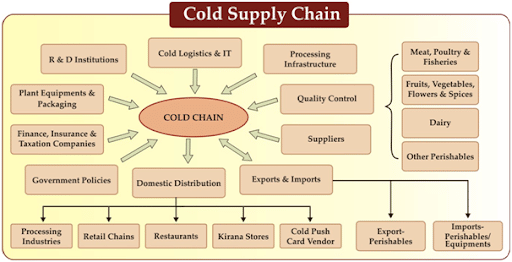
Components of Cold Supply Chain
Significance of the Scheme
- These Integrated Cold Chain projects will not only help the growth of food processing infrastructure in the concerned states but will also help farmers get better prices, doubling their income.
- The infrastructure will also reduce perishable waste, add value to agricultural products, and create numerous job opportunities, particularly in rural areas.
Entities that are Eligible
- Individuals with a business interest in cold chain solutions and supply chain management can set up the integrated cold chain and value addition infrastructure projects.
- The scheme is also open to the following types of entities/organizations:
- Farmers Producer Organizations
- Farmer Producer Company (FPC)
- Non-governmental organisation (NGO)
- Undertakings in the public sector
- Firms
- Companies
- Fruit and vegetable production would also be eligible for irradiation projects
Eligibility Requirements
- The applicant's combined net worth should be at least 1.5 times the grants-in-aid sought from the Ministry of Food Processing Industries (MoFPI) in respect of General Areas and at least equal to grants-in-aid sought in respect of difficult areas or proposals from SC/ST or Farmer Producer Organizations or Self-Help Groups.
- In the case of a proposal from the SC/ST category, the total net worth of the SC/ST members shall not be less than 10% of the entity's total net worth.
Pattern of Assistance
The scheme's financial assistance (grant-in-aid) is limited to a maximum of Rs 10 crore per project for technical civil works and eligible plant and machinery, subject to the following conditions:
- A grant-in-aid of 35% for General Areas and 50% for North East States, Himalayan States, ITDP Areas, and Islands will be provided for storage infrastructure, including Pack House and Pre cooling unit, ripening chamber, and transport infrastructure.
- Grant-in-aid will be provided at 50% for general areas and 75% for North East States, Himalayan States, ITDP Areas, and Islands for value addition and processing infrastructure, including frozen storage/deep freezers associated and integral to the processing.
- Grant-in-aid for irradiation facilities will be provided at 50% for general areas and 75% for North East States, Himalayan States, ITDP Areas, and Islands.
- The scheme's grant-in-aid is distributed in three instalments of 25%, 40%, and 35%.
Conclusion
The Integrated Cold Chain project will not only help to expand food processing infrastructure, but it will also help to streamline the agricultural supply chain, create direct and indirect employment opportunities in rural areas, provide better prices to farmers and end-users, and benefit allied sectors. These benefits are critical to farmers' economic security. This would also ensure the safety, quality, quantity, and storage of perishable produce such as fruits and vegetables, dairy products, meat, fish, and poultry, as well as ready-to-eat food products.
FAQs
Question: What is an integrated cold chain in agriculture?
Answer: An integrated cold chain is a series of temperature-controlled processes in the supply chain that helps preserve the quality of perishable agricultural products from harvest to consumption.
Question: How does the cold chain infrastructure contribute to reducing food wastage?
Answer: Cold chain infrastructure ensures that perishable goods are stored, transported, and distributed at the right temperature, preventing spoilage and reducing wastage, particularly in fruits, vegetables, dairy, and meat.
Question: What is value addition infrastructure in agriculture?
Answer: Value addition infrastructure refers to the processing, packaging, and storage facilities that enhance the quality and marketability of agricultural products, increasing their value and extending their shelf life.
Question: Why is the integrated cold chain and value addition infrastructure important for Indian agriculture?
Answer: It helps in reducing post-harvest losses, improving product quality, ensuring better market access for farmers, and increasing the economic sustainability of agricultural practices by creating value-added products.
Question: How can cold chain and value addition infrastructure improve farmers' incomes?
Answer: By reducing post-harvest losses, improving the quality of products, and enabling farmers to access better markets for processed goods, cold chain and value addition infrastructure directly contribute to higher incomes and economic sustainability.
MCQs
- What is the primary purpose of an integrated cold chain in agriculture?
A) To increase the temperature of perishable goods
B) To reduce spoilage and extend shelf life of perishable products
C) To promote value addition of agricultural products
D) To decrease transportation costs
Answer: (B) See the Explanation
The primary purpose of the cold chain is to ensure that perishable products remain fresh and viable from production to consumption by maintaining a consistent low temperature.
- What does value addition infrastructure in agriculture focus on?
A) Improving agricultural productivity
B) Enhancing the value of agricultural products through processing and packaging
C) Increasing the quantity of agricultural products produced
D) Reducing water consumption in farming
Answer: (B) See the Explanation
Value addition infrastructure focuses on processing, packaging, and storing agricultural products to increase their market value and shelf life.
- Why is cold chain infrastructure important for perishable goods?
A) It lowers transportation costs
B) It helps maintain the freshness and quality of products
C) It increases the supply of non-perishable products
D) It eliminates the need for preservatives
Answer: (B) See the Explanation
Cold chain infrastructure is critical for preserving the quality of perishable goods, such as fruits, vegetables, and meat, by maintaining the required temperature from production to consumption.
- How does an integrated cold chain help farmers in India?
A) By reducing the price of inputs for farming
B) By increasing storage facilities for crops
C) By minimizing post-harvest losses and improving market access
D) By offering subsidies for farming tools
Answer: (C) See the Explanation
The integrated cold chain helps reduce losses due to spoilage and ensures farmers can access better markets by maintaining the quality of their products.
- Which of the following is an example of value addition in agriculture?
A) Harvesting crops
B) Processing and packaging of fruits into juices
C) Irrigation of fields
D) Cultivation of genetically modified crops
Answer: (B) See the Explanation
Value addition includes processes like packaging, processing, and turning raw agricultural products into marketable goods, such as turning fruits into juices.
GS Mains Questions and Model Answers
Q1: Explain the role of integrated cold chain and value addition infrastructure in reducing post-harvest losses in Indian agriculture.
Answer: The integrated cold chain and value addition infrastructure play a crucial role in reducing post-harvest losses in India by improving the storage, transportation, and preservation of agricultural products. Cold chain infrastructure ensures that perishable goods like fruits, vegetables, dairy, and meat are kept at the right temperature throughout the supply chain, preventing spoilage and maintaining product quality. By reducing the time between harvest and consumption, cold chains help prevent wastage. Similarly, value addition infrastructure, which includes processing, packaging, and storage facilities, enhances the value of agricultural produce by converting raw products into finished goods that are more marketable. For example, processing fruits into juices, packaging produce for retail, or making dairy products like cheese and butter, not only increases the shelf life of products but also opens up new market opportunities. Together, these infrastructures help farmers reduce losses, improve income, and contribute to food security.
Q2: Discuss the impact of integrated cold chain infrastructure on the rural economy of India.
Answer: The integrated cold chain infrastructure has a transformative impact on the rural economy of India by enabling farmers to access broader markets and reduce post-harvest losses. In rural areas, a significant portion of agricultural produce is wasted due to the lack of adequate storage and transportation facilities. Cold chain infrastructure helps solve this problem by providing temperature-controlled storage, which preserves the quality of perishable goods and extends their shelf life. This, in turn, ensures that farmers can sell their produce at optimal prices, reducing wastage and improving their income. Additionally, cold chain systems create opportunities for rural entrepreneurs by fostering new businesses in logistics, processing, and packaging. This infrastructure also supports the growth of industries such as dairy, fisheries, and floriculture, providing rural farmers with avenues for value-added products. By improving access to national and international markets, integrated cold chains contribute significantly to the economic development of rural India.
Q3: How does value addition infrastructure contribute to the sustainability of Indian agriculture?
Answer: Value addition infrastructure plays a vital role in the sustainability of Indian agriculture by enhancing the economic viability and environmental resilience of farming. By processing and packaging agricultural products, value addition helps increase the market value of raw produce, making it more attractive and profitable for farmers. This infrastructure enables farmers to diversify their income sources by creating value-added products such as fruit juices, canned vegetables, dairy products, and processed grains, thus providing them with more stable and higher revenues. Moreover, value addition infrastructure supports the reduction of food waste by extending the shelf life of perishable goods. This is particularly important in a country like India, where significant post-harvest losses occur due to inadequate storage and processing facilities. In addition to improving income, value addition helps create jobs in rural areas, stimulates economic growth, and encourages sustainable agricultural practices by reducing reliance on low-value raw agricultural products.
Previous Year Questions on Integrated Cold Chain and Value Addition Infrastructure
1. UPSC CSE 2020
Question: How does the cold chain infrastructure help in reducing post-harvest losses in agriculture?
Answer: Cold chain infrastructure preserves the quality of perishable goods by maintaining the required temperature during storage and transportation. This reduces spoilage, prevents wastage, and ensures that agricultural products reach the market in good condition, leading to reduced post-harvest losses.
2. UPSC CSE 2019
Question: Discuss the role of value addition in enhancing farmers’ income and improving agricultural sustainability.
Answer: Value addition increases the marketability and profitability of agricultural products by processing and packaging raw goods into finished products. This helps farmers access better markets, boosts income, reduces waste, and supports sustainable agricultural practices by offering higher-value products, thereby contributing to long-term agricultural sustainability.
Download the PREPP App and attempt FREE IAS Exam Mock Tests and get complete study material!

Full Test - 04: UPSC CSE Prelims CSAT (Paper-II)
Full Test - 03: UPSC CSE Prelims CSAT (Paper-II)
UPSC CSE Prelims 2026 GS Paper 1 Question Paper (24-May-2026)
UPSC CSE Prelims 2026 CSAT Paper 2 Question Paper (24-May-2026)

17 February 2025 | The Hindu Must Read Articles | Current Affairs

16 February 2026 | The Hindu Must Read Articles | Current Affairs

13 February 2026 | The Hindu Must Read Articles | Current Affairs









Comments