National Horticulture Mission (NHM) - Agriculture Notes
The National Horticulture Mission (NHM) is a government mission that promotes horticultural production throughout the country. The National Horticulture Mission aimed at increasing the productivity of horticultural products such as fruits, vegetables, plantation plants, spices, aromatic plants, and so on. It aims to boost horticulture growth through area-specific strategies and the application of modern scientific practices. In this article, we will discuss the National Horticulture Mission (NHM) which will be helpful for UPSC exam preparation.
|
Table of Contents |
What is Horticulture?
- Horticulture is derived from the Latin words hortus (garden) and cultra (cultivation).
- Horticulture is the branch of agriculture concerned with intensively cultured plants directly used by man for food, medicinal purposes, and aesthetic gratification, or, in simpler terms, the cultivation, production, and sale of vegetables, fruits, flowers, herbs, ornamental or exotic plants.
- Growers of flowers, fruits, nuts, vegetables, herbs, ornamental trees, and lawns are known as horticulturists.
- Horticulture aided in the transition of human populations from nomadic to sedentary or semi-sedentary lifestyles.
- Horticulture is broken down into a number of sections that concentrate on growing and preparing various kinds of plants and foods for certain uses.
- Numerous organizations from all over the world educate, encourage, and promote the development of horticulture in order to preserve the science.
- L.H. Bailey is regarded as the Father of American Horticulture, while M.H. Marigowda is regarded as the Father of Indian Horticulture.
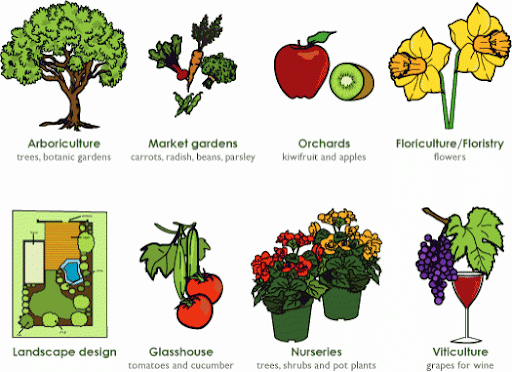
Horticultural Activities
Horticulture in India
- As it is more lucrative than agriculture, the horticulture sector has emerged as a major driver of growth (food grains mainly).
- This industry offers employment opportunities in the primary, secondary, and tertiary sectors.
- Horticulture crops, such as fruits, are more resistant to changes in weather conditions, and vegetables supplement the income of small and marginal farmers.
- Water usage is very low, lowering the risk of crop failure, and it can be done on smaller farms.
- Multiple crops are planted at the same time to maximize yield and use of fertilizers.
- This sector enables the population to eat a diverse and balanced diet to live a healthy lifestyle.
- It has become a key driver of economic development in many states across the country, with the Division of Horticulture of the Indian Council of Agricultural Research playing a critical role.
What is National Horticulture Mission (NHM)?
- A Centrally Sponsored Scheme, the National Horticulture Mission, has been launched to promote holistic growth of the horticulture sector through area-based regionally differentiated strategies.
- The scheme is fully funded by the government, and the various components proposed for implementation are financially supported according to the scales established.
- The National Horticulture Mission (NHM) is being implemented in all Indian states and union territories, with the exception of the North Eastern States, Himachal Pradesh, Jammu and Kashmir, and Uttaranchal.
- For these states, a separate Technology Mission for integrated horticulture development exists to promote holistic growth of the horticulture sector, which includes fruits, vegetables, roots and tuber crops, mushrooms, spices, flowers, aromatic plants, cashew, and cocoa.
Objectives of the National Horticulture Mission (NHM)
- To develop horticulture to its full potential in the state and to increase production of all horticultural products (fruits, vegetables, flowers, coco, cashew nut, plantation crops, spices, medicinal aromatic plants) in the state.
- To provide holistic growth in the horticulture sector through area-based, regionally differentiated strategies.
- To increase horticulture production, improve nutritional security, and provide income support to farm households.
- Convergence and synergy between multiple ongoing and planned horticulture development programs.
- To promote, develop, and disseminate technologies through a seamless blend of traditional wisdom and modern scientific knowledge.
- To provide opportunities for skilled and unskilled workers, particularly unemployed youth.
Role of NHM in Increasing the Productivity of Horticulture Plantation
- Modernizing Production: By modernizing practises, the mission has aided in the development of specific region-based yields.
- Modernization would include mechanization for harvesting as well as product assembly. This will increase production productivity.
- For example, harvester machines can be used to identify coffee beans.
- Creating coordinated governance boards: Precise boards are designed to meet the needs of the crops.
- These specific boards have smoothed out the principles for yield production and trade.
- They also provide a platform for selling produce crops in market sectors across the international market.
- Entrepreneurial training: The NHM has been training people who want to grow certain crops. This will include planting, securing, harvesting, and storing techniques. This will ensure that those producers receive benefits.
Role of NHM in Increasing the Income of Farmers
- Optional source of income: Fruits and vegetables, for example, can be grown alongside traditional crops such as rice and wheat. Apart from the main crop, these crops will help you earn extra money.
- Income security: The board determines crop costs under NHM. Farmers will no longer be reliant on the regular crop for their resources as a result of this.
- Credit is simple to obtain: The board is in charge of marketing as well as the needs and wants of its members. They provide credit facilities and storage for their members. This also provides financial security.
Conclusion
India is the world's second-largest producer of fruits and vegetables. Horticultural crops account for a significant portion of India's total agricultural output. They have a large cultivation area and contribute about 28% of the Gross Domestic Product (GDP). These crops account for 37% of India's total agricultural commodity exports. In 2019-20, the country recorded its highest-ever horticulture production of 320.77 million tonnes from an area of 25.66 million hectares. By incorporating horticulture practices into conventional farming, NHM has played an important role in changing farming practices in our country.
FAQs
Question: What is the National Horticulture Mission (NHM)?
Answer: The National Horticulture Mission (NHM) is a flagship program initiated by the Government of India in 2005-06 to promote horticulture development in the country. The mission aims to enhance the production of horticultural crops, improve the availability of quality planting materials, and provide better marketing facilities. By focusing on various aspects of horticulture, including fruits, vegetables, flowers, and spices, NHM seeks to increase the income of farmers, promote sustainable agricultural practices, and enhance the nutritional security of the population.
Question: What are the primary objectives of the NHM?
Answer: The primary objectives of the National Horticulture Mission include: 1. Increasing the area and production of horticultural crops to boost income and employment opportunities. 2. Enhancing the availability of quality planting materials to ensure higher yields. 3. Promoting integrated pest management and organic farming practices for sustainable horticulture. 4. Establishing post-harvest management and marketing infrastructure to minimize losses and enhance profit margins for farmers. 5. Strengthening research and extension services to disseminate new technologies and practices among farmers.
Question: How does the NHM support farmers?
Answer: The NHM supports farmers through various schemes and initiatives. It provides financial assistance for the establishment of nurseries, cultivation of horticultural crops, and development of infrastructure such as cold storage and processing units. The mission also facilitates capacity-building programs to educate farmers about modern horticultural practices, pest management, and marketing strategies. Additionally, NHM promotes the use of technology in agriculture, encouraging farmers to adopt innovations that can lead to improved productivity and profitability.
Question: What role does NHM play in promoting sustainable horticulture?
Answer: The NHM plays a crucial role in promoting sustainable horticulture by emphasizing the adoption of eco-friendly practices. It encourages integrated pest management (IPM) techniques, which reduce reliance on chemical pesticides and promote biological control methods. The mission also supports organic farming initiatives, helping farmers transition to organic horticulture and access premium markets. By advocating for water-efficient practices and soil health management, NHM contributes to the sustainability of horticultural production and the preservation of natural resources.
Question: How has NHM impacted the horticulture sector in India?
Answer: The National Horticulture Mission has significantly impacted the horticulture sector in India by increasing the production and productivity of various horticultural crops. Since its inception, NHM has led to the expansion of cultivated area under horticulture and has improved the livelihoods of countless farmers. The mission has facilitated the development of a robust supply chain for horticultural products, enhancing market access and reducing post-harvest losses. Overall, NHM has contributed to food security, economic development, and improved nutrition in the country.
MCQs
1. When was the National Horticulture Mission (NHM) launched?
A) 2000-01
B) 2005-06
C) 2010-11
D) 2015-16
Answer: See the Explanation
Explanation: The National Horticulture Mission (NHM) was launched in 2005-06 to promote horticulture development in India.
2. What is one of the primary objectives of NHM?
A) Increase the production of grains
B) Promote traditional farming methods
C) Enhance the area under horticultural crops
D) Decrease agricultural subsidies
Answer: See the Explanation
Explanation: One of the primary objectives of NHM is to enhance the area under horticultural crops to boost production and farmers' income.
3. Which of the following is supported by NHM?
A) Financial assistance for infrastructure development
B) Training in industrial manufacturing
C) Urban gardening initiatives
D) None of the above
Answer: See the Explanation
Explanation: NHM provides financial assistance for infrastructure development, such as cold storage and processing units for horticultural products.
4. How does NHM promote sustainable practices?
A) By advocating chemical fertilizers
B) By encouraging integrated pest management
C) By promoting monoculture
D) By discouraging crop rotation
Answer: See the Explanation
Explanation: NHM promotes sustainable practices by encouraging integrated pest management (IPM) techniques, reducing reliance on chemical pesticides.
5. What impact has NHM had on the horticulture sector in India?
A) Decreased production
B) Increased area and productivity
C) Reduced market access
D) Decreased farmer income
Answer: See the Explanation
Explanation: NHM has had a positive impact on the horticulture sector by increasing both the area and productivity of horticultural crops.
GS Mains Questions and Model Answers
Q1: Discuss the objectives and impact of the National Horticulture Mission on Indian agriculture.
Answer: The National Horticulture Mission (NHM) was established with the primary objective of promoting holistic growth in the horticulture sector in India. It aims to enhance the production of horticultural crops, improve the quality of produce, and ensure better marketing facilities for farmers. NHM has led to a substantial increase in the area cultivated under horticultural crops, thereby contributing to food security and increasing farmers' incomes. By promoting sustainable practices and providing financial assistance for infrastructure development, such as cold storage and processing facilities, NHM has transformed the horticulture landscape in India, making it more resilient and profitable for farmers.
Q2: Analyze the role of NHM in promoting sustainable agricultural practices in the horticulture sector.
Answer: The NHM plays a pivotal role in promoting sustainable agricultural practices within the horticulture sector by encouraging farmers to adopt eco-friendly techniques and technologies. By advocating for integrated pest management (IPM) and organic farming methods, the mission helps reduce the reliance on chemical inputs, thereby minimizing environmental impact. NHM also supports training programs for farmers on water conservation, soil health management, and the use of quality planting materials, further reinforcing sustainable practices. Through these initiatives, NHM not only enhances productivity but also ensures the long-term viability of horticulture in India, contributing to ecological balance and food security.
Q3: Evaluate the challenges faced by the National Horticulture Mission in achieving its objectives.
Answer: While the NHM has made significant strides in promoting horticulture in India, it faces several challenges in achieving its objectives. One major challenge is the lack of adequate infrastructure in rural areas, which hampers effective distribution and marketing of horticultural products. Additionally, limited access to quality planting materials and modern agricultural technologies can hinder productivity improvements. Another challenge is the fragmentation of land holdings, which complicates the implementation of collective farming practices and economies of scale. Addressing these challenges requires coordinated efforts among various stakeholders, including government agencies, agricultural research institutions, and farmers, to create a more supportive environment for horticulture development in the country.
Previous Year Questions on NHM
1. UPSC CSE Prelims 2021:
Question: What is the primary focus of the National Horticulture Mission?
A) Production of grains
B) Promotion of horticulture
C) Livestock management
D) Soil conservation
Answer: (B)
Explanation: The primary focus of the National Horticulture Mission is the promotion of horticulture in India, enhancing production and improving marketing facilities.
2. UPSC CSE Mains 2019 (GS Paper 3):
Question: "Analyze the impact of the National Horticulture Mission on food security and farmer income in India." Discuss its initiatives and challenges.
Answer: The National Horticulture Mission has significantly impacted food security and farmer income by promoting the cultivation of horticultural crops, which are vital for nutrition and economic stability. The mission provides financial assistance and technical support to enhance productivity and quality. By developing infrastructure for marketing and post-harvest management, NHM helps reduce losses and increases farmers' profit margins. However, challenges such as inadequate infrastructure, fragmented land holdings, and access to quality inputs persist. Addressing these challenges through policy reforms and investments in rural development is essential for maximizing the impact of NHM on food security and farmer livelihoods.
Download the PREPP App and attempt FREE IAS Exam Mock Tests and get complete study material!

Full Test - 04: UPSC CSE Prelims CSAT (Paper-II)
Full Test - 03: UPSC CSE Prelims CSAT (Paper-II)
UPSC CSE Prelims 2026 CSAT Paper 2 Question Paper (24-May-2026)
UPSC CSE Prelims 2026 GS Paper 1 Question Paper (24-May-2026)

17 February 2025 | The Hindu Must Read Articles | Current Affairs

16 February 2026 | The Hindu Must Read Articles | Current Affairs

13 February 2026 | The Hindu Must Read Articles | Current Affairs









Comments