National Food Security Mission (NFSM) - Agriculture Notes
In 2007, the Government of India launched the 'National Food Security Mission,' a Centrally Sponsored Scheme, in response to stagnant food grain production and an increasing consumption need of the country's growing population. The scheme was launched in response to the recommendation of the National Development Council's agriculture subcommittee (NDC). The Mission was a resounding success, with additional rice, wheat, and pulse production exceeding expectations. In this article, we will discuss the National Food Security Mission (NFSM) which will be helpful for UPSC exam preparation.
| To Read update on this topic: |
What is Food Security?
- Food security, as defined by the United Nations Committee on World Food Security, means that all people have physical, social, and economic access to sufficient, safe, and nutritious food that meets their food preferences and dietary needs for an active and healthy life at all times.
- Food security is comprised of the three elements listed below:
- Food availability, defined as the availability of food in sufficient quantities and on a consistent basis. It takes into account stock and production in a given area, as well as the ability to import food from elsewhere via trade or aid.
- Food access means that people must be able to obtain adequate amounts of food on a regular basis, whether through purchase, home production, barter, gifts, borrowing, or food aid.
- Utilization of food: Food must have a nutritional impact on people. Cooking, storage, and hygiene practises, individual health, water and sanitation practises, feeding and sharing practises within the household are all covered.
- Food security is closely related to household resources, disposable income, and socioeconomic status.
- It is also inextricably linked to other issues such as food prices, global environmental change, water, energy, and agricultural growth.
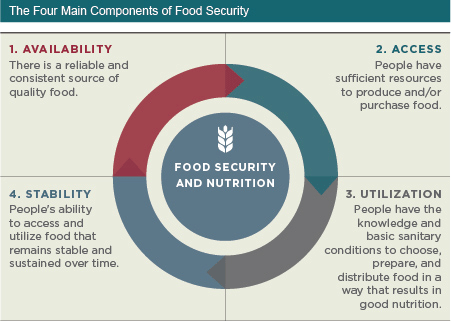
Components of Food Security
Food Security in India
- Concerns about food security can be traced back to the Bengal Famine in 1943, which occurred during British colonial rule and resulted in the deaths of 2 million to 3 million people due to starvation.
- Since gaining independence, an initial rush to industrialise while ignoring agriculture, two consecutive droughts in the mid-1960s, and reliance on food aid from the United States have exposed India's vulnerability to several food security shocks.
- In the late 1960s and early 1970s, the country experienced a Green Revolution, which enabled it to overcome productivity stagnation and significantly increase food grain production.
- Despite its success, the Green Revolution is frequently criticised for being focused on only two cereals, wheat and rice; being confined to a few resource-rich regions in the northwestern and southern parts of the country that benefited mostly rich farmers; and putting too much stress on the ecology of these regions, particularly soil and water.
- The Green Revolution was followed by the White Revolution, which was sparked by Operation Flood in the 1970s and 1980s.
- This national initiative has revolutionised liquid milk production and marketing in India, making it the world's largest producer of milk.
- Lately, particularly since the year 2000, hybrid maize for poultry and industrial use, as well as Bacillus thuringiensis (Bt) cotton, have made significant strides in production, resulting in significant cotton exports, making India the second largest cotton exporter in 2007-2008.
National Food Security Mission - Background
- The National Development Council (NDC) adopted a resolution at its 53rd meeting on May 29, 2007 to launch a Food Security Mission to increase annual rice production by 10 million tonnes, wheat production by 8 million tonnes, and pulse production by 2 million tonnes by the end of the Eleventh Plan (2011-12).
- As a result, on October 2007, the 'National Food Security Mission' (NFSM), a Centrally Sponsored Scheme, was launched.
- The Mission continued during the 12th Five Year Plan with new targets of additional food grain production of 25 million tonnes by the end of the 12th Five Year Plan, consisting of 10 million tonnes rice, 8 million tonnes wheat, 4 million tonnes pulses, and 3 million tonnes coarse cereals.
- Based on past experience and performance of the 12th Plan, it has been decided to extend the programme from 2017-18 to 2019-20, which coincides with the Fourteenth Finance Commission (FFC) period, with new targets to achieve 13 million tonnes of additional foodgrains production by 2019-20, comprising rice (5 million tonnes), wheat (3 million tonnes), pulses (3 million tonnes), and coarse cereals (2 million tonnes).
What is National Food Security Mission?
- In 2007-08, the National Food Security Mission (NFSM) was launched to increase rice, wheat, and pulse production through:
- area expansion and productivity enhancement,
- restoring soil fertility and productivity,
- creating employment opportunities, and
- improving farm level economy.
- Coarse cereals were also included in the Mission under NFSM in 2014-15.
- Cluster demonstrations on improved package of practises, cropping system demonstrations, seed distribution of high yielding varieties, farm machineries/resources conservation machineries/tools, efficient water application tools, plant protection measures, nutrient management/soil ameliorants, cropping system based farmer trainings, and so on are among the interventions covered by NFSM.
- It also aims to increase the availability of vegetable oils and reduce the import of edible oils.
- The National Food Security Mission includes the National Mission on Oil Seeds and Oil Palm (NMOOP).
Objectives of the National Food Security Mission
- Increasing rice, wheat, pulses, and coarse cereals (Maize and wheat) production
- Barley) and Nutri-Cereals through increased area and productivity in the country's identified districts in a sustainable manner.
- Individual farm soil fertility and productivity restoration.
- Improving farm level economy (i.e. farm profits) to reestablish trust amidst the farmers.
- To ensure national food security.
Strategy of National Food Security Mission
To achieve the aforementioned goals, the Mission would employ the following strategies:
- Concentrate on districts with low productivity but high potential, such as food grain crops are grown in rain-fed areas.
- Cropping system interventions are being implemented in a Mission mode approach through active participation of all stakeholders at different levels.
- Crop clustering and agro-climatic zone-based planning for increased productivity.
- Concentrate on pulse production by utilising rice fallow, rice bunds and pulse intercropping with coarse cereals, oilseeds, and crops for commercial use (sugarcane, cotton, jute).
- Promotion and spread of improved technologies, such as, integrated nutrient management (INM) including micronutrients, integrated pest management (IPM), input use efficiency and resource conservation technologies, as well as capacity development of farmers and extension workers.
- Close monitoring of funds flow to ensure timely delivery of interventions for the intended beneficiaries.
- Incorporation of various interventions and goals into the district plan of each designated district.
- Constant monitoring and evaluation by implementing agencies to assess the impact of interventions for a result-oriented approach.
Components of National Food Security Mission
- National Food Security Mission - Rice (NFSM - Rice)
- National Food Security Mission - Wheat (NFSM - Wheat)
- National Food Security Mission - Pulses (NFSM - Pulses)
- National Food Security Mission - Coarse Cereals (NFSM - Coarse Cereals)
- National Food Security Mission - Commercial Crops (NFSM - Commercial Crops)
- National Food Security Mission - Sub-mission on Nutri Cereals
- National Food Security Mission - Oilseeds and Oilpalm
- National Food Security Mission - Seed Village Programme
Structure of National Food Security Mission
National Level
- A National General Council has been formed under the chairmanship of the Union Agriculture Minister.
- The GC is the policy-making body, issuing appropriate directives and guidance to the Mission and reviewing the scheme's overall progress and development.
- A National Food Security Mission Executive Committee (NFSMEC) has been formed, chaired by the Secretary; Department of Agriculture & Cooperation, Ministry of Agriculture, to oversee the Mission's activities and approve State Action Plans.
State Level
State Food Security Mission Executive Committees (SFSMEC) have since been formed in all participating states, led by the respective Chief Secretaries.
District Level
The autonomous body established under the Societies Registration Act, the Agricultural Technology Management Agency (ATMA), has been established at the district level to implement the Mission's programme.
Interventions of the National Food Security Mission
Farmer’s Field School
Farmers' Field Schools are held on farmers' fields to provide practical knowledge about the prevalence of various pests and diseases on crops, as well as their management practises.
Integrated Pest Management (IPM)
A variety of pests and diseases reduce pulse crop productivity. As a result, an integrated approach to managing their incidence and minimising crop productivity loss is required.
Plant Protection Chemicals
- If biological control measures fail to provide effective pest and disease control, the use of chemical pesticides and fungicides becomes necessary.
- Plant Protection chemicals are provided to pulse growing farmers with financial assistance for timely pest control.
Weedicides
- Weeds compete with crop plants for water, nutrients, sunlight, and so on. As a result, weed infestation reduces crop plant water and nutrient uptake efficiency.
- Weedicides are provided to pulse farmers in order to promote timely and better weed management.
Demonstrations
- Demonstrations of improved wheat and pulse practices are being organised with financial assistance.
- Farmers are given inputs such as seed, fertiliser, and plant protection chemicals during these demonstrations.
Seed Minikits
Seed minikits of new and promising wheat varieties are distributed to farmers at no cost in order to assess the performance of these varieties in our state in comparison to existing varieties.
Micronutrients
Micronutrient deficiency reduces crop productivity. Farmers are thus given financial assistance for micronutrients per hectare.
Gypsum
- Gypsum is the most affordable source of Sulphur, an essential element for plants.
- Sulphur deficiency is widespread throughout the state, according to reports. Farmers are thus given financial assistance for gypsum.
Farm Machinery
Farm machinery assistance is provided to farmers in order to improve the efficiency of farming operations and lower the cost of cultivation.
Conclusion
A nation's food security is ensured if all of its citizens have enough nutritious food available, all people have the ability to buy food of acceptable quality, and there are no barriers to food access. The right to food is a well-established principle of international human rights law. It has evolved to include an obligation for state parties to respect, protect, and fulfil their citizens' right to food security.
FAQs
Question: What is the National Food Security Mission (NFSM)?
Answer: The National Food Security Mission (NFSM) is a government initiative launched in 2007 aimed at enhancing the production of food grains, particularly rice, wheat, and pulses, in India. The mission seeks to ensure food security by increasing agricultural productivity and improving the livelihood of farmers.
Question: What are the primary objectives of the NFSM?
Answer: The primary objectives of the NFSM include increasing food grain production, enhancing farm productivity, promoting sustainable agricultural practices, improving the availability of quality seeds, and ensuring better access to farming technology and resources for farmers.
Question: How does NFSM support farmers in increasing productivity?
Answer: NFSM supports farmers through various means such as providing financial assistance for purchasing seeds, fertilizers, and farm equipment. It also facilitates training programs to educate farmers about best practices in farming, modern agricultural techniques, and the use of technology to boost productivity.
Question: Which crops are primarily focused on under the NFSM?
Answer: The NFSM primarily focuses on increasing the production of staple crops such as rice, wheat, and pulses. The mission aims to enhance the productivity of these crops to achieve national food security and self-sufficiency in food production.
Question: What role does the NFSM play in achieving food security in India?
Answer: The NFSM plays a crucial role in achieving food security in India by increasing food grain production to meet the rising demand due to population growth. By enhancing agricultural productivity and ensuring sustainable practices, the NFSM contributes to the stability of food supply, reduces hunger, and improves the economic status of farmers.
MCQs
1. When was the National Food Security Mission launched?
A) 2005
B) 2007
C) 2009
D) 2011
Answer: (B) See the Explanation
Explanation: The National Food Security Mission was launched in 2007 as an initiative to enhance food grain production in India.
2. Which of the following crops is NOT a focus of the NFSM?
A) Wheat
B) Rice
C) Pulses
D) Cotton
Answer: (D) See the Explanation
Explanation: Cotton is not a primary focus of the NFSM, which mainly targets food grains like rice, wheat, and pulses.
3. What is a key objective of the National Food Security Mission?
A) Increase in import of food grains
B) Enhance food grain production
C) Reduce agricultural productivity
D) Increase in crop prices
Answer: (B) See the Explanation
Explanation: A key objective of the NFSM is to enhance food grain production to achieve national food security and self-sufficiency.
4. Which of the following is a method used by the NFSM to support farmers?
A) Providing loans without interest
B) Financial assistance for seeds and fertilizers
C) Importing food grains
D) Reducing farm size
Answer: (B) See the Explanation
Explanation: The NFSM provides financial assistance for purchasing seeds, fertilizers, and equipment, thereby supporting farmers to increase productivity.
5. What impact does NFSM aim to have on farmers' livelihoods?
A) Decrease their income
B) Improve their economic status
C) Limit their farming activities
D) Reduce employment opportunities
Answer: (B) See the Explanation
Explanation: NFSM aims to improve farmers' economic status by enhancing agricultural productivity and providing support for sustainable farming practices.
GS Mains Questions and Model Answers
Q1: Evaluate the significance of the National Food Security Mission in addressing food security challenges in India.
Answer: The National Food Security Mission (NFSM) plays a pivotal role in addressing food security challenges in India by targeting the enhancement of food grain production, which is essential given the country's growing population and increasing food demand. The mission focuses on improving the productivity of staple crops like rice, wheat, and pulses through financial assistance, technological support, and capacity-building measures for farmers. By promoting sustainable agricultural practices, NFSM not only aims to increase food availability but also enhances the livelihoods of farmers, contributing to rural development. The mission aligns with national goals of self-sufficiency and reduces dependency on food imports, thereby stabilizing the food supply chain and ensuring food security for all segments of the population.
Q2: Discuss the methods employed by the NFSM to enhance agricultural productivity among farmers.
Answer: The NFSM employs various methods to enhance agricultural productivity, including providing financial assistance for purchasing quality seeds, fertilizers, and agricultural equipment. The mission also focuses on improving irrigation facilities, promoting modern farming techniques, and conducting training programs for farmers to educate them about sustainable practices and the efficient use of resources. Additionally, NFSM encourages the establishment of farmer producer organizations (FPOs) to facilitate better access to markets and improve bargaining power. Through these integrated approaches, the mission aims to empower farmers, increase crop yields, and promote food security.
Q3: Analyze the impact of the NFSM on rural livelihoods and the overall economy of India.
Answer: The NFSM has a substantial impact on rural livelihoods by enhancing agricultural productivity, which directly contributes to farmers' income and economic stability. As farmers increase their yields, they can achieve better prices for their produce, leading to improved financial conditions. This, in turn, stimulates rural economies through increased spending on goods and services, thus creating a multiplier effect in local markets. Additionally, the mission's emphasis on sustainable practices ensures long-term productivity and environmental health, contributing to food security and economic resilience. Overall, the NFSM fosters a more robust agricultural sector, which is vital for India's economic growth and development.
Previous Year Questions on National Food Security Mission
1. UPSC CSE Prelims 2021:
Question: What is the primary focus of the National Food Security Mission (NFSM)?
A) Increasing food imports
B) Enhancing food grain production
C) Reducing agricultural subsidies
D) Promoting organic farming
Answer: (B)
Explanation: The primary focus of the NFSM is to enhance food grain production to ensure food security in India.
2. UPSC CSE Mains 2020 (GS Paper 3):
Question: "Evaluate the role of the National Food Security Mission in enhancing agricultural productivity and addressing hunger in India."
Answer: The NFSM plays a critical role in enhancing agricultural productivity by providing necessary support, resources, and training to farmers. It addresses hunger by ensuring a steady and sufficient food supply through increased production of essential food grains. The mission also promotes sustainable agricultural practices, thereby ensuring long-term food security and resilience against climate change and market fluctuations. By directly linking food production with rural livelihoods, the NFSM contributes to the overall goal of eradicating hunger and improving the quality of life in rural areas.
Download the PREPP App and attempt FREE IAS Exam Mock Tests and get complete study material!

Full Test - 04: UPSC CSE Prelims CSAT (Paper-II)
Full Test - 03: UPSC CSE Prelims CSAT (Paper-II)
UPSC CSE Prelims 2026 GS Paper 1 Question Paper (24-May-2026)
UPSC CSE Prelims 2026 CSAT Paper 2 Question Paper (24-May-2026)

17 February 2025 | The Hindu Must Read Articles | Current Affairs

16 February 2026 | The Hindu Must Read Articles | Current Affairs

13 February 2026 | The Hindu Must Read Articles | Current Affairs









Comments