Rashtriya Krishi Vikas Yojana – RAFTAAR (RKVY-RAFTAAR ) - Agriculture Notes
RKVY – RAFTAAR also recognized as Rashtriya Krishi Vikas Yojana – Remunerative Approaches for Agriculture and Allied Sectors Rejuvenation is a distinctive scheme of the Government of India (GOI) and Ministry of Agriculture & Farmers Welfare (MoA & FW). The main motive of this plan is to reinforce the infrastructure as well as facilities in Agriculture and its related sectors. It is a unique scheme that supports building an Agripreneurship & Agri-Business environment in the nation, encouraging financial guidance to budding Agristartups and supporting a structure of business growth. This article will explain to you about Rashtriya Krishi Vikas Yojana – RAFTAAR (RKVY-RAFTAAR ) which will be helpful in preparing the Agriculture Syllabus for the UPSC Civil Service exam.
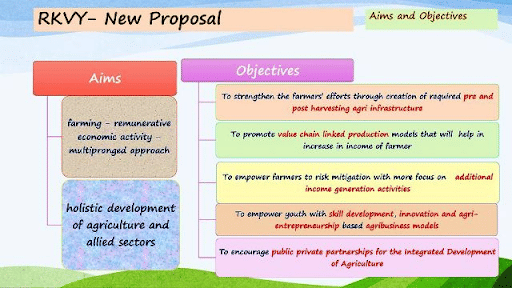
Objectives of the Rashtriya Krishi Vikas Yojana
RKVY-RAFTAAR - Background
- The National Development Council (NDC), in a meeting on May 29, 2007, decided to start a special Additional Central Assistance Scheme (RKVY) because it was concerned about the stagnant growth in agriculture and related industries.
- The NDC decided that agricultural development plans needed to be reoriented to better serve farmer demands, and it urged the central and state governments to adopt a plan to revive agriculture.
- During the 11th-year plan, the NDC reaffirmed its goal of achieving 4% annual growth in the agriculture sector.
- Since its inception, the scheme has come a long way and has been implemented over two plan periods (11th and 12th).
- The scheme was implemented as an Additional Central Assistance (ACA) to State Plan Scheme with 100% central assistance until 2013-14.
- In 2014-15, it was converted into a Centrally Sponsored Scheme, with 100% central assistance.
What is Rashtriya Krishi Vikas Yojana – RAFTAAR?
- RKVY was formed in the year 2007, and later it was reformed as Remunerative Approaches for Agriculture and Allied Sectors Rejuvenation (RAFTAAR ).
- This RAFTAAR scheme was to be implemented for three years, starting from 2017-2018 to 2019-2020 with a budget distribution of 15,722 crores.
- The RKVY scheme was launched as an umbrella scheme to ensure the holistic development of agriculture and allied sectors by allowing states to select their own agriculture and allied sector development activities in accordance with the district/state agriculture plan.
- The National Development Council (NDC) decided on the plan of beginning a Central Assistance Scheme on 29th May 2007 with the aim of building development strategies related to Agriculture to meet the needs, wants and demands of farmers.
- This scheme was also made to provide flexibility as well as autonomy to the various states in performing programs with the purpose of motivating/encouraging investment in Agriculture and its associated areas.
- The RKVY scheme encourages states to increase public investment in agriculture and related industries.
- States have been given flexibility and autonomy under RKVY for selecting, planning, approving, and executing projects/programs under the scheme based on their needs, priorities, and agro-climate requirements.
- The funds are released to the State Governments/UTs based on projects approved by the State Level Sanctioning Committee Meeting (SLSC), which is the empowered body to approve projects under the scheme and is chaired by the Chief Secretary of the concerned State.
- It's for the state government to continue implementing the scheme in the state as needed in areas that require focused attention in order to increase production and productivity in the state
RKVY-RAFTAAR - Objectives
The main objective of the scheme is to increase economic growth through farming. Other major objectives of the scheme are as follows:
- Risk reduction, bolstering farmer efforts, and encouraging agri-business entrepreneurship through the development of agri-infrastructure.
- Granting each state the freedom and discretion to tailor strategies to meet the demands of their particular region.
- Assisting farmers in raising their revenue by fostering productivity and supporting production methods with links to value chains.
- By concentrating on improving income generation through mushroom cultivation, integrated farming, floriculture, etc., to lower the risk faced by farmers.
- Empowering young people through various forms of innovation, skill development, and agribusiness.
RKVY-RAFTAAR - Components
- Agripreneurship Orientation: A two-month Agripreneurship Orientation program with a monthly stipend of Rs. 10,000 is available. Mentorship is offered for financial, technological, IP, and other related difficulties.
- Seed Stage Funding of R-ABI Incubatees: Up to Rs. 25 lakhs in funding (85% grant; 15% incubator contribution).
- Idea/Pre-Seed Stage Funding of Agripreneurs: Agripreneurs' idea/pre-seed stage funding is provided up to Rs. 5 lakhs (90% grant, 10% incubatee commitment).
RKVY-RAFTAAR - Sectors Covered
The sectors/areas covered under the RKVY – RAFTAAR scheme are:
- Crop Cultivation
- Horticulture
- Animal Husbandry
- Fisheries
- Dairy Development
- Agricultural Research and Education
- Forestry
- Wildlife
- Plantation
- Agricultural Marketing
- Food Storage
- Warehousing
- Soil and Water Conservation
- Agricultural Financial Institutions
- Other Agricultural Cooperation
RKVY-RAFTAAR - Funding
- RKVY-RAFTAAR will keep on being executed as a Centrally Sponsored Scheme in the proportion of 60:40 (Government of India and State Share individually) except for northeastern and mountainous states where the sharing example is 90:10.
- For UTs the award is 100% as Central Share.
- All the states, as well as Union Territories (UTs), will be eligible for funding under the RKVY RAFTAAR scheme.
RKVY-RAFTAAR - Sub-Schemes
The main sub-schemes that are implemented under the Rashtriya Krishi Vikas Yojana - (RAFTAAR ) are briefly explained below:
Accelerated Fodder Development Programme (AFDP)
- This sub-scheme of RKVY – RAFTAAR is introduced by the Department of Animal Husbandry to increase the availability of green and dry provender (fodder).
- This scheme is also formed to win the shortage of fodder that is caused due to natural disasters such as pollution, droughts, floods, etc.
National Saffron Mission
- Saffron is also known as the best golden spice in India and the world. It is counted second in terms of production after Iran. India exports saffron to England, America, and some Middle East countries.
- Saffron is cultivated in only four districts of Jammu and Kashmir namely, Pulwama, Budgam, Srinagar, and Kishtwar.
- It is in great demand for its medical, cosmetic and aromatic properties.
- The Saffron Mission originated to enhance the old-style (traditional) saffron cultivation in parts of Jammu and Kashmir.
- The plan was designed to improve saffron production by providing quality seeds and an uninterrupted water supply.
- This scheme has been adopted to encourage and promote saffron farming along with training for the farmers.
Bringing Green Revolution to Eastern India (BGREI)
- This program of the RKVY scheme was initiated to harness the water potential for enhancing rice production in Eastern India.
- It comprises seven states namely, Assam, Bihar, Chhattisgarh, Jharkhand, Odisha, Eastern Uttar Pradesh, and West Bengal.
Crop Diversification Programme (CDP)
- The Crop Diversification Programme (CDP) is utilized in the Original Green Revolution States to redirect paddy cropland to other crops and in states where tobacco is grown to assist tobacco farmers to switch to alternative crops/cropping systems.
- In order to conserve water and safeguard the land in the state of Punjab, the Department of Agriculture, Cooperation, and Farmers Welfare (DAC&FW) is executing this program to replace paddy crops with less water-intensive alternative crops.
- Assistance is given for four primary interventions, including other crop demonstrations, farm mechanization & value addition, site-specific actions & contingency for awareness, training, monitoring, etc., under the CDP for replacing paddy crops.
Reclamation of Problem Soil (RPS)
- This program was established in order to improve and reclaim problem soils, which are areas impacted by alkalinity, salinity, and acidity.
- Additionally, it uses a projectized approach and employs a need-based approach to farm development, bio-engineering techniques, and the application of soil amendments.
- After this program has been executed on a pilot basis in a few potential States with a larger concentration of problematic soil, it will be adopted as a stand-alone centrally sponsored program.
RKVY-RAFTAAR - Significance
The importance of the RKVY scheme is mentioned below:
- Boosting the conditions of India in improving allotment to Agriculture and its associated areas.
- Providing employment opportunities in rural areas.
- Assisting in achieving the aim of expanding the farmer’s income in the coming future.
- Ensuring a holistic development in the Agricultural sector.
Conclusion
RKVY-RAFTAAR’s broad goals of making farming a profitable economic activity include increasing farmer effort, risk mitigation, and promoting agri-business entrepreneurship. The primary focus of RKVY-RAFTAAR is on pre- and post-harvest infrastructure, as well as promoting agri-entrepreneurship and innovation. The expansion of India's agricultural and related sectors has been hampered by a lack of investment, particularly governmental investment in the agricultural sector. Thus, with Additional Central Assistance, the Rashtriya Krishi Vikas Yojana was able to revive agriculture in this regard.
FAQs
Question. What is Rashtriya Krishi Vikas Yojana – RAFTAAR (RKVY-RAFTAAR)?
Answer: RKVY-RAFTAAR is a government initiative launched to rejuvenate agriculture and its allied sectors by promoting agripreneurship, supporting agri-businesses, and encouraging public investments in agriculture.
Question. What are the main objectives of RKVY-RAFTAAR?
Answer: The key objectives include increasing farmer income, promoting agri-business entrepreneurship, improving productivity, and providing tailored solutions for regional agricultural needs.
Question. What are the components of RKVY-RAFTAAR?
Answer: Key components include agripreneurship orientation, seed-stage funding for agribusinesses, and various schemes for sectors like crop cultivation, animal husbandry, dairy, horticulture, and more.
Question. How does RKVY-RAFTAAR benefit farmers?
Answer: It supports farmers by reducing risks, increasing productivity, promoting sustainable farming methods, and fostering income generation through agricultural innovations.
Question. How is RKVY-RAFTAAR funded?
Answer: It is a centrally sponsored scheme with a 60:40 funding share between the Government of India and states, with northeastern and mountainous regions receiving a 90:10 share.
MCQs
- What is the primary aim of RKVY-RAFTAAR?
A) To focus on crop subsidies
B) To encourage agribusiness and entrepreneurship in agriculture
C) To provide financial assistance to farmers directly
D) To increase subsidies for fertilizers
Answer: (B) See the Explanation
RKVY-RAFTAAR focuses on promoting agripreneurship, innovation, and business growth in the agriculture sector.
- Which sectors are covered under the RKVY-RAFTAAR scheme?
A) Only crop cultivation
B) Crop cultivation, horticulture, animal husbandry, and others
C) Only dairy development
D) Forestry and wildlife only
Answer: (B) See the Explanation
RKVY-RAFTAAR covers a wide range of sectors including crop cultivation, horticulture, animal husbandry, dairy development, and more.
- What is the funding ratio under the RKVY-RAFTAAR scheme for most states?
A) 100% government funding
B) 60:40 (Central:State)
C) 90:10 (Central:State)
D) 70:30 (Central:State)
Answer: (B) See the Explanation
The funding ratio is 60% from the central government and 40% from state governments, except for northeastern and mountainous states.
- What is provided under the Agripreneurship Orientation component of RKVY-RAFTAAR?
A) Agricultural loans
B) A two-month orientation program with a stipend
C) Fertilizer subsidies
D) Land grants
Answer: (B) See the Explanation
The Agripreneurship Orientation component includes a two-month program aimed at fostering agripreneurship with a stipend of Rs. 10,000 per month.
- Which of the following is a sub-scheme under RKVY-RAFTAAR?
A) National Horticulture Mission
B) Accelerated Fodder Development Programme
C) Pradhan Mantri Fasal Bima Yojana
D) National Crop Insurance Scheme
Answer: (B) See the Explanation
The Accelerated Fodder Development Programme is one of the sub-schemes under RKVY-RAFTAAR.
GS Mains Questions and Model Answers
Q1: Discuss the impact of RKVY-RAFTAAR on agricultural growth and agribusiness development in India.
Answer: RKVY-RAFTAAR is a comprehensive scheme that aims to transform the agriculture sector by encouraging entrepreneurship and agribusiness development. By providing financial support and training through agripreneurship programs, it aims to create sustainable farming systems. The scheme empowers farmers with the tools and infrastructure needed to enhance productivity, which contributes to higher agricultural growth. Additionally, it facilitates the development of allied sectors, such as animal husbandry, dairy, and fisheries, leading to holistic rural development.
Q2: Analyze the role of RKVY-RAFTAAR in improving the financial sustainability of farmers.
Answer: RKVY-RAFTAAR helps improve the financial sustainability of farmers by promoting innovative agricultural practices and business models. By facilitating the growth of agri-businesses and providing seed funding for agripreneurs, it encourages new avenues for income generation. Moreover, the scheme enhances the infrastructure for farming, making it easier for farmers to access markets and technology, which helps increase farm profitability. With a focus on diversified agricultural practices like floriculture, integrated farming, and mushroom cultivation, it reduces dependency on traditional crop farming and mitigates risks associated with agricultural income.
Q3: Evaluate the challenges in implementing RKVY-RAFTAAR and suggest measures to overcome them.
Answer: Despite its potential, RKVY-RAFTAAR faces challenges like inadequate awareness among farmers, limited access to funds for small-scale agribusinesses, and the difficulty of implementing region-specific projects. To overcome these challenges, the government should ensure better outreach programs, improve financial access through easier loans, and encourage state-level customizations of the scheme. Additionally, strengthening the capacity of agricultural extension services and creating more robust market linkages for farmers and agribusinesses could significantly improve the scheme’s implementation and effectiveness.
Previous Year Questions on RKVY-RAFTAAR
1. UPSC CSE 2018
Question: "Discuss the objectives and components of the Rashtriya Krishi Vikas Yojana – RAFTAAR and its role in the development of Indian agriculture."
Answer: The objectives of RKVY-RAFTAAR include enhancing agricultural growth, improving farmer income, and promoting agribusiness entrepreneurship. The components focus on agripreneurship, financial assistance to agri-startups, and creating market linkages. The scheme supports infrastructure development and helps modernize the agriculture sector, enabling farmers to adopt better farming practices and reduce dependency on traditional methods.
2. UPSC CSE 2020
Question: "Evaluate the role of RKVY-RAFTAAR in addressing the challenges faced by the agriculture sector in India."
Answer: RKVY-RAFTAAR addresses key challenges in agriculture, such as low productivity, lack of market access, and financial constraints. By promoting entrepreneurship and agribusinesses, it provides farmers with the tools, training, and financial resources to diversify and increase their income. The scheme encourages investment in infrastructure, helps integrate technology, and strengthens market linkages, making the agricultural sector more resilient and sustainable.
Download the PREPP App and attempt FREE IAS Exam Mock Tests and get complete study material!

Full Test - 04: UPSC CSE Prelims CSAT (Paper-II)
Full Test - 03: UPSC CSE Prelims CSAT (Paper-II)
UPSC CSE Prelims 2026 CSAT Paper 2 Question Paper (24-May-2026)
UPSC CSE Prelims 2026 GS Paper 1 Question Paper (24-May-2026)

17 February 2025 | The Hindu Must Read Articles | Current Affairs

16 February 2026 | The Hindu Must Read Articles | Current Affairs

13 February 2026 | The Hindu Must Read Articles | Current Affairs









Comments