Paramparagat Krishi Vikas Yojana (PKVY) - Agriculture Notes
"Paramparagat Krishi Vikas Yojana" is a comprehensive part of the National Mission of Sustainable Agriculture's Soil Health Management (SHM) program. Through the adoption of the organic village by cluster concept and PGS certification, organic farming is encouraged under PKVY. This article will explain to you about Paramparagat Krishi Vikas Yojana (PKVY) which will be helpful in preparing the Agriculture Syllabus for the UPSC Civil Service exam.
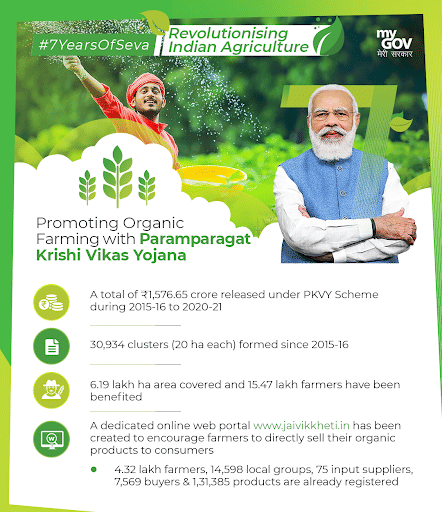
Paramparagat Krishi Vikas Yojana
Why Focus on Organic Farming?
- Given the growing number of issues that using chemical fertilizers and pesticides is generating, organic farming has gained importance in India.
- The yield from GMO (genetically modified) crops may be excellent, but the long-term impacts of these crops have not yet been studied, and consumers are not yet ready to trust these foods.
- In addition to this, the demand for organic food has significantly increased on a global scale.
- India is best positioned to benefit from the enormous export potential of these commodities as a result of the promotion of these organic farming methods.
- The Paramparagat Krishi Vikas Yojana has been launched by the Indian government with these factors in consideration.
Status of Organic Farming in India
- According to the FSSAI, "organic farming" is a technique of farm design and management that avoids using synthetic external inputs like chemical fertilizers, pesticides, synthetic hormones, or genetically modified organisms to build an ecosystem for agriculture production.
- In 2016, Sikkim became the first state in the world to become entirely organic.
- Since organic farming has long predominated in North East India, significantly fewer chemicals are consumed there than elsewhere in the nation.
- Similar to tribal areas, organic farming has long been practiced in island nations.
- Flax seeds, sesame, soybean, tea, medicinal plants, rice, and pulses have been India's top organic exports.
- In 2018–19, organic exports increased by over 50% and totaled Rs. 5151 crores.
- As the demand for healthy foods rises, the beginning of exports from Assam, Mizoram, Manipur, and Nagaland to the UK, USA, Eswatini, and Italy have demonstrated their potential by growing in volume and reaching new markets.
*To know more about the topic, click this link Organic Farming
What is Paramparagat Krishi Vikas Yojana (PKVY)?
- Paramparagat Krishi Vikas Yojana, or the Traditional Farming Improvement program is one of the sub-components of National Mission of Sustainable Agriculture's Soil Health Management (SHM) program.
- Paramparagat Krishi Vikas Yojana or PKVY was launched in April 2015.
- PGS-India or Participatory Guarantee System of India is a quality assurance initiative that strengthens the participation of stakeholders in the quality assurance of organic farming.
- The Ministry of Agriculture and Farmers’ Welfare laid out this scheme chiefly to encourage and strengthen organic farming.
- It advocates the use of bio-pesticides, vermicompost, and so on, instead of chemical fertilizers.
- This ensures a healthy and organic yield. It was a very comprehensively laid out scheme.
Paramparagat Krishi Vikas Yojana - Objectives
The primary objectives of this program were:
- To encourage integrated, climate-resilient, natural resource-based farming methods that maintain and improve soil fertility, protect natural resources, recycle nutrients on-site, and reduce farmers' reliance on outside inputs.
- To increase farmer net income per unit of land by lowering the cost of agriculture for farmers through sustainable integrated organic farming systems.
- To sustainably grow wholesome, chemical-free food for human consumption.
- To save the environment from dangerous inorganic compounds by the adoption of traditional, low-tech eco-friendly farming methods.
- To enable farmers to control production, processing, value addition, and certification management through the formation of their own institutions in the form of clusters and groups.
- To make farmers the business owners through direct connections to regional and global markets.
Paramparagat Krishi Vikas Yojana - Approach
Under the PKVY, a cluster approach to promote organic farming was put to use.
- PKVY operates by adopting organic villages in clusters and through the Participatory Guarantee System (PGS) of Certification.
- The target of the scheme was to operate in 10,000 clusters of 20 hectares or 50 acres of land each and yield around 2,00,000 hectares of agricultural area under organic farming within three years.
- Each group consists of 50 farmers with one acre of land each.
- Every cluster will be allotted not more than Rs.10,00,000 for the farmers and not more than Rs. 4,95,000 for mobilization and PGS Certification with a subsidy ceiling of one hectare per farmer.
- 65% of the total number of farmers should be allocated to small and marginal categories.
- This must be fulfilled at the cluster level to bring about balanced regional growth.
- At least 30% of the budget allocations should be earmarked for women beneficiaries/ farmers.
Paramparagat Krishi Vikas Yojana - Funding & Implementation
Funding
- PKVY is a Centrally Sponsered Scheme. The ratio (Centre: State) of Funding between the Centre and the State Government is as follows:
- Union Territories: 100% Centre
- North-East and the Himalayan States: 90:10
- Rest of the States: 60:40
Implementation
- Paramparagat Krishi Vikas Yojana is implemented by the Organic Farming Cell of the Integrated Nutrient Management Division of the Department of Agriculture; Cooperation and Farmers Welfare.
- At the State level, the State Department of Agriculture and Cooperation has been implementing the scheme with the involvement of Regional Councils that are registered under the PGS- India Certification Programme.
- At the district level, the Regional Councils (RCs) within the district anchor the implementation of PKVY.
Paramparagat Krishi Vikas Yojana - Components and Patterns of Assistance
Adoption of the PGS Certification through Cluster Approach
- Mobilization of farmers to form a cluster on 50 acres for PGS certification.
- Discussions with farmers for the creation of clusters.
- Appointing the Lead Resourceful Person (LRP) for training other trainers.
- Training of the members of the cluster on organic farming.
PGS Certification and Quality Control
- Training of LRPs on PGS Certification.
- Training of Trainers by Lead Resource Persons.
- Online Registration of farmers.
- Collection and testing of Soil samples.
- Documentation of the process - sampling, testing, recommendation.
- Inspection of fields of a cluster members.
- Residue analysis of samples certification Charges.
- Administrative expenses for certification.
Adopting Organic Villages through Cluster Approach
- Action plan for Organic Farming for one cluster.
- Integrated Manure Management and biological nitrogen harvesting.
- Custom Hiring Centre (CHC) charges.
- Packing, Labeling, and Branding of these organic products.
Conclusion
Despite its significance, the Paramparagat Krishi Vikas Yojana has not yet gained traction because the majority of States have not used the funds allocated for this initiative. According to a 2018 assessment on the execution of PKVY, all states except Tripura, Odisha, and Karnataka have failed to use even half of their allocated funding for the program. While the Center has raised funding for the program by 44% for the current year, remedial action is thus required to make sure that the states take responsibility for their actions and support "organic India."
FAQs
Question: What is the Paramparagat Krishi Vikas Yojana (PKVY)?
Answer: The Paramparagat Krishi Vikas Yojana (PKVY) is a scheme launched by the Ministry of Agriculture and Farmers Welfare in India with the aim of promoting organic farming. The scheme focuses on enhancing soil health, improving water conservation, and increasing productivity by promoting traditional organic farming techniques. Under PKVY, farmers are encouraged to adopt organic farming practices, which involve the use of organic inputs like compost, bio-fertilizers, and crop rotation. The scheme provides financial support to farmers for the conversion to organic farming and for the certification process to sell their produce as organic.
Question: What are the objectives of the Paramparagat Krishi Vikas Yojana (PKVY)?
Answer: The key objectives of PKVY are: 1. To promote organic farming and increase the area under organic cultivation. 2. To reduce the dependence on chemical fertilizers and pesticides, thereby ensuring soil and water conservation. 3. To enhance the income of farmers by increasing the demand for organic products. 4. To improve the sustainability of agriculture by promoting natural farming techniques. 5. To provide financial support for farmers to convert to organic farming, including subsidies for certification and organic inputs.
Question: How does the PKVY scheme support farmers?
Answer: The PKVY scheme supports farmers by providing financial assistance for the transition from conventional farming to organic farming. The scheme provides funds for the purchase of organic inputs, such as bio-fertilizers and compost. Additionally, PKVY supports the certification of organic farms, which allows farmers to sell their products as organic, thus fetching a premium price. The scheme also provides training and technical support to farmers to help them adopt sustainable and eco-friendly farming practices.
Question: What are the benefits of organic farming under the PKVY scheme?
Answer: Organic farming under the PKVY scheme offers several benefits: 1. It promotes soil health by improving organic matter content and enhancing microbial activity. 2. It reduces the use of synthetic chemicals, leading to better water quality and reduced environmental pollution. 3. Organic farming enhances biodiversity and improves the sustainability of agricultural practices. 4. It enables farmers to access premium markets for organic products, thus increasing their income. 5. The adoption of organic farming improves long-term soil fertility and reduces the cost of inputs, leading to more profitable farming practices in the long run.
Question: What is the role of certification in the PKVY scheme?
Answer: Certification plays a crucial role in the PKVY scheme, as it ensures that the produce is genuinely organic and meets the required standards. The certification process under the scheme involves third-party verification, where an accredited certification agency inspects the farming practices and inputs used by the farmers. Once certified, farmers are allowed to sell their produce as organic, which enhances its marketability and allows them to access higher-paying organic markets. Certification also helps build consumer confidence in organic products, ensuring the credibility of organic farming practices.
MCQs
1. What is the primary focus of the Paramparagat Krishi Vikas Yojana (PKVY)?
A) Promoting chemical fertilizers
B) Promoting organic farming
C) Increasing pesticide use
D) Enhancing traditional farming
Answer: (B) See the Explanation
Explanation: The primary focus of PKVY is to promote organic farming by encouraging farmers to adopt organic farming practices and reduce reliance on chemical fertilizers and pesticides.
2. Which of the following is a direct benefit of the PKVY scheme to farmers?
A) Financial subsidies for purchasing chemical fertilizers
B) Training on sustainable farming techniques
C) Free distribution of genetically modified seeds
D) Assistance for market regulation
Answer: (B) See the Explanation
Explanation: PKVY provides training and technical assistance to farmers on sustainable farming techniques, especially organic farming practices, to help them transition from conventional farming systems.
3. What is the main environmental benefit of adopting organic farming under PKVY?
A) Increased use of chemical pesticides
B) Improved soil health and water conservation
C) Reduced biodiversity
D) Increased soil erosion
Answer: (B) See the Explanation
Explanation: Organic farming under PKVY enhances soil health and promotes water conservation by reducing the dependence on chemical fertilizers and pesticides, which often degrade the environment.
4. Under the PKVY scheme, what is the role of certification for farmers?
A) To verify the use of chemical inputs
B) To sell products in conventional markets
C) To enable the sale of organic products
D) To monitor government subsidies
Answer: (C) See the Explanation
Explanation: Certification allows farmers to sell their produce as organic, ensuring they can access premium markets that demand certified organic products.
5. What is the financial support provided to farmers under the PKVY scheme for?
A) Purchase of chemical fertilizers
B) Construction of irrigation systems
C) Transitioning to organic farming practices
D) Marketing organic produce
Answer: (C) See the Explanation
Explanation: Financial support is provided to farmers to help them transition from conventional to organic farming practices, including the purchase of organic inputs and the certification process.
GS Mains Questions and Model Answers
Q1: How does the Paramparagat Krishi Vikas Yojana (PKVY) contribute to India’s sustainable agricultural development?
Answer: The PKVY scheme plays a vital role in promoting sustainable agricultural development by encouraging organic farming practices. By supporting farmers with financial assistance for the purchase of organic inputs and certification, the scheme helps reduce dependence on chemical fertilizers and pesticides, thus promoting environmentally friendly agricultural methods. The adoption of organic farming techniques helps restore soil health, conserve water, and improve biodiversity. Additionally, it supports farmers' incomes through access to organic markets, providing economic benefits while contributing to the overall sustainability of agricultural practices in India. This aligns with the government's goal of increasing the adoption of eco-friendly farming practices and ensuring long-term food security.
Q2: Discuss the challenges and opportunities in implementing the PKVY scheme across India.
Answer: The implementation of PKVY faces several challenges, including the lack of awareness and technical expertise among farmers about organic farming practices, as well as resistance to change from conventional farming methods. Additionally, the initial cost of certification and the transition to organic farming can be a financial burden for many farmers. However, the scheme also presents several opportunities, such as the potential for increasing farmers' income by accessing premium organic markets, the promotion of environmentally sustainable farming practices, and the restoration of soil health. The government can address these challenges by providing continuous training, improving access to markets, and increasing awareness about the benefits of organic farming, ensuring that more farmers can take advantage of the opportunities offered by PKVY.
Q3: Analyze the role of organic farming in achieving the Sustainable Development Goals (SDGs) in India, with a focus on the PKVY scheme.
Answer: Organic farming plays a significant role in achieving several of the United Nations’ Sustainable Development Goals (SDGs), particularly in promoting sustainable agriculture (SDG 2) and responsible consumption and production (SDG 12). The PKVY scheme, by encouraging the adoption of organic farming, directly supports these goals. Organic farming reduces the use of harmful chemicals, preserves biodiversity, and improves soil health, contributing to environmental sustainability. It also helps increase farmers' incomes by enabling them to enter the organic produce market, thus fostering economic growth. By promoting sustainable agricultural practices, PKVY supports India's commitment to meeting SDG targets while ensuring food security and environmental health in the long run.
Previous Year Questions on PKVY
1. UPSC CSE Prelims 2021:
Question: What is the objective of the Paramparagat Krishi Vikas Yojana (PKVY)?
A) To promote the use of chemical fertilizers
B) To support farmers' access to organic farming markets
C) To encourage large-scale monoculture farming
D) To facilitate the import of foreign organic products
Answer: (B)
Explanation: PKVY aims to support farmers in adopting organic farming practices, providing them access to organic farming markets and certification to sell their produce as organic.
2. UPSC CSE Mains 2020 (GS Paper 3):
Question: "Evaluate the impact of the Paramparagat Krishi Vikas Yojana (PKVY) on the agricultural sustainability in India."
Answer: The PKVY scheme has significantly contributed to the sustainability of agriculture in India by promoting organic farming practices. It helps reduce the environmental impact of chemical fertilizers and pesticides, restores soil fertility, and conserves water resources. The scheme’s emphasis on eco-friendly practices helps maintain long-term agricultural productivity. By encouraging farmers to adopt organic farming, PKVY supports the creation of a sustainable food production system that benefits both farmers and consumers. Through financial incentives, training, and certification support, the scheme ensures a transition to sustainable and profitable agricultural practices.
Download the PREPP App and attempt FREE IAS Exam Mock Tests and get complete study material!

Full Test - 04: UPSC CSE Prelims CSAT (Paper-II)
Full Test - 03: UPSC CSE Prelims CSAT (Paper-II)
UPSC CSE Prelims 2026 CSAT Paper 2 Question Paper (24-May-2026)
UPSC CSE Prelims 2026 GS Paper 1 Question Paper (24-May-2026)

17 February 2025 | The Hindu Must Read Articles | Current Affairs

16 February 2026 | The Hindu Must Read Articles | Current Affairs

13 February 2026 | The Hindu Must Read Articles | Current Affairs









Comments