Contract Farming - Agriculture Notes
Contract farming is a system for producing and supplying agricultural/horticultural produce through forward contracts between producers/suppliers and buyers. The essence of such an arrangement is the producer/commitment seller's to provide an agricultural commodity of a specific type, at a specific time and price, and in the quantity required by a known and committed buyer. Contracts more commonly outline conditions for the production of farm products and their delivery to the buyer's premises. This article will explain to you about Contract Farming which will be helpful in preparing the Agriculture Syllabus for the UPSC Civil Service exam.
|
Table of Contents |
What is Contract Farming?
- Contract farming is agricultural production that is carried out in accordance with an agreement between a buyer and farmers that establishes conditions for the production and marketing of a farm product or products.
- In most cases, the farmer agrees to supply agreed-upon quantities of a specific agricultural product.
- These should meet the purchaser's quality standards and be delivered at the time specified by the purchaser.
- In turn, the buyer commits to purchasing the product and, in some cases, to assisting production by providing farm inputs, land preparation, and technical advice.
- Contract farming typically consists of the following basic elements: a pre-agreed-upon price, quality, quantity or acreage (minimum/maximum), and time.
- Contract farming has been used to produce agricultural products for decades, but its popularity appears to be growing in recent years.
- Contracts have become appealing to many farmers because they can provide both a guaranteed market and access to production support.
- Contract farming is also appealing to buyers looking for products to sell further up the value chain or for processing.
- Contracts are primarily used by processors because the guaranteed supply allows them to maximise utilisation of their processing capacity.
- Contracts with farmers can also reduce disease or weather risk and make certification easier, which is becoming increasingly important in advanced markets.
Contract Farming - Objectives
- Reducing the burden on central and state procurement systems.
- Increasing private sector agriculture investment.
- Bringing crop selection to the market by Indian farmers.
- At the individual farmer level, generating a consistent source of income.
- Processing and value addition are being promoted.
- Creating gainful employment in rural areas.
- Reducing rural-to-urban migration.
- In general, encouraging rural self-sufficiency by pooling locally available resources and expertise to meet new challenges.
Contract Farming Framework
- According to the contract, the farmer is required to plant the contractor's crop on his land, as well as harvest and deliver a quantity of produce to the contractor based on anticipated yield and contracted acreage. This could be at a predetermined cost.
- To that end, the contractor provides the farmer with specific inputs as well as the necessary technical advice.
- As a result, the contractor provides all of the inputs needed for cultivation, while the farmer provides land and labour.
- However, the terms and nature of the contract vary depending on the type of crops to be grown, agencies, farmers, and technologies, as well as the context in which they are practised.
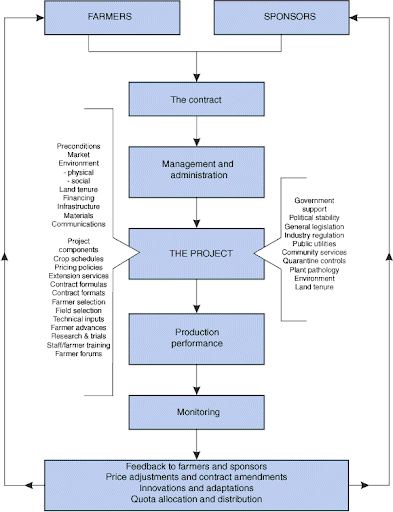
Contract Farming Framework
Regulations in India
- Contract farming is governed in India by the Indian Contract Act of 1872.
- Furthermore, the Model APMC (Agricultural Produce Market Committee) Act of 2003 includes contract farming-specific provisions such as mandatory registration of contract farming sponsors and dispute resolution.
- Contract farming is not uniform because agriculture is a state list subject.
- The NITI Aayog observed that market fees and other levies are paid to the APMC for contract framing even though they do not provide services such as market facilities or infrastructure.
- As a result, it has been suggested that contract farming be excluded from the purview of APMCs.
- To disengage contract farming stakeholders from the existing APMCs, an independent regulatory authority must be brought in.
- As a result, the Ministry of Agriculture issued a draft Model Contract Farming Act, 2018.
- The proposed Model Act aims to establish a regulatory and policy framework for contract farming.
- State legislatures can enact contract farming legislation based on this draft Model Act.
Model Contract Farming Act, 2018
- The Model Contract Farming Act of 2018 prioritises farmer protection.
- The Model Contract Farming Act of 2018 allows farmers and farmer producer organisations (FPOs) to connect directly with businesses, improving market linkage and reducing reliance on middlemen.
- The Act places a special emphasis on protecting farmers' interests, recognising them as the weaker of the two parties entering into a contract.
- Contract farming has been joined by service contracts throughout the value chain, including pre-production, production, and post-production.
- A "Registering and Agreement Recording Committee" or a "Officer" is appointed at the district/block/taluka level for the purpose of online sponsor registration and agreement recording.
- Crop and livestock insurance will cover contracted produce.
- Contract drafting will be exempt from the APMC Act.
- On farmers' land/premises, no permanent structure can be built.
- Farmer Producer Organizations (FPOs)/Farmer Producer Companies (FPCs) have been encouraged to mobilise small and marginal farmers.
- It guarantees the purchase of the entire pre-agreed-upon quantity of one or more agricultural produce, livestock, or its product from a contract farming producer.
- A Contract Farming Facilitation Group (CFFG) is being formed to promote contract farming and services at the village/panchayat level.
- For the quickest resolution of disputes, an accessible and simple dispute resolution mechanism at the lowest level possible is provided.
Contract Farming - Business Models
Informal Model
- This model is the most transient and speculative of all contract farming models, with both the promoter and the farmer at risk of default.
- However, this depends on the circumstances: contract interdependence or long-term trusting relationships may reduce the risk of opportunistic behaviour.
- This model has the following unique features:
- Small businesses enter into simple, informal seasonal production agreements with smallholders.
- The availability and quality of external extension services frequently determines success.
- If embedded services are provided at all, they are usually limited to the delivery of basic inputs on credit; advice is usually limited to grading and quality control.
- Typical products: Those that require minimal processing/packaging and vertical coordination, such as fresh fruits and vegetables for local markets, as well as staple crops.
Intermediary Model
- The buyer subcontracts an intermediary (collector, aggregator, or farmer organisation) who contracts farmers formally or informally in this model.
- This model has the following unique features:
- The intermediary sells the crop and provides embedded services.
- This model can work if it is well-designed, has adequate incentive structures, and has control mechanisms in place.
- This model may have drawbacks in terms of vertical coordination and providing incentives to farmers.
Multipartite Model
- This model can emerge from the centralised or nucleus estate models, for example, after the privatisation of parastatals.
- It involves a variety of organisations, including government statutory bodies, private companies, and, on occasion, financial institutions.
- Special features of Multipartite Model are:
- For processing, this model may include joint ventures of parastatals/community companies with domestic/foreign investors.
- The vertical coordination is at the firm's discretion. Political interference must be avoided at all costs.
- This model may also include a farm-firm arrangement supplemented by third-party service provider agreements (e.g. extension, training, credits, inputs, logistics).
- Separate organisations (such as cooperatives) may be formed to organise farmers and provide embedded services (e.g. credits, extension, marketing, sometimes also processing).
- This model may include producer equity share schemes.
Centralised Model
- In this model, buyers' involvement can range from minimal input provision (e.g., specific varieties) to complete control over all aspects of production (e.g. from land preparation to harvesting).
- This is the most common model, which is defined as follows:
- The buyer purchases goods from and provides services to a large number of small, medium, and large farmers.
- Farmers and contractors have a strictly vertically organised relationship/coordination.
- At the start of the season, the quantities (quota), qualities, and delivery conditions are determined.
- The processes and qualities of production and harvesting are strictly controlled, and are sometimes directly implemented by the buyer's staff.
- Typical products include sugar cane, tobacco, tea, coffee, cotton, tree crops, vegetables, dairy, and poultry in large quantities of uniform quality.
Nucleus Estate Model
- The buyer sources from both his or her own estates/plantations and from contracted farmers in the nucleus estate model.
- The estate system necessitates significant investments by the buyer in land, machinery, personnel, and management.
- This model has the following characteristics:
- The nucleus estate typically guarantees supplies to ensure cost-effective utilisation of installed processing capacity and to meet firm sales obligations.
- The nucleus estate is used for research, breeding, piloting, and demonstration purposes in some cases, and/or as a collection point in others.
- The farmers are sometimes referred to as satellite farmers, indicating their connection to the nucleus farm.
- In the past, this model was frequently used for state-owned farms that re-allocated land to former workers.
Contract Farming - Advantages
- Contract farming strengthens market connections and reduces reliance on middlemen.
- It integrates farmers with bulk purchasers such as exporters, agro-industries, and so on.
- Waste will be greatly reduced because the factories will be located near farm clusters.
- Improved price realisation by mitigating market and price risks for farmers. It makes technology, crop diversification, extension services, financing, and crop insurance more accessible.
- Farmers do not need to transport their produce to the mandis because sponsors usually pick it up at the farm gate. This lowers farmers' costs and, as a result, increases their income.
- It ensures consistent agro raw material supply to agro industries. Food processing will see an increase in employment.
- It encourages the next generation to farm instead of moving to cities.
- Instead of being employed as farm labourers, rural women will sort and grade fruits and vegetables.
- It also provides farmers with an alternative if the procurement mechanism is ineffective.
Contract Farming - Disadvantages
- Contract farming can be harmful because it encourages large monoculture farming.
- Farmers' reliance on companies for seeds and equipment must also be examined.
- Contracting firms can take advantage of the monopsony situation by offering farmers lower prices.
- In some areas, there is a high incidence of conflict between the farmer and the procuring entity over the quality/quantity of produce, as well as a high risk of post-harvest losses.
- Because agriculture reform is a state subject, it requires state cooperation to be implemented. Most of the time, these reforms fail due to political differences between the Centre and the States.
- Contract farming arrangements are frequently criticised for favouring firms or large farmers while exploiting small farmers' lack of bargaining power.
- Growers faced issues such as excessive quality cuts on produce by firms, delayed deliveries at the factory, delayed payments, low prices, and pest attack on the contract crop, which increased the cost of production.
- Contracting agreements are frequently verbal or informal in nature, and even written contracts do not always provide the legal protection found in other countries.
- Contracts can be breached by either party due to the inability of contractual provisions to be enforced.
Contract Farming - Recent Updates
- The Odisha government recently passed an ordinance allowing investors and farmers to enter into contract farming agreements.
- The ordinance is intended to make it easier for farmers and sponsors to develop mutually beneficial and efficient contract farming systems.
- It is also expected to improve agricultural produce and livestock production and marketing while promoting farmer interest.
- The contract farming producer will enter into an agreement with the contract farming sponsor (the one who offers to participate in any component) or the entire value chain, including pre-production (i.e. farmers who agree to produce the crop or rear the livestock).
- It also states that, notwithstanding anything else in the agreement, no title, rights, ownership, or possession of land, premises, or other such property will be transferred, alienated, or vest in the sponsor, its successor, or its agent.
- It also mentions the formation of a "Contract Farming and Services (Promotion and Facilitation) Committee" to evaluate contract farming performance and make recommendations to the government for its promotion and efficient performance.
Conclusion
Contract farming aims to provide farmers with alternative marketing channels and better price realisation. It is also important to remember that agriculture is a source of income for growers while it is a source of profit for processors and aggregators. As a result, the government should act as a facilitator in promoting and developing a healthy system of farmer-corporate relationships for mutual benefit and development of India's agriculture sector.
FAQs
Question: What is contract farming?
Answer: Contract farming is an agricultural production system where a farmer grows crops based on a pre-agreed contract with a buyer (typically a corporation, cooperative, or intermediary). The contract specifies the terms of production, pricing, and delivery of the agricultural produce.
Question: What are the advantages of contract farming for farmers?
Answer: Contract farming provides farmers with guaranteed markets for their produce, thus ensuring stable prices and reducing the risks associated with market fluctuations. It also enables access to high-quality seeds, technology, and financial assistance, promoting better agricultural practices and higher yields.
Question: How does contract farming benefit corporations?
Answer: Corporations benefit from contract farming by ensuring a steady supply of agricultural products that meet quality standards. This reduces procurement risks and enhances supply chain reliability, while also allowing companies to invest in technology and inputs, ensuring better production quality and efficiency.
Question: What are the challenges associated with contract farming?
Answer: Challenges include issues related to contract enforcement, exploitation of farmers due to imbalanced bargaining power, inadequate legal frameworks, and risks of low-quality products. There is also the risk of farmers being overly dependent on a single buyer, which can lead to vulnerabilities.
Question: How can contract farming be regulated to protect farmers?
Answer: To protect farmers, it is essential to have clear and enforceable contracts, transparent pricing policies, and legal safeguards. The government can play a role in setting fair terms, monitoring contracts, ensuring payment timely, and providing legal recourse for disputes between farmers and corporations.
MCQs
1. What is the primary benefit of contract farming for farmers?
A) Guaranteed market access
B) High prices for crops
C) Government subsidies
D) Freedom to choose buyers
Answer: (A) See the Explanation
Explanation: The primary benefit of contract farming for farmers is the guaranteed access to markets for their produce, which minimizes risks related to fluctuating market conditions and provides a stable income.
2. Who usually enters into a contract with farmers in contract farming?
A) Government agencies
B) Private corporations or cooperatives
C) Foreign countries
D) Local traders
Answer: (B) See the Explanation
Explanation: In contract farming, private corporations or cooperatives typically enter into agreements with farmers, ensuring that the produce is of specific quality and quantity.
3. What is a major risk associated with contract farming?
A) Guaranteed returns
B) Market access is limited
C) Risk of low-quality produce
D) Over-dependence on a single buyer
Answer: (D) See the Explanation
Explanation: A major risk of contract farming is that farmers can become overly dependent on a single buyer, which makes them vulnerable to price manipulation or delayed payments if the buyer is unable to fulfill the terms.
4. What is essential for effective contract farming?
A) High prices for crops
B) Government subsidies
C) Clear and enforceable contracts
D) Access to global markets
Answer: (C) See the Explanation
Explanation: Clear and enforceable contracts are essential for effective contract farming, as they protect both farmers and buyers from disputes, ensuring fair pricing, timely payments, and high-quality products.
5. What is one of the key regulatory requirements for contract farming?
A) Freedom of choice for farmers
B) Monitoring of contract fulfillment
C) Restricting competition
D) Global export standards
Answer: (B) See the Explanation
Explanation: One of the key regulatory requirements for contract farming is monitoring the fulfillment of contracts to ensure that the terms are followed and that farmers are paid fairly and on time.
GS Mains Questions and Model Answers
Q1: Discuss the role of contract farming in improving agricultural productivity and farmers' income in India. How can it be made more effective and farmer-friendly?
Answer: Contract farming can play a vital role in enhancing agricultural productivity and increasing farmers' income by providing them with guaranteed markets, access to better technology, and quality seeds. It can also lead to improved crop management practices. However, for it to be more effective and farmer-friendly, it is essential to establish clear and enforceable contracts, ensure fair pricing, and provide adequate legal protection to farmers. The government can support contract farming by offering subsidies on technology, ensuring dispute resolution mechanisms, and protecting farmers' rights from exploitation by corporations.
Q2: What are the advantages and disadvantages of contract farming in India? How can the legal framework be strengthened to protect farmers?
Answer: The advantages of contract farming include guaranteed market access, stable pricing, access to advanced farming technologies, and better crop management practices. However, it also has disadvantages such as the risk of exploitation due to power imbalances, a lack of legal safeguards, and the over-dependence of farmers on a single buyer. To protect farmers, the legal framework can be strengthened by ensuring that contracts are transparent, enforceable, and provide timely payments. Establishing clear guidelines for fair trade practices, monitoring contract terms, and offering dispute resolution mechanisms are crucial steps toward protecting farmers' interests.
Q3: Evaluate the impact of contract farming on the agricultural sector in India, considering both the challenges and opportunities it presents.
Answer: Contract farming has the potential to transform India's agricultural sector by introducing modern practices, improving crop yields, and reducing market uncertainties. It offers opportunities for farmers to increase income through reliable market access, better technology, and improved crop management practices. However, challenges such as unequal bargaining power, exploitation, and dependency on a single buyer exist. These challenges can be mitigated by implementing robust legal protections, promoting transparency in contracts, and ensuring that both parties benefit from the arrangement.
Previous Year Questions on Contract Farming
1. UPSC CSE Prelims 2020:
Question: What is the primary benefit of contract farming for farmers?
A) Guaranteed market access
B) High prices for crops
C) Government subsidies
D) Freedom to choose buyers
Answer: (A)
Explanation: The primary benefit of contract farming for farmers is the guaranteed access to markets for their produce, which minimizes risks related to fluctuating market conditions and provides a stable income.
2. UPSC CSE Mains 2021 (GS Paper 2):
Question: "Assess the role of contract farming in improving agricultural productivity in India. Discuss the challenges faced by farmers and suggest measures to address them."
Answer: Contract farming has the potential to improve agricultural productivity by providing access to modern farming technologies, guaranteed markets, and stable prices. However, challenges such as exploitation by corporations, lack of legal safeguards, and farmers' dependency on a single buyer can limit its effectiveness. To address these challenges, the government must implement policies ensuring transparent contracts, enforceable terms, and timely payments. Strengthening the legal framework and promoting fair trade practices are essential to protect the interests of farmers while enhancing the benefits of contract farming.
Download the PREPP App and attempt FREE IAS Exam Mock Tests and get complete study material!

Full Test - 04: UPSC CSE Prelims CSAT (Paper-II)
Full Test - 03: UPSC CSE Prelims CSAT (Paper-II)
UPSC CSE Prelims 2026 GS Paper 1 Question Paper (24-May-2026)
UPSC CSE Prelims 2026 CSAT Paper 2 Question Paper (24-May-2026)

17 February 2025 | The Hindu Must Read Articles | Current Affairs

16 February 2026 | The Hindu Must Read Articles | Current Affairs

13 February 2026 | The Hindu Must Read Articles | Current Affairs









Comments