Role of Food Corporation of India - Agriculture Notes
The Food Corporation of India is one of the largest corporations established by the Indian government and likely one of the largest supply chain management organisations in India. Its headquarters were relocated from Chennai to New Delhi. The FCI purchases approximately 15 to 20% of India's wheat output, as well as 12 to 15% of total rice output. Purchases are made in accordance with the Minimum Support Price, and no procurement restrictions apply as long as the criteria for Fair Average Quality are met. This article will explain to you about the Role of Food Corporation of India which will be helpful in preparing the Agriculture Syllabus for the UPSC Civil Service exam.
What is the Food Corporation of India?
- The Food Corporation of India (FCI) is a Public Sector Undertaking that reports to the Ministry of Consumer Affairs, Food and Public Distribution.
- The Food Corporations Act of 1964 established the FCI as a statutory body in 1965.
- It was founded against the backdrop of a severe grain shortage, particularly wheat.
- Its primary responsibility is to buy, store, move/transport, distribute, and sell food grains and other foodstuffs.
- FCI coordinates its functions through a nationwide network of offices, with headquarters in New Delhi and five Zonal Offices, twenty-five Regional Offices, and 170 District Offices under its command.
- Concurrently, the Commission for Agricultural Costs and Prices (CACP) was established in 1965 to recommend fair prices to farmers.
Food Corporation of India - Vision & Mission
- Vision: FCI's vision is to ensure food security for all citizens of the country.
- Mission: Following are the missions of FCI:
- Efficient procurement, storage, and distribution of food grains at the Minimum Support Price (MSP).
- Ensure the availability of food grains and sugar through appropriate policy instruments, including the maintenance of food grain buffer stocks.
- Making food grains affordable, particularly to the poor and vulnerable sections of society, through the PDS.
Food Corporation of India - Objectives & Goals
The Food Corporation of India was established under the Food Corporation Act 1964 to achieve the following Food Policy objectives:
- Price support operations that are effective in protecting farmers' interests.
- Food grain distribution throughout the country for the public distribution system.
- Maintaining a sufficient level of operational and buffer food grain stocks to ensure national food security.
FCI's goals are as follows:
- To provide farmers with fair prices.
- Making food grains affordable, especially to the most vulnerable members of society.
- Keeping buffer stocks as a measure of food security.
- To intervene in the market in order to stabilize prices.
Food Corporation of India - Organisational Structure
- The Food Corporation of India is led by a Chairman and operates through a network of depots spread throughout the country.
- The managers oversee various departments such as sales, contracts, procurement, quality control, operations accounting, and so on.
- The FCI is divided into the five zones listed below:
- North
- South
- East
- West
- North-East
- They all have their own zonal offices. Under the Zonal offices are the regional offices.
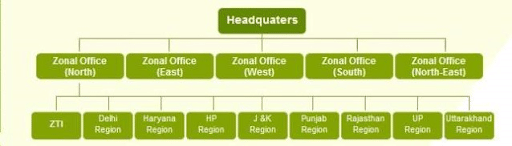
Organisational Structure
Role of Food Corporation of India
- FCI plays a critical role in ensuring food security.
- It entails maintaining a reasonable price to ensure that people of all income levels can buy them, as well as purchasing grains from farmers who have a surplus at a standardised price to avoid mismanagement.
- During its first decade, the FCI was at the forefront of India's quest for rice and wheat self-sufficiency following the Green Revolution, managing grain procurement and stocking to support a vast Public Distribution System (PDS).
- It has played an important role in India's food security since the Food Security Act was passed.
- The main functions of FCI are effective price support operations to protect farmers' interests by providing remunerative prices for their food grains and distribution of food grains throughout the country via the Public Distribution System.
- To contribute to the transformation of crisis-oriented food security into a stable security system that ensures the availability, accessibility, and affordability of food grains to all people at all times, so that no one, nowhere, and at no time goes hungry.
- Ensure national food security by maintaining adequate operational buffer stocks of food grains.
- Food grain distribution throughout the country for the Public Distribution System.
- Effective Price Support Operations to protect farmers' interests.
Functions of Food Corporation of India
Procurement
- Through the FCI and State Agencies, the Central Government provides price support for the procurement of wheat, paddy, and coarse grains.
- All food grains that meet the prescribed specifications are purchased by public procurement agencies at the Minimum Support Price (MSP) plus any announced incentive bonus.
- Procurement is done both directly and indirectly.
- Food grains are procured and distributed by the state governments themselves under the Decentralised Procurement Scheme (DCP), which was implemented in 1997-98.
- The designated states procure, store, and distribute food grains through the Targeted Public Distribution System (TPDS) and other government welfare programs.
- The decentralized procurement system was implemented to improve the efficiency of PDS procurement, encourage procurement in non-traditional states, and save money on transit losses and costs.
- Each procurement season, the Central Government announces uniform specifications for the quality of wheat, paddy, rice, and coarse grains.
- The FCI Quality Control Division ensures that food grains are procured from procurement centers in strict accordance with the uniform quality specifications of the Government of India.
- FCI has also been designated as an additional procurement nodal agency for pulses and oilseeds.
Distribution
- FCI meets the requirements of TPDS by procuring grains that are issued at the Central Issue Price set by the government in order to help the economically vulnerable sections of society.
- FCI delivers food grains to state governments and agencies from its base depots for distribution through Fair Price Shops.
- The role of FCI becomes even more important in the context of the National Food Security Act of 2013, which commits to distributing grains at highly subsidised prices through TPDS and other welfare schemes.
Public Distribution System
- During the interwar period, India had a public distribution of essential commodities.
- However, PDS, with its emphasis on food grain distribution in urban scarcity areas, arose from the 1960s' critical food shortages.
- PDS had made a significant contribution to containing the rise in food grain prices and ensuring food access for urban consumers.
- As national agricultural production increased in the aftermath of the Green Revolution, PDS outreach was expanded to tribal blocks and high-poverty areas in the 1970s and 1980s.
- PDS is supplemental in nature and is not intended to meet a household's or a section of society's entire requirement for any of the commodities distributed under it.
- The PDS is managed jointly by the Central and State Governments. The Central Government, through FCI, has assumed responsibility for food grain procurement, storage, transportation, and bulk allocation to state governments.
- The operational responsibilities of the State Governments include allocation within the State, identification of eligible families, issuance of Ration Cards, and supervision of the operation of Fair Price Shops, among other things.
- Currently, commodities such as wheat, rice, sugar, and kerosene are allocated to states/UTs for distribution under the PDS.
- Some states/UTs also distribute additional mass-consumption items through PDS outlets, such as pulses, edible oils, iodized salt, spices, and so on.
Revamped Public Distribution System
- The Revamped Public Distribution System (RPDS) was launched in June 1992 with the goal of strengthening and streamlining the PDS as well as improving its reach in remote, hilly, and inaccessible areas where a significant portion of the poor life.
- It covered 1775 blocks where area-specific programs such as the Drought Prone Area Programme (DPAP), Integrated Tribal Development Projects (ITDP), Desert Development Programme (DDP), and certain Designated Hill Areas (DHA) were identified for special focus in consultation with State Governments.
Targeted Public Distribution System
- Following the failure of the previous PDS system, the Targeted Public Distribution System (TPDS) was launched in 1997 to benefit the poor and keep budgetary food subsidies under control to the desired extent.
- The transition from universal PDS to TPDS was conceptually sound, as it was intended to include all poor households and significantly increase the unit subsidy and ration quota for them.
- The TPDS aims to provide food grains to people living below the poverty line at heavily subsidized PDS prices and food grains to people living above the poverty line at significantly higher prices than the poverty line.
- Thus, the TPDS adopted by the Government of India retains the universal character of the PDS while focusing specifically on people living below the poverty line.
- The National Food Security Act, 2013 (NFSA) has been notified, providing for all-India coverage of up to 75% of the rural population and 50% of the urban population to receive highly subsidised foodgrains.
Achievements of FCI
- During the COVID-19 lockdown, the Food Corporation of India (FCI) supplied around 126 lakh tonnes of food grains to states and union territories, roughly equivalent to two and a half months' supply in normal circumstances.
- The record supply is due to the PM Garib Kalyan Anna Yojana.
- Enough food grain stocks have been placed across the country to meet the demands of state governments for feeding those affected by COVID-19.
- Far from not having a "proactive liquidation" policy for its stock, it has made room for the public procurement of a bumper rabi crop that was facing storage shortages and wastage.
- To facilitate cooked food distribution at privately run relief camps during the COVID-19 crisis, the Food Ministry has allowed non-governmental organizations (NGOs) and charitable organizations to buy wheat and rice directly from the Food Corporation of India at Open Market Sale Scheme rates without going through the e-auction process.
- These charitable organizations can buy 1 to 10 metric tonnes at a time at predetermined reserve prices and transport the grains from FCI's 2,000-plus godowns across the country.
- The FCI is working around the clock to ensure that food grains are available.
- Recognizing this, it has been decided to provide Jeevan Bima Suraksha (life insurance coverage) to over one lakh FCI officials, including 80,000 laborers, who are working in the midst of the COVID-19 crisis.
Food Corporation of India - Challenges
- Though the FCI has an existing transportation system, it is heavily reliant on the rail route. However, rail transport is unsuitable in times of crisis when food must be delivered to the most remote areas.
- Although containerized transportation is the most cost-effective mode of transportation, it is not the FCI's primary mode of transportation.
- In desperation, the farmers are reaching out to their customers directly. Farmer producer organisations (FPOs) are attempting to repair a shattered supply chain.
- The FCI has not been able to establish a useful relationship with these FPOs.
- Distributional inefficiency and waste in storage and transportation are also issues.
- The FCI is deeply in debt, totaling 2.25 lakh crores in National Small Saving Funds Loans alone.
- The government has not been liquidating these in order to reduce the fiscal deficit. This may impede the FCI's effective engagement.
- Subsidized food distribution over an extended period of time can depress food grain prices in the country, which is detrimental to farmers.
- There is an issue with the massive subsidy bill.
Way Forward for FCI
- Containerized road transport must be used to provide effective and timely transportation to needy and remote hotspot areas.
- The tried-and-true pre-positioning strategy, in which grain is stored in demand hotspots, must be used.
- It has been used in international food aid programs by the United States.
- Block headquarters and Panchayats can serve as storage facilities.
- Beyond the PDS and the PM Garib Kalyan Anna Yojana, the government should look to existing networks such as Farmer Producer Organisations and rural self-help groups under the National Rural Livelihood Mission (NRLM) for last-mile distribution in needy areas.
- When distributing food grains, care should be taken to ensure that the burden does not fall on already burdened states.
- States that are already financially strapped may be unable to increase storage capacity or arrange additional manpower for their Targeted PDS.
- The NRLM SHG cadre and FPOs are ready manpower that the central government can directly assist.
- Though the First-in-First-Out (FIFO) principle is a necessary principle in general because it allows for the liquidation of old stocks first, it is advisable to set it aside temporarily in times of crisis such as COVID-19 because it allows for the cost-effective and less time-consuming movement of food grains.
- The need of the hour is to provide food to people who have returned to their home states and have no other means of subsistence during the lockdown.
- The elimination of FIFO will aid in the reduction of operational time and costs.
- It is especially important when critics complain that FCI is not moving quickly enough.
- Like NAFED, which has already begun procuring and transporting horticulture crops to assist FPOs, the FCI should look to assist FPOs and farmer groups in moving a variety of inputs such as fertilisers, seeds, and other agricultural inputs.
FCI - Recent Updates
- Due to the FCI's many shortcomings, a High-Level Committee (HLC) chaired by Shanta Kumar made several recommendations on how the corporation could be restructured based on procurement, storage, and distribution factors.
- These are the recommendation:
- Procurement
- System of negotiating warehouse receipts
- MSP Policy Revision
- Procurement: The committee recommended that all FCI procurements be handed over to states that have gained experience in this area and built the necessary infrastructure.
- System of negotiating warehouse receipts: A warehouse receipt system should be negotiated so that farmers can deposit their produce at registered warehouses. They can then sell it at a profit while also saving the government money on storage.
- MSP Policy Revision: The HLC recommends that pulses and oilseeds be included in the MSP category.
- Currently, MSPs for 23 commodities have been announced, with wheat and rice receiving priority, but the MSPs are only applicable in a few states.
- The current system creates a lopsided price structure that benefits wheat and rice.
- HLC recommended that the government reconsider the NFSA coverage (67% of the population) because it is on the 'higher' side.
In Union Budget
- The food subsidy allocated to the Food Corporation of India in the Union Budget 2021 was proposed to be revised to Rs 3,44,077 crore from the original subsidy amount of Rs 77,983 crore allocated in the Union Budget 2020.
- The revised allocation resulted from the government's decision to pay off the FCI's rising loans and return to budgetary transfers to fund the food subsidy bill.
Conclusion
The Food Corporation of India is one of the largest corporations established by the Indian government and is most likely one of India's largest supply chain management organizations. FCI has played a significant role in India's success in transforming crisis-oriented food security into a stable security system during its 50 years of service to the nation. It entails maintaining a reasonable price to ensure that people of all income levels can buy them, as well as purchasing grains at a standardized price from farmers who have a surplus to avoid mismanagement.
FAQs
Question: What is the Food Corporation of India (FCI)?
Answer: The Food Corporation of India (FCI) is a statutory body established under the Food Corporation Act of 1964. It plays a vital role in India's food security system by ensuring the procurement, storage, and distribution of food grains. The FCI aims to safeguard the interests of farmers, maintain price stability, and provide food to the public at reasonable prices through its public distribution system.
Question: What are the key functions of the FCI?
Answer: The key functions of the FCI include: (1) Procurement of food grains at minimum support prices (MSP) from farmers, (2) Storage and management of food stocks, (3) Distribution of food grains through the public distribution system (PDS), (4) Implementing government food policies and programs, and (5) Ensuring food security by maintaining buffer stocks to meet unforeseen shortages.
Question: How does the FCI contribute to food security in India?
Answer: The FCI contributes to food security in India by procuring surplus food grains, thus ensuring that farmers receive fair compensation. It maintains strategic reserves to counter food shortages during emergencies, thereby stabilizing market prices. Through the public distribution system, the FCI facilitates the distribution of essential food items to economically weaker sections, ensuring access to food and improving nutritional security.
Question: What challenges does the FCI face in its operations?
Answer: The FCI faces several challenges, including inefficient storage facilities leading to food wastage, logistical issues in the distribution network, and fluctuations in procurement prices. Additionally, corruption and leakages in the public distribution system hinder its effectiveness. The organization also needs to adapt to changing agricultural policies and climate conditions that affect food production.
Question: What reforms have been suggested for improving the functioning of the FCI?
Answer: Suggested reforms for improving the FCI include modernizing storage facilities to reduce wastage, enhancing transparency and accountability in procurement and distribution processes, and integrating technology for better supply chain management. Strengthening the public distribution system by targeting beneficiaries more effectively and increasing the role of private players in food procurement and distribution are also key recommendations for reform.
MCQs
1. When was the Food Corporation of India (FCI) established?
A. 1960
B. 1964
C. 1970
D. 1980
Answer: (B) See the Explanation
The Food Corporation of India (FCI) was established in 1964 to ensure the procurement, storage, and distribution of food grains in the country.
2. Which of the following is NOT a function of the FCI?
A. Procurement of food grains
B. Regulation of market prices
C. Storage of food grains
D. Distribution through PDS
Answer: (B) See the Explanation
Regulation of market prices is not a direct function of the FCI. While the FCI plays a role in stabilizing prices through procurement and distribution, it does not regulate market prices.
3. Which scheme is primarily implemented by the FCI for food distribution?
A. Pradhan Mantri Kisan Samman Nidhi
B. Mid-Day Meal Scheme
C. Public Distribution System
D. National Food Security Mission
Answer: (C) See the Explanation
The Public Distribution System (PDS) is primarily implemented by the FCI for the distribution of food grains to the economically weaker sections of society.
4. What is the primary objective of the FCI?
A. To promote agriculture
B. To ensure food security
C. To regulate food prices
D. To manage exports
Answer: (B) See the Explanation
The primary objective of the FCI is to ensure food security by procuring and distributing food grains to meet the needs of the population.
5. What are buffer stocks maintained by the FCI used for?
A. Export of food grains
B. To control inflation
C. To meet emergencies
D. All of the above
Answer: (C) See the Explanation
Buffer stocks maintained by the FCI are primarily used to meet emergencies such as natural disasters, shortages, or any unforeseen crises that could disrupt the food supply.
GS Mains Questions and Model Answers
1. Assess the role of the Food Corporation of India in achieving food security in the country.
Answer: The Food Corporation of India (FCI) plays a crucial role in achieving food security in India by ensuring the procurement, storage, and distribution of food grains. Through its procurement policies, the FCI provides guaranteed prices to farmers, thus incentivizing food production. By maintaining buffer stocks, the FCI safeguards against shortages and stabilizes prices during lean seasons. The implementation of the Public Distribution System (PDS) allows the FCI to deliver food grains to the economically disadvantaged sections, thereby promoting nutritional security. Overall, the FCI's operations are vital in securing food availability and accessibility, addressing the challenges posed by hunger and malnutrition in India.
2. Discuss the challenges faced by the FCI in its operations and the measures that can be taken to overcome them.
Answer: The FCI faces several challenges, including inefficiencies in storage leading to significant food wastage, logistical issues in the distribution network, and corruption in the public distribution system. To overcome these challenges, the FCI can modernize its storage facilities with advanced technologies to reduce wastage. Implementing a more efficient supply chain management system, coupled with transparency measures, can help in tackling corruption. Additionally, enhancing community participation in food distribution can ensure that benefits reach the intended beneficiaries, thereby improving the overall effectiveness of the FCI.
3. Evaluate the significance of the FCI in the context of agricultural policy in India.
Answer: The FCI is integral to India's agricultural policy as it directly influences the dynamics of food production and farmer welfare. By guaranteeing minimum support prices (MSP) for food grains, the FCI incentivizes farmers to produce surplus crops, contributing to national food security. The agency's role in stabilizing market prices through procurement and strategic reserves aids in mitigating the risks faced by farmers due to market fluctuations. Furthermore, the FCI's operations align with the government's objectives of promoting sustainable agriculture and ensuring equitable food distribution, making it a key player in shaping agricultural policies and practices in India.
Previous Year Questions on Food Corporation of India
1. UPSC CSE Prelims 2017
Question: What is the primary function of the Food Corporation of India?
A. Regulation of agricultural prices
B. Procurement and distribution of food grains
C. Import of food grains
D. Providing loans to farmers
Answer: B
Explanation: The primary function of the Food Corporation of India is the procurement and distribution of food grains to ensure food security and support farmers.
2. UPSC CSE Mains 2020 (GS Paper 3)
Question: "The role of the Food Corporation of India is pivotal in ensuring food security." Discuss this statement, highlighting its functions and challenges.
Answer: The Food Corporation of India plays a pivotal role in ensuring food security by implementing procurement policies, maintaining buffer stocks, and facilitating the distribution of food grains through the Public Distribution System. Its functions directly support farmers by providing them with guaranteed prices and stabilizing market fluctuations. However, challenges such as food wastage due to inadequate storage, corruption in the distribution system, and logistical inefficiencies persist. Addressing these challenges is essential for enhancing the effectiveness of the FCI in fulfilling its mandate and achieving comprehensive food security in India.
Download the PREPP App and attempt FREE IAS Exam Mock Tests and get complete study material!

Full Test - 04: UPSC CSE Prelims CSAT (Paper-II)
Full Test - 03: UPSC CSE Prelims CSAT (Paper-II)
UPSC CSE Prelims 2026 GS Paper 1 Question Paper (24-May-2026)
UPSC CSE Prelims 2026 CSAT Paper 2 Question Paper (24-May-2026)

17 February 2025 | The Hindu Must Read Articles | Current Affairs

16 February 2026 | The Hindu Must Read Articles | Current Affairs

13 February 2026 | The Hindu Must Read Articles | Current Affairs









Comments