Fertiliser Subsidy - Agriculture Notes
Fertiliser is described as any organic or inorganic, natural or manufactured material that supplies one or more of the chemical elements/nutrients essential for plant development. The difference between the holding price of fertilisers and the price at which fertilisers are made accessible to customers is referred to as fertiliser subsidy. Fertilisers are made inexpensive to farmers in order to encourage balanced nutrient application and support agricultural development. This article will explain to you about the Fertiliser subsidy which will be helpful in preparing the Agriculture Syllabus for the UPSC Civil Service exam.
What is Fertilizer Subsidy?
- A subsidy enables an individual to purchase a product or use a service at a lower cost than the market price.
- In order to assist the weaker sectors of the population, the Indian government has provided a variety of price subsidies on kerosene, cooking gas, water, power, fertiliser, and other commodities.
- Fertilizer use in India has increased dramatically since the Green Revolution (mid-1960s).
- To encourage and facilitate the use of fertilisers, the government has provided farmers with fertiliser subsidies.
- It has evolved into a critical component of agricultural input support.
- Some of the important types of fertilizers include:
- Nitrogenous (Urea, Ammonium Nitrate, Ammonium Sulphate)
- Potassic (Potassium Nitrate, Chile Saltpetre)
- Phosphatic (Super Phosphate, Triple Phosphate)
Fertilizer Subsidy in India
- Subsidies are now granted to fertiliser firms based on the receipt of fertiliser at recognised godowns in districts.
- Fertiliser subsidies would be distributed to manufacturers based on actual sales.
- Farmers purchase fertilisers at MRP that is lower than their regular supply-and-demand market rates or the cost to produce/import them.
- The government sets the MRP of neem-coated urea at Rs 5,922.22 per tonne, but the average cost-plus price charged to local producers and imports is roughly Rs 17,000 and Rs 23,000 per tonne, respectively.
- The difference, which varies according to plant and import price, is borne by the Centre as a subsidy.
- Non-urea fertiliser MRPs are decontrolled or fixed by the firms.
- The Centre, on the other hand, pays a fixed per-tonne subsidy to guarantee that these nutrients are priced at "appropriate levels."
- Decontrolled fertilisers thus retail far above urea while attracting lower subsidies.
Mechanism of Subsidies in India
- From March 2018, a new direct benefit transfer (DBT) system was implemented, under which subsidy payments to corporations would be made only when shops made actual purchases to farmers.
- Each store has a point-of-sale (PoS) machine that is linked to the Fertilisers Department's e-Urvarak DBT site.
- Anyone purchasing subsidised fertiliser must provide their Aadhaar or Kisan Credit Card (KCC) number.
- Only until the sale is registered on the e-Urvarak platform can a firm claim a subsidy, which is processed weekly and paid electronically to its bank account.
- The New Urea Policy-2015 was announced with several goals in mind, including increasing indigenous urea production, promoting energy efficiency, and reducing subsidy burden.
- The government is implementing the Nutrient Based Subsidy (NBS) scheme for P (phosphate) and K (potash) fertilisers, which provides a fixed amount of subsidy based on their content.
Fertiliser Association of India (FAI)
- The Fertiliser Association of India (FAI) is a non-profit, non-trading organisation that primarily represents fertiliser manufacturers, distributors, importers, equipment makers, research organisations, and input suppliers.
- The Association was founded in 1955 with the goal of bringing together all parties involved in the manufacturing, marketing, and usage of fertilisers in order to:
- Assist the industry in increasing operational efficiency.
- Find answers to the difficulties that the fertiliser business and agriculture are experiencing.
- Encourage the application of fertiliser in a balanced and effective manner.
- Encourage the consumption of more and higher-quality plant foods.
- Encourage the examination and debate of all issues that contribute to good farming practices.
- According to FAI, the nitrogen:phosphorus:potassium ratio in 2011-2012 was 8.2:3.2:1, compared to an optimum 4:2:1.
Connecting Subsidies Directly with Farmers
- The first step toward a successful fertiliser subsidy transfer would be to compile a list of eligible farmers, including tenant farmers (who farmland owned by others, paying rent with cash or with a portion of the produce).
- Existing databases, such as the PM Kisan list (which contains enrolled farmers in India's PM Kisan cash transfer system), might serve as a starting point.
- The next stage would be to calculate how much subsidy each recipient is entitled to, based on their land holdings, geo-climatic conditions, crop varieties, soil health status, and other factors.
- An option may be to credit farmers' bank accounts. Farmers may then purchase fertiliser from shops at market prices.
Fertilizer Policies in India
- The Union Government controls the fertiliser industry (which is listed in the First Schedule of Industries (Development and Regulation) Act, 1951 at Entry 52 of List I and Entry 33 of List III). The sector is dominated by urea.
- The major (macro) nutrients have been the primary focus of fertiliser policy.
- The Government of India has regulated the sale, pricing, and quality of fertilisers since independence.
- Fertilisers have been designated as a critical commodity by the Government of India.
- Under the Essential Commodities Act of 1957, the GoI issued the Fertiliser Control Order (FCO).
- Except for potash, which received a one-year subsidy in 1977, no subsidies were given on fertilisers until 1977.
- In 1977, the Retention Pricing Scheme (RPS) was implemented for nitrogenous fertilisers. It was later expanded to include phosphatic and potassium fertilisers (Including Imported fertilisers).
- The difference between the retention price (as determined by the government plus a 12% post-tax return on net value) and the statutorily announced selling price was paid to each industrial unit as a subsidy.
- This marked the start of the "Product-based subsidy" system.
Nutrient Based Subsidy (NBS) Policy, 2010
- The government determines the subsidy on a yearly basis depending on the weight of the various macro/micronutrients (N, P, K, S, and so on) in the fertiliser.
- Manufacturers/Marketers are permitted to set a reasonable Maximum Retail Price (MRP).
- The plan seeks to guarantee that a sufficient supply of P&K is available to farmers at legally fixed costs in order to support agricultural development and ensure balanced nutrient application to the soil.
- It seeks to ensure fertiliser balance, improve agricultural production, promote the expansion of the indigenous fertiliser sector, and reduce the subsidy burden.
- The Nutrient Based Subsidy Scheme was adopted with the intention that it will encourage balanced soil fertilisation, resulting in higher agricultural output and, as a result, better returns to farmers.
- The plan provides a defined amount of subsidy on each grade of subsidised Phosphatic and Potassic (P&K) fertilisers, excluding Urea, based on the nutrient level contained in them.
- The plan is managed by the Department of Fertilisers, which is part of the Ministry of Chemicals and Fertilisers.
- In a recent development, the Cabinet Committee on Economic Affairs accepted the Department of Fertilisers' proposal to extend the Nutrient Based Subsidy (NBS) until 2019-20.
Neem Coated Urea Policy, 2015
- The government has mandated that domestic fertiliser companies "Neem coat" at least 75% of their urea production. Previously, there was a 35% restriction on this.
- The government has also permitted firms to charge a 5% extra for Neem-coated urea.
- This is done to control the overuse of urea, which is harming soil health and reducing total agricultural production.
- It will increase indigenous urea production and encourage energy efficiency in urea facilities.
- It will reduce the subsidy outgo, hence reducing the government's subsidy burden.
- It will prevent urea from being diverted for industrial usage.
New Urea Policy, 2015
- To encourage domestic producers and provide free transportation of P (phosphorus) and K (potassium) fertilisers. It is in effect from 2015 until 2019.
- India is the world's third-largest fertiliser user.
- In the case of urea, India is heavily reliant on imports. India now imports around 80 lakh metric tonnes of urea out of a total demand of 310 lakh metric tonnes.
- It's objectives include:
- To increase indigenous urea production to minimise import reliance and the government's subsidy burden.
- Encourage energy efficiency in order to lower carbon footprint (through energy efficiency) and make urea manufacturing more environmentally friendly.
- Make the urea production facility employ the finest available technologies in order to become internationally competitive.
- Subsidy burden rationalisation.
- Timely delivery of urea to farmers at the same MRP.
- The government would pay for the whole cost of natural gas, which is the primary fuel for urea production.
- The movement plan for P&K fertilisers has also been released in order to decrease the monopoly of a few firms in a particular area, allowing any company to sell any P&K fertilisers in any part of the country.
- Rail freight subsidies will be granted in one single payment to help enterprises save money on transportation.
- This will benefit farmers while also relieving congestion on the railway network.
One Nation One Fertiliser
- To ensure uniformity in fertiliser brands across the country, the government issued an order requiring all enterprises to sell their goods under the 'Bharat' brand name.
- Regardless of the manufacturer, all fertiliser bags containing urea, di-ammonium phosphate (DAP), muriate of potash (MOP), or NPK shall have the brand names 'Bharat Urea,' 'Bharat DAP,' 'Bharat MOP,' and 'Bharat NPK'.
- The bag must bear a single brand name and the Pradhan Mantri Bhartiya Janurvarak Pariyojana (PMBJP) emblem.
- The central government provides subsidies to fertiliser firms and the PMBJP on a yearly basis.
- The government now sets the maximum retail price of urea, which compensates enterprises for greater manufacturing or import costs.
- Companies cannot get subsidies if they sell at prices greater than those set by the government.
- The government also decides where they can sell fertiliser under the Fertiliser (Movement) Control Order, 1973.
- When the government spends large sums of money on fertiliser subsidies, choosing where and at what price enterprises may sell, they want to take credit and send a message to farmers.
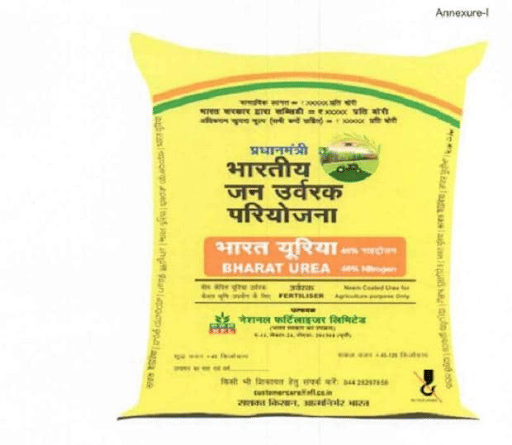
Bharat Urea
Subsidising Fertiliser Use in India - Challenges
- After China, India is the world's second-largest fertiliser consumer.
- Fertiliser subsidies were established more than 40 years ago to make fertilisers more cheap to farmers and, eventually, to secure the country's food security.
- Rising fertiliser subsidy bills (estimated at 80,000 crores in 2019-20, up from around 70,000 crores in 2018-19) have been a major source of concern in the country's fiscal management.
- It was Rs. 1,62,132 crore in 2021-22.
- After food, fertiliser is the country's second-largest subsidy expenditure.
- However, this rise in spending has not necessarily helped farmers. According to official data, an estimated 65% of fertiliser generated does not reach its intended recipients, namely small and marginal farms.
- Excessive reliance on urea as a result of low/distorted fertiliser prices, particularly urea, and regional imbalance in use
- Compost, manure, and other natural nutrient providers are neglected or underutilised.
- Inter and rotational cropping practises are being phased out.
- Use of subsidised fertilisers for non-agricultural purposes.
- The indiscriminate use of fertilisers has not increased crop yield proportionally, but has resulted in soil depletion and salination in many areas.
- There are no limitations on who or how much of the subsidised fertiliser may be purchased.
- This has resulted in the misuse of fertilisers in agriculture, as well as the diversion of urea to other industries (such as dairy, textile, paint, and fisheries) and neighbouring countries such as Bangladesh and Nepal (through organised black market players who buy it in the guise of farmers and sell it for a profit).
Concerns of Farmers
- In India, 65% of farmers do not wish to receive their subsidies via bank transfer.
- This is most likely due to failures with similar initiatives in former years, such as when they were intended to get bank transfers in place of a liquefied petroleum gas subsidy.
- They either never received the money or it was delayed, and they are concerned that the fertiliser subsidy will be the same.
- Another issue is that if the subsidy amount is not received on time, their financial burden will be increased. They would have to pay expensive, non-subsidized costs for the fertiliser and may have to borrow money to do so.
- Farmers currently pay Rs 295-325 per bag of urea, but the non-subsidized price is between Rs 950-1,100. Paying Rs 1,100 per bag up ahead would be too expensive for many of India's small farmers.
- Farmers would have to make many visits to banking locations to withdraw cash, followed by another trip to the fertiliser merchant. Farmers incur opportunity expenses as a result of these excursions.
Steps Taken to Overcome the Challenges
- The Indian government used the Mobile Fertiliser Management System to digitise the fertiliser distribution supply chain.
- Its most major move came in 2016, when it trialled a Direct Benefit Transfer (DBT) method to pay the subsidies.
- Manufacturers are paid only when the retailer sells the fertiliser to "authenticated" persons under the new DBT system.
- That implies the customer is obliged to confirm his identification at the time of purchasing the fertiliser.
- The purchaser must additionally provide his fingerprints on a Point of Sale machine owned by the store.
- The merchant sells the fertiliser at the subsidised price after the Point of Transaction machine validates the buyer's identification, the sale is registered in the fertiliser management system, and the proportionate subsidy is sent to the manufacturer.
- The most significant advantage of the DBT system is that it allows the government to know who is purchasing fertiliser for the first time.
- However, it is vital to highlight that the system does not check if the buyer is a farmer because there is no farmer database in India.
- Despite these flaws, the DBT system has had an impact, particularly in terms of enhancing openness.
- There is room for improvement, and the government is already talking about transitioning to a different system, one in which the subsidy is credited directly to farmers' bank accounts.
- However, adopting this strategy for fertiliser subsidies is more difficult, partially because the government lacks a list of recipients (i.e., database of farmers).
- Until the government can iron out all of the kinks in the bank transfer model, an alternate model for subsidy distribution is possible: establishing a virtual account for farmers.
- This would not be a bank account, but rather a computerised record of how much fertiliser a farmer is entitled to, how much he has used, and how much is left.
Virtual Account
|
Improvements Required in Fertilizer Sector
- Crop-responsive and balanced fertiliser use: It is necessary to facilitate the optimal use of fertilisers based on soil health and fertility status.
- Linking the soil health card to provide a profile of the soil and fertiliser on the basis of the same profile (even if not subsidised) can improve crop yield.
- Micronutrients and organic fertilisers: Most Indian soils are deficient in micronutrients (such as boron, zinc, copper, and iron), limiting crop yields and productivity.
- Fertilisers that supplement micronutrients can provide an additional yield of 0.3 to 0.6 tonne per hectare in cereals. This deficiency can be overcome by increasing the use of organic fertiliser.
- Furthermore, because organic composting and manure are less expensive, they can help improve and retain soil fertility.
- Nutrient Management: To maintain soil health and productivity, judicious use of chemical fertilisers, bio-fertilizers, and locally available organic manures such as farmyard manure, compost, vermi-compost, and green manure is required based on soil testing.
- With over 12 crore farm holdings in India, providing soil-testing facilities to overcome multi-nutrient deficiencies in soils and improve agricultural output is a major challenge.
- The use of information technology and the distribution of soil fertility maps to farmers can go a long way toward nutrient efficiency.
- Regional disparities in fertiliser consumption: Fertilizer consumption varies greatly across India. This could be attributed to the availability of irrigation facilities in high-consuming states (since irrigation is required for proper fertiliser absorption).
- Disparities must be reduced through appropriate soil-testing facilities and other policy measures.
Recent Updates
- A committee led by the Prime Minister has decided to enhance the subsidy on DAP (Diammonium Phosphate) fertiliser. The subsidy has been increased by 140%, from Rs 500 to Rs 1200 per bag.
- DAP was priced at 1700 till last year. Farmers received one bag for 1200 rupees, and businesses received a 500 rupee subsidy.
- The worldwide costs of phosphoric acid, ammonia, and other ingredients used in DAP have risen.
- To dissuade enterprises from selling DAP for 1900 rupees, the government increased the subsidy.
DAP (Diammonium Phosphate)
|
Conclusion
Fertilizer is a critical and costly input in increasing agricultural output. Fertilizer subsidies are very expensive. They promote urea overuse, which harms the soil and undermines rural incomes, agricultural productivity, and thus economic growth. Subsidies are like a handout to farmers; they save their bodies while ruining their spirits. The ultimate objective is to make agriculture more profitable, which would gradually lead to the elimination of subsidies and ease the government's fiscal burden.
FAQs
Question: What is fertilizer subsidy and how does it work in India?
Answer: A fertilizer subsidy is the financial support provided by the government to reduce the cost of fertilizers for farmers. It makes fertilizers more affordable and encourages their balanced usage for better agricultural productivity. In India, the government reimburses the difference between the market price and the subsidized price of fertilizers, including nitrogenous (urea), phosphatic, and potassic fertilizers. This subsidy helps improve agricultural productivity, especially in areas where soil fertility is low.
Question: Why is fertilizer subsidy important for Indian agriculture?
Answer: Fertilizer subsidies play a crucial role in supporting Indian agriculture by making fertilizers accessible to farmers at affordable prices. This is particularly important for small and marginal farmers who rely on subsidized fertilizers for boosting crop yields. The subsidies also contribute to the success of India’s Green Revolution by ensuring that farmers have the required inputs for high-yielding crop varieties. However, fertilizer subsidies also put a strain on government finances, leading to debates on its sustainability and effectiveness.
Question: What are the challenges associated with fertilizer subsidy in India?
Answer: There are several challenges associated with fertilizer subsidies in India:
- Leakages and Inefficiencies: The subsidy system has been criticized for inefficiencies, with some subsidies being diverted or misused, particularly through middlemen.
- Financial Burden: Fertilizer subsidies constitute a significant portion of the government's agricultural spending, contributing to fiscal deficits.
- Environmental Impact: Over-reliance on chemical fertilizers has led to soil degradation and environmental pollution, affecting long-term agricultural sustainability.
- Subsidy Dependence: The continued dependence on subsidies may discourage farmers from adopting sustainable agricultural practices.
Question: What is the NBS (Nutrient-Based Subsidy) policy and how does it function?
Answer: The Nutrient-Based Subsidy (NBS) policy, introduced in 2010, is aimed at providing subsidies based on the content of nutrients in fertilizers, rather than on their prices. Under this system, the government offers a fixed subsidy per kilogram of primary nutrients such as nitrogen, phosphorus, and potassium. This system aims to encourage balanced fertilization and reduce overuse of nitrogenous fertilizers like urea, which has been a major concern in Indian agriculture.
Question: How does the Direct Benefit Transfer (DBT) system work for fertilizer subsidies?
Answer: The Direct Benefit Transfer (DBT) system, implemented in 2018, aims to streamline fertilizer subsidy distribution. Under DBT, subsidies are transferred directly to the bank accounts of farmers through Aadhaar-based authentication, rather than to fertilizer manufacturers. This ensures transparency, reduces middlemen involvement, and ensures that the subsidy reaches the intended beneficiaries. It also helps in tracking and monitoring fertilizer usage.
MCQs
1. Which of the following is a primary objective of the fertilizer subsidy in India?
A) Reduce agricultural imports
B) Encourage balanced use of fertilizers
C) Increase crop prices
D) Promote organic farming
Answer: (B) See the Explanation
Explanation: The primary objective of the fertilizer subsidy is to encourage the balanced use of fertilizers, ensuring that farmers have access to essential nutrients for crops at affordable prices.
2. What is the main disadvantage of the fertilizer subsidy system in India?
A) Increased soil fertility
B) Over-reliance on chemical fertilizers
C) Increased farmer income
D) Promotes sustainable agriculture
Answer: (B) See the Explanation
Explanation: A major disadvantage is the over-reliance on chemical fertilizers, which has led to soil degradation, environmental pollution, and long-term sustainability issues in agriculture.
3. Which of the following policies promotes nutrient-based fertilizer subsidies?
A) The New Urea Policy
B) The National Fertilizer Policy
C) The Nutrient-Based Subsidy Policy
D) The Swachh Bharat Mission
Answer: (C) See the Explanation
Explanation: The Nutrient-Based Subsidy (NBS) policy, introduced in 2010, promotes fertilizer subsidies based on the content of nutrients rather than the price of fertilizers.
4. How does the Direct Benefit Transfer (DBT) system for fertilizer subsidy work?
A) By providing subsidies to manufacturers
B) By providing subsidies directly to farmers through their bank accounts
C) By providing subsidies through cooperatives
D) By direct transfer to state governments
Answer: (B) See the Explanation
Explanation: The DBT system ensures that fertilizer subsidies are directly transferred to farmers' bank accounts, reducing the role of middlemen and ensuring transparency.
5. Which of the following fertilizer types is commonly subsidized in India?
A) Potassium-based fertilizers
B) Phosphatic fertilizers
C) Nitrogenous fertilizers (urea)
D) Organic fertilizers
Answer: (C) See the Explanation
Explanation: Nitrogenous fertilizers, especially urea, are heavily subsidized in India due to their widespread use and importance in boosting crop yields.
GS Mains Questions and Model Answers
Q1: Discuss the impact of fertilizer subsidies on Indian agriculture. What are the potential benefits and challenges?
Answer: Fertilizer subsidies have had a profound impact on Indian agriculture, helping to ensure that fertilizers are accessible to farmers at affordable prices. The main benefits include increased agricultural productivity, enhanced soil fertility, and greater food security. The subsidies also helped in the success of the Green Revolution by making fertilizers affordable for small-scale farmers. However, the challenges include over-dependence on chemical fertilizers, leading to soil degradation, water pollution, and long-term sustainability concerns. Furthermore, the subsidy system has often been inefficient, with leakages and misuse, placing a significant financial burden on the government. There is a need for better targeting of subsidies and a shift towards promoting balanced and sustainable fertilizer use.
Q2: How has the Direct Benefit Transfer (DBT) system for fertilizer subsidies improved the targeting and efficiency of the subsidy system?
Answer: The introduction of the Direct Benefit Transfer (DBT) system for fertilizer subsidies in 2018 has significantly improved the targeting and efficiency of the subsidy distribution process. Under this system, subsidies are directly transferred to farmers' bank accounts, reducing the involvement of middlemen and ensuring that the subsidy reaches the intended beneficiaries. The system also ensures transparency, as each transaction is linked to the Aadhaar or Kisan Credit Card (KCC) number. By streamlining the process and minimizing leakage, the DBT system has made the fertilizer subsidy system more effective and accountable, benefiting farmers and reducing government expenditure on inefficiencies.
Q3: Analyze the long-term implications of fertilizer subsidy dependence on Indian agriculture.
Answer: The long-term dependence on fertilizer subsidies poses significant challenges for Indian agriculture. While subsidies have increased fertilizer usage and agricultural productivity in the short term, they have led to over-reliance on chemical fertilizers, which has degraded soil health, reduced organic matter, and caused water contamination through nutrient run-offs. Additionally, continued subsidies create fiscal pressure on the government and discourage farmers from adopting sustainable agricultural practices such as organic farming. In the long run, there is a need to move towards balanced fertilization, reduce subsidy dependence, and promote agro-ecological practices to ensure the sustainability of Indian agriculture.
Previous Year Questions on Fertilizer Subsidy
1. UPSC CSE Prelims 2020:
Question: Which of the following fertilizers is heavily subsidized in India?
A) Urea
B) Potash
C) Phosphate
D) Organic Fertilizers
Answer: (A)
Explanation: Urea, a nitrogenous fertilizer, is heavily subsidized by the Indian government to support agricultural productivity.
2. UPSC CSE Mains 2019 (GS Paper 3):
Question: What are the challenges associated with the fertilizer subsidy system in India? How can they be addressed?
Answer: The fertilizer subsidy system in India faces several challenges, including inefficiencies, leakages, and the over-reliance on chemical fertilizers. The overuse of nitrogen-based fertilizers has resulted in soil degradation, water pollution, and reduced agricultural sustainability. To address these issues, the government needs to implement reforms such as better targeting of subsidies through the DBT system, promoting organic farming, and encouraging the balanced use of fertilizers. Additionally, efforts should be made to reduce the fiscal burden by optimizing subsidy distribution and focusing on sustainable agricultural practices.
Download the PREPP App and attempt FREE IAS Exam Mock Tests and get complete study material!

Full Test - 04: UPSC CSE Prelims CSAT (Paper-II)
Full Test - 03: UPSC CSE Prelims CSAT (Paper-II)
UPSC CSE Prelims 2026 GS Paper 1 Question Paper (24-May-2026)
UPSC CSE Prelims 2026 CSAT Paper 2 Question Paper (24-May-2026)

17 February 2025 | The Hindu Must Read Articles | Current Affairs

16 February 2026 | The Hindu Must Read Articles | Current Affairs

13 February 2026 | The Hindu Must Read Articles | Current Affairs









Comments