Export Subsidy - Agriculture Notes
Export subsidies are government policies that encourage export of goods while discouraging domestic sales of goods through direct payments, low-cost loans, tax breaks for exporters, or government-financed international advertising. An export subsidy reduces the price paid by foreign importers, which means domestic consumers pay more than foreign consumers. Except for LDCs, the World Trade Organization (WTO) prohibits most direct export subsidies. A country's government provides incentives to exporters in order to encourage the export of goods. This article will explain to you about Export subsidy which will be helpful in preparing the Agriculture Syllabus for the UPSC Civil Service exam.
|
Table of Contents |
What is Export Subsidy?
- Export subsidies include all subsidies on goods and services that become payable to resident producers when the goods leave the economic territory or when the services are delivered to non-resident units.
- They include direct subsidies on exports, losses of government trading enterprises in respect of trade with non-residents, and subsidies resulting from multiple exchange rates.
- The government provides export subsidies to make exports more appealing and to help businesses.
- Export subsidies assist our products to compete in the worldwide market while also opening up new markets for local products.
- Export subsidies are also produced when internal price supports, such as a fixed minimum price for a commodity, produce more than can be consumed domestically.
- The WTO's Tenth Ministerial Conference, held in Nairobi, Kenya from December 15 to 19, 2015, agreed to eliminate agricultural export subsidies.
- Least-developed countries had until the end of 2018 to eliminate agricultural export subsidies (until 1 January 2017 in relation to cotton exports), while developed countries agreed to eliminate most such subsidies immediately.
- Export subsidies can promote inflation since the government subsidizes the business based on expenses, but any increase in the subsidy is spent directly on salary increases sought by employees.
- Salaries in the subsidized industry are now greater than elsewhere, causing other employees to demand higher wages, which are subsequently reflected in pricing, causing inflation across the economy.
Need for Export Subsidies
- Exports are critical to any country's economic development. A developed economy is one in which exports outnumber imports.
- Higher exports attract more foreign remittances, create more jobs, and reduce the current account deficit, all of which contribute to the country's overall economic growth.
- The government offers export incentives not only to encourage exporters, who bring in foreign exchange but also to compensate them for the costs incurred while exporting.
- These incentives are consistent with the government's 'Aatmanirbhar' and 'Make in India' initiatives, which aim to increase self-sufficiency and the reach of local products.
- The Foreign Trade Policy (FTP) of India for 2015-20 promotes various export incentives provided by the government through the Directorate General of Foreign Trade (DGFT).
Types of Export subsidy
Export subsidies are classified into the following three types:
Taxpayer Financed Export Subsidies
- Taxpayer-financed export subsidies are well-known and include direct government export payments.
- It accounted for more than 90% of registered export subsidies in 1997.
- For dairy goods, the European Union and the United States use taxpayer-funded export subsidies.
- A taxpayer-financed export subsidy comprises transfers not just from taxpayers to producers, but also from consumers to producers.
Consumer Only Financed Export Subsidy
- Price discrimination and revenue pooling are involved in a consumer-financed export subsidy.
- Domestic pricing discrimination is a consumer tax in and of itself.
Producer Financed Export Subsidies
Producer financed export subsidies are only partially identified, although they can only exist if financed by a taxpayer or a consumer.
Role of WTO in Export Subsidy
- The World Trade Organization (WTO) is the only global international organization that deals with trade rules between nations.
- At its heart are the WTO agreements, which have been negotiated, signed, and ratified by the vast majority of the world's trading nations.
- The goal is to ensure that trade flows as smoothly, predictably, and freely as possible.
- All major decisions are made by the WTO's member governments: either by ministers (who usually meet at least every two years) or by their ambassadors or delegates (who meet regularly in Geneva).
- The primary goal of the WTO is to open trade for the benefit of all.
- India is a founding member of the World Trade Organization, which was established on January 1, 1995, to replace GATT (General agreement on tariffs and Trade).
- The WTO serves many purposes, including:
- Administration of a global system of trade rules.
- It serves as a forum for the negotiation of trade agreements.
- It settles trade disputes among its members.
- It meets the needs of developing countries.
Export Schemes in India
Export Promotion Schemes
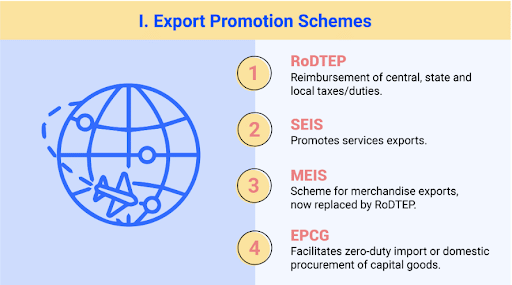
Export Promotion Schemes
Merchandise Exports from India Scheme (MEIS)
- The MEIS rewards exporters by offsetting inefficiencies in infrastructure and associated costs.
- This scheme offers exporters incentives in the form of duty credit scrips, which refund losses on paid duties.
- The MEIS provides an incentive of 2-5% of the 'Free On Board' (FOB) value of exports to all exporters, regardless of annual turnover.
- However, because MEIS is not WTO-compliant, it will be phased out and replaced by the new Rebate of Duties and Taxes on Exported Products (RoDTEP) scheme.
Rebate of Duties & Taxes on Exported Products (RoDTEP)
- The RoDTEP scheme will gradually replace the old MEIS beginning in December 2020.
- The RoDTEP scheme aims to refund all hidden taxes that were previously not refunded under any export incentive scheme, such as central and state taxes on fuel used for export product transportation, duties levied on electricity used for manufacturing, mandi tax levied by APMCs, toll tax and stamp duty on import-export documentation, and others.
Service Exports from India Scheme (SEIS)
- This scheme aims to encourage traders to export notified services.
- Service exports generate foreign exchange for the country and are thus encouraged.
- SEIS provides service exporters with a 3-7% incentive on net foreign exchange earnings.
- To be eligible for a claim under the scheme, service providers must have an active Import-Export Code (IEC Code) with minimum net foreign exchange earnings of US$ 15,000.
Export Promotion Capital Goods Scheme (EPCG)
- The EPCG scheme encourages manufacturers to import capital goods in order to produce goods and services.
- Under this scheme, exporters can collaborate with a manufacturer to import the capital goods needed to produce export goods at 0% duty.
- This scheme also aids in lowering the capital costs of service exporters.
- This scheme benefits service exporters such as hotels, travel and tour operators, taxi operators, logistics companies, and construction companies.
Duty Exemption/Remission Schemes
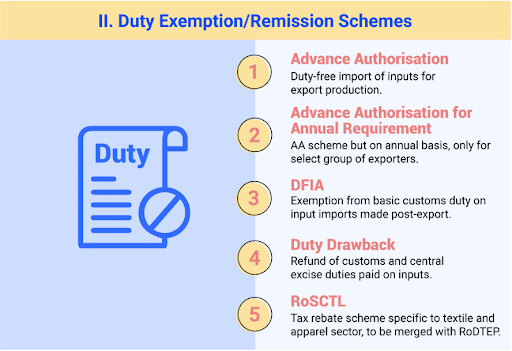
Duty Exemption/Remission Schemes
Advance Authorisation Scheme (AAS)
- The Advance Authorisation Scheme allows duty-free imports of raw materials used to manufacture export goods.
- It allows traders to import raw materials with no import duty if those raw materials are used to manufacture export products.
Duty-Free Import Authorisation Scheme (DFIA)
- This scheme serves the same purpose as the Advance Authorisation Scheme in that it allows duty-free imports of raw materials.
- However, this scheme only applies after exports, which means that duty-free imports will be permitted only after exports are completed.
Duty Drawback Scheme (DBK)
Exporters are compensated for customs and central excise duties paid on materials used in the manufacture of exported goods under the Duty Drawback Scheme (DBK).
Rebate on State & Central Taxes and Levies Scheme (RoSCTL)
- In 2019, the old RoSL scheme was replaced by the new RoSCTL scheme.
- The RoSCTL scheme is only applicable to the apparel and made-up industries.
- Taxes such as VAT on transportation fuel, captive power, 'mandi' tax, and electricity duty are refunded.
- In all sectors, this scheme will soon be merged with the RoDTEP scheme.
Other Schemes
| Schemes | Features |
|---|---|
| Export Oriented Units (EOU) |
|
| GST Refund for Exporters |
|
| Transport and Marketing Assistance (TMA) Scheme |
|
| Deemed Export Benefit Scheme |
|
| Star Export House/ Status Holder Certificate |
|
| Market Access Initiative (MAI) Scheme |
|
| Towns of Export Excellence (TEE) |
|
| Interest Equalisation Scheme (IES) |
|
| NIRVIK Scheme |
|
Export Subsidy - Significance
- An export subsidy is financial assistance provided by the government to producers.
- Subsidies sometimes include a fixed minimum payment for products destined for export to other nations.
- An export subsidy raises domestic prices while lowering foreign prices in the case of a large country.
- Export subsidies increase the quantity of exports.
- The export subsidy will cause a price differential equal to the subsidy value between the product's foreign and domestic prices.
- The subsidy might also be a payout to growers to lessen their expenses, allowing them to lower the pricing of their exports when priced in an international currency.
- The Indian government, for example, has offered substantial assistance to sugarcane growers and sugar producers.
- It has also provided rice exporters with a significant interest-payment subsidy.
- A cost-cutting subsidy has the primary impact of increasing market supply at the micro level and causing an outward shift in short-run aggregate supply.
- A subsidy can also enhance foreign demand for and expenditure on exports such as sugar and rice, causing an outward shift in aggregate demand.
Challenges Related to Export in India
- The high cost of export products is one of the major reasons for India's poor export performance.
- Indian exporters are unable to sell goods at a lower and more competitive price, rendering them uncompetitive in the global market, resulting in order losses.
- Inadequate infrastructure raises the cost of doing business in India. For example, moving a container by ship from Malaysia to Chennai is less expensive and faster than moving the same container by road/rail from Chennai to Mumbai.
- Rail freight rates for the export industry are among the highest in comparison to other countries.
- In addition, industrial electricity rates in India are extremely high.
- Another issue is the high cost of land for industrial development which leads to increase in prices.
- Credit cost - Due to high inflation, interest rates in India have remained very high for a very long time.
Conclusion
All of the aforementioned factors contribute to an increase in the cost of export goods when compared to other countries. As a result, the Indian government attempts to compensate for the disadvantages that Indian exporters face by instituting various Export Promotion Schemes/Export Incentives in India. As a result, in order to improve export pricing and remain competitive in the global market, it is critical to understand and fully utilise all export promotion schemes/export benefits in India.
FAQs
Question. What is export subsidy?
Answer: An export subsidy is a financial assistance provided by the government to domestic producers or exporters to encourage the export of goods. The aim is to make domestic products more competitive in international markets by lowering the price of exported goods through financial aid.
Question. How does export subsidy work in agriculture?
Answer: In agriculture, an export subsidy helps reduce the price of agricultural products in international markets, making them more competitive. The government provides financial support to farmers, cooperatives, or exporters to cover part of the cost of production or transportation, ensuring that the goods can be sold at a lower price abroad.
Question. What are the benefits of export subsidy in agriculture?
Answer: Export subsidies in agriculture benefit farmers by increasing their income and opening new markets for their produce. It helps countries with surplus agricultural products to clear stocks and stabilize domestic prices. Additionally, it promotes agricultural exports, enhances trade relationships, and helps boost the overall economy.
Question. What are the disadvantages of export subsidy in agriculture?
Answer: While export subsidies help in increasing exports, they can distort international trade by making agricultural products from subsidized countries unfairly cheaper, which may harm farmers in other countries. It can lead to trade disputes and even sanctions from other countries or trading bodies, such as the World Trade Organization (WTO).
Question. How is export subsidy regulated internationally?
Answer: Export subsidies are regulated under international trade agreements like the General Agreement on Tariffs and Trade (GATT) and the World Trade Organization (WTO). The WTO has rules that limit the use of export subsidies, particularly in agricultural products, to avoid market distortions and maintain fair competition.
MCQs
- What is the main purpose of an export subsidy?
a) To increase domestic consumption
b) To reduce the cost of exports and promote trade
c) To discourage imports
d) To reduce taxes on domestic products
Answer: (B) See the Explanation
Export subsidies aim to reduce the cost of exported goods, making them more competitive in international markets and boosting exports.
- In agriculture, what does an export subsidy help achieve?
a) It increases the cost of agricultural goods in domestic markets
b) It makes agricultural products cheaper in international markets
c) It restricts the flow of agricultural goods to foreign markets
d) It increases tariffs on agricultural exports
Answer: (B) See the Explanation
Export subsidies help reduce the price of agricultural products in foreign markets, making them more attractive to international buyers.
- What is a potential drawback of export subsidies?
a) They increase international trade competition
b) They can lead to trade disputes and unfair competition
c) They encourage local production only
d) They decrease the agricultural output
Answer: (B) See the Explanation
Export subsidies can make products from subsidized countries unfairly cheaper, leading to trade disputes and violations of international trade agreements.
- Which international body regulates export subsidies in agriculture?
a) World Health Organization (WHO)
b) United Nations (UN)
c) World Trade Organization (WTO)
d) International Monetary Fund (IMF)
Answer: (C) See the Explanation
The WTO regulates the use of export subsidies, particularly in agriculture, to ensure fair competition and avoid market distortions.
- What is the key benefit of export subsidies for farmers?
a) Lower production costs
b) Increased domestic demand for products
c) Increased income through higher exports
d) Reduced cost of agricultural inputs
Answer: (C) See the Explanation
Export subsidies allow farmers to access international markets at competitive prices, leading to increased income from exports.
GS Mains Questions and Model Answers
Q1: Analyze the role of export subsidies in enhancing agricultural exports.
Answer: Export subsidies play a vital role in promoting agricultural exports by making domestically produced goods more competitive in international markets. For countries with agricultural surplus, subsidies can help clear stockpiles and maintain stable domestic prices. By reducing the price of agricultural exports, governments can increase market share in foreign markets, which in turn boosts the income of farmers. However, export subsidies can also distort global trade by making subsidized products unfairly cheaper compared to those from other countries. This could lead to trade disputes and retaliatory actions under international trade agreements, such as those by the World Trade Organization (WTO). Despite the potential for disputes, export subsidies are considered an essential tool for stimulating agricultural growth and ensuring economic stability in countries that rely heavily on agriculture.
Q2: Discuss the advantages and disadvantages of providing export subsidies to the agricultural sector in India.
Answer: In India, providing export subsidies to the agricultural sector has several advantages. It supports farmers by making their products more affordable and competitive in international markets, which can lead to higher exports and increased incomes for agricultural producers. It also helps in managing surplus production and stabilizing domestic prices. The subsidies can also open up new markets for Indian agricultural products, boosting overall trade and contributing to economic growth. However, there are several disadvantages as well. Export subsidies can lead to market distortions, causing prices of subsidized products to be artificially lowered, which may result in unfair competition and trade disputes with other countries. Additionally, excessive subsidies may strain government finances and encourage overproduction, leading to long-term sustainability issues. The subsidies may also not always reach the small farmers effectively, often benefiting larger commercial operations.
Q3: Evaluate the impact of export subsidies on international agricultural trade.
Answer: Export subsidies in agriculture have a significant impact on international trade, often distorting competition. Subsidized products are sold at artificially low prices, making it difficult for non-subsidized countries to compete. This can lead to trade imbalances and tensions between countries, particularly when one country feels that its agricultural producers are being undercut unfairly. The World Trade Organization (WTO) has set rules limiting the use of export subsidies, particularly in agriculture, to maintain fairness in trade. While export subsidies can benefit domestic farmers by opening up export markets, they can also result in retaliatory measures from trading partners, including tariffs or other restrictions. As a result, while export subsidies may offer short-term economic benefits, they can harm long-term global trade relations and economic stability.
Previous Year Questions on Export Subsidy
1. UPSC CSE 2021
Question: "What is the primary objective of export subsidies in agriculture?"
Answer: The primary objective of export subsidies in agriculture is to make domestic agricultural products more competitive in international markets by reducing their prices, thereby boosting exports.
2. UPSC CSE 2020
Question: "Examine the impact of export subsidies on the agricultural economy and global trade."
Answer: Export subsidies play a significant role in boosting agricultural exports by making them more competitive. However, they distort global trade by making subsidized products unfairly cheaper, leading to trade disputes and retaliatory actions under international trade rules. While export subsidies can benefit domestic producers in the short term, they can lead to long-term trade imbalances and market distortions.
Download the PREPP App and attempt FREE IAS Exam Mock Tests and get complete study material!

Full Test - 04: UPSC CSE Prelims CSAT (Paper-II)
Full Test - 03: UPSC CSE Prelims CSAT (Paper-II)
UPSC CSE Prelims 2026 GS Paper 1 Question Paper (24-May-2026)
UPSC CSE Prelims 2026 CSAT Paper 2 Question Paper (24-May-2026)

17 February 2025 | The Hindu Must Read Articles | Current Affairs

16 February 2026 | The Hindu Must Read Articles | Current Affairs

13 February 2026 | The Hindu Must Read Articles | Current Affairs









Comments