Amber Box Subsidy - Agriculture Notes
Amber box subsidies are those that distort international trade by making a country's products cheaper in comparison to the same product in another country. These include price support measures and subsidies directly related to production quantities. Subsidies for inputs such as electricity, seeds, fertilisers, irrigation, and minimum support prices are examples of such subsidies. This article will explain to you about the Amber Box subsidy which will be helpful in preparing the Agriculture Syllabus for the UPSC Civil Service exam.
|
Table of Contents |
WTO and Agriculture Subsidies
- The WTO refers to government subsidies to the agricultural sector (i.e., domestic support) as Aggregate Measure of Support (AMS).
- It is computed using product and input subsidies.
- The WTO contends that product subsidies such as minimum support prices and non-product input subsidies such as credit, fertilisers, irrigation, and power will reduce farming production costs and give such countries an unfair advantage in their access to the global market—such subsidies are referred to as 'distortions' to global trade.
- In one sense, such subsidies are not permitted because they have a de minimis permissible limit under the provisions, which is 5% and 10% of total agricultural output in the case of developed and developing countries, respectively.
- In WTO terminology, agricultural subsidies are generally identified by 'boxes' with the colours of traffic lights—green (means permitted), amber (means slow down, i.e., to be reduced), and red (means forbidden).
- The WTO agricultural provisions have nothing resembling red box subsidies, though subsidies exceeding the reduction commitment levels are prohibited in the 'amber box.'
- The 'blue box' subsidies are linked to programmes that limit production levels.
- There is also an exemption provision for developing countries known as the 'S & D box.'
Aggregate Measurement of Support (AMS)
- The WTO's Agreement on Agriculture (AoA) divides government subsidies or domestic assistance for farmers into many categories.
- Aggregate Measurement of Support (AMS) is a significant category of subsidies or supports.
- The AMS, sometimes known as the "amber box," stands for domestic assistance that distorts trade.
- The AMS refers to both non-product specific assistance given to agricultural producers generally and yearly amount of support (subsidies) supplied for an agricultural product in favour of the producers (product specific), expressed in monetary terms.
- Product-specific subsidies and non-product-specific subsidies make up the aggregate measurement of support.
- The entire amount of support offered for each given agricultural commodity is referred to as the product-specific subsidy. For instance, the AMS for wheat is a special subsidy.
- The overall amount of support provided to the agricultural industry as a whole, including subsidies on inputs like fertiliser, power, irrigation, seeds, finance, etc., is referred to as a non-product specific subsidy.
- These non-product subsidies are often provided to all crops.
What is Amber Box Subsidy?
- Amber box subsidies are those that can distort international trade by making a country's products cheaper in comparison to those of other countries.
- According to the WTO, agriculture's amber box is used for all domestic support measures that are deemed to distort production and trade.
- As a result, the trade agreement requires signatories to commit to reducing trade-distorting domestic supports that fall into the amber box.
- WTO members who do not make these commitments must keep their amber box support within five to ten percent of their value of production.
- 10% for developing countries
- 5% for developed countries
- Any support payments considered to be trade distorting and subject to limitations and disciplines are classified as amber.
- Examples: Subsidies for inputs such as fertilisers, seeds, electricity, irrigation, and Minimum Support Price (MSP).
- It means that countries must reduce subsidies directly related to production promotion above the allowed level (which fall in either the blue or green box) to the prescribed levels.
- Various proposals in the current negotiations address issues such as determining the amount by which such subsidies should be reduced further, as well as whether to set product-specific subsidies or to continue with the current practise of the 'aggregate' method.
- Thirty-two WTO members have pledged to reduce trade-distorting domestic supports in the Amber Box (i.e., to lower the "total aggregate measurement of support," or AMS).
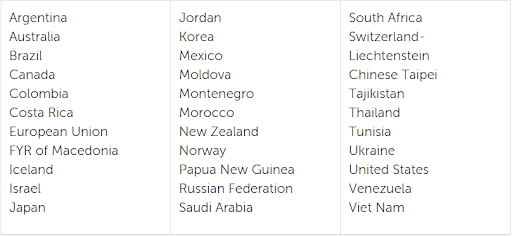
WTO members who will reduce trade-distorting in the Amber Box
Issues Related to Amber Box
- The combination of AMS into a single measure enables subsidies to be distributed across products. The AMS's detractors advocate for subsidy caps for each product.
- Due to low world prices during the base period, the baseline used for commitment reductions is inflated.
- Furthermore, while blue box payments are included in the baseline AMS, they are not included in the reduction commitments.
Measures to Tackle Issues Related to Amber Box
- Domestic support disciplines should be simplified. The current structure is complex and ambiguous, allowing for disparities in the application of member countries' domestic support reduction commitments.
- Find well-targeted and transparent exempt measures that reduce trade distortions.
- Ensure that non-trade concerns, particularly those of developing countries, are taken into account in a way that ensures continued progress in lowering trade barriers.
Conclusion
Amber box subsidies are those that distort international commerce by making one country's products cheaper than the identical product in another. Agriculture's amber box, according to the WTO, is utilised for any domestic assistance programmes that are regarded to distort production and trade. As a result, members to the trade agreement must pledge to lower trade-distorting domestic assistance that fall within the amber box.
FAQs
Question: What is the Amber Box subsidy in agriculture?
Answer: The Amber Box subsidy refers to a category of subsidies in agriculture that are considered to distort trade and competition under the World Trade Organization (WTO) rules. These subsidies are provided by governments to support agricultural production and prices, such as price supports and input subsidies for farmers. They are called "Amber Box" because they are subject to limits and are considered trade-distorting. The WTO requires countries to reduce such subsidies to prevent unfair competition in international markets.
Question: Why is the Amber Box subsidy considered trade-distorting?
Answer: Amber Box subsidies are considered trade-distorting because they lead to increased production, lower market prices, and an unfair advantage in international markets. These subsidies distort the natural market forces of supply and demand, making agricultural products artificially cheap and more competitive in the global market. This can harm farmers in countries that do not provide such subsidies, leading to market imbalances and trade disputes.
Question: How does the Amber Box subsidy affect agricultural trade?
Answer: The Amber Box subsidy can negatively affect agricultural trade by distorting competition. By providing subsidies to domestic agricultural producers, governments make their products artificially cheaper, which can harm farmers in other countries that do not provide similar subsidies. This leads to unfair competition in international markets, which can result in trade disputes and calls for the reduction or elimination of such subsidies under international trade agreements like those governed by the WTO.
Question: What are the limitations of Amber Box subsidies under WTO rules?
Answer: Under WTO rules, Amber Box subsidies are subject to reduction commitments. These subsidies are capped based on a country’s overall support for agriculture, and the amount a country can provide is limited by specific thresholds. The WTO monitors and reviews these subsidies to ensure they do not exceed the agreed-upon limits. If a country exceeds these limits, it could face legal challenges and potential penalties in international trade forums.
Question: How do countries manage to comply with WTO rules on Amber Box subsidies?
Answer: To comply with WTO rules on Amber Box subsidies, countries either reduce the value of their subsidies or shift them to less trade-distorting categories, such as the Green Box or Blue Box subsidies. Green Box subsidies are considered non-distorting, as they are generally aimed at environmental conservation or rural development. By redirecting subsidies to these areas, countries can continue to support their agricultural sectors without violating WTO commitments.
MCQs
1. Which of the following is a key characteristic of Amber Box subsidies?
A) They are considered trade-distorting
B) They are non-distorting and promote fair trade
C) They encourage environmental conservation
D) They are not subject to any WTO regulations
Answer: (A) See the Explanation
Explanation: Amber Box subsidies are considered trade-distorting because they provide financial support to domestic agricultural sectors that distort market competition, making products cheaper and more competitive in international markets.
2. Under WTO rules, Amber Box subsidies are:
A) Non-restricted subsidies
B) Limited and subject to reduction commitments
C) Encouraged to increase
D) Unregulated by WTO
Answer: (B) See the Explanation
Explanation: Amber Box subsidies are restricted and subject to reduction commitments under WTO rules. Countries are required to limit these subsidies to prevent them from distorting international trade.
3. What is the purpose of the Green Box in the context of agricultural subsidies?
A) To categorize subsidies that are trade-distorting
B) To categorize subsidies that support environmental conservation and rural development
C) To eliminate subsidies in agriculture
D) To increase agricultural production in foreign markets
Answer: (B) See the Explanation
Explanation: The Green Box category in WTO rules includes subsidies that are non-distorting and generally support activities like environmental conservation, rural development, and research in agriculture. These subsidies are allowed under WTO guidelines without the risk of trade distortion.
4. Which of the following is an example of a non-distorting subsidy in agriculture under WTO rules?
A) Price support subsidies
B) Input subsidies for fertilizers
C) Green Box subsidies
D) Export subsidies
Answer: (C) See the Explanation
Explanation: Green Box subsidies are considered non-distorting because they do not influence production decisions or trade. They are generally related to environmental practices, rural development, and other similar areas.
5. How does the Blue Box subsidy differ from the Amber Box subsidy?
A) Blue Box subsidies are considered non-distorting
B) Blue Box subsidies are subject to stricter limitations than Amber Box subsidies
C) Blue Box subsidies are aimed at reducing production restrictions
D) Blue Box subsidies are provided for trade-distorting purposes
Answer: (C) See the Explanation
Explanation: Blue Box subsidies are aimed at reducing production restrictions and are less trade-distorting than Amber Box subsidies. They are more flexible but still subject to specific WTO rules.
GS Mains Questions and Model Answers
Q1: Discuss the role of Amber Box subsidies in international trade and their impact on agricultural markets.
Answer: Amber Box subsidies play a significant role in international trade by distorting the natural dynamics of agricultural markets. These subsidies, provided by governments to support domestic agriculture, often result in artificially low prices for agricultural products, making them more competitive in global markets. This creates an uneven playing field for countries that do not provide similar subsidies, leading to trade imbalances. The WTO recognizes the trade-distorting nature of Amber Box subsidies and imposes limits to reduce their impact on international trade. The overall effect is that subsidies can lead to overproduction, market flooding, and reduced income for farmers in countries that do not provide subsidies.
Q2: How can the Green Box and Blue Box subsidies be used to minimize the trade-distorting effects of Amber Box subsidies?
Answer: To minimize the trade-distorting effects of Amber Box subsidies, countries can shift their support for agriculture towards Green Box and Blue Box subsidies. Green Box subsidies are non-distorting and include support for environmental conservation and rural development, which do not affect production levels or trade. The Blue Box subsidies aim to reduce production restrictions and help farmers through targeted interventions that are less disruptive to international trade. By transitioning from Amber Box to these less trade-distorting categories, governments can continue supporting their agricultural sectors without violating WTO commitments and contributing to unfair competition in global markets.
Q3: Analyze the impact of WTO’s restrictions on Amber Box subsidies on developing countries with agrarian economies like India.
Answer: The WTO's restrictions on Amber Box subsidies pose challenges for developing countries like India, which have large agrarian economies. While these restrictions aim to reduce trade distortion, they limit the ability of developing countries to provide direct subsidies to support farmers and ensure food security. For India, a significant portion of the population depends on agriculture for livelihood, and subsidies are crucial to offset price volatility, high input costs, and market inefficiencies. The WTO’s restrictions require India to explore alternative mechanisms like Green Box subsidies, which are harder to implement effectively without addressing the root causes of agricultural distress. The challenge lies in balancing WTO compliance with the need to protect and support small farmers in developing economies.
Previous Year Questions on Amber Box Subsidies
1. UPSC CSE Prelims 2021:
Question: Amber Box subsidies are subject to the restrictions of which global organization?
A) International Monetary Fund (IMF)
B) World Trade Organization (WTO)
C) United Nations Conference on Trade and Development (UNCTAD)
D) World Bank
Answer: (B)
Explanation: Amber Box subsidies are subject to restrictions under the World Trade Organization (WTO), which monitors and regulates trade-distorting agricultural subsidies.
2. UPSC CSE Mains 2020 (GS Paper 3):
Question: Discuss the implications of WTO’s rules on agricultural subsidies for developing countries like India.
Answer: WTO's rules on agricultural subsidies restrict the ability of developing countries like India to provide direct price support and input subsidies to farmers, which are crucial for ensuring food security and protecting rural livelihoods. While these restrictions aim to promote fair competition, they place constraints on domestic agricultural policy. Developing countries often face difficulties in shifting to Green Box or Blue Box subsidies, as these options are less flexible and harder to implement. Consequently, India and other developing nations must navigate the trade-offs between adhering to WTO commitments and protecting their agrarian economies.
Download the PREPP App and attempt FREE IAS Exam Mock Tests and get complete study material!

Full Test - 04: UPSC CSE Prelims CSAT (Paper-II)
Full Test - 03: UPSC CSE Prelims CSAT (Paper-II)
UPSC CSE Prelims 2026 GS Paper 1 Question Paper (24-May-2026)
UPSC CSE Prelims 2026 CSAT Paper 2 Question Paper (24-May-2026)

17 February 2025 | The Hindu Must Read Articles | Current Affairs

16 February 2026 | The Hindu Must Read Articles | Current Affairs

13 February 2026 | The Hindu Must Read Articles | Current Affairs









Comments