Citing Inflation And WTO Subsidy Limit, NITI, Commerce Red-Flagged MSP Hike
Relevance: GS 2 - Government policies and interventions for development in various sectors and issues arising out of their design and implementation; GS 3 - Issues related to direct and indirect farm subsidies and minimum support prices
(Source: Indian Express, 08/29/23)
Click here for Daily Current Affairs
Why in the news?
- Recently, the Union Cabinet chaired by Prime Minister Narendra Modi approved the increase in MSP ranging from 6 per cent to 10 per cent.
- Central government ministries and departments have raised concerns about the proposal to increase the minimum support price (MSP) for kharif crops in the 2023-24 season. This move has led to discussions regarding inflation, compliance with World Trade Organization (WTO) obligations, labor shortages, and rising wages. Key government entities have conveyed their apprehensions to the Union Ministry of Agriculture and Farmers' Welfare.
Table of Contents
What are issues raised by various government departments due to the rise in MSP?
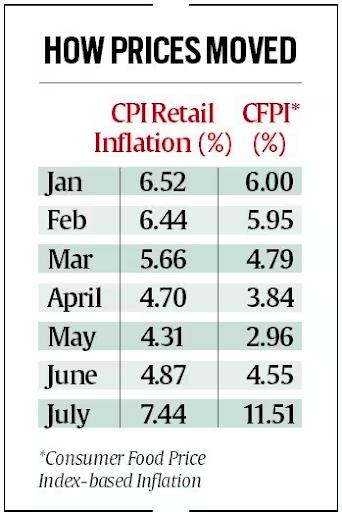
- Inflation: Niti Aayog has expressed reservations about the proposed MSP increase, which ranges from 5.3 percent in the case of urad to more than 10 percent in crops like cotton (long staple), sesamum, and moong.
- It argued that implementing such significant MSP hikes could disrupt efforts to maintain food inflation within the target range of 4-6%, crucial for overall macroeconomic stability.
- Against current approach: NITI Aayog raised concerns about the proposed MSP increase, linking it to the 1.5 times projected cost approach.
- According to Niti Aayog, actual data on some of the cost items shows that the real wages in agriculture are not rising and the increase in price of urea has been absorbed by the Government of India by increasing subsidies, warranting a closer examination of projected costs by CACP and the Ministry and CACP at the state level regarding the effects of both price and non-price recommendations.
- WTO limits: According to the WTO's Agreement on Agriculture, government procurement of crops at administered prices (MSP in India's case) for food security purposes must be notified to the WTO.
- Additionally, product-specific support should not exceed 10% of the crop's production value, and a similar limit applies to non-product-specific price support within the agriculture sector.
- Additional financial burden: The Department of Food and Public Distribution revealed that the increased MSP for paddy in the 2023-24 kharif marketing season (KMS) would result in an additional financial burden of Rs 13,819.80 crore, contributing to a total implication of Rs 2,12,907.60 crore.
- Similarly, the Investment and Price Support division of the Ministry of Agriculture and Farmers’ Welfare, projected a financial implication of Rs 126.99 crore due to the higher MSP of pulses and oilseeds.
What are the arguments for rising MSP?
- The government argued that the increase was in line with the Union Budget 2018-19 announcement of fixing MSP at a level of at least 1.5 times the cost of production, aimed at reasonably fair remuneration for farmers.
- The Agriculture Ministry in response to NITI Aayog, the Ministry stated in a Cabinet note that while recommending MSP, CACP considers the cost of production and overall demand-supply situations of various crops in domestic and world markets.
- Food security: An increase in MSP for Kharif Marketing Season (KMS) 2023-24 is in the range of 5.3% to 10.4% and is essential to ensure remunerative prices for farmers, encouraging them to invest more in production and ensuring food security in the country.
- Higher MSP for crops such as oilseeds, pulses, and Shree Anna aims to promote crop diversification.
- Cost Consideration for MSP Determination: The Agriculture Ministry emphasizes that the "All India weighted average cost of production" is a pivotal factor in setting MSP. The Commission for Agricultural Costs and Prices (CACP) incorporates inputs like labor, fertilizers, seeds, and more through the Composite Input Price Index (CIPI). The estimated production cost rise ranges from 6.13% to 10.52% compared to the previous year.
- Promotion of Agricultural Mechanization: In response to the Department of Expenditure's comments, the Ministry highlights the implementation of the "Sub-mission on Agricultural Mechanization." This scheme aims to expand custom hiring services of agricultural machinery and equipment, fostering farm mechanization and access for small farms. The Rashtriya Krishi Vikas Yojana (RKVY) contributes to this effort.
- Addressing WTO Commitments: The Ministry underscores adhering to World Trade Organization (WTO) commitments. It notes that the aggregate support calculation doesn't account for inflation since 1986, resulting in an understated External Reference Price (ERP) and overstated aggregate support.
Recommendations by CACP
- CACP highlights labor scarcity and increasing wages as major issues in Indian agriculture, advocating for farm mechanization to counter labor shortages.
- The commission commission recommends that collective/group ownership of machinery through self-help groups, cooperatives, and custom hiring centers to enhance access to expensive farming equipment.
- Furthermore, urgent action is needed to resolve supply-side challenges like storage, warehouse infrastructure, and transportation.
(*Click this link to read prelims specific weekly current affairs articles)
FAQs
Question: What is MSP?
Answer:
The Minimum Support Price (MSP) is the government-set minimum price for certain agricultural goods at which the items would be purchased directly from farmers if open-market prices were less than the cost incurred. The MSP set by the government is thought to be beneficial to farmers. MSPs, on the other hand, lack legal protection.
Question: Question: What do you mean by Blue Box subsidy?
Answer:
The term "Blue Box" refers to a type of domestic support or subsidy provided under the World Trade Organisation's Agriculture Agreement. Subsidies in the blue box are linked to programmes that limit production. As a result, it is an exception to the general norm of agricultural assistance. Blue box subsidies are intended to limit output by establishing limits or compelling farmers to reserve a section of their land.
Question: What is Commission for Agricultural Costs and Prices (CACP)?
Answer:
The Commission for Agricultural Costs and Prices (CACP) is an attached office of the Government of India's Ministry of Agriculture and Farmers Welfare. It was established in January 1965. The Commission currently consists of a Chairman, Member Secretary, one Member (Official), and two Members (Non-Official). Non-official members are representatives of the farming community who are usually involved in the farming community.
UPSC Mains Practice Question:
|
MCQ
Question: Which of the following factors/policies were affecting the price of rice in India in the recent past? (UPSC-2020)
(1) Minimum Support Price
(2) Government’s trading
(3) Government’s stockpiling
(4) Consumer subsidies
Select the correct answer using the code given below:
(a) 1, 2 and 4 only
(b) 1, 3 and 4 only
(c) 2 and 3 only
(d) 1, 2, 3 and 4
Answer: (d) See the Explanation
- Minimum Support Price (MSP): The MSP is a policy where the government sets a floor price at which it purchases agricultural commodities from farmers. In the case of rice, the MSP can influence the market price of rice. When the government increases the MSP for rice, it can lead to an increase in market prices as well.
- Government’s Trading: The government's involvement in trading agricultural commodities can impact prices. If the government decides to import or export rice based on market conditions, it can affect the domestic prices of rice.
- Government’s Stockpiling: The government often procures a certain quantity of rice to build its strategic food reserves. If the government increases its stockpiling of rice, it can reduce the available supply in the market, potentially leading to higher prices due to decreased availability.
- Consumer Subsidies: If the government provides subsidies on rice to consumers, it can influence the effective price that consumers pay. Subsidies can help keep consumer prices lower than they would be otherwise, affecting the overall demand and supply dynamics in the rice market.
- Therefore, option (d) is the correct answer.
Download the PREPP App and attempt FREE IAS Exam Mock Tests and get complete study material!

Full Test - 04: UPSC CSE Prelims CSAT (Paper-II)
Full Test - 03: UPSC CSE Prelims CSAT (Paper-II)
UPSC CSE Prelims 2026 GS Paper 1 Question Paper (24-May-2026)
UPSC CSE Prelims 2026 CSAT Paper 2 Question Paper (24-May-2026)

17 February 2025 | The Hindu Must Read Articles | Current Affairs

16 February 2026 | The Hindu Must Read Articles | Current Affairs

13 February 2026 | The Hindu Must Read Articles | Current Affairs









Comments