Population Growth Alone Will Not Drive Credit Benefits For Emerging Economies: Population Growth Not A Panacea
Relevance: GS1 - Population and associated issues, poverty and developmental issues, urbanization, their problems and their remedies; GS2 - Issues relating to development and management of Social Sector/Services relating to Health, Education, Human Resources.
(Source: The Hindu, 08/29/2023)
Click here for Daily Current Affairs
Why in the news?
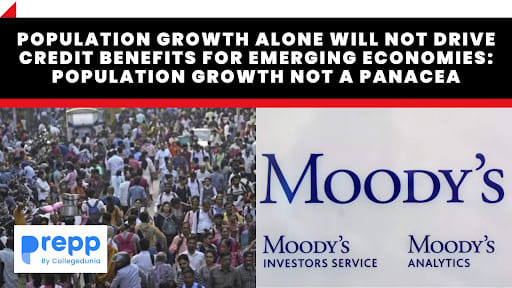
- Recently, in a report on Sovereigns in South and SouthEast Asia, titled ‘Population growth alone will not drive credit benefits for emerging economies’, Moody's Investors Service emphasized that despite India’s increasing labour force availability attributed to an increasing population, it will not be sufficient to strengthen the economy or improve fiscal outcomes.
- It was stated that the quality of education is a major component that puts the population at a disadvantage.
Table of Contents
Highlights of the Report
- Analysis of Educational Outcomes: Moody’s report mentioned that there remains a considerable gap in the quality of education between Pakistan, Bangladesh and India compared with China and other peers in Southeast Asia, which contributes to labour-force participation imbalances.
- Increase in Population: It predicts that the population of India, Bangladesh, Indonesia, Pakistan, the Philippines, and Vietnam will account for a third of the global population increase, thereby leading to a 40% of the increase in people in working age, over the next 20 years.
- Gender Disparities: The difference in the proportion of the male and female population that has completed an upper secondary education is most pronounced in India and Bangladesh.
- Skills Development for Future Opportunities: The development of relevant engineering and programming expertise may actually provide employment opportunities, not only in technology-related fields, but also in higher-value-added manufacturing given the increasingly complex products being produced in some of these large countries.
- For instance, India's potential in smartphone manufacturing and Vietnam's role in electric vehicle production could create jobs and contribute to more advanced economic activities.
About India’s Population
- According to the UN, India’s population reached 1.4 billion people in April 2023, surpassing China as the world's most populous nation.
- The UN has estimated that China’s population peaked in 2022 at around India’s current level; it expects that India will do so only in 2063.
- India ranks a weak four out of five on Moody’s social issuer profile scores (S-IPS), under our environmental, social and governance(ESG) framework, which indicates that the country’s population is exposed to a range of social risks.
*To read more about United Nations Population Fund's (UNFPA) State of World Population report, click here
What is the way ahead?
- India should focus on comprehensive educational reforms that emphasize quality over quantity. Investments should be directed towards improving curriculum design, teaching methodologies, and teacher training.
- Efforts to bridge the gender gap in education are crucial. Initiatives should aim to increase female enrollment, retention, and completion rates in schools and higher education institutions.
- Promoting vocational and technical training programs will equip individuals with practical skills that are relevant to the job market. These programs should be designed in collaboration with industries to ensure that graduates possess skills that meet industry demands.
- Given the growing importance of technology, integrating digital literacy and computer skills into the education system is essential which will prepare students for the digital economy and ensure they are competitive in fields influenced by automation, AI, and digitalization.
- Investments in research and innovation within the education sector can lead to the development of new teaching methodologies, curriculum enhancements, and educational technologies.
(*Click this link to read prelims specific weekly current affairs articles)
FAQs
Question: What is India’s Population?
Answer:
According to the UN, India’s population reached 1.4 billion people in April 2023, surpassing China as the world's most populous nation.
Question: What is Gender Inequality?
Answer:
Gender inequality is the social phenomenon in which people are not treated equally on the basis of gender. This inequality can be caused by gender discrimination or sexism.
Question: What is meant by labour force?
Answer:
The labor force, or workforce, is the total number of people who are currently employed plus the number of people who are unemployed and seeking employment. This number does not include people who are unemployed and not seeking employment, such as students and retirees.
UPSC Mains Practice Question:
|
Download the PREPP App and attempt FREE IAS Exam Mock Tests and get complete study material!

Full Test - 04: UPSC CSE Prelims CSAT (Paper-II)
Full Test - 03: UPSC CSE Prelims CSAT (Paper-II)
UPSC CSE Prelims 2026 GS Paper 1 Question Paper (24-May-2026)
UPSC CSE Prelims 2026 CSAT Paper 2 Question Paper (24-May-2026)

17 February 2025 | The Hindu Must Read Articles | Current Affairs

16 February 2026 | The Hindu Must Read Articles | Current Affairs

13 February 2026 | The Hindu Must Read Articles | Current Affairs









Comments