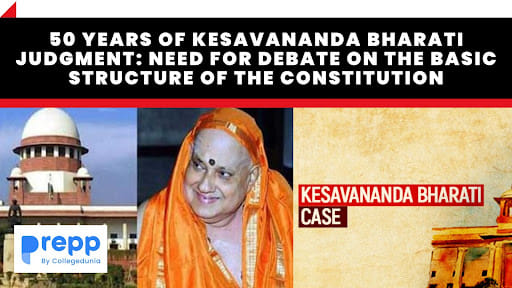
50 Years Of Kesavananda Bharati Judgment: Need For Debate On The Basic Structure Of The Constitution
(Source: Indian Express, 08/28/2023)
Click here for Daily Current Affairs
Why in the news?
- Recently, former CJI and Rajya Sabha MP Ranjan Gogoi claimed that the Basic Structure Doctrine has a very debatable jurisprudence.
- This article discusses the need for debating the Basic Structure and adapting the Constitution to modern times and requirements, without which the functioning of the government would be impaired.
Table of Contents
What is the Basic Structure Doctrine?
- The Basic Structure Doctrine (Kesavananda Bharati) is a legal common law doctrine that states that a sovereign state's constitution contains specific features that cannot be changed by its legislature.
- It imposes limits on the alteration of a Constitution's core via amendments and expansion of the restricted executive domain, which could impact the efficacy of the democracy.
- It recognizes the basic identity of the Constitution, which can not be destroyed by any amendment.
- It was developed by the Supreme Court of India in the Kesavananda Bharati v State of Kerala in 1973 and reaffirmed in the Indira Nehru Gandhi case of 1975.
- The Keshavananda Bharati verdict which was delivered by a 7:6 majority held that Parliament could not alter the basic structure of the Constitution by an amendment.
- In addition to India, Bangladesh, Malaysia, Pakistan, and Uganda all accept the basic structure doctrine.
To know more, click the link.
What is the debate around?
- The debate arose around the Rajya Sabha debate concerning the competence of the Union government acting through the Parliament to curtail the power of the Delhi Government over the services.
- Although the bill was passed, it has been criticized for its adverse effect on the federal structure, which is a key component of the Basic Structure.
- The opposition to the statement regarding the jurisprudence of the Basic Structure Doctrine has raised questions about censorship which could impair the proper functioning of the Constitution
Previous debates
- In 1951, Parliament debated the First Amendment, seeking curtailment of the fundamental right to freedom of expression.
- Article 21 of the Constitution prioritizes the procedure established by law over the due process of law, with the Supreme Court being authorized to police it.
- Article 21 and Article 368 were designed as a joint mechanism to maintain the sync between the state and society through incremental amendments to the Constitution.
- Both articles have specific areas which have been excluded from their purview.
Why is the Basic Structure considered necessary?
- Although only very few amendments and actions have been declared invalid, almost all exercises of legislative and executive power are challenged on the basis of the basic structure doctrine.
- The basic structure doctrine is driven by the self-perceived vulnerability of the judiciary which needs protection despite being the protector of individual liberty in the country.
- Judicial independence is the essence of the rule of law combining both decisional autonomy and institutional autonomy.
- In the Second Judge case, it was indicated that a convention existed that accorded primacy to the CJI in judicial appointments.
- There is now a two-fold “limited primacy” wherein the concurrence of the CJI (or collegium) is essential for any elevation, but the President may consult other lawyers and justices.
- Any breakdown of this constitutional togetherness could lead to a structural crisis of legality and legitimacy.
- The basic structure doctrine helped prevent constitutional and fundamental rights from being eroded and destroyed during the Emergency.
- Therefore, in the absence of the basic structure, it would lead to a constitution without constitutionalism.
Criticism of the doctrine
- A critical dissection of the Basic Structure Doctrine indicates that it is instrumentalized by those opposed to specific legislative measures.
- The whole doctrine must be reviewed and brought into the public sphere.
- The doctrine does not contain an exclusive and definitive list of what the basic features are as they are included on a case-by-case basis by the judiciary.
- As a result, there is an increase in the number of areas that are off-limits to the executive leading to undeliverable political mandates.
- The executive is constrained by the limited material resources and uncertainties about the legality of their actions.
- As a result of this lacuna between parliamentary competence and executive impotence, electoral democracy is weakened.
- This also leads to a political culture, defined as “cheap talk” in game theory.
- This includes grandstanding, rhetoric, inaction, and costless, non-binding, and unverifiable communication between politicians and the electorate.
- The Basic Structure Doctrine puts “procedure established by law” below “due process” in the functioning of the legislative process
- However, Article 368 of the Constitution clearly states that the Parliament may exercise its constituent power to amend any provision of the Consitution through addition, variation, or repeal in accordance with the procedure laid down by the article.
- The scheme of Separation of powers includes a watchful judiciary and an empowered legislature, with control mechanisms such as the committee system, and accountability to two different electorates, following different electoral cycles.
- The political system is based on the principle of the joint family which helps deepen and enhance the resilience of Indian democracy.
- If the political system does not adapt the Constitution to challenging times, the state will not be able to withstand the pressures emanating from the deeper layers of society and history.
Conclusion
- According to Pt. Nehru, Parliament is the instrument of the collective voice of the nation. Therefore, its autonomous and unhindered functioning is critical for Indian democracy.
- CJI D.Y Chandrachud has stated that the Basic Structure Doctrine is the “Pole Star” of Indian politics.
- Therefore, the Basic Structure Doctrine should be used to steer the ship that is Indian politics.
(*Click this link to read prelims specific weekly current affairs articles)
FAQs
Question: What is the procedure established by law and the due process of law?
Answer:
- Procedure Established by Law is a principle that is primarily associated with legal systems based on common law. In countries following this principle, the government enacts laws, and individuals must comply with those laws.
- If Parliament passes a law, then the life or personal liberty of a person can be restricted according to the provisions and procedures of that law.
- Due process of law doctrine not only checks if there is a law to deprive the life and personal liberty of a person but also sees if the law made is fair, just, and not arbitrary.
- If the judiciary finds that any law is not fair, it will declare it null and void. This doctrine provides for a more fair treatment of individual rights.
Question: What is the First Amendment?
Answer:
This Amendment established a precedent to rewrite the Constitution to override judicial decisions that prevented the government from carrying out its alleged obligations. It is also known as the Constitution (First Amendment) Act, 1951.
UPSC Mains Practice Question:
|
MCQs
Question: Consider the following statements.
- The Constitution of India defines its ‘basic structure’ in terms of federalism, secularism, fundamental rights, and democracy.
- The Constitution of India provides for ‘judicial review’ to safeguard the citizens’ liberties and to preserve the ideals on which the Constitution is based.
Which of the statements given above is/are correct?
(a) 1 only
(b) 2 only
(c) Both 1 and 2 only
(d) Neither 1 nor 2
Answer: (b) See the Explanation
- The Basic Structure concept has not been defined by the Constitution but by the Supreme Court of India in the Keshavananda Bharati case of 1973. Hence statement 1 is incorrect.
- Although there is no explicit mention of the principle of judicial review in the Constitution, it is an integral part of the constitution through various provisions. Hence statement 2 is correct.
Therefore, option (b) is the correct answer.
Download the PREPP App and attempt FREE IAS Exam Mock Tests and get complete study material!

Full Test - 04: UPSC CSE Prelims CSAT (Paper-II)
Full Test - 03: UPSC CSE Prelims CSAT (Paper-II)
UPSC CSE Prelims 2026 GS Paper 1 Question Paper (24-May-2026)
UPSC CSE Prelims 2026 CSAT Paper 2 Question Paper (24-May-2026)

17 February 2025 | The Hindu Must Read Articles | Current Affairs

16 February 2026 | The Hindu Must Read Articles | Current Affairs

13 February 2026 | The Hindu Must Read Articles | Current Affairs









Comments