France To Ban Muslim Abaya Dress In State Schools
Relevance: GS2 - Effect of policies and politics of developed and developing countries on India’s interests, Indian diaspora; Comparison of the Indian constitutional scheme with that of other countries
(Source: The Hindu, 08/29/23)
Click here for Daily Current Affairs
Why in the news?
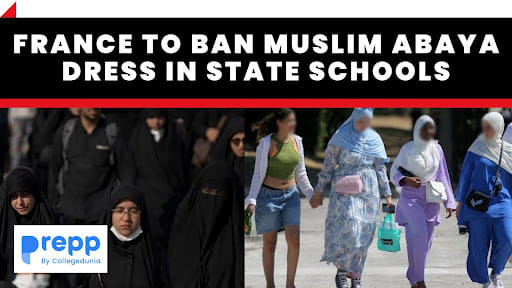
- Recently, the French Education minister said that France will ban children from wearing the abaya citing violations of secular laws.
- Abaya is increasingly worn in schools which has led to a political divide over their use in France. While right-wing parties are pushing for a ban, the left has voiced concerns for the rights of Muslim women and girls, as per BBC.
- Critics also view the ban as unnecessary, perceiving the garments as fashion rather than religious symbols.
- According to the data from the national statistics bureau, Insee in 2019-2020, Muslims constituted around 10% of the French population.
Table of Contents
What is the issue?
- France has enforced a strict ban on religious signs in state schools since 19th-century laws removed any traditional Catholic influence from public education, however, it has struggled to update guidelines to deal with a growing Muslim minority.
- In 2004, it banned headscarves in schools and passed a ban on full face veils in public in 2010, angering some in its five million-strong Muslim community.
What are the arguments for and against Abaya?
Arguments for
- Promotion of Tolerance: Allowing students to wear abayas can foster a culture of tolerance and understanding among students of different backgrounds. It sends a message that diversity is valued and respected within the school community.
- Religious Freedom: Wearing an abaya is a deeply personal and religious choice for many Muslim girls. Allowing them to wear abayas in schools respects their religious freedom, which is a fundamental human right. Also, Wearing Abayas is not a religious symbol according to some communities.
- Respect for Diversity: Schools should be inclusive and respect the diverse backgrounds and beliefs of their students. Allowing Muslim girls to wear abayas promotes a culture of inclusivity and respect for cultural and religious differences.
- Equal Access to Education: Prohibiting the wearing of abayas in schools may limit the educational opportunities of Muslim girls who believe it is a religious obligation.
Arguments against
- Secularism: Schools are meant to be secular spaces where religious symbols or attire should not be prominently displayed. Banning abayas can help maintain a neutral environment that respects the separation of religion and education.
- Equality: A ban on religious clothing, including abayas, can be seen as promoting equality among students by preventing any one religious group from displaying their symbols more prominently than others.
- Uniformity: Schools often have dress codes or uniforms to maintain a sense of uniformity among students. Banning specific religious attire like abayas can contribute to a consistent appearance among the student body.
Indian Vs. Western Model Of Secularism
India has created its own distinct idea of secularism over time, which differs significantly from the equivalent Western concept in the following ways:
| Western Secularism | Indian Secularism |
|---|---|
|
|
Secularism And The Indian Constitution
|
(*Click this link to read prelims specific weekly current affairs articles)
FAQs
Question: What is abaya?
Answer:
An abaya is a long, usually dark-colored cloak, worn by many of Muslim women. An abaya covers the woman totally from her neck to her toes.
Question: What is secularism in the Constitution?
Answer:
With the Forty-second Amendment of the Constitution of India enacted in 1976, the Preamble to the Constitution asserted that India is a secular nation. The Constitution does not recognize, it does not permit, mixing religion and state power. That is the constitutional injunction.
Question: What is Communalism?
Answer:
Communalism is blind allegiance to one’s own religious community in our culture. It is defined as a tool for or against mobilizing people by appealing for communal services. Communalism is related to dogmatism and religious fundamentalism.
UPSC Mains Practice Question:
|
MCQ
Question: What was the exact constitutional status of India on 26th January, 1950? (UPSC-2021)
(a) A Democratic Republic
(b) A Sovereign Democratic Republic
(C) A Sovereign Secular Democratic Republic
(d) A Sovereign Socialist Secular Democratic Republic
Answer: (b) See the Explanation
- Though India became a free nation on August 15, 1947, it declared itself a Sovereign, Democratic and Republic state with the adoption of the Constitution on January 26, 1950.
- 42nd Amendment Act of 1976 added three new words in the Preamble ‘Socialist’, ‘Secular’ and ‘Integrity’.
- Therefore, option (b) is the correct answer.
Download the PREPP App and attempt FREE IAS Exam Mock Tests and get complete study material!

Full Test - 04: UPSC CSE Prelims CSAT (Paper-II)
Full Test - 03: UPSC CSE Prelims CSAT (Paper-II)
UPSC CSE Prelims 2026 GS Paper 1 Question Paper (24-May-2026)
UPSC CSE Prelims 2026 CSAT Paper 2 Question Paper (24-May-2026)

17 February 2025 | The Hindu Must Read Articles | Current Affairs

16 February 2026 | The Hindu Must Read Articles | Current Affairs

13 February 2026 | The Hindu Must Read Articles | Current Affairs









Comments