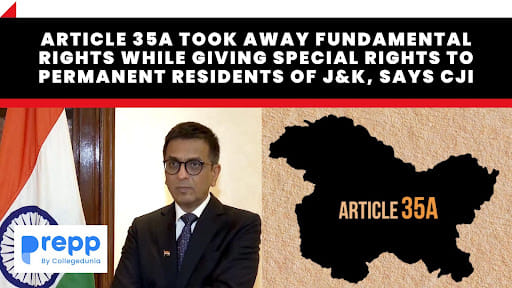
Article 35A Took Away Fundamental Rights While Giving Special Rights To Permanent Residents Of J&K, Says CJI
(Source: The Hindu, 08/29/2023)
Click here for Daily Current Affairs
Why in the news?
- Recently, Chief Justice of India DY Chandrachud while intervening during the submission of solicitor general, Tushar Mehta, remarked that Article 35A gave special rights and privileges to permanent residents and virtually took away the rights of non-residents.
- The remarks came during the Day 11 hearing on a batch of petitions challenging the abrogation of Article 370 in the context of the erstwhile state of Jammu and Kashmir.
Table of Contents
What is Article 35A?
- Article 35A stems from Article 370, having been introduced through a Presidential Order in 1954.
- Article 35A allowed the legislature of the erstwhile J&K state to define "permanent residents" and provide them with special rights and privileges in terms of public employment, immovable property, and settlement.
- Non-permanent residents of the state, even if Indian citizens, were not entitled to these 'privileges'.
- The Article 35A barred anyone from outside Jammu and Kashmir (who is not a permanent resident) from getting a state job or owning a property in the state.
*For detailed notes on Article 35A, click here
Who are the Permanent Residents?
- People classified as permanent residents were those who held hereditary State subject status dating back to 1927, during the period when Jammu & Kashmir existed as a princely state prior to joining the Indian Dominion in 1947.
- Article 35A, which was introduced through the Constitution (Application to Jammu and Kashmir) Order, 1954 issued by the President under Article 370, demarcated permanent residents with exclusive right to purchase land, seek State government employment and other benefits in education and health care.
- The others, called ‘non-permanent residents’, were not privy to these privileges.
Current Status of Articles 370 and 35A
- On August 5th 2019, the President of India promulgated the Constitution (Application to Jammu and Kashmir) Order, 2019.
- It revokes the special status given to Jammu & Kashmir under Article 370 and Article 35A.
- A separate Bill, the Jammu and Kashmir Reorganisation Bill 2019 was passed and bifurcated the State into two separate union territories of Jammu and Kashmir (with legislature), and Ladakh (without legislature).
Recent Observations and Judgements of Supreme Court on Article 35A
- The Chief Justice stated that Article 35A gave special rights and privileges to permanent residents and virtually took away the rights for non-residents.
- These rights included the right to equal opportunity of state employment, right to acquire property and the right to settle in Jammu and Kashmir.
- It had even granted immunity from judicial review to these special privileges.
- This artificially created class of ‘permanent residents’ alienated people who did not fall within the category.
- The CJI asked the government whether the Centre had adhered to the principle of federalism while abrogating Article 370 and abolishing J&K as a full-fledged State.
- It stated that Article 3 made it mandatory for the President to consult the State Legislature before altering the status of a State.
- The abrogation was facilitated by first dissolving the J&K State Legislature and then proclaiming President’s Rule under Article 356.
- Impact of Article 325A on Fundamental Rights: The CJI stated that the Constitution Order of 1954 had extended the entirety of Part III of the Indian Constitution, which encompasses fundamental rights, to Jammu and Kashmir.
- However, Article 35A created exceptions under three specific areas:
- Equality of opportunity for all citizens in public jobs under Article 16(1);
- Acquisition of properties under Articles 19(1)(f) and 31; and
- Right to settle in any part of the country under Article 19(1)(e).
What are the other controversies regarding Article 35A?
- Constitutional Placement: Article 35A is distinct for not being part of the main body of the Constitution. It was introduced without following the regular parliamentary amendment process outlined in Article 368, which grants amendment powers solely to Parliament.
- Temporariness of Article 370: Article 370 was initially a temporary provision designed to restore stability in Jammu and Kashmir (J&K) and bolster democracy in the region. The original intent of Article 370 was not to facilitate permanent amendments like Article 35A in the Constitution.
- Undermining the Unity of India: Critics argue that Article 35A goes against the spirit of Indian unity by establishing a "class within a class" of Indian citizens. It leads to differential treatment based on residency status, potentially fostering divisions.
- Violation of Fundamental Rights: Article 35A restricts citizens from other states from obtaining employment or purchasing property within J&K, potentially infringing upon their fundamental rights.
- Violates judicial review principle: Article 35A mandates that no act of the legislature coming under it can be challenged for violating the Constitution or any other law of the land.
(*Click this link to read prelims specific weekly current affairs articles)
FAQs
Question: What is Article 35A?
Answer:
It was introduced through a Presidential Order in 1954, on the recommendation of the J&K Constituent Assembly. Article 35A empowers the Jammu & Kashmir legislature to define the permanent residents of the state, and their special rights and privileges. It appears in Appendix I of the Constitution.
Question: What are Fundamental Rights?
Answer:
The Fundamental Rights are defined as basic human freedoms which every Indian citizen has the right to enjoy for the proper and harmonious development of personality. It is enshrined in Part III of the Indian Constitution.
Question: What is Article 370?
Answer: Article 370 acknowledges the special status of the state of Jammu and Kashmir in terms of autonomy and its ability to formulate laws for the state's permanent residents.
UPSC Mains Practice Question:
|
MCQ
Question: What did Article 35A of the Indian Constitution pertain to?
(a) Reservation for women in government jobs
(b) Special rights and privileges for residents of Jammu and Kashmir
(c) Freedom of speech and expression
(d) Right to education for minority communities
Answer: (b) See the Explanation
Article 35A allowed the legislature of the erstwhile J&K state to define "permanent residents" and provide them with special rights and privileges in terms of public employment, immovable property, and settlement.
Therefore, option (b) is the correct answer.
Question: Economic Justice as one of the objectives of the Indian; Constitution has been provided in (UPSC 2013)
(a) The Preamble and the Fundamental Rights
(b) The Preamble and the Directive Principles of State Policy
(c) The Fundamental Rights and the Directive Principles of State Policy
(d) None of the above
Answer: (b) See the Explanation
The Preamble to the Constitution of India in its; introductory statement says- “Justice- Social, Economic and; Political” and the Directive Principles of state policies aim to create a social and economic condition under which the citizens can lead a good life. They also aim to establish social and economic democracy through a welfare state.
Therefore, option (b) is the correct answer.
Download the PREPP App and attempt FREE IAS Exam Mock Tests and get complete study material!

Full Test - 04: UPSC CSE Prelims CSAT (Paper-II)
Full Test - 03: UPSC CSE Prelims CSAT (Paper-II)
UPSC CSE Prelims 2026 GS Paper 1 Question Paper (24-May-2026)
UPSC CSE Prelims 2026 CSAT Paper 2 Question Paper (24-May-2026)

17 February 2025 | The Hindu Must Read Articles | Current Affairs

16 February 2026 | The Hindu Must Read Articles | Current Affairs

13 February 2026 | The Hindu Must Read Articles | Current Affairs









Comments