ISRO To Launch Aditya- L1 On September 2 To Study The Sun
Relevance: GS3 - Awareness in the fields of IT & Space
(Source: The Hindu, 08/29/2023)
Click here for Daily Current Affairs
Why in the news?
- After the successful achievement of the Chandrayaan-3 lunar landing, the Indian space agency is now preparing to launch a new spacecraft dedicated to solar research.
- The Indian Space Research Organisation (ISRO), recently announced that the Aditya-L1 mission, India's inaugural space-based solar observatory, is slated for liftoff on September 2 from the Satish Dhawan Space Centre in Sriharikota.
Table of Contents
About the Mission
- Aditya L1 is the first space-based Indian mission to study the Sun.
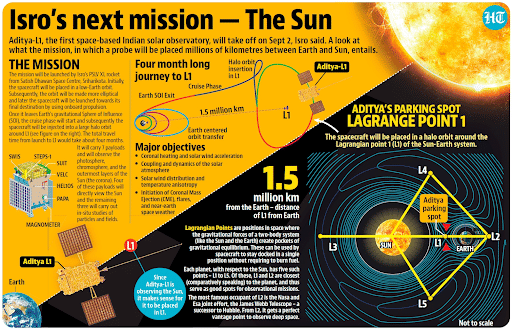
- The spacecraft will be placed in a halo orbit around the Lagrange point 1 (L1) of the Sun-Earth system, which is about 1.5 million km from the Earth.
- It is expected to take more than 120 days for the spacecraft to reach the L1.
- The mission will be launched using the ISRO PSLV rocket from the Satish Dhawan Space Centre SHAR (SDSC SHAR) in Sriharikota.
- The spacecraft will initially be placed in a low Earth orbit, which will then be transformed into an elliptical orbit before reaching L1 using on-board propulsion.
- The Aditya-L1 mission would carry seven payloads to observe the photosphere, chromosphere and the outermost layers of the Sun, the corona, in different wavebands.
- The mission Aditya-L1 from ISRO will travel for a total distance of 1.5 million kilometers from Earth, which is four times as far as the moon.
Objective of the Mission
- The main objective of the mission is to get a deeper understanding of the star closest to us, and how its radiation, heat, flow of particles, and magnetic fields affects us.
- This encompasses investigating aspects such as coronal heating and the acceleration of solar wind, understanding the interplay and dynamics within the solar atmosphere, analyzing the dispersion of solar wind and temperature imbalances.
- The payloads onboard will analyze the Sun's upper layers, the chromosphere and corona, studying phenomena like coronal mass ejections (CMEs) involving plasma and magnetic fields.
- The mission aims to unravel the enigma of the corona's extreme heat, a million degrees Celsius, despite the temperature of the solar surface at 5,500 degrees Celsius.
- It will probe particle acceleration causing solar winds, shedding light on space weather drivers.
What is L1?
- The Lagrange point L1 resides roughly 1.5 million km from Earth and enables continuous solar observation through unobstructed halo orbit movement.
- This facilitates real-time monitoring of solar activities and their space weather impact.
- L1 is one of five equilibrium points in the Earth-Sun system where gravitational and centrifugal forces balance, allowing objects to remain relatively stationary in relation to the larger bodies.
- Positioned on the Earth-Sun line, specifically in Earth's orbital trajectory, L1 is governed by the combined gravitational pull of Earth and Sun.
Significance of the Mission
- As our closest star, the Sun offers unparalleled opportunities for detailed study, which in turn can enhance our understanding of other stars.
- Despite supporting life on Earth, the Sun exhibits explosive events that pose risks to satellites and communication systems. Exploring the Sun helps in issuing advance warnings for such incidents.
- The Sun's extreme thermal and magnetic phenomena act as a natural laboratory for research, which isn't feasible within controlled lab environments.
- Space-based observations are crucial due to Earth's protective atmosphere and magnetic field that block harmful radiations like UV light.
- Studying the Sun from Earth alone is limited, necessitating space exploration for a comprehensive understanding.
Important missions launched by space agencies of different countries exploring the Sun
- US: National Aeronautics and Space Administration (NASA), the US space agency, launched the Parker Solar Probe in August 2018. In December 2021, Parker flew through the Sun's upper atmosphere, the corona, and sampled particles and magnetic fields there. This was the first time ever that a spacecraft touched the Sun.
- In February 2020, NASA joined hands with the European Space Agency (ESA) and launched The Solar Orbiter to collect data to find out how the Sun created and controlled the constantly changing space environment throughout the solar system.
- In December, 1995, NASA, ESA and JAXA (Japan Aerospace Exploration Agency) jointly launched the Solar and Heliospheric Observatory (SOHO).
- Japan: JAXA, Japan's space agency, launched its first solar observation satellite, Hinotori (ASTRO-A), in 1981.
- JAXA's other solar exploratory missions are Yohkoh (SOLAR-A) launched in 1991; SOHO (along with NASA and ESA) in 1995; and Transient Region and Coronal Explorer (TRACE), along with NASA, in 1998.
- In 2006, Hinode (SOLAR-B) was launched, which was the successor to Yohkoh (SOLAR-A), the orbiting solar observatory. Japan launched it in collaboration with the US and the UK.
- Europe: In October, 1990, the ESA launched Ulysses to study the environment of space above and below the poles of the Sun. Other than solar missions launched in collaboration with NASA and the JAXA, the ESA launched Proba-2 in October, 2001. Proba stands for Project for On-Board Autonomy. Upcoming solar missions of the ESA include Proba-3, scheduled for 2024 and Smile, scheduled for 2025.
- China: The Advanced Space-based Solar Observatory (ASO-S) was successfully launched by National Space Science Center, Chinese Academy of Sciences (CAS), on October 8, 2022.
(*Click this link to read prelims specific weekly current affairs articles)
FAQs
Question: What is the Aditya L1 Mission?
Answer:
Aditya L1 is the first space-based Indian mission to study the Sun. The spacecraft will be placed in a halo orbit around the Lagrange point 1 (L1) of the Sun-Earth system, which is about 1.5 million km from the Earth.
Question: What are Lagrangian Points?
Answer:
Lagrangian points, also known as Lagrange points or libration points, are specific locations in space where the gravitational forces of two large bodies, such as a planet and its moon or a planet and the Sun, produce enhanced regions of gravitational equilibrium.
Question: What are the different layers of the Sun?
Answer:
The inner layers are the Core, Radiative Zone and Convection Zone. The outer layers are the Photosphere, the Chromosphere, the Transition Region and the Corona.
UPSC Mains Practice Question:
|
MCQ
Question: What is the primary objective of the Aditya-L1 mission?
(a) Studying lunar surface composition
(b) Observing Earth's climate patterns
(c) Analyzing the outer planets of the solar system
(d) Studying the Sun's various layers and phenomena
Answer: (d) See the Explanation
Aditya-L1 is the first space-based Indian observatory to study the sun.
Therefore, option (d) is the correct answer.
Download the PREPP App and attempt FREE IAS Exam Mock Tests and get complete study material!

Full Test - 04: UPSC CSE Prelims CSAT (Paper-II)
Full Test - 03: UPSC CSE Prelims CSAT (Paper-II)
UPSC CSE Prelims 2026 GS Paper 1 Question Paper (24-May-2026)
UPSC CSE Prelims 2026 CSAT Paper 2 Question Paper (24-May-2026)

17 February 2025 | The Hindu Must Read Articles | Current Affairs

16 February 2026 | The Hindu Must Read Articles | Current Affairs

13 February 2026 | The Hindu Must Read Articles | Current Affairs









Comments