Livestock - Agriculture Allied Sector - Agriculture Notes
Livestock is vital to the Indian economy. The livestock sector in India contributes 4.35% of GDP and 29.35% of total Agriculture GDP. About 20.5 million people rely on livestock for a living. Livestock contributed 16% of income to small farm households, compared to an average of 14% for all rural households. Livestock provides a living for two-thirds of rural communities. It also employs approximately 8.8% of the Indian population. In this article, we will discuss the Livestock - Agriculture Allied Sector which will be helpful for UPSC exam preparation.
|
Table of Contents |
What is Livestock?
- Livestock is farm animals. They are domesticated by agriculturalists and raised to produce labour and commodities.
- Furthermore, the term livestock is commonly used to refer to animals that have been domesticated by humans for commercial purposes.
- The livestock sector is an important sub-sector of agriculture, providing nutrient-rich food products, draught power, organic manure and domestic fuel, hides and skin, as well as a consistent source of cash income for rural households.
|
|
|
|---|---|
| Crop and its Classifications | Horticulture |
| Poultry | Animal husbandry |
| Fisheries | Dairy |
Role of Livestock in Farmer’s Socioeconomic Life
Livestock is vital to farmers' economies. Farmers in India practise mixed farming, which is a combination of crop and livestock production in which the output of one enterprise becomes the input of another, achieving resource efficiency.
Income
- Livestock is a secondary source of income for many Indian families, particularly the resource poor who keep a few heads of animals.
- Cows and buffaloes, if in milk, will provide livestock farmers with consistent income through milk sales.
- Animals such as sheep and goats provide income during emergencies to cover expenses such as marriages, medical treatment, child education, house repairs, and so on.
- The animals also serve as moving banks and assets, providing the owners with economic security.
Employment
- Agriculture provides a living for a large number of people in India who are illiterate and unskilled.
- Agriculture, on the other hand, being seasonal, could provide employment for a maximum of 180 days per year.
- People are increasingly reliant on livestock to supplement their income during the lean agricultural season.
Food
- Livestock products such as milk, meat, and eggs provide an important source of animal protein to livestock owners.
- Milk is available per capita at around 355 g per day, while eggs are available at 69 per year.
Social security
- The animals provide social security to their owners by virtue of their social standing.
- Families who own animals, particularly those who are landless, are in a better position than those who do not.
- Animals are frequently given as wedding gifts in various parts of the country.
- Animal husbandry is a part of Indian culture. Animals are used for a variety of socio-religious functions.
- Cows are used in housewarming ceremonies; rams, bucks, and chickens are sacrificed during festive seasons; and bulls and cows are worshipped at various religious functions.
Gender equity
- Animal husbandry promotes gender equity.
- Women account for more than three-fourths of the labour demand in livestock production.
- In Punjab and Haryana, where dairying is a major activity and animals are stall-fed, the share of women employed in the livestock sector is around 90%.
Dung
- In rural areas, dung is used for a variety of purposes, including fuel (dung cakes), fertiliser (farm yard manure), and plastering material (poor man's cement).
Draft
- Bullocks are the foundation of Indian agriculture. Bullocks are used by farmers, particularly small and marginal farmers, for ploughing, carting, and transporting both inputs and outputs.
Contributions of the Livestock Sector to the Indian Economy
- Employment: According to the NSSO's 68th Round Survey on Employment and Unemployment, 16.44 million workers were engaged in animal farming, mixed farming, fishing, and aquaculture.
- Largest Milk producer: India is the world's largest milk producer. Milk production in the country was 188 million tonnes in 2018-19, with a yearly growth rate of 6.5 percent, resulting in increased per capita availability to 394 grammes per day.
- Income: Around 20.5 million people rely on livestock for a living. Livestock contributed 16% of income to small farm households, compared to an average of 14% for all rural households.
- Livestock provides a living for two-thirds of the rural population. According to the 70th round of NSSO, livestock rearing is the primary source of income for 3.7% of agricultural households.
- Food: Livestock products such as milk, meat, and eggs are an important source of animal protein for livestock owners. During 2017-18, the per capita availability of milk is around 375 g per day, and eggs are 74 / annum.
- Social security: The animals provide social security to their owners by virtue of their social standing. Families who own animals, particularly those who are landless, are in a better position than those who do not.
- Fisheries Sector: At the primary level, the sector employs approximately 16 million fishers and fish farmers, with nearly twice that number employed further up the value chain.
- Agriculture, forestry, and fishing account for 58 percent of GDP.
- Furthermore, the sector is a major contributor to foreign exchange earnings, with India being one of the world's leading seafood exporting nations.
- Total fish production in the country was 13.42 million metric tonnes (MMT) in 2018-19. (Marine fisheries: 3.71 MMT; inland fisheries: 9.71 MMT).
- Draft: Bullocks are the backbone of Indian agriculture. Despite significant advances in the use of mechanical power in Indian agricultural operations, Indian farmers, particularly in rural areas, continue to rely on bullocks for a variety of agricultural operations.
- The bullocks save a lot of fuel, which is a necessary input for using mechanical power like tractors and combine harvesters.
- In addition to bullocks, pack animals such as camels, horses, donkeys, ponies, and mules are widely used to transport goods throughout the country.
- In hilly terrain, mules and ponies are the only options for transporting goods.
- Similarly, the army must rely on these animals to transport various items in high altitude areas.
Challenges Faced by Livestock Sector
- Productivity: One of the major challenges is increasing the productivity of farm animals. Indian cattle produce 1172 kg of milk per year, which is only about half of the global average.
- Diseases: Frequent outbreaks of diseases such as Foot and Mouth Disease, Black Quarter infection, Influenza, and others continue to negatively impact livestock health and productivity.
- Greenhouse Gases: India's massive ruminant population contributes to greenhouse gas emissions. Reduced greenhouse gas emissions will be a major challenge through mitigation and adaptation strategies.
- Loss of indigenous breeds: Crossbreeding of indigenous species with exotic stocks to improve the genetic potential of different species has only been partially successful.
- Limited artificial insemination: The major impediments have been limited artificial insemination services due to a lack of quality germplasm, infrastructure, and technical manpower, as well as a low conception rate following artificial insemination.
- Less credit: The sector received only about 12% of total public expenditure on agriculture and allied sectors, which is disproportionately lower than its contribution to agricultural GDP. Financial institutions have largely ignored this sector.
- Production and distribution of meat: Slaughtering facilities are inadequate. Unregistered, makeshift slaughterhouses produce roughly half of total meat production.
- The marketing and transaction costs of livestock products are high, accounting for 15-20% of the sale price.
National Livestock Mission (NLM)
- NLM was launched in the 2014-15 fiscal year with the goal of ensuring quantitative and qualitative improvements in livestock production systems as well as capacity building for all stakeholders.
- Beginning in April 2019, the scheme will be implemented as a sub-scheme of the White Revolution - Rashtriya Pashudhan Vikas Yojana.
- The mission is divided into four sub-missions:
- Sub-Mission on Livestock Development
- Sub-Mission on Pig Development in the North-Eastern Region
- Sub-Mission on Feed and Fodder Development
- Sub-Mission on Skill Development, Technology Transfer, and Extension
Special Livestock Sector Package
|
20th Livestock Census
- The Department of Animal Husbandry and Dairying, Ministry of Fisheries, Animal Husbandry and Dairying, and all States and Union Territories participated in the 20th Livestock Census in 2019.
- It includes all domesticated animals, including Cattle, Buffalo, Mithun, Yak, Sheep, Goat, Pig, Horse, Pony, Mule, Donkey Camel, Dog, Rabbit, and Elephant, as well as poultry birds (Fowl, Duck, Turkeys, and other poultry birds) owned by households, household enterprises/non-household enterprises, and institutions.
- Furthermore, the 20th livestock census is a one-of-a-kind attempt because it is the first time data has been collected using tablets computers to digitise household level data via online transmission from the field.
- Another significant feature of the 20th Livestock Census is that it has been designed to capture the number of animals and poultry birds by breed.
Key Findings
- The total livestock population in the country is 536.76 million, representing a 4.8% increase over the Livestock Census-2012.
- The total livestock population in rural and urban areas is 514.11 million and 22.65 million, respectively, with a rural population share of 95.78% and an urban population share of 4.22%.
- In 2019, the total Bovine population (Cattle, Buffalo, Mithun, and Yak) is 303.76 million, representing a 1.3% increase over the previous census.
- In 2019, the total number of cattle in the country is 193.46 million, representing a 1.3% increase over the previous Census.
- The country's Exotic/Crossbred and Indigenous/Non-descript Cattle populations are 51.36 million and 142.11 million, respectively.
- When compared to the previous census, the Indigenous/Non-descript Female Cattle population increased by 10% in 2019.
- When compared to the previous census, the total Exotic/Crossbred Cattle population increased by 29.3% in 2019.
- The total Indigenous (both descript and non-descript) Cattle population has decreased by 6% since the previous census.
- The total number of Buffalo in the country is 109.85 million, representing a 1.1% increase over the previous Census.
- The total number of Milch Animals (in-milk and dry) in Cows and Buffalo is 125.75 million, up 6.0% from the previous census.
- In 2019, the total number of sheep in the country is 74.26 million, up 14.1% from the previous Census.
- The country's goat population in 2019 is 148.89 million, an increase of 10.1% from the previous census.
- In the current Census, the total number of Pigs in the country is 9.06 million, a 12.03% decrease from the previous Census.
- In 2019, the total number of Mithun and Yak in the country is 3.9 lakh and 58 thousand, respectively, up 29.5% and 24.9% from the previous Census.
- In 2019, the total number of horses and ponies in the country is 3.4 lakh, a 45.2% decrease from the previous Census.
- In 2019, the total population of Mules and Donkeys in the country is 84thousandand1.2 lakhs, a decrease of 57.1% and 61.2% from the previous Census.
- In 2019, the total Camel population in the country is 2.5 lakhs, a 37.1% decrease from the previous Census.
- In 2019, the total number of poultry in the country is 851.81 million, up 16.8% from the previous Census.
- In 2019, the total number of backyard poultry in the United States is 317.07 million, up 45.8% from the previous Census.
- The total commercial poultry population in the country is 534.74 million in 2019, up 4.5% from the previous Census.
- The total number of stray cattle and stray dogs in the country in 2019 is 50 lakhs and 153 lakhs, respectively.
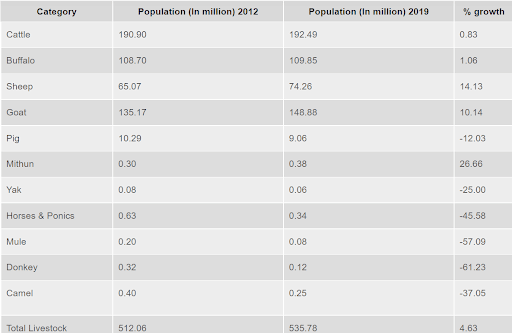
Livestock Population - Major Species
India's Livestock Sector - Current Status
- India is the world's largest producer of milk and the third largest producer of eggs.
- According to the Economic Survey-2021, livestock contributed 28.63% of total agriculture and allied sector GVA (at constant prices) in 2018-19.
- Approximately 200 million Indians are involved in livestock farming, including approximately 100 million dairy farmers.
- Approximately 80% of the country's bovines have low productivity and are raised by small and marginal farmers.
- According to the 20th Livestock Census, the total livestock population in the country is 535.78 million, a 4.6% increase over the Livestock Census-2012.
- With approximately 535.78 million livestock owners, India is the world's largest livestock owner.
Conclusion
A sustained rise in per capita income and urbanisation is fueling rapid growth in demand for animal food products. Demand for animal food products is income elastic, meaning that as their income rises, low-income households will spend more on them. Though urbanisation will continue to be the primary driver of demand growth, rural areas will not lag. Furthermore, global trade in livestock products has been rapidly expanding, implying opportunities for increased exports. Livestock production has been growing faster than crop production, and this trend is likely to continue. Demand-driven growth in livestock production will allow millions of poor people to escape poverty because livestock distribution is more equitable than land distribution.
|
|
|
|---|---|
| Agriculture Notes | Land Reforms in India |
| Scope and Importance of Agriculture | Problems of Indian Agriculture |
| Farming Systems | Agricultural Revolutions in India |
FAQs
Question: What is the role of livestock in agriculture?
Answer: Livestock plays a critical role in agriculture by contributing to the livelihoods of farmers and enhancing agricultural productivity. It provides essential products such as meat, milk, eggs, wool, and leather. Livestock also supports crop production through the provision of manure for fertilizing the soil, improving soil health and fertility. Additionally, livestock is an important source of income for farmers, particularly in rural areas, and plays a crucial role in the socio-economic development of the agricultural sector.
Question: What are the different types of livestock in agriculture?
Answer: The major types of livestock in agriculture include:
- Cattle: Primarily used for milk, beef, and as draft animals for plowing fields.
- Buffaloes: Mainly raised for milk production, especially in areas where dairy farming is prevalent.
- Sheep and Goats: Raised for meat, wool, and milk. Goats, in particular, are important for meat production in many parts of India.
- Poultry: Chickens are primarily raised for eggs and meat, making poultry farming a major component of livestock agriculture.
- Pigs: Raised for meat, especially in certain regions where pork is a dietary staple.
- Horses and Camels: Used primarily for transportation and draft purposes in some regions.
Question: What are the economic benefits of livestock farming in India?
Answer: Livestock farming contributes significantly to India's economy. It provides employment opportunities, particularly in rural areas, where millions of people are engaged in the care, breeding, and management of livestock. Livestock also contributes to the agricultural value chain through the production of milk, eggs, wool, and meat, which are essential for both domestic consumption and export. The dairy industry alone is one of the largest sectors within the agricultural economy, with India being the world's largest producer of milk. Additionally, livestock farming plays a role in improving food security and nutrition, as animal-based products are a rich source of protein.
Question: How does livestock farming contribute to sustainability in agriculture?
Answer: Livestock farming contributes to agricultural sustainability in several ways:
- Manure for Fertilization: Livestock manure is an essential organic fertilizer that helps maintain soil fertility, reducing the need for chemical fertilizers.
- Diversification of Farming Systems: Integrating livestock into farming systems helps diversify income sources and reduces risks associated with crop failure, particularly in areas dependent on monoculture farming.
- Grazing Systems: Grazing animals contribute to maintaining grasslands, preventing soil erosion, and promoting biodiversity in certain ecosystems.
- Renewable Energy: Animal waste can be used to produce biogas, providing a renewable source of energy for cooking and lighting in rural areas.
Question: What are the challenges faced by the livestock sector in India?
Answer: The livestock sector in India faces several challenges, including:
- Inadequate Health and Veterinary Care: There is a lack of proper healthcare facilities, vaccinations, and veterinary services, leading to diseases that affect livestock productivity.
- Poor Genetic Improvement: The genetic potential of indigenous breeds is often underutilized, leading to low productivity in terms of milk, meat, and other products.
- Feed and Water Scarcity: Many regions face challenges in providing adequate nutrition and water to livestock, especially during droughts or dry seasons.
- Market Access and Infrastructure: Poor infrastructure, including inadequate transportation and marketing facilities, limits the ability of farmers to access markets and sell livestock products at fair prices.
- Climate Change: Changing weather patterns and extreme climate events can impact livestock health, feed production, and water availability, threatening livestock farming.
MCQs
- What is the primary role of livestock in agriculture?
A) Soil erosion control
B) Providing manure for crop fertilization
C) Reducing the water requirements for crops
D) Increasing crop yield directly
Answer: (B) See the Explanation
Livestock provides essential manure that is used for fertilizing crops, improving soil fertility.
- Which of the following is a major economic contribution of livestock farming in India?
A) Export of cotton
B) Employment generation in rural areas
C) Increase in wheat production
D) Reduction in food imports
Answer: (B) See the Explanation
Livestock farming plays a crucial role in providing employment, particularly in rural areas, through breeding, care, and management of animals.
- What is a significant challenge faced by the livestock sector in India?
A) Excessive use of fertilizers
B) Inadequate feed and water availability
C) Overproduction of dairy products
D) Too many veterinary clinics
Answer: (B) See the Explanation
Livestock farming faces challenges such as insufficient feed and water, particularly during dry seasons and droughts.
- Which type of livestock is most commonly associated with milk production in India?
A) Pigs
B) Buffaloes
C) Sheep
D) Horses
Answer: (B) See the Explanation
Buffaloes are primarily raised for milk production, and India is one of the largest producers of buffalo milk.
- How does livestock farming contribute to sustainable agricultural practices?
A) By increasing the use of chemical fertilizers
B) By promoting monoculture farming
C) By providing organic manure and supporting crop diversification
D) By limiting animal waste disposal
Answer: (C) See the Explanation
Livestock farming contributes to sustainability by providing organic manure, which improves soil fertility, and by supporting crop diversification, which reduces risks for farmers.
GS Mains Questions and Model Answers
Q1: Discuss the role of livestock in supporting agricultural sustainability and rural economies.
Answer: Livestock plays a fundamental role in supporting agricultural sustainability and the rural economy. As a major source of income for millions of rural households, livestock contributes to economic security, particularly in areas where crop farming alone may not be sufficient. The integration of livestock into farming systems helps diversify income sources, making farmers less dependent on single crops and providing a buffer against crop failure. Livestock also supports crop production through the provision of organic manure, which enhances soil fertility and reduces the need for chemical fertilizers, promoting long-term sustainability.
Furthermore, livestock farming generates employment across various stages of the production process, from breeding to marketing. This makes it an essential sector for rural livelihoods and a key contributor to food security, as livestock products such as milk, meat, eggs, and wool are critical components of the diet and provide necessary nutrients, including protein. The livestock sector also has a significant role in the broader rural economy by supporting related industries such as feed production, veterinary care, and leather manufacturing. Therefore, strengthening the livestock sector is vital for ensuring economic stability and environmental sustainability in rural areas.
Q2: What are the challenges faced by the livestock sector in India, and how can they be addressed?
Answer: The livestock sector in India faces several key challenges that need to be addressed for its sustainable growth and productivity. One of the most pressing challenges is the inadequate healthcare and veterinary infrastructure. A lack of accessible veterinary services and vaccines has led to widespread animal diseases that affect livestock productivity. To address this, there is a need for increased investment in veterinary care and healthcare facilities, especially in rural areas, to ensure healthier livestock and higher productivity.Another significant issue is the poor genetic improvement of indigenous breeds, which limits productivity in terms of milk, meat, and other animal products. Improved breeding programs and the use of modern genetic tools can help improve the yield and health of livestock. Additionally, feed scarcity, particularly during drought periods, affects livestock health and growth. The development of drought-resistant forage crops and improved feed management systems can mitigate this issue.
Q3: Examine the economic importance of livestock farming in India and its contribution to food security.
Answer: Livestock farming is a major economic contributor to India’s rural economy and plays a crucial role in food security. Livestock provides a consistent source of income for millions of farmers and rural households, especially those with limited land for crop cultivation. The dairy industry, in particular, is one of the largest contributors to India’s agricultural GDP, with India being the world’s largest producer of milk. Milk and its by-products, such as ghee and cheese, form an essential part of the Indian diet, contributing to nutritional security.
The economic importance of livestock extends beyond direct products like milk, meat, and eggs. It also supports various ancillary industries, including feed production, veterinary care, leather manufacturing, and animal health products, thereby creating jobs and boosting rural economies. Additionally, livestock plays a key role in maintaining ecological balance, as manure from animals is used to fertilize crops, reducing dependence on chemical fertilizers and enhancing soil health.
The contribution of livestock to food security is substantial, as it provides a reliable source of protein, particularly in regions where plant-based protein sources may be limited. The livestock sector’s ability to withstand environmental fluctuations and the diverse range of products it offers makes it an indispensable part of India’s agricultural system, ensuring that food security is maintained even during crop failures or economic downturns.
Previous Year Questions on Livestock
1. UPSC CSE (IAS) Prelims 2020
Question: What are the economic contributions of the livestock sector in India?
Answer: The livestock sector contributes to rural employment, agricultural productivity, food security, and economic stability, particularly through milk, meat, and by-products, supporting various related industries.
2. UPSC CSE (IAS) Mains 2019
Question: Discuss the challenges faced by the livestock sector in India and the measures required for its development.
Answer: Challenges such as inadequate veterinary care, feed scarcity, and poor infrastructure need to be addressed through improved healthcare services, better feed management, and investment in rural infrastructure to support livestock farming.
Download the PREPP App and attempt FREE IAS Exam Mock Tests and get complete study material!

Full Test - 04: UPSC CSE Prelims CSAT (Paper-II)
Full Test - 03: UPSC CSE Prelims CSAT (Paper-II)
UPSC CSE Prelims 2026 GS Paper 1 Question Paper (24-May-2026)
UPSC CSE Prelims 2026 CSAT Paper 2 Question Paper (24-May-2026)

17 February 2025 | The Hindu Must Read Articles | Current Affairs

16 February 2026 | The Hindu Must Read Articles | Current Affairs

13 February 2026 | The Hindu Must Read Articles | Current Affairs









Comments