Zaid - Agriculture Notes
Zaid is one of the three major cropping seasons in India. Zaid generally refers to the summer season (March-June) that occurs between the Rabi and Kharif seasons. Zaid Crops are crops that are sown in March and harvested in June. Watermelon, muskmelon, vegetables, and fodder crops are some of the important crops grown during the Zaid season. In this article, we will discuss Zaid which will be helpful for UPSC exam preparation.
|
Table of Contents |
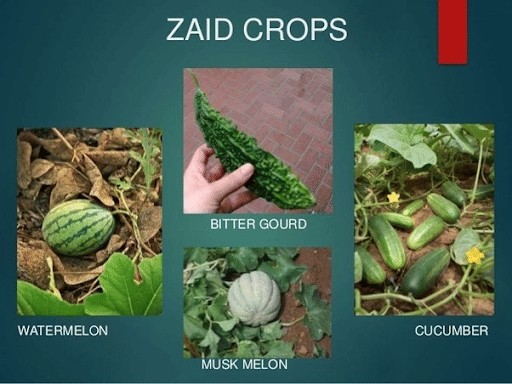
Common Zaid Crops
What exactly are Zaid Crops?
- Zaid crops are summer crops. They grow for a short period between the Kharif and rabi crops, primarily from March to June.
- The season during which the zaid crops are primarily grown is known as the zaid crop season.
- Zaid Crops require warm, dry weather as a major growth period, as well as longer day lengths for flowering.
- Some crops require summer months and rainy seasons. These crops also tend to mature quickly.
- Pumpkin, Cucumber, and Bitter Gourd are some of the other zaid crops grown during the zaid season.
What is the Zaid Season?
- As said earlier, the Zaid season is the one that occurs during the summer months between the Rabi and Kharif seasons.
- Zaid crops, like rabi crops, are rain-fed by monsoon rains (October to November).
- Zaid crops are planted in Northern India during the winter sowing of rabi crops in March and April.
- Potatoes, tomatoes, soybeans, and Sunflowers are among the crops grown by Zaid.
- Different varieties of seeds have different seasons, which vary by region (rainfall pattern).
Important Zaid Crops
- Watermelon
- Muskmelon
- Cucumber
- Bitter gourd
- Fodder
- Pumpkin
- Guar (Cluster Beans)
- Strawberry
- Arhar (Pigeon pea)
- Masur (Lentil)
- Sugarcane
Crop Seasonality
Crop seasonality is an important feature of agriculture (both before and after harvest) for two reasons:
Crop Predictability
- A predictable crop production system ensures food production throughout the year.
- This has a significant impact on price stabilization and thus directly affects the interests of farmers and consumers.
Food availability throughout the year
- This is also important for ensuring food supply to the rural population.
- This has the potential to aid in the development of sustainable agricultural practices, especially given how climate change has affected crop production, which has become more erratic over time.
Importance of Zaid Crops
- Zaid In addition to raising cropping intensity and enhancing land utilization, zaid crops also increase farmers' income.
- Less than 2% of the land is planted during the Zaid season, compared to 107 million hectares during the Kharif season, which is mostly used for the sowing of pulses.
- Pulses sown in the summer rejuvenate the soil and boost farmer income in addition to cereals grown in the summer, which provide food security.
- A variety of fodders are grown over the summer to feed cattle.
- Summertime farming of zaid crops such as fruits, vegetables, and oilseeds not only increases nutrient security but also saves money.
Conclusion
The government is actively encouraging and fostering the growth of the zaid crops since it offers the Indian economy several extremely beneficial advantages. The government plans to embrace the additional revenue that comes with zaid crops and to give farmers who were previously underemployed or out of work as they awaited the next season new employment options. The current emphasis on Zaid crops has been a huge success, as evidenced by the fact that the area under cultivation at this period has been gradually growing over the previous few years.
FAQs
Question: What is Zaid agriculture?
Answer: Zaid agriculture refers to a specific cropping pattern in India that occurs during the Zaid season, which typically runs from March to June. This period falls between the Rabi and Kharif cropping seasons. Zaid agriculture primarily involves the cultivation of short-duration crops that can thrive in the warmer climate. Common crops grown during this period include fruits, vegetables, and legumes such as cucumber, pumpkin, and gourds, as well as certain cereals like maize. The main objective of Zaid agriculture is to utilize the available resources effectively during the offseason to enhance agricultural productivity.
Question: What are the characteristics of Zaid crops?
Answer: Zaid crops are characterized by their short growing period, typically ranging from 60 to 90 days. They are well-suited to warm weather conditions and require relatively less water compared to Kharif crops. These crops can be sown quickly after the Rabi harvest and are often harvested before the onset of monsoon rains, making them an efficient use of available land. The cultivation of Zaid crops also supports the diversification of cropping systems and helps in improving the overall resilience of agricultural production.
Question: What is the significance of Zaid agriculture in India?
Answer: Zaid agriculture holds significant importance in India as it allows farmers to optimize land use and enhance agricultural productivity during the offseason. By growing short-duration crops, farmers can generate additional income and improve food security. This cropping pattern also contributes to the diversification of crops, reducing the risks associated with monoculture and climate variability. Furthermore, Zaid agriculture promotes better utilization of available resources, including labor and water, which can be crucial in regions facing water scarcity.
Question: What are the challenges faced by Zaid agriculture?
Answer: Despite its benefits, Zaid agriculture faces several challenges, including reliance on timely rainfall and favorable weather conditions. Inconsistent monsoon patterns can adversely affect crop yields, making farmers vulnerable to crop failures. Additionally, there may be limited access to quality seeds and agricultural inputs, which can hinder productivity. Market access and pricing for Zaid crops can also pose challenges, as farmers might struggle to find buyers for their produce during the peak harvest season.
Question: How can the productivity of Zaid agriculture be improved?
Answer: To improve the productivity of Zaid agriculture, several measures can be undertaken. These include promoting research and development for high-yielding and disease-resistant varieties of Zaid crops, enhancing access to quality seeds and inputs, and providing training to farmers on best agricultural practices. Additionally, improving irrigation facilities and adopting water-efficient practices can help mitigate the impacts of erratic rainfall. Strengthening market linkages and ensuring fair prices for Zaid produce will also encourage farmers to invest more in this cropping pattern, leading to increased productivity.
MCQs
1. What is the main cropping season for Zaid agriculture in India?
A) October to December
B) March to June
C) June to September
D) January to March
Answer: (B) See the Explanation
Explanation: The main cropping season for Zaid agriculture in India is from March to June, falling between the Rabi and Kharif seasons.
2. Which of the following crops is commonly grown during the Zaid season?
A) Wheat
B) Rice
C) Maize
D) Barley
Answer: (C) See the Explanation
Explanation: Maize is one of the common crops grown during the Zaid season due to its short growing period and adaptability to warm conditions.
3. What is a significant challenge faced by farmers practicing Zaid agriculture?
A) Excessive water availability
B) Reliance on timely rainfall
C) Low market prices
D) High labor costs
Answer: (B) See the Explanation
Explanation: A significant challenge faced by farmers practicing Zaid agriculture is the reliance on timely rainfall, as erratic weather can adversely affect crop yields.
4. How can the productivity of Zaid agriculture be enhanced?
A) By decreasing crop diversity
B) By promoting water-efficient practices
C) By limiting access to quality seeds
D) By reducing market linkages
Answer: (B) See the Explanation
Explanation: Promoting water-efficient practices can enhance the productivity of Zaid agriculture, particularly in regions facing water scarcity.
5. What is the primary goal of Zaid agriculture?
A) To promote monoculture
B) To utilize land effectively during the offseason
C) To increase import of food grains
D) To reduce crop rotation
Answer: (B) See the Explanation
Explanation: The primary goal of Zaid agriculture is to utilize land effectively during the offseason to enhance agricultural productivity and farmer income.
GS Mains Questions and Model Answers
Q1: Evaluate the significance of Zaid agriculture in enhancing food security in India. How does it contribute to overall agricultural productivity?
Answer: Zaid agriculture plays a significant role in enhancing food security in India by allowing farmers to cultivate short-duration crops during the offseason. This cropping pattern increases overall agricultural productivity by utilizing available land effectively, thereby contributing to higher food production. The cultivation of Zaid crops, such as vegetables and pulses, provides essential nutrients and diversifies food sources, thus improving dietary diversity. Moreover, Zaid agriculture offers farmers an additional income stream, which can reduce their vulnerability to market fluctuations and crop failures. By promoting crop diversification and maximizing land use, Zaid agriculture supports the broader goal of food security and sustainable agricultural development in India.
Q2: Discuss the challenges faced by Zaid agriculture and suggest strategies to overcome these challenges.
Answer: Zaid agriculture faces several challenges, including dependence on favorable weather conditions, limited access to quality seeds and inputs, and potential market instability. To overcome these challenges, it is essential to improve irrigation facilities and promote water conservation practices, ensuring that crops receive adequate moisture regardless of rainfall patterns. Enhancing access to high-quality seeds and fertilizers through cooperative societies can empower farmers and boost productivity. Additionally, establishing market linkages and providing price support mechanisms will help stabilize income for farmers, encouraging them to invest in Zaid agriculture more confidently. Through these strategies, the sustainability and productivity of Zaid agriculture can be significantly enhanced.
Q3: Analyze the role of government policies in promoting Zaid agriculture. What measures can be taken to enhance its effectiveness?
Answer: Government policies play a critical role in promoting Zaid agriculture through initiatives such as providing subsidies for seeds and fertilizers, enhancing irrigation infrastructure, and facilitating market access for Zaid crops. Policies that encourage research and development in high-yielding and resilient crop varieties can also support farmers in maximizing their productivity. To enhance the effectiveness of these policies, there should be a focus on training programs that educate farmers about modern agricultural practices and resource management. Furthermore, creating a comprehensive database to monitor crop performance and market trends will assist in making informed policy decisions, ultimately leading to increased adoption and success of Zaid agriculture among farmers.
Previous Year Questions on Zaid Agriculture
1. UPSC CSE Prelims 2021:
Question: What is the primary season for Zaid agriculture?
A) Rabi
B) Kharif
C) Zaid
D) Monsoon
Answer: (C)
Explanation: The primary season for Zaid agriculture is during the Zaid season, which occurs from March to June.
2. UPSC CSE Mains 2020 (GS Paper 3):
Question: "Assess the significance of Zaid agriculture in India's agricultural landscape. What are its advantages and challenges?"
Answer: Zaid agriculture is significant in India's agricultural landscape as it allows farmers to optimize land use during the offseason, increasing overall agricultural productivity. Advantages include generating additional income and enhancing food security through diverse crops. However, challenges such as dependency on weather conditions and market access issues persist. To address these challenges, it is essential to promote irrigation infrastructure, provide quality inputs, and ensure fair market practices, thus sustaining the importance of Zaid agriculture in the broader agricultural framework of India.
Download the PREPP App and attempt FREE IAS Exam Mock Tests and get complete study material!

Full Test - 04: UPSC CSE Prelims CSAT (Paper-II)
Full Test - 03: UPSC CSE Prelims CSAT (Paper-II)
UPSC CSE Prelims 2026 CSAT Paper 2 Question Paper (24-May-2026)
UPSC CSE Prelims 2026 GS Paper 1 Question Paper (24-May-2026)

17 February 2025 | The Hindu Must Read Articles | Current Affairs

16 February 2026 | The Hindu Must Read Articles | Current Affairs

13 February 2026 | The Hindu Must Read Articles | Current Affairs









Comments