Kharif - Agriculture Notes
Kharif crops, also known as monsoon crops or autumn crops, are domesticated plants grown and harvested in India, Pakistan, and Bangladesh during the monsoon season, which lasts from June to November depending on location. Rice, maize, and cotton are some of India's major Kharif crops. Monsoon rains can begin as early as May in some parts of the Indian subcontinent, and crops are typically harvested between the third and fourth weeks of September and October. In contrast to Rabi crops, which are grown in the winter, Kharif crops require adequate rainfall. In this article, we will discuss Kharif which will be helpful for UPSC exam preparation.
|
Table of Contents |
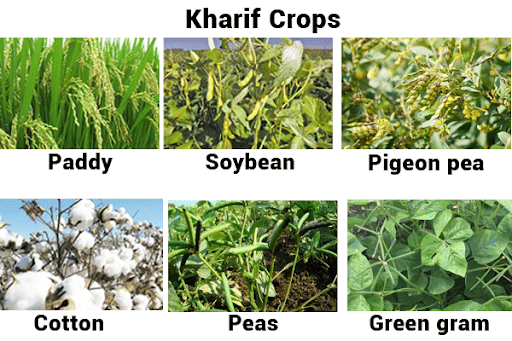
Common Kharif Crops
What is a Kharif Crop?
- The Kharif crops are often called monsoon crops because they are usually sown in the months of June-October.
- The monsoon months are regarded as ideal for seeding since the crops need a warm, humid temperature for germination.
- As monsoon arrives at a different time in the different states of the country, the exact months vary from state to state.
- For instance, seeds may be seeded in the southern states by the end of May, whereas they are often shown in the northeastern states by the end of June.
- Major crops planted during this season are paddy, maize, jowar, bajra, tur (arhar), moong, urad, cotton, jute, groundnut, and soya bean.
Common Kharif Crops
The type of crops grown and harvested in the Kharif season is:
Rice
Since India is the world's top producer of rice, it is a staple food in Indian households, rice is seeded and harvested during the Kharif season because it is a crop that demands a lot of water and thrives in a hot, humid atmosphere.
Sugarcane
In India, sugar cane production occupies about 2.8% of the gross planted area. It requires a hot and humid atmosphere to be grown because it is an important raw ingredient in this sugar industry.
Cotton
Indian cotton, the most significant fiber crop in the nation, is well known around the world for its superior quality. Cotton can grow best in climates with black soil and high humidity levels.
What is the Kharif Season?
- Kharif is one of the three major cropping seasons in India. The Kharif season starts in May and ends in January at the latest and it varies from crop to crop and from region to region.
- In India, the Kharif Season generally starts in June and ends in October.
- Kharif crops are typically planted at the start of the first rains of the southwest monsoon season and harvested at the end of the monsoon season (October–November).
- Monsoon sowing dates vary, occurring toward the end of May in the southern state of Kerala and reaching July in some north Indian states.
- Kharif crops are sown in May, June, and July in other regions where rains fall in June, such as Maharashtra, the west coast of India, and Pakistan.
- Kharif crops are typically planted in Bangladesh at the start of the first rain in June.
Kharif Crops and the Producing States
| Kharif Crop | Producing States |
|---|---|
| Rice | West Bengal, Uttar Pradesh, Andhra Pradesh, Punjab and Tamil Nadu |
| Sugarcane | Maharashtra, Andhra Pradesh, Tamil Nadu, Karnataka, Gujarat, Madhya Pradesh, Goa, Pondicherry and Kerala |
| Cotton | Punjab, Haryana, Rajasthan, Uttar Pradesh, Madhya Pradesh, Gujarat, Maharashtra and parts of Andhra Pradesh and Karnataka. |
| Maize | Andhra Pradesh, Karnataka, Rajasthan, Maharashtra, Bihar, Uttar Pradesh |
| Groundnut | Gujarat, Rajasthan, Tamil Nadu, Andhra Pradesh, Karnataka and Madhya Pradesh |
| Bajra | Rajasthan, Uttar Pradesh, Haryana, Gujarat |
Difference Between Kharif And Rabi Crops
| Kharif Crops | Rabi Crops |
|---|---|
| Kharif or monsoon crops are crops that are planted during the southwest monsoon season. | Rabi or winter crops are those that are sown during the Retreating Monsoon and Northeast Monsoon season, which begins in October. |
| These crops are planted in the late spring to early summer and harvested after the monsoon rains begin in October. | These crops are typically harvested between April and May, during the summer season. |
| Kharif crops are reliant on rainfall patterns. | Rainfall has little impact on these crops. |
| Rice, maize, and pulses such as urad, moong dal, and millets are examples of Kharif Crops. | Wheat, gram, peas, and barley are examples of Rabi Crops. |
| It requires a lot of water and hot weather to grow. | A warm climate is required for seed germination, and a cold climate is required for crop growth. |
Conclusion
A successful Kharif and rabi season is critical to ensuring food availability to feed the country's growing population. In addition, a poor monsoon and lower crop output may prompt the government to raise minimum support prices for farmers as a show of solidarity with the larger farming community. This, in turn, may result in a higher market price.
FAQs
Question: What is Kharif agriculture and when is it practiced in India?
Answer: Kharif agriculture, also known as monsoon or summer cropping, is a type of farming that is primarily practiced in India during the monsoon season. It typically begins with the onset of the southwest monsoon around June and continues until September. The crops harvested during this period are usually sown with the first rains and are dependent on the moisture provided by the monsoon. Kharif crops include staples like rice, maize, and millet, as well as pulses and oilseeds, playing a crucial role in the agricultural economy of India.
Question: What are the major crops cultivated during the Kharif season?
Answer: The major crops cultivated during the Kharif season include rice, maize, sorghum (jowar), pearl millet (bajra), cotton, groundnut, and various pulses such as moong and urad. These crops are specifically chosen for their compatibility with the climatic conditions prevalent during the monsoon season, as they require substantial rainfall for optimal growth. The diversity of Kharif crops is essential for maintaining food security and supporting the livelihoods of farmers across India.
Question: What are the key climatic conditions required for Kharif farming?
Answer: Kharif farming requires specific climatic conditions to thrive, primarily characterized by adequate rainfall and warm temperatures. The southwest monsoon, which brings heavy rains from June to September, is crucial for the growth of Kharif crops. The average rainfall during this season ranges from 75 cm to 100 cm, which is essential for moisture retention in the soil. Additionally, temperatures during this period typically range between 25°C to 35°C, promoting optimal growth conditions for various crops.
Question: How does Kharif agriculture impact the Indian economy?
Answer: Kharif agriculture has a significant impact on the Indian economy as it contributes to food security, rural employment, and overall agricultural output. With approximately 50% of the total cultivated area in India dedicated to Kharif crops, the season is vital for ensuring the supply of staple foods like rice and pulses. The economic activities generated by Kharif agriculture also support livelihoods for millions of farmers and laborers, playing a crucial role in rural development. Moreover, the success of Kharif crops influences market prices and the stability of the agricultural sector as a whole.
Question: What challenges does Kharif agriculture face in India?
Answer: Kharif agriculture faces several challenges in India, including unpredictable weather patterns, which can lead to irregular monsoon rainfall. Excessive rainfall can cause flooding, while insufficient rainfall can result in drought, both adversely affecting crop yields. Additionally, farmers often deal with issues such as soil degradation, pest infestations, and lack of access to modern agricultural technologies and irrigation systems. These challenges can significantly impact the productivity and sustainability of Kharif farming, necessitating the adoption of improved farming practices and government support for farmers.
MCQs
1. What is the primary season for Kharif agriculture in India?
A) Winter
B) Summer
C) Monsoon
D) Spring
Answer: See the Explanation
Explanation: The primary season for Kharif agriculture in India is the monsoon season, starting around June and ending in September.
2. Which of the following is a major Kharif crop?
A) Wheat
B) Rice
C) Barley
D) Mustard
Answer: See the Explanation
Explanation: Rice is a major Kharif crop that is sown with the onset of the monsoon rains.
3. What climatic condition is essential for Kharif crops?
A) Low humidity
B) Heavy rainfall
C) Cool temperatures
D) Dry conditions
Answer: See the Explanation
Explanation: Heavy rainfall is essential for Kharif crops, as they depend on the monsoon for moisture.
4. How does Kharif agriculture contribute to the Indian economy?
A) By increasing imports
B) By reducing employment
C) By enhancing food security and providing rural livelihoods
D) By discouraging local farming
Answer: See the Explanation
Explanation: Kharif agriculture enhances food security and provides rural livelihoods, significantly contributing to the Indian economy.
5. What are the challenges faced by Kharif agriculture in India?
A) Consistent rainfall
B) Weather unpredictability and soil degradation
C) Advanced technology access
D) High crop yields
Answer: See the Explanation
Explanation: Kharif agriculture faces challenges such as weather unpredictability and soil degradation, affecting crop yields.
GS Mains Questions and Model Answers
Q1: Discuss the importance of Kharif agriculture in India’s agricultural landscape.
Answer: Kharif agriculture plays a vital role in India's agricultural landscape by contributing significantly to food production and rural employment. The monsoon season, which is critical for Kharif crops, provides the necessary moisture for growing staple foods like rice and pulses, thereby supporting food security. Kharif crops are cultivated on approximately half of India’s total agricultural land, making them essential for the livelihoods of millions of farmers. The economic activities associated with Kharif farming also stimulate local economies, fostering rural development. Overall, Kharif agriculture is integral to India’s agrarian economy, influencing market prices and food availability throughout the year.
Q2: Analyze the impact of climate change on Kharif agriculture and the measures needed to mitigate its effects.
Answer: Climate change poses significant risks to Kharif agriculture, primarily through alterations in rainfall patterns and increased frequency of extreme weather events. Erratic monsoon rainfall can lead to either drought or flooding, both of which adversely affect crop yields. Additionally, rising temperatures can impact the growth cycles of Kharif crops. To mitigate these effects, it is essential to adopt adaptive agricultural practices, such as crop diversification, improved irrigation techniques, and the use of climate-resilient crop varieties. Furthermore, investing in research and development to enhance agricultural resilience and promoting sustainable farming practices will be critical in safeguarding Kharif agriculture against the impacts of climate change.
Q3: Evaluate the role of government policies in supporting Kharif agriculture in India.
Answer: Government policies play a crucial role in supporting Kharif agriculture in India through various initiatives aimed at enhancing productivity and ensuring the welfare of farmers. Subsidies for fertilizers and seeds, along with access to credit, help reduce production costs for Kharif crops. Additionally, the implementation of minimum support prices (MSP) provides a safety net for farmers, ensuring they receive fair compensation for their produce. Furthermore, government programs focusing on irrigation development and agricultural extension services aim to improve farming practices and increase yield. These policies are instrumental in promoting sustainable agricultural growth and securing the livelihoods of millions of farmers engaged in Kharif agriculture.
Previous Year Questions on Kharif Agriculture
1. UPSC CSE Prelims 2021:
Question: During which season is Kharif agriculture practiced in India?
A) Winter
B) Summer
C) Monsoon
D) Spring
Answer: (C)
Explanation: Kharif agriculture is practiced during the monsoon season in India, beginning in June and ending in September.
2. UPSC CSE Mains 2019 (GS Paper 1):
Question: "Analyze the challenges faced by Kharif agriculture in India and suggest measures to overcome them." Discuss.
Answer: Kharif agriculture in India faces several challenges, including unpredictable monsoon patterns, soil degradation, and pest infestations. These factors lead to fluctuations in crop yields and threaten the livelihoods of farmers. To overcome these challenges, it is essential to implement integrated pest management techniques, promote sustainable agricultural practices, and invest in irrigation infrastructure to reduce dependency on monsoon rainfall. Additionally, enhancing access to agricultural education and technology can empower farmers to adopt innovative practices that improve resilience and productivity in Kharif farming.
Download the PREPP App and attempt FREE IAS Exam Mock Tests and get complete study material!

Full Test - 04: UPSC CSE Prelims CSAT (Paper-II)
Full Test - 03: UPSC CSE Prelims CSAT (Paper-II)
UPSC CSE Prelims 2026 CSAT Paper 2 Question Paper (24-May-2026)
UPSC CSE Prelims 2026 GS Paper 1 Question Paper (24-May-2026)

17 February 2025 | The Hindu Must Read Articles | Current Affairs

16 February 2026 | The Hindu Must Read Articles | Current Affairs

13 February 2026 | The Hindu Must Read Articles | Current Affairs









Comments