Classification Based on Length of Photoperiod Required for Floral Initiation - Agriculture Notes
Photoperiodism refers to the time of day when plants receive light. It is the reaction of plants to the hours of day and night. Plants undergo changes after detecting differences in the lengths of days and nights. Thus, plants use this time-measurement mechanism to grow, develop, and reproduce. In this article, we will discuss Classification based on length of photoperiod required for floral initiation which will be helpful for UPSC exam preparation.
|
Table of Contents |
What is Photoperiodism?
- Photoperiod is the difference between the lengths of day and night.
- Some plants require a specific amount of time in the sun to flower. This is why flowers bloom seasonally.
- In 1880, Charles Darwin and his son Francis discovered and identified this type of natural phenomenon.
- Most angiosperms (flowering plants) use photoperiodism to determine when to flower.
- They do this by using one of the photoreceptor proteins found in their bodies, such as cryptochrome or phytochrome.
- There is a well-defined critical duration and this critical duration varies by plant.
- Plants can be classified into three types based on their duration:
- Long-Day Plants (LDP)
- Short-Day Plants (LDP)
- Day Neutral Plants (LDP)
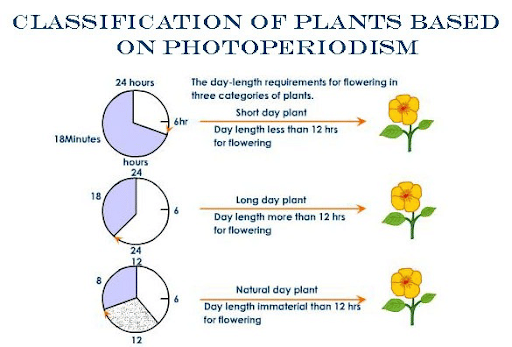
Classification of Plants Based on Photoperiodism
Classification of Plants Based on Photoperiodism
Long-Day Plants (LDP)
- Long-day plants (LDP) are those that require more light exposure.
- When the days grow longer, these plants bloom.
- They require more than the critical duration of light to flower (usually 14-16 hours).
- The light period is critical in LDP plants. Flowering in these plants is boosted by extending the light period or exposing them to light briefly during the dark period.
- LDP plants are rarely found in areas where the day is too short.
- They're also known as 'Short Night Plants.'
- Examples include spinach, radish, hibiscus, sugar beet, etc.
Short-Day Plants (SDP)
- Short-day plants are those that require less light exposure (SDP).
- When the days grow shorter, these plants bloom.
- They require less than the critical duration of light (about 8-10 hours) and a continuous dark period (about 14-16 hours) to flower.
- The dark period is critical for SDP plants and must be continuous. These plants will not flower if the dark period is briefly interrupted by light.
- SDP plants are rarely found in areas where the length of the day is excessively long.
- They're also known as 'Long Night Plants.'
- For example, sunflower, rice, soybeans, tobacco, chrysanthemum are a few examples.
Day Neutral Plants
- Plants that flower regardless of the length of the day are referred to as day-neutral plants (DNP).
- After reaching a certain developmental stage, day-neutral plants flower.
- Flowering is not dependent on photoperiodism.
- Roses, tomatoes, cucumbers, pea plants are examples.
Other plants avoid seasonal ambiguity by distinguishing between days that are getting shorter and days that are getting longer. There are two types of "dual-day length plants":
Long Short Day Plants (LSDPs)
- Long-short-day plants are those that flower after being exposed to long-day conditions followed by short periods of light.
- Bryophyllum, Kalanchoe, and Cestrum nocturnum (night-blooming jasmine) are LSDPs that bloom in the late summer and fall, when the days are getting shorter.
Short Long Day Plants (SLDPs)
- Short-long-day plants are those that require a series of short days followed by long days in order to begin flowering.
- These plants bloom in late spring or early summer, when the days lengthen from short to long.
- Examples: Winter rye, candytuft, Trifolium repens (white clover), Campanula medium (Canterbury bells), and Echeveria harmsii (echeveria).
Concept of Critical Day Length
- The critical day length is the duration of light (photoperiod) required to induce flowering.
- It has been discovered that photoperiodism does not refer to the absolute length of day and night, but rather to the fact that each class of plants flowers in response to a specific duration of light (photoperiod).
- Both Maryland mammoth tobacco and Xanthium sp are short-day plants, but Maryland mammoth flowers when exposed to light for less than 12 hours, i.e., 12 hours of light and 12 hours of darkness, whereas Xanthium sp flowers when exposed to light for less than 15.5 hours, i.e., 15.5 hours of light and 8.5 hours of darkness.
- Thus, the critical day length of the Maryland mammoth is 12 hours, and that of Xanthium sp is 15.5 hours.
- This suggests that when a short-day plant is given a photoperiod shorter than its critical day length, it flowers.
- Long-day plants, on the other hand, flower when photoperiods are longer than their critical day length.
- For example, the critical day length for black henbane (Hyoscymus niger) is 11 hours, which corresponds to 11 hours of light and 13 hours of darkness.
- When exposed to light for more than 11 hours, it produces flowers.
Significance of Photoperiodism in Plants
- Photoperiodism in plants is important in hybridization experiments, cross-breeding, and other processes.
- Photoperiodism in plants is used by horticulturists to increase tuber and rhizome yield.
- Photoperiodism is useful in determining the flowering season of various plants.
- It promotes cross-breeding between flowers that bloom at different times of the year.
- By providing a suitable photoperiod, any flower can be grown year round in a greenhouse.
Conclusion
Plant growth is one of the most visible phenomena. Temperature, humidity, light, nutrition, and other factors all have an impact on it. Photoperiodism is a plant reaction in which it responds to changes in the length of light and dark periods in order to complete the flowering process. It also indicates that a specific flower can bloom at a specific time of year, which may vary from plant to plant. Phytochrome is a pigment that aids in the induction of photoperiods. Photoperiodism is critical for plant hybridisation experiments because it allows the plant to produce flowers at different times of the year.
FAQs
Question. What is photoperiodism in plants?
Answer: Photoperiodism is the physiological reaction of plants to the length of day and night, influencing flowering, growth, and other processes.
Question. How are plants classified based on photoperiod requirements?
Answer: Plants are classified as short-day, long-day, and day-neutral plants depending on their flowering response to the length of light exposure.
Question. What are short-day plants?
Answer: Short-day plants require a photoperiod shorter than a critical length to flower, usually blooming in late summer, fall, or early winter.
Question. What are long-day plants?
Answer: Long-day plants need a longer photoperiod than the critical length to initiate flowering, typically blooming in late spring or summer.
Question. What are day-neutral plants?
Answer: Day-neutral plants flower regardless of the photoperiod length, as their flowering is not influenced by day or night duration.
MCQs
- Which of the following plants is a short-day plant?
A) Wheat
B) Rice
C) Barley
D) Lettuce
Answer: (B) See the Explanation
Rice requires a shorter photoperiod to initiate flowering and is thus categorized as a short-day plant.
- What is the critical photoperiod for long-day plants?
A) Less than 12 hours
B) Exactly 12 hours
C) More than 12 hours
D) Irrespective of light duration
Answer: (C) See the Explanation
Long-day plants flower when the day length exceeds a critical photoperiod of 12 hours or more.
- Which hormone is closely associated with photoperiodic response in plants?
A) Cytokinin
B) Ethylene
C) Florigen
D) Auxin
Answer: (C) See the Explanation
Florigen is a flowering hormone that regulates photoperiodic responses in plants.
- Which of the following crops is day-neutral?
A) Tomato
B) Wheat
C) Sunflower
D) Maize
Answer: (A) See the Explanation
Tomato is a day-neutral plant and flowers irrespective of photoperiod length.
- What is the process of flowering induced by photoperiod called?
A) Vernalization
B) Phototropism
C) Photoperiodism
D) Transpiration
Answer: (C) See the Explanation
Photoperiodism is the process in which the duration of light and dark periods influences flowering in plants.
GS Mains Questions and Model Answers
Q1: Explain the significance of photoperiodism in crop production.
Answer: Photoperiodism influences flowering, fruiting, and maturity of crops. It helps determine the suitability of crops for specific regions based on day length. Short-day plants like rice are suitable for tropical areas, while long-day plants like wheat thrive in temperate regions. Photoperiodism also enables manipulation of flowering using artificial light or shade in controlled environments.
Q2: Discuss the role of critical photoperiod in determining the agricultural calendar.
Answer: Critical photoperiod ensures crops flower during optimal environmental conditions. Farmers use knowledge of photoperiodism to schedule planting and harvesting. It impacts intercropping systems and season-specific planting, aiding in maximizing productivity.
Q3: Describe the differences between short-day, long-day, and day-neutral plants with examples.
Answer: Short-day plants flower when day length is less than critical (e.g., Rice, Chrysanthemum). Long-day plants flower when day length exceeds critical (e.g., Wheat, Lettuce). Day-neutral plants flower irrespective of photoperiod (e.g., Tomato, Cotton).
Previous Year Questions on Photoperiodism
1. UPSC CSE Prelims 2021
Question: Which of the following statements is correct regarding photoperiodism?
- Short-day plants flower when exposed to less light than the critical photoperiod.
- Long-day plants flower only when exposed to more light than the critical photoperiod.
- Day-neutral plants flower regardless of photoperiod.
A) 1 and 2 only
B) 2 and 3 only
C) 1, 2, and 3
D) 1 and 3 only
Answer: (C) See the Explanation
The classification of plants into short-day, long-day, and day-neutral types is based on their flowering response to light exposure duration.
2. UPSC CSE Mains 2019
Question: Examine the role of photoperiodism in the agricultural adaptation of crops.
Answer: Photoperiodism allows crops to adapt to specific geographical and climatic conditions. Short-day plants are suited for regions with shorter days, e.g., rice in tropical areas. Long-day plants thrive in longer daylight, e.g., wheat in temperate climates. Photoperiodism facilitates crop rotation and diversification by understanding the flowering behavior. It also plays a critical role in protected cultivation where artificial lighting controls photoperiod.
Download the PREPP App and attempt FREE IAS Exam Mock Tests and get complete study material!

Full Test - 04: UPSC CSE Prelims CSAT (Paper-II)
Full Test - 03: UPSC CSE Prelims CSAT (Paper-II)
UPSC CSE Prelims 2026 GS Paper 1 Question Paper (24-May-2026)
UPSC CSE Prelims 2026 CSAT Paper 2 Question Paper (24-May-2026)

17 February 2025 | The Hindu Must Read Articles | Current Affairs

16 February 2026 | The Hindu Must Read Articles | Current Affairs

13 February 2026 | The Hindu Must Read Articles | Current Affairs









Comments