Classification Based on Root System - Agriculture Notes
Roots are an essential underground component of all vascular plants. This part of the plant is primarily in charge of anchoring it to the ground and absorbing essential mineral elements, nutrients, and water from the soil. It is also used for food storage. Plants have two types of root systems: taproot, which has a larger main taproot that grows faster than branch roots, and fibrous, which has all roots about the same size. This article will explain the Classification based on the root system which will be helpful in preparing the Agriculture Syllabus for the UPSC Civil Service exam.
|
Table of Contents |
What is a Root System?
- The root system is the plant's descending (growing downwards) portion.
- A plant's root system constantly supplies water and dissolved minerals to the stems and leaves.
- To accomplish this, the roots must expand into new soil regions.
- The photosynthesis process in the leaves promotes the growth and metabolism of the plant root system.
- The phloem transports photosynthate from the leaves to the root system. This process is aided by the root structure.
- Root systems are mainly of two types:
- Tap root system
- Fibrous Root System
- However, not all plants have underground roots; some have roots that grow above ground. These are known as aerial roots.
- Aerial roots, like underground roots, are responsible for absorbing nutrients, anchoring and affixing the plant to structures such as nearby walls, rocks, trellises, and so on.
- Plants with aerial roots include bonsai, banyan trees, mangroves, and others.
Classification of Crops Based on Root System
Tap Root System
- Taproot is the primary root system main root that grows vertically downwards.
- Most dicotyledonous plants, such as dandelions, produce taproots, and some of the roots, such as carrots and beets, are edible and specialised for food storage.
- Taproot is nearly straight, thicker, and taper in size; roots grow directly downwards in the taproot system.
- A taproot system is made up of one thick, cylindrical main root known as the primary root.
- Secondary and tertiary roots are formed by branching off from the primary roots.
- The taproot system is very different from the adventitious root system or the fibrous root system, but some plants that germinate as taproot plants will develop branching root structures.
- Some rely on the main root for storage and may keep the dominant taproot for centuries.
- Taproot System Examples: Turnip, Parsnip, Beetroot, Carrot, Radish
- Taproot weeds: Common milkweed, Dandelion
- Taproot trees: Pines, Firs, Oaks, Jamun tree, Elms
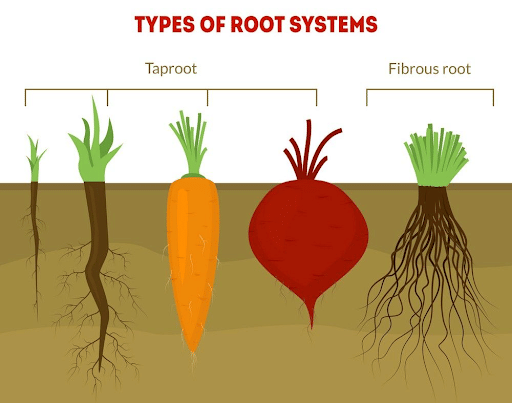
Taproot System
*For detailed notes of this topic, check this link Tap root system
Fibrous Root System
- Fibrous roots are extrinsic roots that are slim, exceptionally stretched, and concentrated near the soil's surface.
- They support the plant with a dense network of fine roots. These plants are generally effective at preventing disintegration.
- Fibrous roots are bushy roots from which thin, moderately branching roots grow.
- Rice, wheat, maize, marigold, banana, and all monocotyledons have fibrous root systems.
- Fibrous roots, like taproot systems, begin as a single main root. These primary roots are short-lived, and as the plant grows, they are replaced by a large number of fibre-like roots that emerge from the base of the stem.
- Fibrous roots, such as those of palm trees, spread like a mat in the soil.
- The roots of the fibrous root system are morphologically similar to the roots of the taproot system, which produces a thin, short root from a single, thick root.
- Except for the radicle, these are roots that grow from any part of the plant. They can be either aerial or underground.
- They can sprout from a node (money plant, bamboo), a stem cutting (rose), a tree branch (banyan), or the base of a stem (fibrous roots in monocots).
- A few examples of plants with fibrous root systems: Rosemary, grass, and coconut palm.
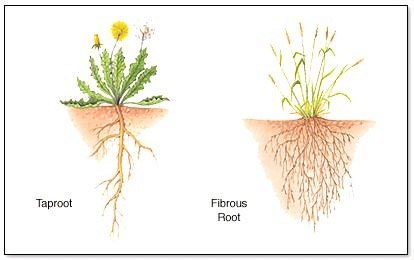
Fibrous Root System
*For detailed notes of this topic, check this link Fibrous Root System
Significance of Root system
- Roots perform a variety of functions that are essential for plant survival. They are an integral or integrated system that assists the plan.
- Plants remain attached to the ground due to their roots. They provide support to the plant body, allowing it to stand upright.
- Absorption: The roots' primary function is to absorb water and dissolved minerals from the soil. This is critical because it aids in photosynthesis.
- Plants prepare food and store it as starch in their leaves, shoots, and roots.
- Carrots, radishes, beets, and other vegetables are prominent examples.
- Reproduction: Although roots do not reproduce, they are vegetative parts of plants. The roots of some plants serve as a means of reproduction.
- New plants, for example, emerge from creeping horizontal stems known as runners (stolons) in jasmine, grass, and other plants. This method of reproduction is known as vegetative propagation.
- Ecological Function: They prevent soil erosion and provide food and shelter to a variety of organisms.
Conclusion
All vascular plants require roots as an underground component. Roots perform a number of essential functions for plant survival. They are an integral or integrated system that aids in the execution of the plan. Because of their roots, plants remain attached to the ground. They support the plant's body and allow it to stand upright. This part of the plant is primarily responsible for anchoring it to the ground and absorbing essential minerals, nutrients, and water from the soil.
FAQs
Question. What are the two main types of root systems in plants?
Answer: The two main types of root systems in plants are the fibrous root system and the tap root system. In the fibrous root system, multiple thin roots arise from the base of the stem, while in the tap root system, a single primary root grows thicker and deeper with secondary roots branching from it.
Question. What is a fibrous root system?
Answer: A fibrous root system is one where the primary root is short-lived and many smaller roots arise from the base of the stem. This type of root system is found in grasses, wheat, and other monocots.
Question. What is a tap root system?
Answer: A tap root system consists of a thick primary root that grows deep into the soil, with smaller lateral roots branching off it. This root system is typical of dicots like carrots, beets, and trees.
Question. How does the root system affect plant growth?
Answer: The root system plays a vital role in anchoring the plant, absorbing water and nutrients, and storing food. A deep tap root system helps plants access water from deeper soil layers, while a fibrous root system is effective in spreading across a larger area for nutrient uptake.
Question. Can a plant have both root systems?
Answer: Some plants can have a combination of both root systems. These are known as adventitious roots. For example, in some dicots, the fibrous roots may emerge from the base of the stem in addition to the primary tap root.
MCQs
- Which of the following plants has a fibrous root system?
A) Carrot
B) Mango
C) Wheat
D) Sunflower
Answer: (C) See the Explanation
Wheat, like most grasses, has a fibrous root system where many thin roots arise from the base of the stem.
- What is the primary function of the root system?
A) Photosynthesis
B) Water and nutrient absorption
C) Reproduction
D) Storage of food
Answer: (B) See the Explanation
The root system's primary function is to absorb water and nutrients from the soil and anchor the plant to the ground.
- Which type of root system is most common in dicot plants?
A) Fibrous root system
B) Tap root system
C) Adventitious root system
D) Aquatic root system
Answer: (B) See the Explanation
The tap root system is most commonly found in dicots, where the primary root grows thicker and deeper with smaller lateral roots.
- Which of the following is true about fibrous root systems?
A) It has a single dominant root.
B) It is common in dicots.
C) It helps in the rapid absorption of water.
D) It grows deeper into the soil.
Answer: (C) See the Explanation
Fibrous roots are good at rapidly absorbing water and nutrients from the surface soil, as they spread out from the base of the stem.
- Which plant has a tap root system?
A) Grass
B) Wheat
C) Carrot
D) Rice
Answer: (C) See the Explanation
Carrot is a classic example of a plant with a tap root system, where the main root grows deep into the soil.
GS Mains Questions and Model Answers
Q1: Describe the classification of plants based on their root systems.
Answer: Root systems in plants are classified into two main types: the fibrous root system and the tap root system. The fibrous root system is characterized by many thin roots arising from the base of the stem, typical in monocots such as grasses, wheat, and rice. The tap root system consists of a thick primary root that grows deep into the soil, with smaller lateral roots branching from it, typical of dicots such as carrots, beets, and trees. The root system plays a crucial role in anchoring the plant, absorbing water and nutrients, and storing food. Additionally, some plants exhibit adventitious roots, which may form from other parts of the plant, contributing to both nutrient uptake and vegetative reproduction.
Q2: Explain the role of root systems in the growth and development of plants.
Answer: Root systems are essential for plant survival and growth, serving multiple functions. The primary role of roots is to anchor the plant in the soil, providing stability. Roots also absorb water and nutrients essential for growth and metabolic processes, supporting photosynthesis in leaves. The root system is also involved in food storage, particularly in plants with tap roots such as carrots and beets, where nutrients are stored for future growth. Additionally, the root system can influence plant development by affecting the plant's access to resources, including water and minerals, and contributing to the overall health and vigor of the plant.
Q3: Discuss the significance of root system adaptation in agriculture.
Answer: Root system adaptation is critical for enhancing agricultural productivity. The type and structure of a plant’s root system influence its ability to absorb water and nutrients, which is particularly important in regions with irregular rainfall. For example, plants with deep tap roots, such as trees and certain vegetables, are better suited to survive drought conditions by reaching deeper soil layers for moisture. On the other hand, crops with fibrous root systems, such as cereals, are better at rapidly absorbing surface water and nutrients. Understanding root system adaptation can help farmers select the best crops for specific soil types and environmental conditions, improving yield and resource management in agriculture.
Previous Year Questions on Classification based on Root System
1. UPSC CSE 2016
Question: "What are the different types of root systems in plants, and how do they affect plant growth?"
Answer: The two main types of root systems in plants are the fibrous root system and the tap root system. In the fibrous root system, numerous thin roots emerge from the base of the stem, spreading out in the soil. This system helps in the rapid absorption of water and nutrients. In contrast, the tap root system features a dominant primary root that grows deep into the soil, with smaller lateral roots branching from it. This system is efficient in accessing deep water reserves and storing nutrients. Both systems play vital roles in plant growth by anchoring the plant, absorbing nutrients, and supporting overall development.
2. UPSC CSE 2019
Question: "Explain the advantages and disadvantages of fibrous and tap root systems in agriculture."
Answer: The fibrous root system offers advantages such as efficient water absorption from surface soil, rapid spread across a wide area, and minimal soil erosion. It is commonly found in cereals and grasses. However, it may struggle in dry conditions as it is less able to access deeper water reserves. The tap root system, on the other hand, offers deep penetration into the soil, making it ideal for drought conditions as it can access deeper water sources. However, it may be slower in spreading, and shallow roots can be vulnerable to nutrient depletion in the upper soil layers. Both systems have distinct advantages depending on the environmental conditions and agricultural requirements.
Download the PREPP App and attempt FREE IAS Exam Mock Tests and get complete study material!

Full Test - 04: UPSC CSE Prelims CSAT (Paper-II)
Full Test - 03: UPSC CSE Prelims CSAT (Paper-II)
UPSC CSE Prelims 2026 CSAT Paper 2 Question Paper (24-May-2026)
UPSC CSE Prelims 2026 GS Paper 1 Question Paper (24-May-2026)

17 February 2025 | The Hindu Must Read Articles | Current Affairs

16 February 2026 | The Hindu Must Read Articles | Current Affairs

13 February 2026 | The Hindu Must Read Articles | Current Affairs









Comments