Classification of Crops Based on Cultural Method - Agriculture Notes
A crop is a plant that can be widely grown and harvested for profit or subsistence. Crop can refer to either the harvested parts or the harvest in its refined state. The majority of crops are grown in agriculture or aquaculture. Rainfed crops are those that grow solely on rainwater. Irrigated crops are those that are grown with the assistance of irrigation water. In this article, we will discuss Classification of crops based on cultural methods which will be helpful for UPSC exam preparation.
|
Table of Contents |
What is a Crop?
- A crop is a plant that can be grown and harvested on a large scale for profit or subsistence. Most crops are grown in agriculture or aquaculture.
- The majority of crops are harvested for human consumption or as livestock fodder.
- Some crops are often gathered from the wild in a form of intensive gathering (e.g. ginseng, yohimbe, and eucommia).
- Horticulture, floriculture, and industrial crops are important non-food crops.
- Plants used in horticulture include those used in other crops (e.g. fruit trees).
- Floriculture crops include bedding plants, houseplants, flowering garden and pot plants, cut cultivated greens, and cut flowers.
- Industrial crops are grown for clothing (fibre crops such as cotton), biofuel (energy crops such as algae fuel), or medicine (medicinal plants).
Importance of Plant Classification
- To become acquainted with crops.
- To understand the soil and water requirements of various crops.
- To understand crop adaptability.
- Understand crop growing habits.
- To comprehend the climatic needs of various crops.
- Understand the economic value of the crop plant and its application.
- Understanding the crop's growing season
- Understand the actual conditions required for plant cultivation.
Classification Based on Cultural Method
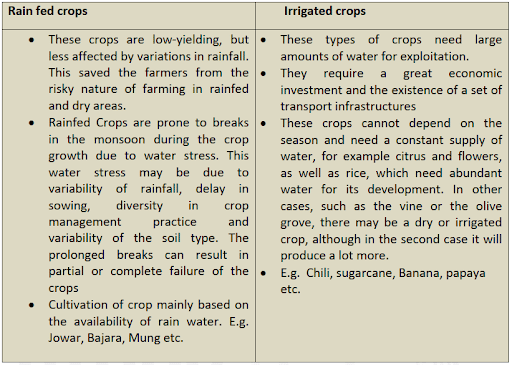
Rainfed Crops
- Crops grown in rainfed areas must be tailored to the length of the growing season.
- The duration of rainfed crops ranges from 75 to 150 days, depending on region and crop type.
- There are many criteria for selecting rainfed crop and variety, but the ability to produce a reasonably good yield under limited soil moisture conditions is the most desirable.
- Rainfed crops should be short-lived, high-yielding, and drought-resistant.
- Rainfed crops suffer from both moisture stress and nutrient deficiency.
- The supply of required nutrients to rainfed crops is inadequate, resulting in very low yield.
- Rainfed crops have lower fertiliser requirements than irrigated crops.
- Rainfed crops are traditionally seeded by broadcasting, placing seed behind a country plough, and drilling seed with a funnel attached to a country plough.
*For detailed notes of this topic, check this link Rain fed crops
Irrigated Crops
- These types of crops need large amounts of water for irrigation.
- They require a great economic investment and the existence of a set of transport infrastructures.
- These crops cannot depend on the season and need a constant supply of water, for example citrus and flowers, as well as rice which need abundant water for its development.
- In other cases, such as the vine or the olive grove, there may be a dry or irrigated crop, although in the second case it will produce a lot more.
- Examples of irrigated crops are chili, sugarcane, banana, papaya, etc.
*For detailed notes of this topic, check this link Irrigated crops
Difference Between Rainfed Crops and Irrigated Crops
Conclusion
To provide rainfed farmers with the same research and technology focus and production support that irrigation farmers have received over the last few decades, a more balanced approach is required. To properly implement irrigation systems, farmers must be familiar with the various types of soil moisture, irrigation water quality, and irrigation frequency.
FAQs
Question: What are the different classifications of crops based on cultural methods?
Answer: Crops can be classified into cereal crops, pulses, oilseeds, vegetables, fruits, and commercial crops, based on their cultural methods and agricultural practices.
Question: What is the significance of crop classification in agriculture?
Answer: Classification helps in determining suitable agricultural practices, crop rotations, irrigation methods, and pest management, leading to improved productivity and sustainability.
Question: How do seasonal crops differ from perennial crops in terms of cultural methods?
Answer: Seasonal crops require planting annually and harvesting after a single growing season, while perennial crops are harvested multiple times over several years.
Question: What is the role of irrigation in crop classification?
Answer: Irrigation methods vary depending on the crop type, and understanding crop classification based on water needs helps in optimizing water resources for maximum yield.
Question: What are the factors considered when classifying crops based on cultural methods?
Answer: Factors include growth duration, water and nutrient requirements, seasonality, and the agricultural practices involved, such as tillage, irrigation, and harvesting techniques.
MCQs
1. Which of the following is NOT a classification of crops based on cultural methods?
A) Cereal crops
B) Vegetative crops
C) Oilseeds
D) Pulses
Answer: (B) See the Explanation
Explanation: Vegetative crops are not a standard classification. Crops are generally classified into cereals, pulses, oilseeds, fruits, vegetables, and commercial crops based on cultural methods.
2. What is the main difference between seasonal and perennial crops?
A) Seasonal crops are harvested annually, while perennial crops are harvested multiple times over several years.
B) Seasonal crops require less irrigation compared to perennial crops.
C) Seasonal crops are more resistant to pests.
D) Perennial crops need more fertilizers than seasonal crops.
Answer: (A) See the Explanation
Explanation: Seasonal crops are planted, grown, and harvested within one growing season, while perennial crops are grown over multiple years and can be harvested multiple times.
3. Which of the following crops is classified as a commercial crop?
A) Rice
B) Cotton
C) Soybean
D) Lentils
Answer: (B) See the Explanation
Explanation: Cotton is a commercial crop grown primarily for industrial use, while rice, soybean, and lentils are typically food crops.
4. How does crop rotation benefit the classification of crops based on cultural methods?
A) It helps in the long-term preservation of soil health.
B) It increases the demand for irrigation.
C) It reduces crop diversity.
D) It ensures that crops are harvested at the same time each year.
Answer: (A) See the Explanation
Explanation: Crop rotation helps in preserving soil health by preventing the depletion of specific nutrients and controlling pest buildup, thus improving yields over time.
5. Which type of crop requires a high amount of water for growth?
A) Cereal crops
B) Oilseeds
C) Pulses
D) Fruits
Answer: (A) See the Explanation
Explanation: Cereal crops like rice require large amounts of water for growth, particularly in regions with irrigation systems, while pulses and oilseeds require less water.
GS Mains Questions and Model Answers
Q1: Discuss the importance of classifying crops based on cultural methods in agricultural practices. How does this classification impact farming productivity?
Answer: Classifying crops based on cultural methods is critical for optimizing farming practices. It helps in deciding crop rotation, water management, and selecting appropriate pest control methods. For instance, cereal crops like wheat require different irrigation techniques compared to pulses. This classification also aids in determining soil requirements and optimizing fertilization techniques, ultimately leading to higher yields and more efficient farming practices. Such classification is essential for managing resources and ensuring sustainable agricultural productivity.
Q2: Explain the role of irrigation and tillage in the classification of crops based on cultural methods. How do these factors contribute to crop health and yield?
Answer: Irrigation and tillage are critical factors that determine the classification of crops. Crops that require more water, such as rice, fall under a different cultural classification compared to drought-tolerant crops like millet. Tillage practices, such as deep or shallow plowing, also vary based on crop requirements; for example, deep tillage is essential for crops like sugarcane that require well-drained soil. Proper irrigation and tillage ensure healthy crops by providing adequate water and soil aeration, which enhance growth and yield.
Q3: Evaluate the benefits and challenges of crop classification based on cultural methods in the context of modern sustainable agriculture practices.
Answer: Crop classification based on cultural methods benefits modern sustainable agriculture by promoting crop diversity, improving resource use efficiency, and enhancing soil health. It allows farmers to select crops suited to local conditions and optimize inputs such as water, fertilizers, and pesticides. However, the challenges include the risk of over-reliance on monoculture and the need for ongoing adaptation to changing climatic conditions. Integrating traditional crop classifications with modern techniques, such as precision agriculture, could improve sustainability and resilience in farming.
Previous Year Questions on Crop Classification
1. UPSC CSE Prelims 2021:
Question: Which of the following is a key consideration when classifying crops based on cultural methods?
A) Soil texture
B) Seasonal rainfall patterns
C) Irrigation needs
D) All of the above
Answer: (D)
Explanation: Classification of crops based on cultural methods takes into account various factors including soil texture, seasonal rainfall patterns, and irrigation needs to determine the best practices for cultivation.
2. UPSC CSE Mains 2018 (GS Paper 3):
Question: What are the advantages of classifying crops based on cultural methods in ensuring food security and agricultural sustainability?
Answer: Classifying crops based on cultural methods helps in efficient use of resources like water and soil, ensuring sustainable agricultural practices. It allows for improved crop rotation, pest management, and better adaptation to local climatic conditions, ultimately contributing to food security and sustainability. Proper classification leads to optimal crop growth, better yields, and reduced environmental impact.
Download the PREPP App and attempt FREE IAS Exam Mock Tests and get complete study material!

Full Test - 04: UPSC CSE Prelims CSAT (Paper-II)
Full Test - 03: UPSC CSE Prelims CSAT (Paper-II)
UPSC CSE Prelims 2026 GS Paper 1 Question Paper (24-May-2026)
UPSC CSE Prelims 2026 CSAT Paper 2 Question Paper (24-May-2026)

17 February 2025 | The Hindu Must Read Articles | Current Affairs

16 February 2026 | The Hindu Must Read Articles | Current Affairs

13 February 2026 | The Hindu Must Read Articles | Current Affairs









Comments