Irrigated Crops - Agriculture Notes
Irrigation is the artificial supply of water to crops. India is not only hot, but it also has seasonal and irregular rainfall. Irrigation is critical in addressing these issues. Irrigation is essential for the cultivation of annual crops, hydrophytes crops, porous soil, and commercial farming. In this article, we will discuss Irrigated Crops which will be helpful for UPSC exam preparation.
|
Table of Contents |
What is Irrigation?
- Irrigation is the process of artificially applying water to crops in order to meet their water requirements.
- Irrigation can also be used to provide nutrients to crops.
- Irrigation is typically used in areas where rainfall is irregular, dry periods are expected, or drought is predicted.
- There are various types of irrigation systems that supply water uniformly to the entire field.
- Groundwater, from springs or wells, surface water, from rivers, lakes, or reservoirs, and even treated wastewater or desalinated water can be used for irrigation.
- Irrigation provides the necessary moisture for growth and development, germination, and other related functions.
- The frequency, rate, amount, and time of irrigation differ for different crops, as well as depending on soil type and season.
- Summer crops, for example, require significantly more water than winter crops.
- Irrigation has been a central feature of agriculture for over 5,000 years, and many cultures around the world have developed it independently.
- Irrigation aids in the growth of agricultural crops, the preservation of landscapes, and the revegetation of disturbed soils in dry areas and during periods of below-average rainfall.
- Irrigation also serves other purposes in crop production, such as frost protection, weed suppression in grain fields, and soil consolidation prevention.
Need for Irrigation
- It increases productivity.
- Utilize the soil's productive potential.
- Reduces reliance on the monsoon and rain-fed agriculture.
- Increases production by growing multiple crops in a single year.
What are Irrigated Crops?
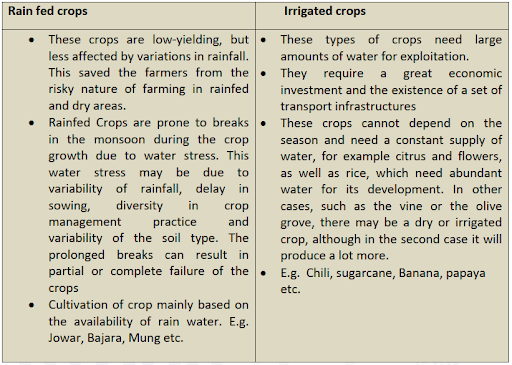
- These types of crops need large amounts of water for irrigation.
- They require a great economic investment and the existence of a set of transport infrastructures.
- These crops cannot depend on the season and need a constant supply of water, for example citrus and flowers, as well as rice which need abundant water for its development.
- In other cases, such as the vine or the olive grove, there may be a dry or irrigated crop, although in the second case it will produce a lot more.
- Examples of irrigated crops are chili, sugarcane, banana, papaya, etc.
Sources of Irrigation
Canal Irrigation
- Canal irrigation is one of the most important sources of water. It accounts for about 24% of total irrigation in the country.
- It is an effective source of irrigation in low-level relief, deep fertile soil, and perennial river areas.
Well Irrigation
- Wells irrigate about 62% of India's net irrigated area. It is both inexpensive and dependable.
- Well irrigation is popular in areas where tank and canal irrigation are unavailable.
- There are two kinds of well irrigation - One is an open well, and the other is a tube well.
Tank Irrigation
- Tanks can be both natural and man-made. On the surface, a hollow is formed by erecting bunds and canals across the stream.
- The Tanks are used to collect rainwater and store it for irrigation and other uses during the rainy season. It includes ponds and lakes.
- Tank irrigation is popular in peninsular India.
Difference Between Rainfed Crops and Irrigated Crops
Conclusion
Farmers must be familiar with the types of soil moisture, irrigation water quality, and irrigation frequency in order to properly implement irrigation systems. Canals, tanks, and wells are the primary sources of irrigation in India. There are several other systems in India, such as rainwater harvesting, dams, and so on.
FAQs
Question. What are irrigated crops?
Answer: Irrigated crops are crops that require artificial water supply (irrigation) to grow. These crops are typically grown in regions where rainfall is insufficient or irregular, and irrigation systems are used to provide the necessary water for crop development.
Question. What are the types of irrigation systems used for irrigated crops?
Answer: Common irrigation systems include drip irrigation, sprinkler irrigation, surface irrigation (flood and furrow irrigation), and subsurface irrigation. These systems ensure that crops receive adequate water throughout their growing cycle.
Question. Why is irrigation important for crop growth?
Answer: Irrigation ensures a consistent water supply, especially in areas where natural rainfall is insufficient. It helps in maintaining crop yields, particularly for water-intensive crops like rice, wheat, and sugarcane. Proper irrigation supports crop growth, reduces water stress, and improves productivity.
Question. What are some examples of irrigated crops?
Answer: Some examples of irrigated crops include rice, wheat, cotton, sugarcane, and maize. These crops require consistent water supply during their growing period to achieve optimal yields.
Question. How does irrigation impact agricultural productivity?
Answer: Irrigation increases agricultural productivity by providing consistent water to crops, which is essential for growth. It reduces the risks associated with irregular rainfall and extends the growing season. As a result, irrigation leads to higher yields and more stable crop production.
MCQs
- What is the main purpose of irrigating crops?
A) To protect crops from pests
B) To ensure consistent water supply for crop growth
C) To increase soil fertility
D) To reduce the cost of fertilizers
Answer: (B) See the Explanation
Irrigation provides a reliable water source to crops, ensuring that they grow efficiently, especially in areas with low or irregular rainfall.
- Which of the following crops are typically grown using irrigation?
A) Rice
B) Cotton
C) Wheat
D) All of the above
Answer: (D) See the Explanation
Rice, cotton, and wheat are all examples of crops that often require irrigation to achieve optimal yields, especially in regions with limited rainfall.
- What type of irrigation system involves water being applied directly to plant roots through a network of pipes and emitters?
A) Surface irrigation
B) Drip irrigation
C) Sprinkler irrigation
D) Subsurface irrigation
Answer: (B) See the Explanation
Drip irrigation delivers water directly to the plant roots using a system of pipes and emitters, ensuring efficient water use.
- Which of the following is a disadvantage of flood irrigation?
A) High water use efficiency
B) Uniform water distribution
C) Risk of waterlogging and soil salinization
D) Requires minimal maintenance
Answer: (C) See the Explanation
Flood irrigation can lead to waterlogging and salinization of the soil, which can negatively affect crop growth and soil health.
- Which of the following irrigation methods is most water-efficient?
A) Surface irrigation
B) Drip irrigation
C) Flood irrigation
D) Furrow irrigation
Answer: (B) See the Explanation
Drip irrigation is the most water-efficient method, as it delivers water directly to the plant roots, reducing wastage and evaporation.
GS Mains Questions and Model Answers
Q1: Explain the importance of irrigation in modern agriculture and its impact on crop productivity.
Answer: Irrigation is a cornerstone of modern agriculture, particularly in regions with insufficient rainfall or unreliable monsoon patterns. By providing a consistent and controlled water supply, irrigation systems enable the cultivation of crops that require a steady water source, such as rice, cotton, and sugarcane. The primary benefit of irrigation is its ability to increase crop yields and stabilize production, which is critical for food security. Irrigation also allows farmers to grow multiple crops per year, particularly in areas with dry seasons. It reduces the dependence on erratic rainfall, thus mitigating the risk of crop failure due to droughts. However, improper irrigation practices, such as excessive water usage or inefficient systems, can lead to water wastage, soil degradation, and the salinization of agricultural lands.
Q2: Discuss the environmental concerns associated with irrigation and how they can be managed.
Answer: While irrigation boosts agricultural productivity, it also raises several environmental concerns. One of the primary concerns is the depletion of water resources, particularly in regions where water for irrigation is drawn from rivers or underground aquifers. Over-irrigation can lead to waterlogging, which reduces soil aeration and affects crop growth. Additionally, poor irrigation practices can contribute to the salinization of soils, especially in areas with inadequate drainage systems. To manage these issues, efficient irrigation techniques such as drip and sprinkler irrigation should be promoted, as they reduce water wastage and direct water to the root zone of crops. Proper management of water resources, including the use of rainwater harvesting and watershed management practices, is essential to ensure the sustainability of irrigation systems. Furthermore, monitoring and regulating the use of groundwater can help prevent over-extraction and depletion of aquifers.
Q3: Analyze the role of irrigation in ensuring food security and its implications for sustainable agricultural practices in India.
Answer: Irrigation plays a vital role in ensuring food security in India, where agriculture is heavily dependent on seasonal rainfall. By providing a reliable water source, irrigation supports the cultivation of key crops like rice, wheat, and sugarcane, which are central to India's food production. Irrigation also enables the diversification of crops, thus increasing the resilience of farming systems to climate variability. However, excessive reliance on irrigation has led to concerns about water use efficiency and sustainability. Over-irrigation and the depletion of groundwater resources are significant challenges in many parts of India. To ensure sustainable agricultural practices, India needs to focus on water-efficient irrigation technologies, such as drip irrigation and sprinkler systems, and invest in rainwater harvesting and water conservation practices. Additionally, crop rotation and the adoption of drought-resistant crop varieties can help improve water-use efficiency and reduce the strain on water resources.
Previous Year Questions on Irrigated crops
1. UPSC CSE 2016
Question: "Explain the role of irrigation in agriculture and the challenges associated with it in India."
Answer: Irrigation plays a crucial role in Indian agriculture by providing a reliable water source, especially in areas with inadequate rainfall. It supports the cultivation of water-intensive crops and increases productivity. However, the over-extraction of groundwater, waterlogging, salinization, and inefficient irrigation practices are major challenges. Sustainable water management and the adoption of water-efficient technologies are essential to address these issues.
2. UPSC CSE 2019
Question: "Discuss the environmental and economic impacts of irrigation in India."
Answer: Irrigation boosts agricultural productivity, ensuring food security and contributing to the economy. However, its environmental impacts include water depletion, soil salinization, and waterlogging. Economically, irrigation enhances crop yields, but the high cost of infrastructure and maintenance, along with inefficient water use, can reduce its benefits. To address these, India needs to focus on sustainable irrigation methods like drip and sprinkler irrigation, water conservation, and improving irrigation efficiency.
Download the PREPP App and attempt FREE IAS Exam Mock Tests and get complete study material!

Full Test - 04: UPSC CSE Prelims CSAT (Paper-II)
Full Test - 03: UPSC CSE Prelims CSAT (Paper-II)
UPSC CSE Prelims 2026 CSAT Paper 2 Question Paper (24-May-2026)
UPSC CSE Prelims 2026 GS Paper 1 Question Paper (24-May-2026)

17 February 2025 | The Hindu Must Read Articles | Current Affairs

16 February 2026 | The Hindu Must Read Articles | Current Affairs

13 February 2026 | The Hindu Must Read Articles | Current Affairs









Comments