Crop Rotation - Agriculture Notes
Crop rotation is the planned successional growth of various crops on a given plot of land. Simple crop rotations may consist of two or three crops, while complicated crop rotations may contain a dozen or more crops. Without using artificial inputs, crop rotation assists in replenishing soil nutrients. Additionally, this practice breaks the cycles of pests and diseases, boosts soil health by increasing biomass from various crops' root systems and boosts biodiversity on the farm. This article will explain to you about Crop Rotation which will be helpful in preparing the Agriculture Syllabus for the UPSC Civil Service exam.
|
Table of Contents |
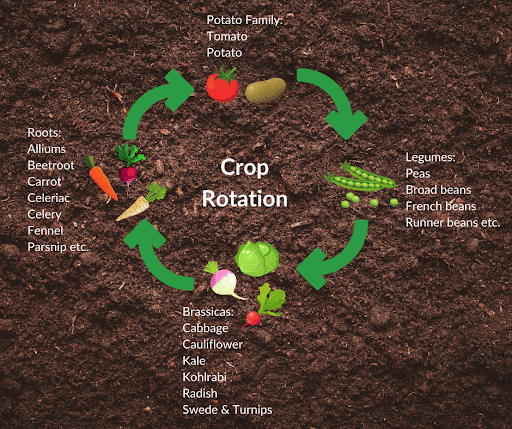
Typical Cycle of Crop Rotation
What is Crop Rotation?
- Crop rotation is the practice of growing a variety of crops in the same area over a number of growing seasons.
- It reduces reliance on a single set of nutrients, pest and weed pressure, and the likelihood of developing resistant pests and weeds.
- It is the process of producing a variety of crops in the same place over the course of several growing seasons.
- For example, rotating Rice, Red Gram, and Banana.
- Assume a farmer has planted a field of corn. After the corn harvest, he may plant beans because corn consumes a lot of nitrogen and beans return nitrogen to the soil.
- It's crucial to pick a crop that replenishes soil nutrients and returns nitrogen to the environment.
- Crop health is maintained, soil deficiency is addressed, and long-term sustainability is ensured with the aid of a well-planned crop rotation system.
- Crop rotation can sometimes involve not planting any crops at all to give the bare ground time to regenerate before the following season.
- Many farmers use livestock farming as part of the crop rotation process during the period the land is bare for regrowth.
- Crop rotation aids in preventing pests and insects that attack particular plant types in addition to enhancing crop and soil health.
- Crop rotations can help to improve or maintain good soil physical, chemical, and biological conditions.
- They can be used to slow the rate of erosion in a field.
Criteria for Selection of Crops for Rotation
- There should be enough moisture.
- Fertilizer, labour, and machine power are all available.
- Marketing and processing facilities.
- Nutrient availability in the soil.
- The crop's duration—short or long.
What is the need of Crop Rotation?
- Different plants have different nutritional requirements and are vulnerable to various pathogens and pests.
- If a farmer plants the same crop in the same spot every year, as is common in conventional farming, the same nutrients are drawn out of the soil year after year.
- Pests and diseases will happily make themselves at home as long as their preferred food source is available.
- Increased levels of chemical fertilisers and pesticides are required in monocultures like these to keep yields high while keeping bugs and disease at bay.
- Crop rotation aids in the return of nutrients to the soil without the use of synthetic fertilisers.
- Additionally, the practise works to interrupt pest and disease cycles, improve soil health by increasing biomass from different crop root structures, and increase farm biodiversity.
- Variety is essential for soil life, and beneficial insects and pollinators are drawn to it above ground as well.
Crop Rotation - Principles
- Due to fact that legumes fix atmospheric nitrogen into the soil and add organic matter to the soil, they should be planted before non-leguminous crops.
- Crops with tap roots (deep rooted crops like cotton) should be followed by crops with fibrous roots (shallow rooted crops like sorghum or maize). This allows for the proper and uniform use of soil nutrients.
- More exhaustive crops should be followed by less exhaustive crops because crops such as potato, sugarcane, maize, and others require more inputs such as better tillage, more fertilisers, more irrigation, and so on.
- Crop selection should be based on need or demand.
- Crops from the same family should not be grown consecutively because they serve as alternate hosts for insect pests and diseases.
- Crop selection should take into account the farmer's financial situation.
- The crop chosen should also be appropriate for the soil and climatic conditions.
*For detailed notes of this topic, check this link Principles of Crop Rotation
Crop Rotation - Planning
- Divide the crops into families when planning a rotation. This adheres to the principle of not cultivating the same crop or one from the same family.
- For example, beets, chard, and spinach are all members of the same family.
- Consider how much space the crop will require. Radish requires far less water than corn.
- Many farmers rotate their livestock among different pasture sections in addition to rotating crops. This improves manure dispersal in the fields and prevents overgrazing in any one section.
- Overgrazing of pasture can result in vegetation depletion and soil erosion.
- Planning an effective rotation necessitates weighing fixed and fluctuating production circumstances such as market, farm size, labour supply, climate, soil type, growing practises, etc.
- Furthermore, crop rotation must consider how one crop will leave the soil for the succeeding crop and how one crop can be seeded with another crop.
- A nitrogen-fixing crop, such as a legume, should always come before a nitrogen-depleting crop; similarly, a low residue crop (i.e. a crop with low biomass) should be offset by a high biomass cover crop, such as a mixture of grasses and legumes.
- There are no restrictions on the number of crops that can be used in a rotation or the length of time it takes to complete a rotation.
- Rotation decisions are made years in advance, seasons in advance, or even at the last minute when an opportunity to increase profits or soil quality arises.
Crop Rotation - Types
One-year Rotation
- Crop rotation can be carried out for one year, depending on the size of the available plot of land.
- Following harvest, the soil that is suitable for another specific crop will be planted with that crop for the remaining half of the year. One crop would be planted during the first half of the year.
- The planting of maize and then mustard is an example of a one-year crop rotation.
- Another example is the planting of wheat first, then rice.
Two Years Rotation
- The two-year rotation is essentially identical to the one-year rotation, with the exception that more crop options are available and the crop planting rotation would last for two years instead of one.
- Within the course of a two-year crop rotation, there may be a total of two, three, or four crops planted.
- After the prior crop is harvested, the subsequent crops should have all of the nutrients they need.
- A two-year rotation might involve planting successive crops of corn, mustard, sugarcane, and fenugreek as well as subsequent crops of corn, potatoes, sugarcane, and peas.
Three Years Rotation
- A three-year rotation, as the name suggests, calls for a number of crops to be planted over the course of three years while addressing all of their nutrient needs.
- On the same piece of land, the crops will be planted one after the other in succession.
- The subsequent crop's nutritional needs will be satisfied by the previously planted crops.
- Some examples of three-year crop rotations include:
- Rice, wheat, mung, and mustard in succession;
- Sugarcane and berseem in succession; and
- Cotton, oat, sugarcane, peas, maize, and wheat in succession.
Crop Rotation - Advantages
- Improves Soil Condition: Utilizing various crops, especially those with fibrous or tap roots, can improve the soil's chemical, biological, and physical composition. This increases the amount of organic matter and nutrients in the soil as well as its ability to store water.
- Improves Soil Structure: Rotation helps to preserve and improve soil structure. Crops have various root structures and grow to different depths. Rotating exposes the soil not only to shallow depth crops, but also to deep diggers, which gradually deepen the topsoil.
- Reduces Soil Erosion and Water Runoff: Crop rotation can reduce erosion by enhancing the microbial populations and soil tilth. Surface runoff is reduced as a result of the more stable soil structure created.
- Reduces Pests and Weeds: Pests, plants, and insects can't live without their host for very long. Those pests have no chance if you move your crops around and improve the soil structure at the same time.
- Control of Insects: Insects tend to enter your plants' leaves and vines as they prepare to reawaken in the spring in search of their favourite meal. When you rotate, these insects come into contact with a plant that they do not feed on.
- Disease Prevention: Plant diseases can over winter enter in plant leaves, roots, and vines beneath your soil. Crop rotation helps to keep these diseases from returning the following year.
- Improvement in Water Quality: Water quality can be improved by reducing sediment loss, as well as dissolved and sediment-attached nutrient and pesticide losses.
- Provides Diversification: Some crops demand less labor and equipment than others. This implies that the workload can be distributed throughout the year.
- Additionally, it increases the range of the products that can be sold, preventing from having to "place all your eggs in one basket."
- Nutrient Uptake Regulation: As various crops require different nutrients in different quantities, crop rotation aids in boosting the nutrient uptake by plants from the soil.
- Crop rotation helps the various crops that are planted within the rotation make the most of all the nutrients in the soil, including the nutrients left over from the previous crop that was planted.
Crop Rotation - Disadvantages
- Involves Risk: Crop rotation requires a significant financial investment each season to purchase various seedlings of the various crops that will be grown.
- Moreover, particular crops demand specific sorts of equipment, thus farmers may have to invest in different types of machinery.
- This implies that the upfront fees can be higher. However, the success of each crop kind is not assured, and one may wind up losing a harvest.
- Requires More Skill & Knowledge: Crop rotation calls for a broader range of abilities and information regarding each type of crop collected because it involves a variety of crops.
- It also calls for various machinery, the operation of which also takes skill. This implies that learning and perfecting this agricultural method will require more time and effort on the part of farmers.
- Difference in Growing Conditions: For monoculture, or a particular type of crop, some places and their temperatures are better suited.
- The specific type of temperature and soil conditions cannot support the growth of any other crops than that particular type of crop.
- Obligatory Crop Diversification: It is mandatory to plant different crops each time for crop rotation to be effective. However, it prevents a farmer from specializing in a particular crop.
Conclusion
Previously, not planting anything (also known as leaving the field fallow) allowed the land to rest and replenish its nutrients. Crop rotation has helped to increase productivity by replacing fallow periods with growing different crops that replenish soil nutrients. Crop rotation also aids in the fight against erosion forces. Rotating crops improves soil stability by alternating between crops with deep roots and those with shallow roots. Pests are also deterred by eliminating their food source on a regular basis. Crop rotation is affected by a variety of factors, including soil type, climate, precipitation, and crop markets.
|
|
|
|---|---|
| Agriculture Notes | Cropping |
| Permaculture | Manures |
| Land Reforms in India | Watershed Management |
| Scope and Importance of Agriculture | Problems of Indian Agriculture |
FAQs
Question: What is crop rotation?
Answer: Crop rotation is an agricultural practice where different types of crops are planted sequentially on the same land to improve soil health, reduce pest and weed growth, and enhance crop yield.
Question: Why is crop rotation important in sustainable agriculture?
Answer: Crop rotation helps maintain soil fertility, minimizes soil erosion, and reduces dependency on chemical fertilizers and pesticides, promoting long-term soil health and sustainable agriculture.
Question: Which crops are typically rotated to improve nitrogen levels in the soil?
Answer: Leguminous crops like beans, peas, and lentils are often rotated with cereals as they enrich soil nitrogen levels through symbiotic nitrogen fixation.
Question: How does crop rotation help in controlling pests and diseases?
Answer: Rotating crops disrupts pest and disease cycles by depriving pests of their host plants, reducing the need for chemical pesticides and preventing soil-borne diseases.
Question: What are the common types of crop rotation systems?
Answer: Common systems include two-year, three-year, and four-year rotations, often alternating between root crops, cereals, and legumes to maximize soil health and crop yield.
MCQs
1. Which of the following crops is commonly used in crop rotation to enhance soil nitrogen?
A) Wheat
B) Rice
C) Peas
D) Maize
Answer: (C) See the Explanation
Explanation: Leguminous crops like peas help increase soil nitrogen through nitrogen-fixing bacteria, making them ideal for crop rotation.
2. Which practice involves growing different crops in succession on the same land to improve soil health?
A) Monocropping
B) Crop Rotation
C) Agroforestry
D) Mulching
Answer: (B) See the Explanation
Explanation: Crop rotation is the practice of alternating crops each season to enhance soil fertility, control pests, and improve overall soil structure.
3. What is a primary benefit of crop rotation in pest management?
A) Increases pesticide use
B) Encourages monoculture
C) Disrupts pest life cycles
D) Reduces soil fertility
Answer: (C) See the Explanation
Explanation: By rotating crops, pests lose their usual host plants, which helps break their life cycles and reduces pest populations naturally.
4. Which of the following is NOT a benefit of crop rotation?
A) Reduces soil erosion
B) Improves soil fertility
C) Increases crop biodiversity
D) Requires more chemical fertilizers
Answer: (D) See the Explanation
Explanation: Crop rotation reduces the need for chemical fertilizers as it enhances natural soil fertility and structure, unlike monocropping.
5. Which crop rotation sequence is commonly used for soil improvement?
A) Cereal-Cereal-Legume
B) Legume-Cereal-Cereal
C) Cereal-Cereal-Cereal
D) Legume-Legume-Cereal
Answer: (B) See the Explanation
Explanation: A rotation of Legume-Cereal-Cereal is beneficial as legumes enhance nitrogen levels, followed by cereals that utilize the enriched soil.
GS Mains Questions and Model Answers
Q1: Discuss the significance of crop rotation in sustainable agriculture. How does it contribute to environmental conservation?
Answer: Crop rotation is vital for sustainable agriculture as it improves soil health, reduces dependency on chemical inputs, and minimizes soil erosion. By alternating crops, farmers can maintain balanced nutrient levels and enhance soil structure, making land more resilient to degradation. This practice also curbs pest and disease cycles, supporting a healthier ecosystem. Crop rotation aligns with conservation goals, reducing chemical runoff into water bodies, protecting biodiversity, and promoting a balanced environment, essential for long-term agricultural productivity.
Q2: Explain how crop rotation can aid in pest and disease control. What are the broader benefits of this practice in modern agriculture?
Answer: Crop rotation disrupts pest and disease cycles by varying the host plants available each season, which hinders pest populations from thriving continuously. This naturally reduces the need for chemical pesticides, lowering costs and environmental impact. In modern agriculture, crop rotation supports soil conservation, nutrient cycling, and biodiversity enhancement, fostering healthier soil and ecosystems. By integrating crop rotation, agriculture becomes more resilient, sustainable, and capable of supporting diverse crop yields for growing populations.
Q3: How does crop rotation enhance soil fertility, and what are its implications for agricultural productivity?
Answer: Crop rotation replenishes soil nutrients by alternating nutrient-depleting crops with nutrient-replenishing ones, such as legumes that fix nitrogen. This balance reduces the need for artificial fertilizers, promotes natural nutrient cycling, and supports robust crop growth. In the long run, improved soil fertility leads to better yields, healthier crops, and reduced production costs, benefiting farmers and ensuring sustainable food supply. Crop rotation also enhances water retention in soil, making agriculture more resilient to droughts and climate variability.
Previous Year Questions on Crop Rotation
1. UPSC CSE Prelims 2021:
Question: Which of the following is a primary purpose of crop rotation?
A) To increase pesticide use
B) To maintain soil fertility
C) To promote monoculture
D) To reduce crop biodiversity
Answer: (B)
Explanation: Crop rotation helps maintain soil fertility by balancing nutrients in the soil and reducing the need for chemical fertilizers, supporting sustainable agriculture.
2. UPSC CSE Mains 2020 (GS Paper 3):
Question: "Evaluate the role of crop rotation in improving soil health and agricultural sustainability." Discuss its relevance in today’s agriculture.
Answer: Crop rotation enhances soil health by maintaining nutrient levels and supporting soil structure through diverse plant root systems. It reduces soil erosion, encourages microbial growth, and curbs the need for chemical fertilizers, aligning with sustainable agricultural practices. In contemporary agriculture, crop rotation is essential for resilience against climate change, pest resistance, and increased crop yield potential, making it relevant for sustainable food security and environmental health.
Download the PREPP App and attempt FREE IAS Exam Mock Tests and get complete study material!

Full Test - 04: UPSC CSE Prelims CSAT (Paper-II)
Full Test - 03: UPSC CSE Prelims CSAT (Paper-II)
UPSC CSE Prelims 2026 CSAT Paper 2 Question Paper (24-May-2026)
UPSC CSE Prelims 2026 GS Paper 1 Question Paper (24-May-2026)

17 February 2025 | The Hindu Must Read Articles | Current Affairs

16 February 2026 | The Hindu Must Read Articles | Current Affairs

13 February 2026 | The Hindu Must Read Articles | Current Affairs









Comments