Elements Required in Plant Growth - Agriculture Notes
Plant like all other living things requires elements in the form of nutrition for growth and development. The elements are classified generally into micronutrients and macronutrients. Macronutrients are nutrients that plants and other living things need in larger quantities such as carbon, hydrogen, nitrogen, etc. Micronutrients are the types of nutrients that plants need in smaller amounts. Boron, manganese, copper, iron, and molybdenum, are some examples of micronutrients. This article will explain to you about Elements Required In Plant Growth which will be helpful in preparing the Agriculture Syllabus for the UPSC Civil Service exam.
|
Table of Contents |
What is Plant Nutrition?
- Plant Nutrition is essentially the supply and absorption of chemical compounds or inorganic elements that aid in the growth and improvement of the metabolism of the plant.
- It is the process through which plants receive and utilize critical materials required for their development and reproduction.
- Numerous inorganic minerals are utilized by plants as food. For inorganic minerals to form in the soil, complex interactions involving the weathering of rock minerals, decomposing organic waste, animals, and other microbes must take place.
- The study of chemical substances and elements necessary for plant growth, reproduction, and improved metabolism is also referred to as "plant nutrition."
- It is impossible for plants to go through a typical life cycle without nutrients, which prevents them from growing and reproducing.
- There are actually 20 mineral elements that are either required or beneficial for plant growth.
- Air and water provide carbon (C), hydrogen (H), and oxygen (O).
- Plants require large amounts of the six macronutrients nitrogen (N), phosphorus (P), potassium (K), calcium (Ca), magnesium (Mg), and sulphur (S).
- The remaining elements are only required in trace amounts (micronutrients). Boron (B), chlorine (Cl), copper (Cu), iron (Fe), manganese (Mn), sodium (Na), zinc (Zn), molybdenum (Mo), and nickel are all essential trace elements (Ni).
- Mineral elements that are beneficial include silicon (Si) and cobalt (Co).
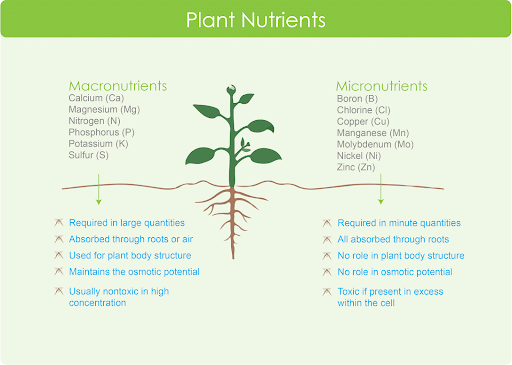
Micronutrients and Macronutrients
How do Plants Extract Nutrients?
- Subsoil naturally contains these elements. They are absorbed by the plants.
- The majority of soils on the earth are such that plants can adapt and thrive without the need to apply various fertilizers.
- Utilizing fertilizers helps crops grow more quickly and produce more throughout the year.
- The lack of nutrients can significantly slow down a plant's rapid growth.
- In order to encourage a plant's growth, fertilizers are utilized along with enough sunlight and water.
- The nutrients can then circulate throughout the body after being absorbed by the plant.
What are Essential and Benficial Elements?
- Arnon and Stout coined the term essential mineral element (or mineral nutrient) in 1939.
- They came to the conclusion that an element must meet three criteria in order to be considered essential. These are the criteria:
- In the absence of the mineral element, a plant must be unable to complete its life cycle.
- The element's function cannot be replaced by another mineral element.
- The element must play a direct role in plant metabolism.
- These criteria are important for plant nutrition, but they exclude beneficial minerals.
- Beneficial elements are those that can compensate for the toxic effects of other elements or that can replace mineral nutrients in a less specific function, such as osmotic pressure maintenance.
- The absence of beneficial nutrients in commercial production may imply that plants are not being grown to their full genetic potential, but are instead being produced for subsistence.
- The beneficial elements have not been determined to be essential for all plants, but they may be for some.
- In the case of some trace elements, distinguishing between beneficial and essential is frequently difficult.
- Cobalt, for example, is required for nitrogen fixation in legumes.
- Silicon has been found to improve heat and drought tolerance as well as resistance to insects and fungal infections when deposited in cell walls.
- As a beneficial element, silicon can help compensate for toxic levels of manganese, iron, phosphorus, and aluminium, as well as zinc deficiency.
- A more holistic approach to plant nutrition would include mineral elements at levels beneficial for optimum growth as well as nutrients essential for survival.
Important Elements Required in Plant Growth
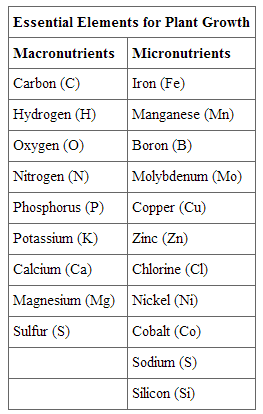
Important Elements for Plant Growth
Macronutrients
- Since plants are living things, they need nutrients to live, grow, reproduce, and develop just like humans do.
- Macronutrients are nutrients that provide plants energy and are needed in huge amounts to maintain development and growth.
- Examples of these essential elements for crops are nitrogen (N), potassium (K), calcium (Ca), phosphorous (P), magnesium (Mg), sulphur (S), oxygen (O), carbon (C), and hydrogen (H).
- The most significant of them are nitrogen, phosphorus, and potassium because they have a direct impact on plant growth and really help to form different portions of the plant.
*To know more about the topic, click this link Macronutrient - Elements Required In Plant Growth
Micronutrients
- Micronutrients are vital plant nutrients that are present in tissue in minimal amounts yet are crucial for the growth and development of plants.
- Some of the micronutrients include Boron, Manganese, Molybdenum, Copper, Zinc, Iodine, Iron, Chlorine, and Chromium.
- Other than the aforementioned, sodium (Na), cobalt (Co), vanadium (Va), nickel (Ni), and silicon (Si) are considered essential micronutrients in some plants.
- Without these nutrients, the nutrition of the plants would be affected, perhaps resulting in decreased plant yield.
- Their absence causes senescence, chlorosis, necrosis, delayed maturation, and stunted growth.
- Plant micronutrients actively bind to soil particles and are very soluble in acidic environments.
*To know more about the topic, click this link Micronutrient - Elements Required In Plant Growth
Conclusion
Plant nutrition refers to the interrelationships of mineral elements in soil or soilless solutions, as well as their role in plant growth. This interdependence involves a complex balance of mineral elements that are both necessary and beneficial for optimal plant growth. Without a range of minerals, macronutrients, and micronutrients, the plant cannot carry out or complete vital life cycles like reproduction, respiration, photosynthesis, pollination, seed germination, flowering, etc.
|
|
|
|---|---|
| Agriculture Notes | Cropping |
| Tillage | Watershed Management |
| Scope and Importance of Agriculture | Problems of Indian Agriculture |
FAQs
Question: What are the main elements required for plant growth?
Answer: Plants require essential elements such as nitrogen (N), phosphorus (P), potassium (K), calcium (Ca), magnesium (Mg), and sulfur (S) for macronutrients, and iron (Fe), manganese (Mn), zinc (Zn), copper (Cu), molybdenum (Mo), boron (B), and chlorine (Cl) for micronutrients.
Question: Why are nitrogen, phosphorus, and potassium critical for plant growth?
Answer: Nitrogen is crucial for protein and chlorophyll synthesis, phosphorus aids in energy transfer and root development, and potassium helps in regulating water balance and enhancing disease resistance, making these three macronutrients essential for healthy plant growth.
Question: What is the role of calcium in plant growth?
Answer: Calcium is vital for maintaining cell wall structure, promoting root development, and facilitating the absorption of other nutrients. It also helps in regulating enzyme activity and maintaining cellular integrity, making it an essential element for plants.
Question: How do micronutrients differ from macronutrients in plant growth?
Answer: Micronutrients are required in smaller quantities compared to macronutrients, but they are equally essential. While macronutrients like nitrogen, phosphorus, and potassium are crucial for overall plant structure and function, micronutrients such as iron, boron, and zinc assist in specific biochemical processes like enzyme activation and chlorophyll production.
Question: Can plant growth be affected by the deficiency of any specific element?
Answer: Yes, the deficiency of any essential nutrient can cause poor plant growth, chlorosis (yellowing of leaves), stunted growth, or poor fruiting. For example, nitrogen deficiency leads to yellow leaves and poor growth, while phosphorus deficiency causes weak roots and delayed flowering.
MCQs
1. Which of the following elements is primarily responsible for the synthesis of proteins and chlorophyll in plants?
A) Nitrogen
B) Phosphorus
C) Potassium
D) Calcium
Answer: (A) See the Explanation
Explanation: Nitrogen is a key component of amino acids, proteins, and chlorophyll. It is vital for the overall growth of plants and is one of the most essential macronutrients for plant development.
2. What role does phosphorus play in plant growth?
A) Regulates water balance
B) Aids in root development and energy transfer
C) Helps in protein synthesis
D) Promotes cell wall formation
Answer: (B) See the Explanation
Explanation: Phosphorus plays a crucial role in energy transfer and root development. It is part of ATP (adenosine triphosphate), which is essential for energy transfer in plants, and also helps in the development of strong, healthy roots.
3. Which of the following is NOT considered a macronutrient for plants?
A) Nitrogen
B) Phosphorus
C) Zinc
D) Potassium
Answer: (C) See the Explanation
Explanation: Zinc is a micronutrient, not a macronutrient. While nitrogen, phosphorus, and potassium are required in large quantities by plants, micronutrients like zinc, iron, and copper are required in trace amounts but are still essential for plant growth.
4. Which element is primarily involved in the formation of cell walls and overall plant structure?
A) Calcium
B) Magnesium
C) Potassium
D) Iron
Answer: (A) See the Explanation
Explanation: Calcium plays a vital role in the formation of cell walls and overall plant structure. It also assists in maintaining the integrity of cell membranes and is essential for proper root growth and nutrient uptake.
5. What does a deficiency in potassium usually cause in plants?
A) Yellowing of leaves
B) Weak roots and poor flowering
C) Poor water regulation and reduced disease resistance
D) Increased chlorophyll production
Answer: (C) See the Explanation
Explanation: Potassium helps regulate water balance in plants and enhances disease resistance. A deficiency in potassium often leads to poor water regulation, weak growth, and increased susceptibility to diseases.
GS Mains Questions and Model Answers
Q1: Discuss the importance of macronutrients and micronutrients in plant growth. How does the deficiency of these elements affect crop production?
Answer: Macronutrients such as nitrogen, phosphorus, and potassium are required in large quantities and are essential for plant growth. They play a crucial role in processes like photosynthesis, energy transfer, and cell development. Micronutrients, though needed in smaller amounts, are vital for enzyme activation, chlorophyll production, and overall plant health. Deficiency in these elements can lead to reduced crop yields, poor plant health, and susceptibility to diseases. For instance, nitrogen deficiency leads to yellowing of leaves, while phosphorus deficiency weakens the roots, resulting in poor growth and development.
Q2: How do environmental factors and nutrient deficiencies interact to affect plant growth and agriculture?
Answer: Environmental factors such as soil type, water availability, and temperature influence the availability of nutrients to plants. A nutrient deficiency, exacerbated by poor soil conditions or unfavorable climatic conditions, can severely affect plant health. For example, in drought conditions, plants may not be able to absorb sufficient nutrients, leading to stunted growth. Similarly, extreme temperatures can interfere with the uptake of nutrients, causing imbalances that hinder plant development and reduce agricultural productivity.
Q3: What are the modern techniques used to improve nutrient availability in soils for sustainable agriculture?
Answer: Modern techniques to improve nutrient availability include the use of organic fertilizers, crop rotation, and bio-fertilizers. The use of precision agriculture, where nutrient management is done based on soil testing, ensures that the right nutrients are provided at the right time and in the right amounts. Additionally, techniques like green manuring, composting, and the application of micronutrient-rich fertilizers help in maintaining soil fertility and promoting sustainable agriculture.
Previous Year Questions on Elements Required in Plant Growth
UPSC CSE 2016
Question: "Explain the role of essential nutrients in plant growth and how their deficiencies impact crop productivity. Illustrate with examples."
Answer: Essential nutrients like nitrogen, phosphorus, and potassium are vital for plant development. Their deficiency causes specific symptoms, such as yellowing of leaves due to nitrogen deficiency or poor root growth due to phosphorus shortage. These deficiencies ultimately result in lower crop yields and reduced agricultural productivity.
UPSC CSE 2018
Question: "Discuss the impact of nutrient management practices on sustainable agriculture in India. How can the nutrient supply be optimized in the context of Indian agriculture?"
Answer: Proper nutrient management through techniques like crop rotation, organic farming, and balanced fertilization helps optimize nutrient supply and enhances soil health. In India, integrating bio-fertilizers and improving irrigation practices can lead to sustainable agricultural practices, increasing crop productivity and ensuring long-term soil fertility.
Download the PREPP App and attempt FREE IAS Exam Mock Tests and get complete study material!

Full Test - 04: UPSC CSE Prelims CSAT (Paper-II)
Full Test - 03: UPSC CSE Prelims CSAT (Paper-II)
UPSC CSE Prelims 2026 GS Paper 1 Question Paper (24-May-2026)
UPSC CSE Prelims 2026 CSAT Paper 2 Question Paper (24-May-2026)

17 February 2025 | The Hindu Must Read Articles | Current Affairs

16 February 2026 | The Hindu Must Read Articles | Current Affairs

13 February 2026 | The Hindu Must Read Articles | Current Affairs









Comments