Integrated Farming System - Agriculture Notes
The term "Integrated Farming System" is frequently used to describe a more integrated method of farming than monoculture methods. It is a multidimensional approach designed to manage resources sustainably and effectively for higher crop output. The Integrated Farming System uses organic farming, livestock, vermicomposting, and other methods to achieve its numerous goals of sustainability, food security, farmer security, and poverty reduction. This article will explain to you about Integrated Farming System which will be helpful in preparing the Agriculture Syllabus for the UPSC Civil Service exam.
| To Read update on this topic: |
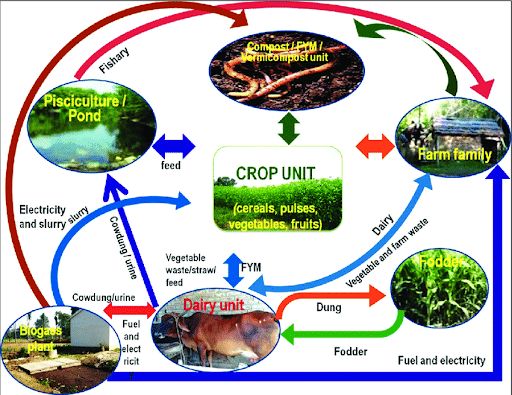
Integrated Farming System
What is Integrated Farming System?
- The term "Integrated Farming System" (IFS) refers to a set of interdependent, related, and frequently interlocking production systems that are based on a small number of crops, animals, and related subsidiary businesses.
- They are basically designed to maximize the utilization of nutrients in each system and minimize the negative environmental effects of these businesses.
- Because of the interconnected, interdependent, and interlocking character of IFS, primary and secondary output from one system are used as the primary input for the other system, integrating the two systems into one cohesive whole.
- It is an integration of farm enterprises such as cropping systems, animal husbandry, fisheries, forestry, and so on for optimal resource utilisation and farmer prosperity.
- The components of a farming system should be chosen and implemented based on the availability of land, the type of land, water, capital, resources, the farmer's technical skill, market facilities, and so on.
- In order to coordinate the joint management of land, water, vegetation, livestock, and human resources, integrated farming systems have long been recognised as a sound approach.
Goals of Integrated Farming System
- Maximizing the yield of all component enterprises in order to provide consistent and stable income at higher levels.
- Rejuvenation/improvement of system productivity and attainment of agro-ecological equilibrium.
- Control the population of insects, pests, diseases, and weeds through natural cropping system management and maintain a low level of intensity.
- Reducing the use of chemical fertilizer and other harmful agrochemicals and pesticides in order to provide society with pollution-free, healthy produce and environment.
- Increased natural resource efficiency through early nutrient recycling.
- Mitigation of the negative environmental impact of agriculture or livestock.
Integrated Farming System - Principles
The fundamental principle is to boost ecological biodiversity by the following:
- By using the proper cropping techniques, such as intercropping, crop rotation, crop combination, and mixed cropping, there will be less rivalry for scarce natural resources, such as water, food, and space. Additionally, by implementing eco-friendly procedures.
- Using a multi-story layout to make the most of the space that is available and to maximize the interplay between biotic and abiotic elements.
- By incorporating subsystems that allow the various elements to interact favorably, increasing total agricultural production.
- The integrated farming system, which emphasizes intensifying agricultural productivity through resource integration, market linkages, and increased diversification, is also a sustainable agriculture system.
What is an Ideal Integrated Farming System?
- An ideal Integrated Farming System should have a low risk for farmers, modest investment requirements, quick returns, and be straightforward and repeatable.
- Five fundamental requirements must be met for an IFS to be considered ideal:
- Economic Viability
- Nutritional Security
- Environmental Sustainability
- Energy Self-sufficiency
- Climatic Adaptation
- It ought to produce enough revenue and job opportunities to sustain the farmer's and his family's way of life.
- Additionally, it should be able to offer a nutritious balanced diet to the entire family using various agricultural products.
- Furthermore, it should be sustainable, generating less waste through efficient by-product utilization and trash recycling inside the IFS.
- This would lessen emissions of greenhouse gases (GHG) and groundwater contamination (eg: due to nitrogen leaching from fertilizer application).
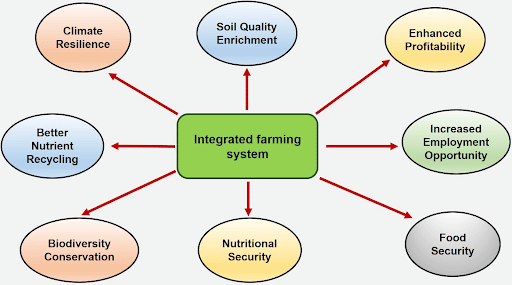
Ecosystem Services provided by Integrated Farming System
Integrated Farming System - Working
- This system makes use of a network of connected businesses so that the "waste" from one component can be used as an input for another.
- Costs are decreased, while productivity and/or income are increased.
- Farmers guarantee that the entire farming system is more productive overall by using waste as a resource, which also helps to reduce waste emissions.
- As part of integrated farming, different species of plants, animals, birds, fish, and other aquatic flora and fauna are used to produce crops, following a principle that is similar to that of nature.
Integrated Farming System in India
- Efforts were made in India to develop low-cost farming systems appropriate for Indian conditions, based on the principles of productive utilisation of farm wastes and greater utilisation of available resources and manpower.
- The development of integrated farming systems involving fish culture, livestock raising, and agriculture has resulted from sustained research efforts.
- Packages of practices for fish-cum-pig, fish-cum-duck, and fish-cum-poultry farming have been extensively developed and validated at the farmer level for economic viability and feasibility.
- Livestock manure contains a significant amount of nutrients and biomass, and its application in the pond promotes the growth of phytoplankton and zooplankton, which serve as a source of nutrients for fish.
- The fish consume indigestible feed ingredients found in manure. Feed waste from feeding can also be recycled through fish culture.
- The bottom soil layer of the pond is periodically removed and applied in the field for crop or vegetable farming because it is high in biomass.
- The following are some of the Integrated Farming Systems, which are particularly suitable for hilly areas of the North Eastern Region:
- Integrated fish-cum-pig farming
- Integrated fish-cum-duck farming
- Integrated fish-cum-poultry farming
- Integrated fish-cum-cattle farming
- Integrated fish-cum-rabbit farming
- Integrated fish-cum-agriculture
Integrated Farming System - Advantages
- Increase in Food Supply: On the same plot of land, vegetable or horticulture crops can produce two to three times as many calories as grain crops.
- Additionally, if beekeeping, mushroom cultivation, silviculture, and aquaculture are combined in a multi-tiered system, they can provide more food without reducing the yield of crops that are grown for food grains.
- Recycling of Crop Residue: For instance, India produces more than 200 metric tonnes of residue annually. The number of mushrooms produced would increase many times over if just 1% of this was dedicated to mushroom farming.
- Crop debris can also be used to make good vermin compost, which will help to replenish the soil's fertility. The cost of production is decreased.
- Use of Marginal and Waste Land: Wastelands and marginal areas can be productively exploited for crop production, beekeeping, dairying, poultry, fisheries, and mushroom growing.
- Increased Employment: According to studies on integrated farming systems in India, adopting crop + fish + livestock on arable land can result in three times as many gainful jobs than crop alone.
- If additional farming ventures like silviculture, beekeeping, and mushroom cultivation are implemented, they can raise the standard of living for farm families by increasing their revenue and offering gainful employment.
- Restoration of Soil Fertility & Conservation of the Environment: Soil fertility can be maintained through effective recycling of agricultural waste and crop residue in crop-livestock-poultry-fishery systems.
- Additionally, it will lessen the need for chemical fertilizers and allow for the maintenance of a cleaner environment.
- Enhances Self-Reliance: It can increase farmers' independence and self-sufficiency. The various systems involved generate a significant amount of knowledge and advances.
- Participation in Development Process: Poor and landless farmers might receive assistance to make money and take part in the process of development.
- Decreased Need for External Inputs: There are fewer external inputs required in the system. Furthermore, it allows for more effective distribution and labour use. Costs are typically decreased, and labour productivity is raised.
Integrated Farming System - Challenges
Although an integrated farming system can increase farmers' income and nutritional security, there are still challenges that must be overcome, including the following:
- Non-Affordability: Financial restrictions prevent small and marginal farmers from affording huge cattle, thus we must promote small ruminants like goats and sheep.
- Lack of Acceptance: Farmers in non-coastal areas are hesitant to accept fisheries, poultry, and duck rearing due to a lack of role models and religious perceptions.
- Not under MSP: The Minimum Support Price (MSP) mechanism does not apply to the mushroom and beekeeping industries. Therefore, there is a need for improved interaction with the hospitality and food manufacturing sectors.
Conclusion
This sustainable farming approach has been adopted by thousands of small and marginal family farmers in resource-poor areas in order to diversify farm production, raise cash revenue, boost the quality and quantity of food produced, and use underutilized resources. A well-integrated farm with market connections that will assure a family's nutrition and way of life often takes three to four years to create.
|
|
|
|---|---|
| Agriculture Notes | Cropping |
| Tillage | Watershed Management |
| Scope and Importance of Agriculture | Problems of Indian Agriculture |
FAQs
Question: What is the Integrated Farming System (IFS)?
Answer: The Integrated Farming System (IFS) is an agricultural approach that integrates different components like crop production, livestock, aquaculture, and agroforestry to create a sustainable and productive farm ecosystem.
Question: What are the benefits of IFS?
Answer: The benefits include improved resource use efficiency, increased farm productivity, environmental conservation, reduced risk, and enhanced farm income through diversification.
Question: How does IFS help in resource management?
Answer: IFS promotes efficient utilization of available resources by recycling farm waste and integrating different farming systems, leading to sustainable agriculture.
Question: Which components can be included in the IFS model?
Answer: Components of IFS include crop production, livestock farming, poultry, fishery, horticulture, and sericulture depending on the agro-climatic conditions.
Question: How does IFS contribute to climate resilience?
Answer: IFS helps in creating climate resilience by diversifying income sources, promoting sustainable practices, and improving the overall productivity of the farming ecosystem.
MCQs
- Which of the following is a key principle of the Integrated Farming System (IFS)?
a) Monocropping
b) Diversification of farm activities
c) Intensive chemical use
d) Complete dependence on external inputs
Answer: (B) See the Explanation
IFS emphasizes the diversification of activities like crop production, animal husbandry, and aquaculture to increase farm productivity and sustainability.
- Which component is NOT typically included in an Integrated Farming System?
a) Crop production
b) Livestock farming
c) Aquaculture
d) Heavy machinery farming
Answer: (D) See the Explanation
Heavy machinery farming is not a typical component of IFS, which focuses on sustainable practices through resource recycling and diversification.
- What is the primary objective of the Integrated Farming System (IFS)?
a) Maximizing the use of chemical inputs
b) Sustainable farm income through diversification
c) Reducing farm activities to a single source of income
d) Exclusive focus on crop farming
Answer: (B) See the Explanation
IFS aims to enhance farm income and sustainability by integrating multiple activities like livestock, crops, and aquaculture.
- Which of the following farming systems integrates crop and livestock farming for mutual benefits?
a) Monoculture farming
b) Organic farming
c) Integrated Farming System
d) Commercial farming
Answer: (C) See the Explanation
IFS integrates crop and livestock farming, allowing for the recycling of resources like manure for crop fertilization and providing feed for animals.
- How does IFS contribute to environmental sustainability?
a) By promoting monoculture farming
b) By integrating multiple farming activities
c) By using excessive pesticides
d) By focusing on cash crops
Answer: (B) See the Explanation
IFS promotes environmental sustainability by integrating different activities, reducing waste, and recycling nutrients within the farm.
GS Mains Questions and Model Answers
Q1: Analyze the role of the Integrated Farming System (IFS) in increasing farm productivity and resource use efficiency in India.
Answer: The Integrated Farming System (IFS) plays a crucial role in improving farm productivity by integrating various farm activities such as crop production, livestock, fisheries, and agroforestry. This approach ensures efficient use of available resources like land, water, and nutrients by promoting the recycling of farm waste. By reducing dependence on external inputs, IFS minimizes input costs while enhancing soil fertility. The diversification of activities under IFS helps farmers mitigate risks, ensure year-round income, and contribute to sustainable agricultural practices.
Q2: Discuss how Integrated Farming Systems contribute to climate-resilient agriculture in India.
Answer: Integrated Farming Systems contribute significantly to climate-resilient agriculture by promoting diversification and reducing the risks associated with climate variability. By integrating crops, livestock, fisheries, and other components, IFS allows farmers to maintain productivity even during adverse climatic conditions. The system emphasizes resource recycling, efficient use of water, and reduced reliance on chemical inputs, all of which help in adapting to climate change. Additionally, the resilience offered by IFS ensures that farmers can sustain their livelihoods in the face of climate-induced challenges.
Q3: Evaluate the potential of Integrated Farming Systems (IFS) in ensuring sustainable agriculture in India.
Answer: The Integrated Farming System (IFS) has immense potential for ensuring sustainable agriculture in India by promoting resource efficiency and improving farm incomes. The system emphasizes the integration of crops, livestock, and fisheries, leading to optimal use of land, water, and nutrients. It also reduces waste by promoting recycling within the farm ecosystem, contributing to soil health and reducing the dependency on chemical inputs. IFS supports biodiversity, improves resilience to climate change, and ensures that farmers can maintain productivity and profitability while safeguarding the environment.
Previous Year Questions on Integrated Farming System
1. UPSC CSE Prelims 2018:
Question: Which of the following best describes the Integrated Farming System (IFS)?
A. A system that focuses solely on crop production
B. A system that integrates crops, livestock, aquaculture, and agroforestry
C. A system based on monoculture
D. A system that relies on external inputs
Answer: B
Explanation: The Integrated Farming System aims to integrate various components such as crop production, livestock, and aquaculture to enhance sustainability and productivity.
2. UPSC CSE Mains 2016 (GS Paper 3):
Question: Evaluate the importance of the Integrated Farming System (IFS) in enhancing farmers’ income and ensuring environmental sustainability.
Answer: The Integrated Farming System (IFS) is vital in improving farmers' incomes through diversification, reducing risks from crop failures, and ensuring year-round income by integrating livestock, fishery, and crops. By recycling resources, reducing dependency on external inputs, and promoting biodiversity, IFS enhances environmental sustainability. It helps in soil conservation, improves resource use efficiency, and mitigates the adverse effects of climate change, making it a resilient agricultural model.
3. UPSC CSE Prelims 2017:
Question: Which component is essential in the Integrated Farming System for resource optimization?
A. Dependence on synthetic fertilizers
B. Waste recycling within the farm
C. Intensive monocropping
D. Exclusive animal husbandry
Answer: B
Explanation: One of the core principles of IFS is to ensure waste recycling within the farm, using by-products from one system as input for another, leading to efficient resource optimization
Download the PREPP App and attempt FREE IAS Exam Mock Tests and get complete study material!

Full Test - 04: UPSC CSE Prelims CSAT (Paper-II)
Full Test - 03: UPSC CSE Prelims CSAT (Paper-II)
UPSC CSE Prelims 2026 CSAT Paper 2 Question Paper (24-May-2026)
UPSC CSE Prelims 2026 GS Paper 1 Question Paper (24-May-2026)

17 February 2025 | The Hindu Must Read Articles | Current Affairs

16 February 2026 | The Hindu Must Read Articles | Current Affairs

13 February 2026 | The Hindu Must Read Articles | Current Affairs









Comments