Integrated Nutrient Management (INM) - Agriculture Notes
The term "integrated nutrient management" refers to the process of maximizing the advantages from all potential sources of organic, inorganic, and biological components in a coordinated manner in order to maintain the soil fertility and plant nutrient supply at an optimal level for maintaining the desired productivity. This article will explain to you about Integrated Nutrient Management (INM) which will be helpful in preparing the Agriculture Syllabus for the UPSC Civil Service exam.
|
Table of Contents |
What are Nutrients & Nutrient Management?
Nutrients
- A substance used by an organism for survival, growth, and reproduction is referred to as a nutrient.
- They are of two types namely: Some nutrients, known as macronutrients, are needed by plants in vast quantities, while others, known as micronutrients, are needed in lesser proportions.
- Water provides hydrogen whereas gases like carbon dioxide and oxygen are delivered by the air.
- Thirteen additional micronutrients and macronutrients are provided by soil, including iron, copper, zinc, chlorine, boron, manganese, calcium, magnesium, potassium, nitrogen, and phosphorous.
- Lack of these essential nutrients prevents plants from growing, impairs their life cycle, functions, and immunity to diseases.
- By adding nutrients in the form of manure and fertilizers, soil fertility can be raised.
Nutrient Management
- Utilizing crops effectively to increase yield is referred to as nutrient management. The intake of soil nutrients and the needs of the crop must be balanced.
- The best crop yield is achieved if the nutrients are supplied at the proper time and in the necessary amount.
- It limits yield when used sparingly but harms the crop when used in large numbers.
- The nutrients that the crops do not need seep into the neighboring surface water or groundwater.
|
|
|
|---|---|
| Manures | Fertilizers |
| Classification of Organic manures | Concentrated organic manures |
| Elements Required In Plant Growth | Permaculture |
What is Integrated Nutrient Management (INM)?
- The technique of maintaining soil fertility and plant nutrient supply at an optimum level for preserving the intended crop output is known as integrated nutrient management (INM).
- The goal of Integrated Nutrient Management (INM) is to combine the use of natural and man-made soil nutrients to increase crop productivity while also preserving soil productivity for future generations.
- As a result, integrated nutrient management refers to the application of both chemical and organic manures for increasing crop productivity.
- Rather than focusing nutrition management practices on a single crop, INM seeks to maximize the use of nutrient sources across cropping systems or crop rotations. This encourages farmers to focus on long-term planning and to consider environmental impacts more carefully.
- INM is dependent on several factors, including proper nutrient application and conservation, as well as the transfer of knowledge about INM practices to farmers and researchers.
- Terracing, alley cropping, conservation tillage, intercropping, and crop rotation are all methods for increasing plant nutrients.
- It is socially, environmentally, and financially viable.
Integrated Nutrient Management - Components
- On-site Resource Generation: Resource production on-site mandates the recycling of crop leftovers, animal dung, etc.
- Mobilisation of Off-site Nutrient Resources: The addition of chemical nutrients from external sources is required when off-site nutrient resources are mobilized.
- Resources Integration: Chemical forms of nutrients and other management elements that increase productivity must be properly integrated with the resources in charge of on-site production of nutrients and energy.
- Resources Management: The integrated nutrient supply system calls for the management of the farming system as a whole, including the use of chemicals to transform plant, animal, and poultry resources into food grains and other types of food.
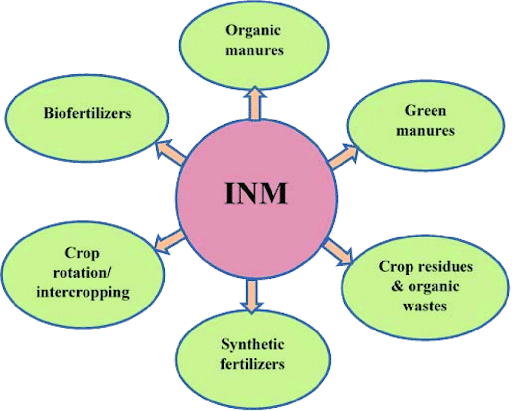
Aspects of Integrated Nutrient Management
Integrated Nutrient Management - Advantages
- Soil Health: The physical features of the soil, such as granulation, porosity, water-holding and drainage capacity, aeration, etc., are improved by the INM. Additionally, it improves the amount of organic matter in the soil, resulting in healthy soil.
- Better Yield: Greater nutrient absorption and balanced crop nutrition promote better plant growth and productivity.
- Environmental Benefits: INM reduces nutrient losses to ground and surface water bodies as well as to the atmosphere, which slows down the deterioration of soil, water, and ecosystems.
- Utilization of Farm Waste: INM encourages using farm wastes as manure and a source of nutrients for crops.
- Cost Reduction: Since some organic sources are readily available at low prices, they aid in lowering production costs.
- Judicious Use: In Indian agriculture, the overuse of artificial fertilizers is a major problem. INM thus supports the wise application of chemical fertilisers.

Advantages of Integrated Nutrient Management
Integrated Nutrient Management - Limitations
- Lack of Knowledge: Farmers frequently lack the information necessary to utilize fertilizers in a balanced ratio.
- Funding: Farmers, particularly those in rural areas, lack access to loans. They don't have enough money to purchase fertilizer and manure, which are essential for INM.
- Land Degradation: One of the biggest challenges for INM is the deterioration of lands due to intensive cultivation and over-exploitation due to the tremendous pressure of the ever-increasing population.
- Monsoon Vagaries: The monsoon is essential to Indian agriculture. The greatest hindrance to the usage of fertilizers is thought to be the risk of water shortage during drought-prone seasons. Water erosion poses a severe danger to soil fertility and productivity during monsoons.
- Limitation of Small Holdings: The majority of farmers in India have small holdings since the country's land is divided. This makes it impossible to use INM on a commercial scale.
- Limitation of Biofertilizers: The use of biofertilizers is restricted to certain crops and geographical areas, has a short shelf life, requires careful handling, and has other drawbacks that make it difficult to efficiently use and spread.
- Furthermore, because the products contain living or latent organisms, low-quality bio-fertilizers that reach the farmers are inefficient and their marketing is challenging.
Conclusion
Integrated Nutrient Management is thus a sustainable approach to agriculture. In addition to boosting agricultural yield, it also aids in biological, water, and soil restoration. In order to promote INM in India, extension organisations must educate farmers about the declining soil health, unsustainable output, and environmental pollution caused by the non-use of organics.
FAQs
Q1: What is Integrated Nutrient Management (INM)?
Answer: Integrated Nutrient Management (INM) is an approach that combines the use of organic, inorganic, and biological sources of plant nutrients in a balanced manner to ensure sustainable soil fertility and crop productivity. The objective is to optimize the nutrient supply to crops while minimizing environmental harm.
Q2: Why is INM important for sustainable agriculture?
Answer: INM is important for sustainable agriculture because it promotes efficient use of nutrients, improves soil health, and reduces dependency on chemical fertilizers. It helps maintain the ecological balance, enhances soil productivity over time, and mitigates environmental degradation.
Q3: What are the key components of INM?
Answer: The key components of INM include the balanced use of chemical fertilizers, organic manures, crop residues, bio-fertilizers, and other organic amendments. These components work synergistically to improve soil fertility and crop productivity.
Q4: How does INM contribute to environmental protection?
Answer: INM reduces the excessive use of chemical fertilizers, thus preventing nutrient runoff and leaching into water bodies. By using organic and biological sources of nutrients, it helps reduce pollution, enhances soil biodiversity, and maintains the ecological balance.
Q5: What are the challenges in implementing INM?
Answer: The challenges in implementing INM include lack of awareness among farmers, insufficient availability of organic materials, and the need for training and education to adopt balanced nutrient management practices effectively.
MCQs
- What is the primary goal of Integrated Nutrient Management (INM)?
a) Maximizing the use of chemical fertilizers
b) Increasing soil degradation
c) Sustainable soil fertility and crop productivity
d) Minimizing the use of organic matter
Answer: (C) See the Explanation
- Which of the following is NOT a component of INM?
a) Organic manures
b) Chemical fertilizers
c) Bio-fertilizers
d) Pesticides
Answer: (D) See the Explanation
- How does INM help in improving soil health?
a) By using only chemical fertilizers
b) By avoiding any nutrient application
c) By combining organic and inorganic nutrient sources
d) By applying excessive fertilizers
Answer: (C) See the Explanation
- Which of the following is a benefit of adopting INM practices?
a) Increased soil erosion
b) Decreased crop yield
c) Enhanced soil fertility and productivity
d) Increased use of synthetic pesticides
Answer: (C) See the Explanation
- What is a key environmental benefit of INM?
a) Increased pollution
b) Reduced nutrient runoff and leaching
c) Depletion of soil organic matter
d) Dependence on chemical fertilizers
Answer: (B) See the Explanation
GS Mains Questions and Model Answers
Q1. Discuss the role of Integrated Nutrient Management (INM) in enhancing soil fertility and ensuring sustainable agricultural practices.
Answer: Integrated Nutrient Management (INM) plays a crucial role in enhancing soil fertility and ensuring sustainable agricultural practices by promoting the balanced use of organic, inorganic, and biological nutrient sources. By integrating chemical fertilizers with organic manures, crop residues, and bio-fertilizers, INM provides plants with the essential nutrients they need for growth while improving soil structure and fertility. One of the key benefits of INM is that it reduces the dependence on chemical fertilizers, which, when overused, can lead to soil degradation, pollution, and reduced soil biodiversity. INM promotes the recycling of organic matter, helping to increase the organic content in the soil, improve water retention, and enhance microbial activity. This holistic approach not only ensures better crop yields but also maintains long-term soil health. Moreover, INM helps mitigate environmental degradation by reducing nutrient runoff and leaching, protecting water bodies from eutrophication, and supporting biodiversity. In this way, INM is vital for promoting sustainable agricultural practices that can meet the growing demand for food while conserving natural resources for future generations.
Q2. Evaluate the challenges and opportunities in the adoption of Integrated Nutrient Management (INM) in India’s agricultural sector.
Answer: The adoption of Integrated Nutrient Management (INM) in India presents both challenges and opportunities. One of the key challenges is the lack of awareness and knowledge among farmers regarding the benefits of INM and the importance of balanced nutrient management. Many farmers still rely heavily on chemical fertilizers, leading to soil degradation and environmental harm. Additionally, the availability of organic materials, such as farmyard manure and compost, is often limited, making it difficult for farmers to implement INM effectively. There is also a lack of proper training and infrastructure to support the widespread adoption of INM practices. However, the opportunities presented by INM are significant. INM has the potential to improve soil health, enhance crop productivity, and reduce the environmental impact of agriculture. With government initiatives promoting sustainable agriculture and organic farming, there is increasing support for INM practices. Programs such as soil health cards, awareness campaigns, and subsidies for organic inputs can further encourage the adoption of INM. By integrating traditional knowledge with modern agricultural techniques, INM can play a key role in achieving sustainable food production in India, enhancing farmer incomes, and protecting the environment.
Q3. How does Integrated Nutrient Management (INM) contribute to reducing the environmental impact of agricultural practices?
Answer: Integrated Nutrient Management (INM) contributes to reducing the environmental impact of agricultural practices by promoting the balanced and efficient use of nutrients, minimizing the over-reliance on chemical fertilizers, and encouraging the use of organic and biological inputs. Excessive use of chemical fertilizers can lead to nutrient runoff and leaching into water bodies, causing pollution and eutrophication. INM addresses this issue by integrating organic manures, crop residues, and bio-fertilizers with chemical fertilizers, which reduces the risk of nutrient losses and ensures that plants receive nutrients in a more sustainable manner. Additionally, INM enhances soil health by increasing organic matter content and improving soil structure, which helps in better nutrient retention and water infiltration, further reducing runoff. By improving soil fertility and promoting microbial activity, INM also enhances the long-term sustainability of agricultural systems. Moreover, the use of bio-fertilizers in INM contributes to reducing greenhouse gas emissions associated with the production and use of synthetic fertilizers. Overall, INM reduces the environmental footprint of agriculture, promotes ecological balance, and supports the conservation of natural resources.
Previous Year Questions on Integrated Nutrient Management
1. UPSC CSE 2019
Question: Analyze the role of Integrated Nutrient Management (INM) in addressing the challenges of soil degradation and nutrient depletion in Indian agriculture.
Answer: Integrated Nutrient Management (INM) addresses the challenges of soil degradation and nutrient depletion in Indian agriculture by promoting a balanced approach to nutrient application. The overuse of chemical fertilizers, particularly nitrogen-based fertilizers, has led to the depletion of essential soil nutrients and the degradation of soil health. INM seeks to reverse these trends by incorporating organic manures, crop residues, and bio-fertilizers into the nutrient management system, ensuring that the soil receives a diverse range of nutrients in a sustainable manner. By improving soil organic matter content, INM enhances soil structure, water retention, and microbial activity, all of which are critical for restoring soil fertility. The judicious use of chemical fertilizers in combination with organic inputs helps prevent the depletion of key nutrients like phosphorus and potassium. Additionally, INM reduces nutrient runoff and leaching, which are major contributors to soil degradation. This approach not only improves crop productivity but also ensures the long-term sustainability of agricultural practices. By addressing both immediate and long-term nutrient needs, INM plays a vital role in combating soil degradation and ensuring food security in India.
2. UPSC CSE 2018
Question: Discuss the potential of Integrated Nutrient Management (INM) in achieving sustainable agricultural practices in India.
Answer: Integrated Nutrient Management (INM) holds significant potential in achieving sustainable agricultural practices in India by promoting the judicious use of chemical fertilizers alongside organic and biological nutrient sources. This balanced approach helps maintain soil fertility, enhance crop yields, and reduce environmental degradation, all of which are critical for the sustainability of agriculture. INM’s reliance on organic manures, compost, bio-fertilizers, and crop residues reduces the dependency on synthetic fertilizers, thereby minimizing the adverse impacts of chemical overuse, such as soil acidification, nutrient runoff, and water pollution. Furthermore, INM promotes the recycling of organic matter, improving soil health and biodiversity.
Download the PREPP App and attempt FREE IAS Exam Mock Tests and get complete study material!

Full Test - 04: UPSC CSE Prelims CSAT (Paper-II)
Full Test - 03: UPSC CSE Prelims CSAT (Paper-II)
UPSC CSE Prelims 2026 GS Paper 1 Question Paper (24-May-2026)
UPSC CSE Prelims 2026 CSAT Paper 2 Question Paper (24-May-2026)

17 February 2025 | The Hindu Must Read Articles | Current Affairs

16 February 2026 | The Hindu Must Read Articles | Current Affairs

13 February 2026 | The Hindu Must Read Articles | Current Affairs









Comments