Fertilizers - Agriculture Notes
Fertilizers are chemical substances that are applied to crops in order to boost their yield. Farmers utilize fertilizers on a daily basis to boost crop productivity. The fertilizers include nitrogen, potassium, and phosphorus, which are necessary minerals for plants. They improve the soil's water retention capacity while also increasing its fertility. Urea, Ammonia are some of the most commonly used fertilizers around the world. This article will explain to you about Fertilizers which will be helpful in preparing the Agriculture Syllabus for the UPSC Civil Service exam.
|
Table of Contents |
Fertilizers
What are Fertilizers?
- A fertilizer is a natural or artificial substance that contains the chemical components necessary to increase plant growth and productivity.
- Fertilizers may restore chemical elements that previous crops removed from the soil or increase the land's inherent fertility.
- When other conditions (such as light, moisture, temperature, and soil structure) are favorable, soil fertility is the property of a soil that permits it to provide chemicals in appropriate numbers and proper balance to encourage plant growth.
- Fertilizers are industrially produced chemicals that contain plant nutrients.
- Fertilizers have a higher nutrient content than organic manures, and nutrients are released almost immediately.
- Natural or synthetic materials may be added to deficient soil to provide the necessary plant nutrients.
- These are referred to as fertilizers, despite the fact that the term is often used to describe mostly inorganic compounds other than lime or gypsum.
|
|
|
|---|---|
| Manures | Classification of Organic manures |
| Concentrated organic manures | Integrated Nutrient Management (INM) |
| Elements Required In Plant Growth | Permaculture |
Types of Fertilizers
Organic Fertilizers
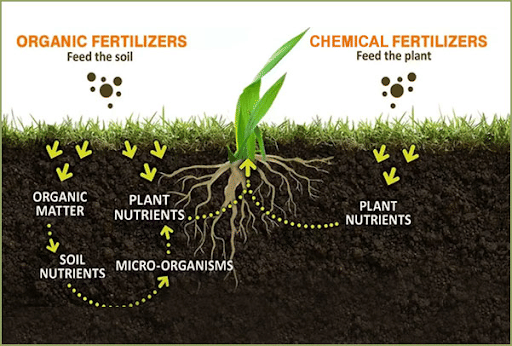
- Natural fertilizers derived from plants and animals are known as organic fertilizers.
- It adds carbonic chemicals to the soil, which are necessary for plant growth.
- Organic fertilizers boost the soil's organic matter content, promote microorganism growth, and alter the soil's physical and chemical qualities.
- It is one of the most important nutrients in green foods.
- The following products can be used to make organic fertilizers:
- Agricultural Waste
- Livestock Manure
- Industrial Waste
- Municipal Sludge
Inorganic Fertilizers
Chemical fertilizers containing nutritional elements for crop growth generated by chemical processes are known as inorganic fertilizers. The following are examples of inorganic fertilizers:
Nitrogen Fertilizers
- Nitrogen fertilizers contain nitrogen, which is essential for crop development.
- The key component of chlorophyll that keeps the photosynthesis process balanced is nitrogen.
- It is also found in plants as part of the amino acids that make up protein.
- Nitrogen fertilizers boost agricultural product production and quality.
Phosphorus Fertilizers
- Phosphorus is the most important nutrient in phosphorus fertilizers.
- Fertilizer efficiency is determined by effective phosphorus concentration, fertilization methods, soil conditions, and crop strains.
- Phosphorus, which is contained in the cell's protoplasm, is vital for cell growth and proliferation.
- The use of phosphorus fertilizer is favorable to the growth of plant roots.
Fertilizers - Benefits
- Fertilizers restore soil fertility and provide plant nutrients quickly.
- They are lightweight and transportable and plants easily absorb fertilizers.
- Many crops, such as wheat, maize, and rice, benefit from fertilizers, which boost and raise their yield.
- Fertilizers increase a plant's pest resistance. They are using less insecticide and herbicide as a result, which leads to healthier crops. Because fewer diseases are present, the crops have a higher aesthetic value.
- Fertilizers deepen roots and increase a plant's ability to hold water.
- The straws and stalks of the plants are strengthened by the fertilizers' potassium concentration.
- The phosphorus found in fertilizers aids in the faster generation of seeds and roots in plants.
- The fertilizers' nitrogen content encourages plant development, as evidenced by the green colour of the plants.
Fertilizers - Harmful Effects
- Although fertilizers are primarily used to repair deficiencies in soil nutrients such as potassium, calcium, nitrogen, and sulfur, among other key macronutrients, they should be treated with the appropriate fertilizer and in the appropriate amount.
- Fertilizers are used carelessly by some farmers, resulting in soil pollution.
- Furthermore, the materials utilized in fertilizer production contain harmful substances that contribute to soil toxicity.
- For example, the rock phosphate mineral used to make mixed fertilizers contains traces of Asbestos, Cadmium, and Lead, which are transferred to the fertilizer throughout the manufacturing process.
- These metals are non-biodegradable and build up to dangerous quantities over time.
Degradation of Soil Quality
- Fertilizers pollute soil due to waste material released from raw materials used in manufacturing processes.
- Because metals are not biodegradable, they can contaminate soil by accumulating in it as a result of excessive phosphate fertilizer use.
- Because of the overuse of NPK fertilizers, agricultural practices have been reduced. Wheat, maize, and gram grown in such soils have lower protein content.
- Furthermore, the carbohydrate content of such crops degrades in quality.
- When there is an excess of potassium in the soil, the vitamin C and carotene content of vegetables and fruits decreases.
- Excessive fertilizer use can alter soil fertility and acidity levels. This is why the soil should be tested at least once every three years to determine the exact amount of fertilizer to be used.
- The loss of humus reduces the soil's ability to store nutrients.
Change in Biology of Water Bodies
- Eutrophication is caused by the overuse of fertilizers. Fertilizers contain chemicals such as NO3 and PO4, which are washed into lakes and oceans.
- These substances are toxic to aquatic life because they promote the growth of algae in bodies of water and reduce oxygen levels.
- This results in a toxic environment and the extinction of aquatic life as well as other aquatic animals and plants.
- It indirectly disrupts the food chain because different types of fish in water bodies are the primary food source for many birds and animals in the environment.
Effects on Human Health
- Fertilizers, which contain N2 and other chemicals, have an impact on groundwater systems and are used for drinking.
- One of the most common outcomes is the development of blue baby syndrome, which occurs in infants whose skin tissues are low in oxygen, causing their skin to appear purplish or blue in color.
- Various studies have revealed that the use of lawn fertilizers and pesticides can endanger one's health.
- Cancer and chronic diseases in humans, particularly in children, are examples of these risks.
Climate Change
- Fertilizers contain substances and chemicals such as methane, carbon dioxide, ammonia, and nitrogen, and the emission of these gases contributes to the presence of greenhouse gases in the environment.
- As a result, global warming and weather changes occur.
- Carbon dioxide, methane, and nitrous oxide are the three most significant greenhouse gases. Nitrous oxide is a nitrogen byproduct.
Fertilizers - Prevention and Control Measures
- Both inorganic and organic fertilizers should be used sparingly for healthy soil.
- Aside from that, the soil should be allowed to replenish its nutrients naturally by resting from crop production, and fertilizers should be avoided during precipitation.
- Planting crops like corn, tobacco, and cotton on the same land for several years in a row can deplete nutrients (especially nitrogen) in the topsoil. Crop rotation is one method for reducing these losses.
- Farmers plant nutrient-depleting crops in areas or strips for one year. The following year, they plant legumes with nitrogen-fixing root nodules in these areas.
- Furthermore, by keeping the soil covered with vegetation, this method reduces erosion.
- Furthermore, the use of 'green manure' is recommended.
Conclusion
Since chemical fertilizers have a negative impact on soil fertility, biofertilizers have been developed. These are substances that include microorganisms, latent cells, or both. They give the soil the nutrients and microorganisms the plants need to develop. They aid in preserving the fertility of the soil. They also eliminate the pathogenic elements that are the source of plant disease while being environmentally beneficial.
FAQs
Question: What are fertilizers and why are they important in agriculture?
Answer: Fertilizers are substances added to soil or plants to supply essential nutrients needed for growth. They are crucial for increasing agricultural productivity by replenishing nutrients like nitrogen, phosphorus, and potassium that are depleted from the soil after repeated crop cultivation. Fertilizers help improve soil fertility, enhance crop yields, and ensure food security.
Question: What are the different types of fertilizers used in agriculture?
Answer: Fertilizers are classified into two main types: organic and inorganic (chemical) fertilizers. Organic fertilizers include compost, manure, and bio-fertilizers, which improve soil structure and microbial activity. Inorganic fertilizers, such as nitrogen, phosphorus, and potassium-based fertilizers, provide essential nutrients to crops in a concentrated form. Each type has distinct benefits for soil and plant health.
Question: How do chemical fertilizers impact the environment?
Answer: Chemical fertilizers can have adverse environmental effects if not used judiciously. Excessive use can lead to soil degradation, water pollution, and loss of biodiversity. Leaching of nutrients from the soil into groundwater can result in contamination, while runoff into water bodies can cause eutrophication, leading to the growth of harmful algae.
Question: What are the benefits of organic fertilizers over chemical fertilizers?
Answer: Organic fertilizers have several benefits over chemical fertilizers, including improving soil structure, increasing water retention, and enhancing soil biodiversity. They release nutrients slowly, reducing the risk of over-fertilization, and help maintain long-term soil health. Organic fertilizers are considered environmentally friendly as they are biodegradable and reduce dependency on synthetic chemicals.
Question: What is the role of bio-fertilizers in sustainable agriculture?
Answer: Bio-fertilizers are natural fertilizers that contain living microorganisms, such as bacteria and fungi, which help improve soil fertility by fixing nitrogen, decomposing organic matter, and enhancing plant nutrient uptake. Bio-fertilizers play a crucial role in sustainable agriculture by reducing the need for chemical fertilizers, improving soil health, and promoting eco-friendly farming practices.
MCQs
1. Which of the following is an example of an organic fertilizer?
A) Urea
B) Compost
C) Superphosphate
D) Potassium nitrate
Answer: (B) See the Explanation
Explanation: Compost is an example of an organic fertilizer, as it is made from decomposed organic matter, such as plant residues and animal manure.
2. What is the primary role of nitrogen in fertilizers?
A) Root development
B) Flowering and fruiting
C) Leaf and stem growth
D) Soil fertility
Answer: (C) See the Explanation
Explanation: Nitrogen plays a crucial role in promoting leaf and stem growth in plants by enhancing protein synthesis and chlorophyll production.
3. Which of the following is a potential environmental consequence of excessive use of chemical fertilizers?
A) Improved soil structure
B) Water contamination
C) Reduced crop yield
D) Increase in beneficial soil organisms
Answer: (B) See the Explanation
Explanation: Excessive use of chemical fertilizers can lead to water contamination due to nutrient runoff, which can cause eutrophication in aquatic ecosystems.
4. What is the main difference between bio-fertilizers and chemical fertilizers?
A) Bio-fertilizers contain living organisms, while chemical fertilizers are synthetically produced
B) Bio-fertilizers are only applied to the soil, while chemical fertilizers can be sprayed on leaves
C) Bio-fertilizers improve soil texture, while chemical fertilizers do not
D) Bio-fertilizers are more effective in increasing yield than chemical fertilizers
Answer: (A) See the Explanation
Explanation: Bio-fertilizers contain living microorganisms that naturally enhance soil fertility, whereas chemical fertilizers are synthetically produced to provide specific nutrients to plants.
5. What is the environmental benefit of using organic fertilizers?
A) Reduction in soil erosion
B) Preservation of soil fertility
C) Increase in carbon emissions
D) Decrease in water retention capacity
Answer: (B) See the Explanation
Explanation: Organic fertilizers help preserve soil fertility by improving soil structure, increasing organic matter, and supporting beneficial soil organisms, thereby enhancing long-term soil health.
GS Mains Questions and Model Answers
Q1: Analyze the advantages and disadvantages of chemical fertilizers in modern agriculture. How can their negative effects be mitigated?
Answer: Chemical fertilizers provide essential nutrients to crops, which can significantly increase agricultural productivity. However, their excessive use can lead to soil degradation, water pollution, and negative impacts on biodiversity. To mitigate these negative effects, it is important to use fertilizers in a balanced manner, integrate organic farming practices, and adopt sustainable agricultural practices such as crop rotation, green manuring, and the use of bio-fertilizers.
Q2: Discuss the role of organic fertilizers in sustainable agriculture. What are the challenges associated with their use?
Answer: Organic fertilizers play a vital role in sustainable agriculture by enhancing soil fertility, improving soil structure, and reducing dependency on chemical inputs. They help in maintaining soil health and increasing water retention capacity. However, the challenges associated with their use include slower nutrient release, higher labor costs for production, and potential nutrient imbalances if not properly managed. Furthermore, the availability of organic fertilizers is often limited compared to chemical fertilizers, especially in regions with insufficient organic farming infrastructure.
Q3: Evaluate the impact of bio-fertilizers on agricultural productivity and soil health. How do they compare to chemical fertilizers?
Answer: Bio-fertilizers contribute to sustainable agriculture by enhancing soil fertility through natural processes such as nitrogen fixation and organic matter decomposition. They improve soil health by promoting beneficial microorganisms and reducing the risk of soil erosion and degradation. Compared to chemical fertilizers, bio-fertilizers have a slower and more consistent nutrient release, which reduces the likelihood of nutrient imbalances and environmental damage. However, they may not provide the rapid nutrient boost that chemical fertilizers offer, and their adoption requires farmers to adjust to new practices and technologies.
Previous Year Questions on Fertilizers
1. UPSC CSE Prelims 2021:
Question: Which of the following is a key characteristic of organic fertilizers?
A) They release nutrients rapidly
B) They improve soil structure and biodiversity
C) They are synthetically produced
D) They are highly concentrated and require minimal application
Answer: (B)
Explanation: Organic fertilizers improve soil structure and promote biodiversity by supporting beneficial microorganisms and enhancing organic matter content.
2. UPSC CSE Mains 2020 (GS Paper 3):
Question: "The use of chemical fertilizers has led to a significant increase in agricultural productivity but at the cost of long-term sustainability." Discuss the environmental consequences of over-reliance on chemical fertilizers and suggest alternatives.
Answer: Over-reliance on chemical fertilizers has led to soil degradation, water pollution, and a reduction in biodiversity. The negative effects include nutrient imbalances, contamination of groundwater, and eutrophication of water bodies. Alternatives include the use of organic fertilizers, bio-fertilizers, crop rotation, and integrated nutrient management to improve soil health and sustainability in agriculture.
Download the PREPP App and attempt FREE IAS Exam Mock Tests and get complete study material!

Full Test - 04: UPSC CSE Prelims CSAT (Paper-II)
Full Test - 03: UPSC CSE Prelims CSAT (Paper-II)
UPSC CSE Prelims 2026 GS Paper 1 Question Paper (24-May-2026)
UPSC CSE Prelims 2026 CSAT Paper 2 Question Paper (24-May-2026)

17 February 2025 | The Hindu Must Read Articles | Current Affairs

16 February 2026 | The Hindu Must Read Articles | Current Affairs

13 February 2026 | The Hindu Must Read Articles | Current Affairs









Comments