Classification of Organic Manures - Agriculture Notes
Organic manure is a well-decomposed material used in agriculture that is devoid of pesticides, dangerous organisms, and weed seeds, whether it comes from plants or animals. There are several organic manures available, including farm yard manure, green manures, compost made from crop leftovers and other agricultural wastes, and biological wastes like animal bones and slaughterhouse waste. This article will explain to you the Classification of Organic Manures which will be helpful in preparing the Agriculture Syllabus for the UPSC Civil Service exam.
|
Table of Contents |
What are Organic Manures?
- Organic manures are natural substances that farmers employ to increase crop yield that is sustainable in nature.
- The organic matter in the soil is increased by using organic manures. In turn, organic matter makes plant food for usage by crops readily available.
- However, organic manures shouldn't be viewed as merely plant food transporters.
- These manures also assist clay soils to drain better and allow the soil to hold more water.
- They offer organic acids that aid in dissolving soil nutrients and releasing them for plant uptake.
|
|
|
|---|---|
| Manures | Farm Yard Manure |
| Compost Manure | Sheep and Goat droppings |
| Fertilizers | Concentrated organic manures |
| Integrated Nutrient Management (INM) | Elements Required In Plant Growth |
Classification of Organic Manures
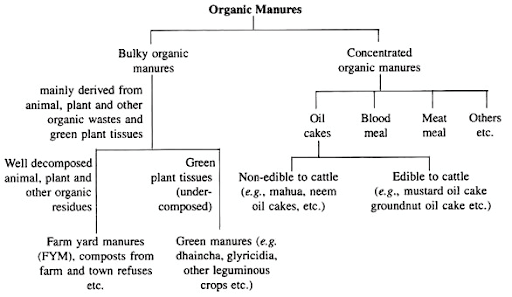
Types of Organic Manures
Bulky Organic Manure
- Bulky organic manures have a low nutrient content and are applied in large quantities.
- The most important and widely used bulky organic manures are farmyard manure (FYM), compost manure and green manure.
- There are several advantages to using bulky organic manures:
- They provide plant nutrients such as micronutrients.
- They improve soil physical properties such as structure, water retention capacity, and so on.
- They improve nutrient availability.
- Carbon dioxide produced during decomposition serves as a CO2 fertilizer.
- Plant parasitic nematodes and fungi can be controlled to some extent by changing the soil microorganism balance.
Farm Yard Manure
- Farmyard manure is a natural fertilizer that helps to improve the soil structure.
- It expands the capacity of the soil to hold more water and minerals.
- It also boosts the soil's microbial activity, which improves mineral delivery and plant nutrition.
- Examples of farmyard manures include cattle shed wastes-dung, urine, sewage, sludge, poultry wastes, droppings of sheep and goat and fish wastes.
*To know more about the topic, click this link Farm Yard Manure
Compost Manure
- Compost manure is a combination of nutrients used to spruce up and enrich the soil. It is frequently made by recycling organic materials and decaying plant and food waste.
- The resulting mixture is loaded with plant nutrients and helpful creatures like worms and mycelium from fungi.
- It improves the soil structure as well as its water and nutrient retention capacity.
- As a result, the nutrient value increases, and the plants' health improves.
- Examples of compost manures include food scraps, grass clippings, leaves, wood chippings and coffee grounds.
*To know more about the topic, click this link Compost Manure
Green Manures
- Crops planted specifically for improving and preserving the fertility and structure of the soil are known as "green manures."
- Normally, plants used as green manures are either returned to the soil unprocessed or after being removed and composted.
- Green manure raises the organic matter content of the soil.
- Such manures have deep roots that penetrate the soil.
- These aid in the control of weeds as well as the avoidance of soil erosion.
- Legumes such as vetch, clover, beans, and peas; grasses such as annual ryegrass, oats, rapeseed, winter wheat, and winter rye; and buckwheat are examples of green manures.
*To know more about the topic, click this link Green Manuring
Sheep and Goat Droppings
- Fertilizer is one of the most popular uses for goat manure. Farmers can increase crop yields and plant health by using fertilizer made from goat and sheep droppings.
- Sheep and Goat Droppings are naturally the form of pellets and are cleaner.
- Sheep and goat droppings in general don't often burn plants or attract insects like those of cows or horses.
- Both are practically odorless and good for the soil.
*To know more about the topic, click this link Sheep and Goat Droppings
Green Leaf Manuring
- Green leaf manure is a rapidly growing crop that is farmed and ploughed under in order to absorb it into the soil and improve its physical structure and fertility.
- The concept of using green leaf manures to grow crops is not new at all and has been practiced for generations in several South Asian nations.
- Green leaf manuring is the practice of cutting and gathering green leaves and twigs from a variety of trees, herbs, and shrubs in order to use them as fertilisers in other places.
- The main sources of these manures are forest tree leaves, while other notable sources include plants and shrubs that grow in field bunds, wastelands, etc.
- Utilizing green leaf manures is a highly beneficial practice, particularly in hilly locations.
*To know more about the topic, click this link Green Leaf Manuring
Concentrated Organic Manures
- Concentrated organic manures are those that are naturally organic and have higher concentrations of important plant nutrients like N, P2O5, and K2O than bulky organic manures.
- These concentrated manures are made from basic materials that are either plant- or animal-derived.
- Oil cakes, bone meal, fish meal, blood meal, and green leaf manures are some of the concentrated organic manures that are frequently employed
- These are also referred to as organic nitrogen fertilizers.
- Before their organic nitrogen is utilized by the crops, it is transformed by bacterial action into easily available ammoniacal nitrogen and nitrate nitrogen.
- Because of this, these organic fertilizers are often delayed acting, but they provide available nitrogen for a longer time.
*To know more about the topic, click this link Concentrated Organic Manures
Oil Cakes
- Oil cake, which is made up of the leftovers from the oil extraction process at the processing plant and contains a high nitrogen content, is one of the natural organic fertilizers.
- Among the products whose processing results in oil cakes are olives for olive oil, peanuts for peanut oil, coconut flesh for coconut cream and milk (sapal), grapes for wine, apples for cider, and soybeans for soy milk.
- Other frequent oil cakes are made from sunflower, cottonseed, and flax seed (also known as linseed).
*To know more about the topic, click this link Oil Cakes
Fish Meal
- Fish meal is a type of fertilizer made from dried fish waste after the rancid oil has been removed and preservatives have been added.
- This slow-releasing fertilizer is beneficial for leafy plants.
- It is a great all-purpose organic fertilizer due to its high levels of nitrogen and phosphorus and the presence of significant trace elements.
- Fish meal is a good source of micronutrients and feeds the beneficial soil microorganisms, promoting the growth of larger, more robust plants.
*To know more about the topic, click this link Fish Meal
Bone Meal
- A bone meal is organic manure manufactured from heating animal bones that are then ground into a fine powder or granules for use on plants or crops.
- The plants will benefit from the nutrients and minerals found in bones, especially calcium and phosphorous which will help them grow stronger and healthier.
- It provides plants with Phosphorus, Calcium, and a small quantity of Nitrogen as a slow-release organic fertilizer.
*To know more about the topic, click this link Bone Meal
Conclusion
Chemical fertilizer use is increasing day by day in order to increase production. Its overuse reduces soil fertility and harms human health. As a result, using organic manure is one of the alternative methods for increasing production and improving soil health. It is not only less expensive, but it also ensures sustainable agriculture.
FAQs
Question: What are organic manures?
Answer: Organic manures are natural substances derived from animal, plant, or human waste, which improve soil fertility by providing essential nutrients to crops. Unlike chemical fertilizers, organic manures enhance soil structure and microbial activity, making them sustainable for long-term agricultural use.
Question: What are the types of organic manures?
Answer: Organic manures are primarily classified into farmyard manure (FYM), compost, green manure, and bio-fertilizers. Each type of manure contributes to improving soil fertility through different mechanisms, such as increasing organic matter or fixing nitrogen.
Question: What is the difference between green manure and farmyard manure?
Answer: Green manure involves the growing of crops specifically for the purpose of plowing them into the soil to increase organic content and nitrogen levels. Farmyard manure (FYM), on the other hand, is animal dung mixed with bedding materials like straw or hay, which decomposes to release nutrients.
Question: How does composting improve the quality of organic manure?
Answer: Composting accelerates the decomposition of organic matter, transforming waste materials like leaves, kitchen scraps, and farm residues into nutrient-rich humus. This process enhances the quality of organic manure by making nutrients more readily available to plants and reducing harmful pathogens.
Question: What are the advantages of using organic manure over chemical fertilizers?
Answer: Organic manure improves soil health, promotes microbial activity, enhances water retention, and reduces the risk of soil degradation. Unlike chemical fertilizers, organic manures do not cause nutrient imbalances or harm beneficial organisms in the soil. They also promote long-term sustainability and reduce environmental pollution.
MCQs
1. Which of the following is an example of green manure?
A. Urea
B. Cow dung
C. Azolla
D. Compost
Answer: (C) See the Explanation
Azolla is an example of green manure. It is a water fern that is used to enrich soil with nitrogen when plowed under, especially in rice fields.
2. Which of the following is the primary benefit of using farmyard manure (FYM)?
A. Increases nitrogen fixation
B. Improves soil structure
C. Controls pests
D. Accelerates crop growth
Answer: (B) See the Explanation
Farmyard manure primarily improves soil structure by adding organic matter, which enhances water retention and supports soil microbial life.
3. Which process is used to produce compost?
A. Dehydration
B. Decomposition
C. Fermentation
D. Oxidation
Answer: (B) See the Explanation
Composting is a decomposition process in which organic materials are broken down by microorganisms under controlled conditions, resulting in nutrient-rich humus.
4. What is the main difference between bio-fertilizers and organic manure?
A. Bio-fertilizers are chemical-based
B. Bio-fertilizers contain living organisms
C. Organic manure is synthetic
D. Organic manure fixes nitrogen in the soil
Answer: (B) See the Explanation
Bio-fertilizers contain living microorganisms that help fix nitrogen, decompose organic matter, or improve nutrient availability, while organic manure consists of decomposed plant and animal matter without active microorganisms.
5. Which of the following organic manures is most effective for adding nitrogen to the soil?
A. Green manure
B. Bio-fertilizers
C. Compost
D. Farmyard manure
Answer: (A) See the Explanation
Green manure, especially nitrogen-fixing plants like legumes, is highly effective for adding nitrogen to the soil as it incorporates fresh organic material directly into the soil, boosting nitrogen levels.
GS Mains Questions and Model Answers
1. Discuss the role of organic manures in promoting sustainable agriculture in India.
Answer: Organic manures play a pivotal role in promoting sustainable agriculture by enhancing soil fertility and structure without depleting natural resources. Unlike chemical fertilizers, organic manures improve microbial activity, promote biodiversity, and help retain soil moisture, leading to healthier crops and reduced environmental degradation. They also reduce the dependency on chemical inputs and mitigate soil erosion, making them vital for long-term soil health and sustainable farming practices.
2. Analyze the advantages and challenges of using farmyard manure (FYM) in Indian agriculture.
Answer: Farmyard manure (FYM) provides numerous advantages, including improving soil structure, enhancing moisture retention, and adding essential nutrients to the soil. FYM is also readily available and reduces the need for chemical fertilizers. However, challenges include the slow nutrient release, bulkiness, transportation costs, and variability in nutrient content. Despite these challenges, FYM remains an important tool for organic farming and sustainable agricultural practices in India.
3. How can green manure help in increasing agricultural productivity while maintaining soil health?
Answer: Green manure contributes to agricultural productivity by fixing nitrogen in the soil, enhancing organic content, and improving soil fertility. The incorporation of green manure crops like legumes adds fresh biomass to the soil, increasing nutrient availability and improving soil structure. This not only boosts crop yields but also helps maintain soil health by preventing erosion and improving water retention. Green manure is especially valuable for sustainable and organic farming practices, as it reduces the need for synthetic fertilizers.
Previous Year Questions on Organic Manures
1. UPSC CSE Prelims 2019
Question: Which of the following is a natural fertilizer that improves soil fertility by adding nitrogen?
A. Urea
B. Bio-fertilizer
C. Green manure
D. Phosphorus
Answer: C
Explanation: Green manure refers to crops that are grown and plowed into the soil to improve fertility, particularly by adding nitrogen, which is crucial for plant growth.
2. UPSC CSE Mains 2018 (GS Paper 3)
Question: "The use of organic manures is essential for sustainable agriculture." Discuss this statement in light of the environmental and economic benefits of organic farming.
Answer: Organic manures are essential for sustainable agriculture as they improve soil health, enhance microbial activity, and reduce environmental pollution caused by chemical fertilizers. They offer long-term economic benefits by reducing input costs and increasing crop resilience to pests and diseases. The environmental advantages include lower greenhouse gas emissions, reduced soil degradation, and improved biodiversity, making organic manures a cornerstone of eco-friendly farming practices.
Download the PREPP App and attempt FREE IAS Exam Mock Tests and get complete study material!

Full Test - 04: UPSC CSE Prelims CSAT (Paper-II)
Full Test - 03: UPSC CSE Prelims CSAT (Paper-II)
UPSC CSE Prelims 2026 CSAT Paper 2 Question Paper (24-May-2026)
UPSC CSE Prelims 2026 GS Paper 1 Question Paper (24-May-2026)

17 February 2025 | The Hindu Must Read Articles | Current Affairs

16 February 2026 | The Hindu Must Read Articles | Current Affairs

13 February 2026 | The Hindu Must Read Articles | Current Affairs









Comments