Green Leaf Manuring - Agriculture Notes
Green leaf manures are organic fertilizers manufactured from leaves that are collected from all sources and used to replenish depleted soils with vital plant nutrients and boost soil fertility in a natural way. For instance, sunn hemp (sanai) - Crotalaria juncea, Glyricidia, Wild Dhaicha, Karanj (pongamia), Leucaena, etc. This article will explain to you about Green Leaf Manuring which will be helpful in preparing the Agriculture Syllabus for the UPSC Civil Service exam.
|
Table of Contents |
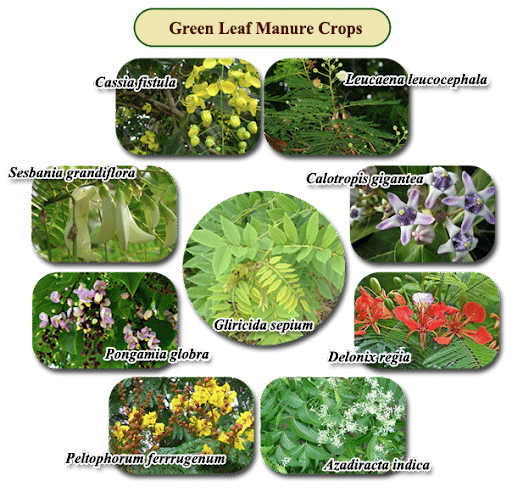
Some Important Green Leaf Manure Crops
Why Green Leaf Manures?
- It is definitely not a good idea to treat the soil by using chemical fertilizers as a source of nutrients for plant growth.
- Green leaf manure, which is organic, has the ability to both maintain excellent soil health and provide the necessary plant nutrients.
- For instance, using GLMs dramatically enhanced the production of rice in an experiment.
- According to the findings of that experiment, rice can be produced with a yield and other outputs comparable to those obtained with N at a rate of 60 kg/ha from urea when GLM N at 120 kg/ha from Leucaena and Gliricidia is used.
- GLMs can thereby take the place of chemical fertilizers and shield the world from the many risks that chemicals provide.
What is Green Leaf Manure?
- Green leaf manure is a rapidly growing crop that is farmed and ploughed under in order to absorb it into the soil and improve its physical structure and fertility.
- The concept of using green leaf manures to grow crops is not new at all and has been practiced for generations in several South Asian nations.
- Green leaf manuring is the practice of cutting and gathering green leaves and twigs from a variety of trees, herbs, and shrubs in order to use them as fertilisers in other places.
- The main sources of these manures are forest tree leaves, while other notable sources include plants and shrubs that grow in field bunds, wastelands, etc.
- Utilizing green leaf manures is a highly beneficial practice, particularly in hilly locations.
Green Manuring Crops - Characteristics
- The crops used as green manure should be capable of quickly growing and expanding.
- They must be tolerant of pests and diseases as well as unfavorable environmental circumstances such as drought, waterlogging, high and low temperatures, etc.
- They should be capable of fixing nitrogen and have enough Rhizobium nodulation potential.
- It should be easy to integrate and quickly decomposable, capable of growing very quickly, and able to accumulate enough fixed nitrogen in 4-6 weeks.
Green Leaf Manuring - Preparation
- Green leaf manures are relatively simple and affordable to produce. On bare land or in live fences, various green manuring trees and plants are grown.
- Their leaves are simply cut when they are mature and bundled before being transported to the fields of crops.
- Numerous trees and plants are utilized to make green leaf manures, including weeds like water hyacinth, Calotrophis, Trianthema, Cassia, Ipomoea, Parthenium, and trees like Pungam, Gliricidia, Mahua, Erukku, Subabul, Vahai, Karanji, Wild indigo, Wild dhaincha, Neem, and others.
- Before adding the leaves of a green manuring crop like Thespesia to the soil, the leaves must wither for two days.
Green Leaf Manuring - Application
- The moisture level of the soil must be considered while applying green leaf manures to it.
- For this manure to be applied to soil, there must be sufficient moisture content.
- Farmers who employ green leaf manures utilize their own methods to gauge moisture content.
- They take a soil sample from a depth of 5 cm and analyze it to assess the soil's moisture state. They use their hands to form clods out of the soil sample.
- If the clod instantly crumbles when they hold it between their palms, they decide that the moisture content is insufficient for applying green leaf manures.
- Only when the moisture content is deemed adequate do they add GLMs to the soil.
- Prior to applying GLMs to the soil, they also measure the soil's content of organic matter.
Green Leaf Manuring - Advantages
- Green Leaf Manure plants significantly increase the soil's nitrogen content.
- Green Leaf Manures make sure that plants have proper nutrition and greatly increase soil fertility.
- They do not need to replant because Green Leaf Manure trees are perennial and provide leaves for manuring two to three times per year.
- Green Leaf Manures are slow-releasing fertilizers that continue to provide nutrients to plants for a considerable amount of time after being applied.
- The application of Green Leaf Manure significantly improves soil structure.
- Because they serve as food for earthworms, green leaf manure promotes their growth.
- Because they decompose quickly, organic matter can be easily retained in the soil.
- Green manures improve the soil's physical and chemical properties.
- They provide microbes with energy.
- They supply nutrients to both the current crop and the next crop.
- Green manure crops are added to the soil to help prevent soil erosion.
- Green manure can be used to prevent nutrient leaching in light soils.
Conclusion
The indiscriminate use of different chemical fertilizers is endangering the environment, human health, and the soil, our most valuable natural resource, permanently. After a certain amount of time, the soil won't be suitable for crop production if this horrible chemical use continues. So, in order to maintain healthy soil for future generations, it is important to switch the agricultural system from chemicals to organic manures. Green leaf manures are typically applied directly to the soil. When cutting green leaves or branches from roadside trees, which attract fuel residues like lead, extreme caution should be exercised. It is recommended that green leaves and branches be washed with water before being placed on the soil or in the compost pit.
FAQs
Question: What is green leaf manuring?
Answer: Green leaf manuring involves incorporating green leaves and twigs of trees, shrubs, and other plants into the soil to enhance its organic content, improve fertility, and boost nutrient availability for crops.
Question: Which plants are commonly used for green leaf manuring?
Answer: Plants like Gliricidia, Sesbania, Cassia, and various leguminous trees are commonly used due to their nitrogen-fixing properties and fast decomposition rates.
Question: How does green leaf manuring benefit soil health?
Answer: It improves soil structure, increases organic matter, enhances microbial activity, and supplies essential nutrients, particularly nitrogen, which supports better crop yields.
Question: When is green leaf manuring typically applied?
Answer: It is usually applied before sowing a crop or during land preparation to maximize nutrient availability and improve soil fertility.
Question: What role does green leaf manuring play in sustainable agriculture?
Answer: By enriching soil naturally, it reduces the dependency on chemical fertilizers, promotes organic farming practices, and enhances soil resilience, contributing to sustainable agriculture.
MCQs
- What is the primary purpose of green leaf manuring?
A) To provide shade to crops
B) To enrich the soil with organic matter
C) To increase water logging
D) To protect plants from pests
Answer: (B) See the Explanation
Green leaf manuring involves adding organic matter from green leaves and twigs to the soil, enhancing fertility and microbial activity.
- Which plant is commonly used for green leaf manuring?
A) Wheat
B) Gliricidia
C) Maize
D) Sugarcane
Answer: (B) See the Explanation
Gliricidia is a fast-growing leguminous plant commonly used for green leaf manuring due to its nitrogen-fixing properties.
- What is a key benefit of green leaf manuring?
A) Increased pesticide use
B) Reduced soil fertility
C) Enhanced microbial activity
D) Soil erosion
Answer: (C) See the Explanation
By adding organic matter to the soil, green leaf manuring boosts microbial populations, improving nutrient cycling and soil health.
- Green leaf manuring primarily supplies which nutrient?
A) Potassium
B) Phosphorus
C) Nitrogen
D) Calcium
Answer: (C) See the Explanation
Many green manure plants are nitrogen-fixing, enriching the soil with nitrogen and promoting plant growth.
- When is green leaf manuring typically incorporated into the soil?
A) After crop harvesting
B) During peak crop growth
C) Before sowing
D) At crop maturity
Answer: (C) See the Explanation
Green leaf manuring is often applied before sowing to decompose and release nutrients that benefit the next crop cycle.
GS Mains Questions and Model Answers
Q1: Explain the role of green leaf manuring in enhancing soil fertility and sustainable agriculture.
Answer: Green leaf manuring involves incorporating green plant material into the soil to enrich it with organic matter and essential nutrients. This practice boosts soil fertility, enhances microbial activity, and promotes nutrient cycling, reducing the need for chemical fertilizers. It supports sustainable agriculture by improving soil structure, increasing water retention, and promoting organic farming practices. By using nitrogen-fixing plants, green leaf manuring adds nitrogen to the soil, benefiting subsequent crops and contributing to soil health and sustainability.
Q2: Compare green leaf manuring with other organic soil amendments.
Answer: Unlike compost and farmyard manure, green leaf manuring directly incorporates fresh plant material into the soil. It decomposes quickly, enhancing nutrient availability, especially nitrogen. While compost and manure offer a broader range of nutrients over a longer period, green leaf manuring quickly boosts soil fertility before crop planting. Combining these methods can maximize soil health, enhance nutrient availability, and support sustainable farming practices.
Q3: Discuss the limitations and challenges of adopting green leaf manuring in modern agriculture.
Answer: Challenges include the availability of suitable green manure crops, labor-intensive incorporation processes, and competition for land that could be used for food crops. Farmers may face initial productivity delays as organic matter decomposes. Additionally, awareness and access to suitable green manuring practices remain limited in many regions. Addressing these challenges through education, support programs, and research can promote broader adoption of green leaf manuring as a sustainable practice.
Previous Year Questions on Green Leaf Manuring
1. UPSC CSE 2018
Question: Analyze the benefits of green leaf manuring for soil fertility management in India.
Answer: Green leaf manuring improves soil fertility by enriching it with organic matter, enhancing microbial activity, and supplying essential nutrients like nitrogen. It contributes to better soil structure, increased water retention, and sustainable crop production. By reducing the reliance on chemical fertilizers, it supports environmental health and promotes organic farming practices. However, its success depends on the availability of green manure plants and farmer awareness, which necessitate supportive policies and extension services.
2. UPSC CSE 2020
Question: Examine how green leaf manuring contributes to sustainable agricultural practices.
Answer: Green leaf manuring promotes sustainability by enhancing soil fertility, improving nutrient cycling, and reducing chemical fertilizer dependency. It boosts soil health, supports biodiversity, and increases resilience to climate variability. By incorporating green plant material into the soil, farmers can enhance productivity while preserving environmental resources. Challenges such as labor intensity and land allocation need to be addressed for widespread adoption and success in promoting long-term sustainability.
Download the PREPP App and attempt FREE IAS Exam Mock Tests and get complete study material!

Full Test - 04: UPSC CSE Prelims CSAT (Paper-II)
Full Test - 03: UPSC CSE Prelims CSAT (Paper-II)
UPSC CSE Prelims 2026 GS Paper 1 Question Paper (24-May-2026)
UPSC CSE Prelims 2026 CSAT Paper 2 Question Paper (24-May-2026)

17 February 2025 | The Hindu Must Read Articles | Current Affairs

16 February 2026 | The Hindu Must Read Articles | Current Affairs

13 February 2026 | The Hindu Must Read Articles | Current Affairs









Comments