Nitrogen Fixers - Agriculture Notes
The primary biological process and the beginning of the nitrogen cycle is nitrogen fixation. In this process, certain bacterial species like Rhizobium, Azotobacter, etc., as well as other natural events transform atmospheric nitrogen into ammonia (another type of nitrogen). The nitrogen-fixing organisms are thus called Nitrogen Fixers and the process of fixing nitrogen is called Nitrogen Fixation. This article will explain to you about Nitrogen Fixers which will be helpful in preparing the Agriculture Syllabus for the UPSC Civil Service exam.
|
Table of Contents |
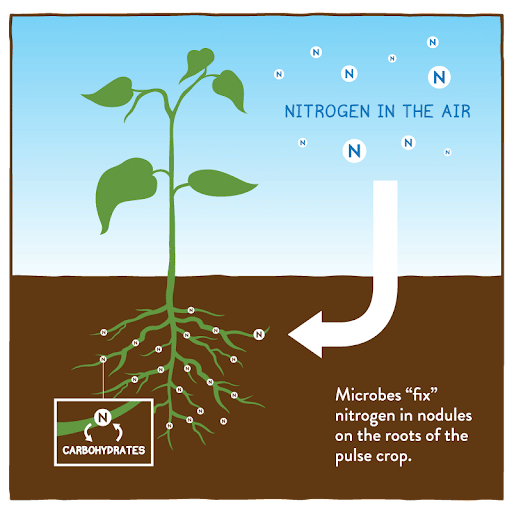
Nitrogen Fixers
What is Nitrogen Fixation?
- All creatures need nitrogen since it is a component of proteins and nucleic acids, both of which are essential for life (DNA).
- The majority of organisms cannot directly absorb nitrogen from the atmosphere, which contains 78% of all atmospheric nitrogen.
- Only a few bacteria have the metabolic processes necessary to convert gaseous nitrogen into chemicals that other organisms (especially vegetative ones) may absorb.
- This process is collectively referred to as "nitrogen fixation" and is only capable of occurring in certain bacteria.
- Nitrogen fixation is the process of converting relatively non-reactive atmospheric N2 into more reactive compounds (nitrates, nitrites, or ammonia).
- These reactive forms are suitable for crops and help them grow.
- Nitrogen deficiency, on the other hand, stunts crop growth and healthy development.
- Soil microorganisms are responsible for approximately 90% of natural N fixation on our planet.
- Lightning and UV rays are abiotic natural inducers.
- N can also be fixed with electrical equipment or industrially.
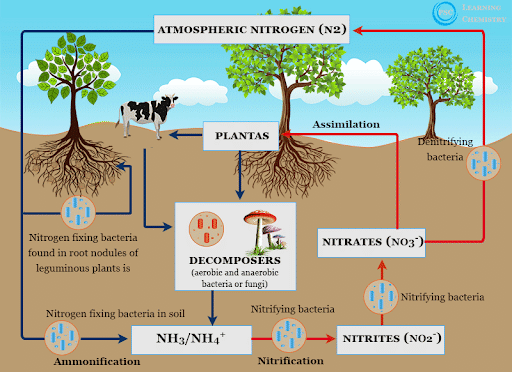
Nitrogen Fixation Cycle
What are Nitrogen Fixers?
- Nitrogen-fixing plants have roots colonised by bacteria that extract nitrogen from the air and convert or "fix" it into a form needed for growth.
- When the bacteria have finished with the nitrogen, it becomes available to the plants.
- After they die, nitrogen-fixing plants release nitrogen back into the atmosphere, making it available to neighboring plants. Plants in the legume family have been shown to fix nitrogen.
- The most significant species that fix nitrogen are cyanobacteria, also referred to as blue-green algae and found in water.
- On the mainland, Azotobacter which dwells on the earth, and Rhizobium which coexists in symbiosis in the roots of plants belonging to the genus Leguminosae (bean, lentil, and clover) primarily perform nitrogen fixation.
- These species which fix atmospheric nitrogen are referred to as the “Nitrogen Fixers”.
- There are two types of nitrogen-fixing microorganisms: free-living (nonsymbiotic) bacteria, such as the cyanobacteria (or blue-green algae) Anabaena and Nostoc, as well as genera such as Azotobacter, Beijerinckia, and Clostridium; and mutualistic (symbiotic) bacteria, such as Rhizobium, associated with leguminous plants, and various Azospirillum species
Nitrogen Fixing Plants
- An N-fixing crop is a natural way to provide plant-adjusted N while causing no industrial harm to the environment. When used in crop rotation, they fix nitrogen for succeeding plants.
- Intercropping with nitrogen-fixing plant species is another successful practice.
- Legumes are the best nitrogen-fixing plants and can be grown as both cash and cover crops.
- Farmers benefit from nitrogen-fixing cover crops in a variety of ways:
- take part in N fixation;
- protect soil from erosion by covering it or anchoring it with strong root systems;
- when used as green manure, it improves soil fertility;
- maintain soil moisture;
- aid in weed control with crop residues;
- provide forage and grazing for poultry and cattle;
- attract pollinators during crop flowering.
What is Nitrogen Fixing Bateria?
- Nitrogen-fixing bacteria are involved in the nutrient fixation process.
- Rhizobium (formerly Agrobacterium), Frankia, Azospirillum, Azoarcus, Herbaspirillum, Cyanobacteria, Rhodobacter, Klebsiella, and other nitrogen-fixing bacteria are some examples.
- Nitrogenase, the enzyme responsible for N fixation, is synthesized by N-fixing bacteria.
- Nitrogen-fixing bacteria convert inorganic compounds from gaseous nitrogen in the air.
- Even though legumes play an undeniable role in N fixation, the task is too difficult for them to complete alone.
- In fact, the fixation process occurs as a result of the symbiotic relationship between legumes and nitrogen-fixing bacteria. Rhizobium frequently colonizes legume roots.
- However, their symbiotic relationship is not the only option: there are also free-living and associated N-fixation organisms.
Impact of Nitrogen Fixing Bacteria
Effect on Plants
- The role of nitrogen-fixing bacteria is to provide plants with nutrients that they cannot obtain from the air.
- Nitrogen-fixing microorganisms do what crops cannot: they obtain assimilative N. Bacteria absorb it as a gas from the air and release it to the soil, primarily as ammonia.
- It is the only viable option for plants because they can only consume N from the soil as nitrogenous inorganic compounds, emphasizing the significance of nitrogen fixation.
Helps in the Growth of Crops
- N-fixing bacteria supply crops with ready-to-use N that they require as a component of chlorophyll molecules.
- Chlorophyll is essential for photosynthesis, which converts sunlight energy into chemical energy.
- Furthermore, they require N as a component of amino acids in order to construct proteins that participate in metabolism and energy storage.
- A lack of N fixation results in a lack of food, which causes yellowing, thinning, withering, overall growth delay, and decay.
Improves Soil Fertility
- Soil nitrogen-fixing bacteria saturate it with inorganic N-containing compounds, which are essential crop nutrients.
- When nitrogen fixation bacteria die, the N stored in their biomass is released into the soil.
- They increase soil fertility naturally in this manner, allowing farmers to save money on synthetic fertilizers.
Help Cycle Nitrogen Through Ecosystem
- N-fixing bacteria contribute to N-circulation in ecosystems by capturing it from the air and adjusting for plant requirements (fixation of nitrogen).
- When plants and bacteria die, decomposers split their nitrogenous compounds, releasing ammonia or ammonium (ammonification).
- Nitrifying bacteria use ammonia to produce nitrates, which are then consumed by plants or denitrifying bacteria.
- The latter converts nitrates into free atmospheric nitrogen, which is then released back into the atmosphere (denitrification).
- Even though N is necessary for plants, excessive N fixation is harmful. As a result, crop rotation of N-fixers and non-fixers is required for optimal balance.
Types of N-Fixing Bacteria - On the Basis of Interaction With Plants
There are different types of N-fixing bacteria based on how they coexist with crops (basically, whether they live on/inside the plant or not - endophytes vs. exophytes). Thus, nitrogen-fixing bacteria can be symbiotic, associative, or free-living.
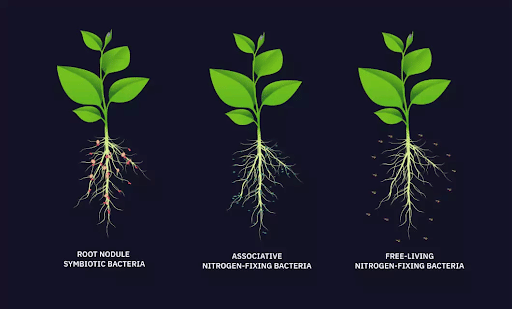
Types of Nitrogen Fixing Bacteria
Symbiotic Nitrogen Fixation
- Symbiotic N-fixing bacteria form nodules on the host's roots, accumulating atmospheric N2 and converting it to ammonia.
- The host uses it to grow and then releases it into the soil via broken nodules when it dies. N fixation symbionts, on the other hand, aren't doing the 'favour' for nothing.
- Because any symbiotic relationship implies a win-win situation, the bacteria feed on plant-produced carbohydrates (sugars) and take carbon.
- So, while their N fixation symbiosis is technically defined as infection, both parties benefit from it quite well. As a result, such a relationship is also known as mutualism.
- Rhizobium and Frankia are two common symbiotic N-fixing bacteria.

Root Nodules
| Nitrogen Fixing Bacteria - Rhizobium | Nitrogen Fixing Bacteria - Frankia |
|---|---|
|
|
Associative Nitrogen Fixation
- Cereals and free-living N-fixing bacteria that may adhere to the host roots exhibit associative symbiosis.
- This includes the genera Azospirillum, Glucenobacter, Acetobacter, Herbaspirillum, and Azoarcus.
- They are closely related to wheat, rice, corn, sugarcane, barley, sorghum, Setaria, and other biofuel crops.
- Grains, unlike legumes, do not fix N in nodules, but instead rely on nutrient availability in the soil, i.e. its fixation.
- Bacteria, in turn, use atmospheric N for their needs and 'share' it with the host crop.
- Most N fixation bacteria live on roots, but some, such as Herbaspirillum, can penetrate the entire plant.
- These microorganisms have the potential to improve crop growth and yields, which is especially important in poor soils.
Free Living Nitrogen Fixation
- Crops can also get N from free-living N-fixing bacteria.
- Rice farmers, for example, add aquatic Azolla ferns to their fields as green manure, and Azolla serves as a habitat for Anabaena Azolla (cyanobacteria type), which is known for its N-fixing abilities.
- Cyanobacteria can live symbiotically or freely in moist soils and inland bodies of water.
- This type combines distinct properties: it is classified as bacteria while resembling algae.
- Because it contains chlorophyll, cyanobacteria are phototrophs (like plants). They can, however, fix N2, unlike plants.
Other Ways of Nitrogen Fixation
Nitrogen Fixation by Lightning
- Lightning is another activity that aids in nitrogen fixation. It is a natural occurrence where the energy of a lightning strike transforms nitrogen from an unusable form into one that may be absorbed.
- Even though lightning has a minor role in nitrogen fixation, it protects plants from a lack of vital nutrients.
Other Occurrences
Additionally, industrial activities, car exhausts, power plants, and forest fires all contribute to the atmospheric production of nitrogen oxides, such as NO, N2O, and NO2.
Conclusion
Nitrogen is a necessary nutrient for plant growth and development, but it is in short supply in its most common form, atmospheric nitrogen. Plants instead rely on combined, or fixed, nitrogen forms such as ammonia and nitrate. Much of this nitrogen is supplied to cropping systems in the form of nitrogen fertilizers manufactured industrially. The use of these fertilizers has resulted in global ecological issues, such as the formation of coastal dead zones. Biological nitrogen fixation, on the other hand, provides plants with a natural source of nitrogen. It is an essential component of many aquatic and terrestrial ecosystems throughout our biosphere.
FAQs
Question: What are nitrogen fixers?
Answer: Nitrogen fixers are organisms that convert atmospheric nitrogen (N2) into ammonia (NH3) or related compounds in the soil, making nitrogen available for plant use. This process is crucial because most plants cannot utilize atmospheric nitrogen directly. Nitrogen-fixing organisms can be categorized into two main types: free-living nitrogen-fixing bacteria, such as Azotobacter and Clostridium, and symbiotic nitrogen-fixing bacteria, such as Rhizobium, which form nodules on the roots of leguminous plants.
Question: Why is nitrogen fixation important for agriculture?
Answer: Nitrogen fixation is vital for agriculture as it enriches the soil with nitrogen, an essential nutrient for plant growth. Most fertilizers contain nitrogen, but relying solely on chemical fertilizers can be costly and environmentally damaging. By using nitrogen-fixing plants or bacteria, farmers can enhance soil fertility naturally, reduce the need for synthetic fertilizers, and promote sustainable farming practices. This process also improves crop yields and contributes to a healthier ecosystem.
Question: What role do legumes play in nitrogen fixation?
Answer: Legumes, such as peas, beans, and lentils, play a crucial role in nitrogen fixation due to their symbiotic relationship with nitrogen-fixing bacteria, primarily Rhizobium. These bacteria colonize the root nodules of leguminous plants and convert atmospheric nitrogen into forms that the plant can absorb and utilize. This relationship benefits both the plant, which gains access to essential nitrogen, and the bacteria, which receive carbohydrates and a suitable environment for growth. Incorporating legumes into crop rotations enhances soil nitrogen levels and promotes biodiversity.
Question: What are some common nitrogen-fixing organisms?
Answer: Common nitrogen-fixing organisms include:
- Bacteria: Rhizobium (associated with legumes), Azotobacter (free-living), Clostridium (anaerobic nitrogen-fixing), and Frankia (associated with actinorhizal plants).
- Cyanobacteria: Blue-green algae, such as Anabaena and Nostoc, can fix nitrogen in aquatic environments and soil.
- Plants: Leguminous plants like clover, alfalfa, and peanuts are well-known for their nitrogen-fixing capabilities.
Question: How can farmers promote nitrogen fixation in their fields?
Answer: Farmers can promote nitrogen fixation in their fields by:
- Incorporating Legumes: Including leguminous crops in crop rotations enhances nitrogen levels in the soil.
- Using Inoculants: Applying specific nitrogen-fixing bacterial inoculants to the soil or seed can improve nitrogen fixation.
- Maintaining Soil Health: Practices such as minimizing soil disturbance and maintaining organic matter enhance the activity of nitrogen-fixing bacteria.
- Implementing Agroforestry: Integrating trees and shrubs that fix nitrogen can improve soil fertility and biodiversity.
MCQs
1. Which of the following is a nitrogen-fixing bacterium?
A) Azospirillum
B) Lactobacillus
C) Streptococcus
D) Escherichia
Answer: See the Explanation
Explanation: Azospirillum is a nitrogen-fixing bacterium that enhances nitrogen availability in the soil, particularly in association with grasses.
2. What type of plants are primarily associated with Rhizobium bacteria?
A) Grasses
B) Cacti
C) Legumes
D) Ferns
Answer: See the Explanation
Explanation: Rhizobium bacteria primarily associate with leguminous plants, forming root nodules that facilitate nitrogen fixation.
3. What is a significant benefit of planting nitrogen-fixing crops?
A) Increased pesticide use
B) Enhanced soil fertility
C) Reduced biodiversity
D) Higher water consumption
Answer: See the Explanation
Explanation: Planting nitrogen-fixing crops enhances soil fertility by increasing nitrogen levels, which benefits subsequent crops.
4. Which of the following is a free-living nitrogen-fixing bacterium?
A) Frankia
B) Rhizobium
C) Azotobacter
D) Clostridium
Answer: See the Explanation
Explanation: Azotobacter is a free-living nitrogen-fixing bacterium that does not require a symbiotic relationship with plants.
5. What is the process of converting atmospheric nitrogen into a usable form for plants called?
A) Photosynthesis
B) Respiration
C) Nitrogen fixation
D) Nitrification
Answer: See the Explanation
Explanation: The process of converting atmospheric nitrogen into a usable form for plants is called nitrogen fixation.
GS Mains Questions and Model Answers
Q1: Analyze the role of nitrogen-fixing organisms in sustainable agriculture.
Answer: Nitrogen-fixing organisms play a vital role in sustainable agriculture by enhancing soil fertility naturally, reducing reliance on chemical fertilizers. These organisms, including bacteria like Rhizobium and free-living species such as Azotobacter, convert atmospheric nitrogen into forms that plants can absorb and utilize. Incorporating nitrogen-fixing crops, particularly legumes, in crop rotations improves soil health and productivity while promoting biodiversity. This biological approach not only minimizes environmental impacts associated with synthetic fertilizers but also supports sustainable farming practices by improving the resilience of agroecosystems. The use of nitrogen-fixers contributes to a more sustainable agricultural framework that supports food security and environmental health.
Q2: Discuss the implications of nitrogen fixation for food security.
Answer: Nitrogen fixation has significant implications for food security by ensuring the availability of this essential nutrient for crop production. As a vital component of amino acids, proteins, and nucleic acids, nitrogen is crucial for plant growth and development. The ability to naturally fix nitrogen through legumes and other nitrogen-fixing organisms enhances soil fertility and contributes to higher crop yields. By promoting sustainable agricultural practices that utilize nitrogen fixation, farmers can reduce dependency on chemical fertilizers, lower production costs, and improve crop resilience. This natural process is integral to maintaining soil health and productivity, ultimately supporting food security in the face of growing global population demands and environmental challenges.
Q3: Evaluate the environmental benefits of utilizing nitrogen-fixing crops in agriculture.
Answer: Utilizing nitrogen-fixing crops in agriculture offers several environmental benefits that contribute to sustainable farming practices. Firstly, these crops enhance soil fertility by increasing nitrogen levels, which improves the nutrient profile of the soil without the need for chemical fertilizers. This leads to reduced soil degradation and lower risks of water contamination from fertilizer runoff. Secondly, nitrogen-fixing crops promote biodiversity and ecological balance within agroecosystems, supporting beneficial insects and other organisms. Additionally, incorporating legumes can help in preventing soil erosion and improving soil structure, which enhances water retention and reduces the need for irrigation. Overall, the use of nitrogen-fixing crops supports environmentally friendly agricultural practices that align with sustainable development goals.
Previous Year Questions on Nitrogen Fixers
1. UPSC CSE Prelims 2021:
Question: Which of the following is a primary function of nitrogen-fixing bacteria?
A) Photosynthesis
B) Decomposition
C) Nitrogen fixation
D) Fermentation
Answer: (C)
Explanation: The primary function of nitrogen-fixing bacteria is nitrogen fixation, converting atmospheric nitrogen into a usable form for plants.
2. UPSC CSE Mains 2019 (GS Paper 1):
Question: "Examine the role of legumes in promoting soil health and their impact on agricultural sustainability." Discuss the significance of nitrogen fixation.
Answer: Legumes play a crucial role in promoting soil health through their nitrogen-fixing capabilities, which enhance soil fertility and contribute to sustainable agricultural practices. The symbiotic relationship between legumes and nitrogen-fixing bacteria, such as Rhizobium, allows for the conversion of atmospheric nitrogen into forms that plants can absorb, significantly improving nutrient availability. This process reduces reliance on chemical fertilizers, mitigating environmental impacts and promoting soil structure. Additionally, legumes help in preventing soil erosion, increasing biodiversity, and supporting beneficial microorganisms in the soil. Overall, the significance of nitrogen fixation in legumes is paramount for achieving agricultural sustainability and ensuring long-term food security.
Download the PREPP App and attempt FREE IAS Exam Mock Tests and get complete study material!

Full Test - 04: UPSC CSE Prelims CSAT (Paper-II)
Full Test - 03: UPSC CSE Prelims CSAT (Paper-II)
UPSC CSE Prelims 2026 CSAT Paper 2 Question Paper (24-May-2026)
UPSC CSE Prelims 2026 GS Paper 1 Question Paper (24-May-2026)

17 February 2025 | The Hindu Must Read Articles | Current Affairs

16 February 2026 | The Hindu Must Read Articles | Current Affairs

13 February 2026 | The Hindu Must Read Articles | Current Affairs









Comments