Bio-fertilizers - Agriculture Notes
"Biofertilizer" refers to a material that contains living microorganisms that, when added to soil, seeds, or plant surfaces, colonize the rhizosphere or inside of the plant and encourage development by boosting the availability of primary nutrients to the host plant. By transforming environmental nitrogen fixes, phosphorus soluble, and compounds that encourage plant growth into bio-fertilizers, bio-fertilizers deliver nutrients to plants. The recommended scientific term for these helpful bacteria is "plant-growth promoting rhizobacteria (PGPR)" due to the variety of roles they play. This article will explain to you about Bio-fertilizers which will be helpful in preparing the Agriculture Syllabus for the UPSC Civil Service exam.
| To Read update on this topic: |
|
Table of Contents |
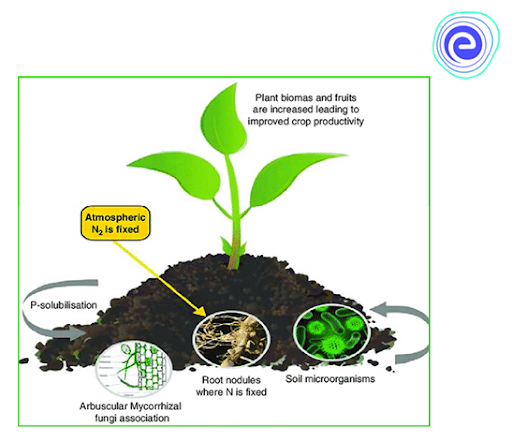
Functions of Biofertilizers
What are Bio-fertilizers?
- Biofertilizers are microbe-containing substances that aid in the growth of plants and trees by increasing the supply of essential nutrients to the plants.
- It is made up of living organisms such as mycorrhizal fungi, blue-green algae, and bacteria.
- Mycorrhizal fungi preferentially extract minerals from organic matter for the plant, whereas cyanobacteria are known for nitrogen fixation.
- Nitrogen fixation is the conversion of di-nitrogen molecules into ammonia. Some bacteria, for example, convert nitrogen to ammonia. Nitrogen becomes available to plants as a result.
- A carrier medium containing several living microorganisms makes up biofertilizer.
- It enhances the number of soil nutrients or makes them physiologically available when applied to seed, soil, or growing plants.
- Natural processes such as nitrogen fixation, phosphorus solubilization, and plant growth-stimulating hormone synthesis are used by biofertilizers to add nutrients.
- Different kinds of fungi, root bacteria, and other microorganisms are present in biofertilizers.
- As they develop in the soil, they create a symbiotic or mutually beneficial connection with host plants.
Bio-fertilizers - Types
Symbiotic Nitrogen-Fixing Bacteria
- One of the essential symbiotic bacteria that fix nitrogen is rhizobium.
- Here, the bacteria look for shelter and a source of food from the plants.
- They assist by giving the plants fixed nitrogen in return.
Loose Association of Nitrogen-Fixing Bacteria
- Azospirillum is a nitrogen-fixing bacterium that coexists with higher plants but does not form close bonds with them.
- Rhizosphere association is a common name for it because these bacteria collect plant exudate and consume it as food.
- The term "associative mutualism" refers to this process.
Symbiotic Nitrogen-Fixing Cyanobacteria
- Cyanobacteria or blue-green algae form a symbiotic relationship with several plants.
- Among the cyanobacteria that fix nitrogen are liverworts, cycad roots, ferns, and lichens.
- Anabaena can be found in the fern's leaf cavities. It is in charge of fixing nitrogen.
- As the fern plants deteriorate, they provide nutrients that the rice plants can use.
- The fern Azolla pinnate lives in rice fields, however, it does not control the plant's growth.
Free-Living Nitrogen-Fixing Bacteria
- They are nitrogen-fixing soil microorganisms that live freely. They include saprotrophic anaerobes such as Azotobacter, Clostridium beijerinckii, etc.
- The most often utilized biofertilizers are Rhizobium and Azospirillum.
Bio-fertilizers - Components
Bio Compost
- It is one of the environmentally favourable products made from decomposed waste materials discharged by the sugar industry.
- Human-friendly bacteria, fungi, and different plants have enlarged it.
Tricho-Card
- It is a nonpathogenic, environmentally benign substance used in a range of crops, including citrus, paddy apples, sugar cane, brinjal, corn, cotton, and horticultural and decorative plants.
- It functions as a productive destroyer and antagonistic hyperparasite against the eggs of many bores, as well as other infections and eaters of flowers, fruits, leaves, and shoots in the field.
Azotobacter
- It defends the roots from soil-borne diseases and is essential for fixing atmospheric nitrogen.
- Since nitrogen makes up roughly 78% of the atmosphere, it is a crucial nutrient for plants.
Phosphorus
- One crucial ingredient for the growth and development of plants is phosphorus.
- Microorganisms that hydrolyze phosphorus compounds into the soluble form for plant absorption are called phosphate solubilizing microorganisms.
- For this, a variety of fungi and bacteria are employed, including Penicillium, Aspergillus, Bacillus, Pseudomonas, etc.
Vermicompost
- Vermicompost is an organic fertiliser that is eco-friendly and contains vitamins, hormones, organic carbon, sulphur, and antibiotics that help to improve the yield's amount and quality.
- One of the easy remedies to increase the fertility of the soil is to use vermicompost.
Commonly Produced Bio-fertilizers
| Bio-fertilizer | Features |
|---|---|
| Bio NPK |
|
| Acetobacter |
|
| Azospirillum |
|
| Mycorrhiza |
|
| Phosphate Solubilizing Bacteria |
|
| Potassium Solubilizing Bacteria |
|
Bio-fertilizers - Applications
Following are some important applications of biofertilizers:
- Seedling Root Dip: Rice crops are planted using the seedling root dip technique, which involves placing the seedlings in a waterbed for 8 to 10 hours.
- Seed Treatment: During this step, fertiliser mixtures including phosphorus and nitrogen are applied to the seeds. They are dried before being sown as soon as possible.
- Soil Treatment: The Biofertilizer and Compost Fertilizer Blend is stored overnight and applied to the Soil the next Day. Prior to planting the seedlings, this treatment is administered.
Bio-fertilizers - Advantages
- More organically than other fertilizers, biofertilizers increase the amount of nitrogen and phosphorus that plants can access.
- Unlike chemical fertilizers, which frequently lead to excess phosphate and nitrogen in the soil, they do not harm the environment or the soil.
- They are a low-cost, simple substitute for produced petrochemical goods.
- They make the soil biologically active and return its fertility to normal.
- They increase the amount of organic matter and enhance the structure and texture of the soil.
- Because they supply nitrogen and phosphorus to the soil, they can improve yield by up to 30%.
- Plants grow more successfully during droughts due to better soil texture and quality.
- Biofertilizers aid in the greater root development and growth of plants.
- Biofertilizers also lessen the effects of damaging nematodes and fungi in the soil. Plants live longer and can withstand stress better.
Bio-fertilizers - Disadvantages
- Since they include living organisms, biofertilizers need to be handled carefully during long-term storage. They must be used before they lose their effectiveness.
- They are less successful if other microbes contaminate the carrier media or if farmers use the incorrect strain.
- In order for organisms that act as biofertilizers to flourish, the soil must have enough nutrients.
- They don't completely replace other fertilizers, but they do supplement them.
- If the soil is too hot or dry, they stop working.
- The growth of the helpful microbes is likewise hampered by excessively acidic or alkaline soils.
- They are also less efficient when the soil has too many of its natural microbiological enemies.
- Some biofertilizers are less accessible because of shortages of specific microbial strains or the optimal growing medium.
- During the production of microbial fertiliser, strict aseptic precautions must be taken. Contamination is a common issue in microbial mass manufacturing.
- Because microbes are light-sensitive, they are killed when exposed to sunlight for an extended period of time.
Conclusion
Because the Indian economy is based on agriculture, biofertilisers are a necessity for Indian farmers. Though most of our agricultural activities are dependent on the monsoon, the use of a good biofertilizer can provide farmers with a better crop while also increasing soil fertility. It has been shown that biofertilizers can have a wide range of effects in various environments and even within the same environment. However, it has been observed that in drier climates, they have the most significant effects. It is believed that the effects of biofertilizers will one day be better managed and regulated across all ecosystems.
FAQs
Q1: What are bio-fertilizers?
Answer: Bio-fertilizers are substances containing living microorganisms that enhance the availability of nutrients to plants by fixing atmospheric nitrogen, solubilizing phosphorus, and promoting plant growth through the synthesis of growth-promoting substances. They are eco-friendly alternatives to chemical fertilizers.
Q2: What are the types of bio-fertilizers?
Answer: The main types of bio-fertilizers include nitrogen-fixing bio-fertilizers (e.g., Rhizobium, Azotobacter), phosphate-solubilizing bio-fertilizers (e.g., Pseudomonas), and potassium-mobilizing bio-fertilizers (e.g., Frateuria aurantia). They cater to specific nutrient needs of plants.
Q3: How do bio-fertilizers work?
Answer: Bio-fertilizers work by enhancing the natural nutrient cycle of the soil. Nitrogen-fixing bacteria convert atmospheric nitrogen into a form that plants can absorb, while phosphate-solubilizing bacteria break down insoluble phosphorus compounds, making them accessible to plants.
Q4: What are the advantages of using bio-fertilizers?
Answer: Bio-fertilizers improve soil fertility, enhance plant growth, and increase crop yield without causing harm to the environment. They reduce the dependency on chemical fertilizers, promote sustainable agriculture, and help maintain soil health.
Q5: Are there any limitations to using bio-fertilizers?
Answer: Bio-fertilizers have some limitations, such as requiring specific conditions like proper temperature, moisture, and pH for effectiveness. They work slowly compared to chemical fertilizers and may not provide immediate results in nutrient-deficient soils.
MCQs
- What is the main function of nitrogen-fixing bio-fertilizers?
a) Solubilizing phosphorus in the soil
b) Fixing atmospheric nitrogen into a usable form for plants
c) Mobilizing potassium
d) Promoting pest resistance in plants
Answer: (B) See the Explanation
- Which of the following is an example of a phosphate-solubilizing bio-fertilizer?
a) Rhizobium
b) Azotobacter
c) Pseudomonas
d) Frateuria aurantia
Answer: (C) See the Explanation
- Which type of bio-fertilizer is responsible for potassium mobilization in soil?
a) Azotobacter
b) Rhizobium
c) Pseudomonas
d) Frateuria aurantia
Answer: (D) See the Explanation
- What is one major limitation of bio-fertilizers?
a) They are harmful to the environment
b) They work instantly like chemical fertilizers
c) They require specific soil conditions for effectiveness
d) They deplete soil nutrients over time
Answer: (C) See the Explanation
- Which of the following is NOT a benefit of using bio-fertilizers?
a) Enhancing soil fertility
b) Increasing crop yield
c) Promoting plant growth
d) Immediate nutrient supply
Answer: (D) See the Explanation
GS Mains Questions and Model Answers
Q1: Discuss the role of bio-fertilizers in sustainable agriculture and how they contribute to maintaining soil health.
Answer: Bio-fertilizers play a crucial role in promoting sustainable agriculture by enhancing soil fertility and reducing the reliance on chemical fertilizers. These microorganisms improve nutrient availability by fixing nitrogen, solubilizing phosphorus, and mobilizing potassium. Unlike chemical fertilizers, bio-fertilizers do not degrade soil quality over time. Instead, they maintain soil health by fostering beneficial microbial activity, which enhances soil structure and fertility. They also promote plant growth by producing growth-promoting substances. Additionally, bio-fertilizers are eco-friendly and contribute to reducing the environmental pollution caused by chemical fertilizers. Their use supports long-term agricultural productivity and sustainability by maintaining the natural nutrient cycles of the soil.
Q2: Analyze the advantages and limitations of using bio-fertilizers in modern farming practices.
Answer: The advantages of bio-fertilizers include their ability to enhance soil fertility, promote sustainable agriculture, reduce the dependency on chemical inputs, and increase crop yield. They improve nutrient availability through biological processes, contributing to long-term soil health and reducing the risk of soil degradation. Bio-fertilizers are environmentally friendly and reduce the harmful effects of chemical fertilizers on ecosystems. However, bio-fertilizers also have limitations, such as requiring specific soil conditions (appropriate moisture, temperature, and pH) to be effective. Their slow action compared to chemical fertilizers can be a disadvantage, especially in nutrient-deficient soils where immediate nutrient supply is needed. Despite these limitations, bio-fertilizers are essential for promoting eco-friendly and sustainable farming practices.
Q3: What are the challenges associated with the adoption of bio-fertilizers in India? Suggest measures to overcome these challenges.
Answer: The challenges associated with the adoption of bio-fertilizers in India include a lack of awareness among farmers, inadequate infrastructure for production and distribution, and the need for specific soil conditions to ensure their effectiveness. Farmers often prefer chemical fertilizers because of their quick results, whereas bio-fertilizers work slowly and require careful management. Additionally, improper handling and storage can reduce the efficacy of bio-fertilizers. To overcome these challenges, the government and agricultural institutions should promote awareness campaigns to educate farmers on the long-term benefits of bio-fertilizers. Improving the supply chain for bio-fertilizers and offering incentives for their use can encourage farmers to adopt them. Research and development should focus on improving the efficiency of bio-fertilizers under diverse climatic and soil conditions.
Previous Year Questions on Bio-fertilizers
1. UPSC CSE 2020
Question: Evaluate the significance of bio-fertilizers in achieving sustainable agriculture in India.
Answer: Bio-fertilizers play a pivotal role in achieving sustainable agriculture in India by providing an eco-friendly alternative to chemical fertilizers. They enhance soil fertility by facilitating natural nutrient cycles, such as nitrogen fixation and phosphorus solubilization, without depleting the soil’s natural resources. Bio-fertilizers contribute to long-term soil health by fostering beneficial microbial populations, which improve nutrient availability and soil structure. They reduce the environmental impact associated with chemical fertilizers, such as soil degradation, water pollution, and greenhouse gas emissions. Despite their slow action, bio-fertilizers support sustainable farming practices by promoting biodiversity and reducing the dependency on synthetic inputs. Their widespread adoption can contribute to India's goals of sustainable agricultural development.
2. UPSC CSE 2019
Question: Discuss the challenges and prospects of using bio-fertilizers as part of India's agricultural policy.
Answer: Bio-fertilizers offer significant prospects for promoting sustainable agriculture in India, yet their adoption faces several challenges. Farmers often prefer chemical fertilizers due to their immediate results, while bio-fertilizers require specific conditions such as optimal moisture and temperature, which limits their application. The lack of awareness about their long-term benefits, insufficient infrastructure for production and distribution, and inadequate government support are additional challenges. To overcome these hurdles, India's agricultural policy must focus on increasing awareness through educational programs, offering financial incentives to farmers who adopt bio-fertilizers, and investing in research and development to improve their efficacy. Government initiatives such as soil health cards and organic farming schemes can also promote bio-fertilizer usage, helping to integrate them into mainstream agricultural practices.
Download the PREPP App and attempt FREE IAS Exam Mock Tests and get complete study material!

Full Test - 04: UPSC CSE Prelims CSAT (Paper-II)
Full Test - 03: UPSC CSE Prelims CSAT (Paper-II)
UPSC CSE Prelims 2026 GS Paper 1 Question Paper (24-May-2026)
UPSC CSE Prelims 2026 CSAT Paper 2 Question Paper (24-May-2026)

17 February 2025 | The Hindu Must Read Articles | Current Affairs

16 February 2026 | The Hindu Must Read Articles | Current Affairs

13 February 2026 | The Hindu Must Read Articles | Current Affairs









Comments