Micro Irrigation - Agriculture Notes
Micro irrigation is a modern method of irrigation in which water is irrigated on the land's surface or subsurface using drippers, sprinklers, foggers, and other emitters. The the major components of a micro irrigation system include water supply, pumping devices (motor and pump), ball valves, fertigation equipment, filters, control valves, PVC joining accessories (Main and sub main), and emitters. Water is applied drop by drop closer to the crop's root zone area in this system. The drippers are set based on crop spacing. In this article, we will discuss Micro-Irrigation which will be helpful for UPSC exam preparation.
| To Read update on this topic: |
|
Table of Contents |
Micro Irrigation
What is Irrigation & Irrigation System?
- Irrigation is the process of artificially applying water to crops in order to meet their water requirements.
- Irrigation can also be used to provide nutrients to crops.
- Irrigation is typically used in areas where rainfall is irregular, dry periods are expected, or drought is predicted.
- There are various types of irrigation systems that supply water uniformly to the entire field.
- Groundwater, from springs or wells, surface water, from rivers, lakes, or reservoirs, and even treated wastewater or desalinated water can be used for irrigation.
- Irrigation provides the necessary moisture for growth and development, germination, and other related functions.
- The frequency, rate, amount, and time of irrigation differ for different crops, as well as depending on soil type and season.
- Summer crops, for example, require significantly more water than winter crops.
- Farmers must protect their agricultural water source to reduce the risk of contamination.
- As with any groundwater removal, irrigation water users must exercise caution to avoid pumping groundwater out of an aquifer faster than it is being recharged.
- It is regarded as a basic infrastructure and a necessary input for agricultural production.
- The primary goal is to maintain agricultural output while using as little water as possible, as well as to maintain landscapes and re-vegetate disturbed soils.
- Irrigation is frequently studied in conjunction with drainage, which is the natural or artificial removal of surface and subsurface water from a specific area.
What is Micro Irrigation?
- Micro-irrigation is a prudent irrigation technology that is being promoted both nationally and internationally in order to achieve higher cropping intensity and irrigation intensity through more focused water application to crops.
- Micro irrigation is defined as the application of a small volume of water at a low pressure and frequency.
- Micro-irrigation can boost yields while reducing water, fertiliser, and labour requirements.
- The practise reduces water loss through conveyance, run-off, deep percolation, and evaporation by applying water directly to the root zone.
- The system includes a large network of pipes that operate at low pressure.
- Outlets for emission water, also known as emitters, are provided at predetermined spacing.
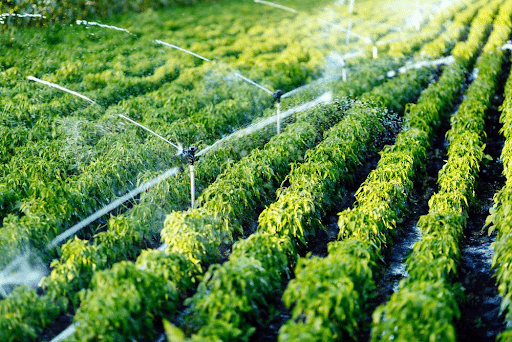
- Drip irrigation, sprinkler irrigation, micro-sprinkler, porous pipe system, rain gun, are other systems of micro irrigation which are available, with drip irrigation and sprinkler irrigation being the most common.
- Drip irrigation is best suited for crops with wider spacing.
- Micro sprinkler irrigation is commonly used in sandy or loamy soils. This system works best with horticultural crops and small grasses.
- Water is sprinkled from a lower height in various directions in this method.
- There are also portable micro sprinklers available. They provide slightly more water distribution than drippers and micro sprinklers.
- They spray water within a one-meter radius. It is used to prepare nursery and lawn soils with low water retention capacity.
- Sugarcane, banana, cotton, lemon, grapes, oranges, mangoes, and a wide variety of vegetables are among the major crops grown using drip irrigation.
- Sprinkler irrigation is most commonly used for groundnuts, wheat, millet, sorghum, and mustard, among other crops.
Importance of Micro Irrigation
- Micro-irrigation increases water efficiency as much as 50%-90%.
- Water savings are in the range of 30-50% when compared to flood irrigation, with an average of 32.3%.
- Electricity consumption is drastically reduced.
- Micro-irrigation saves money on fertilizer.
- Increased average fruit and vegetable production.
- It increases farmers' overall income.
Types of Micro Irrigation
Sprinkler Irrigation
- A sprinkler irrigation system or device delivers water for irrigation. It functions in a pressurized manner similar to natural rainfall.
- This method of irrigation uses water efficiently. Furthermore, this ensures an increase in crop yield.
- High-pressure sprinklers, sprays, and guns are among the irrigation devices used.
- They provide the plant with the precise amount of water required for optimal growth.
*For detailed notes of this topic, check this link Sprinkler Irrigation
Drip Irrigation
- Drip irrigation uses emitters to deliver water directly to plant roots in the soil.
- These emitters use vents, twisters, and convoluted or long flow paths to optimize and distribute pressure from the water source.
- The emitters can be placed on the ground or planted deep in the soil.
- Water flowing through emitters moves at the desired rate with no barriers.
*For detailed notes of this topic, check this link Drip Irrigation
Spray Irrigation
- Water can be delivered using a jet spray, which is widely used.
- It can move easily in any size and can be used to water crops in large farms or on lawns.
Sub-surface Irrigation
- This irrigation system delivers water to plants from beneath the soil's surface. This micro-irrigation is both beneficial and efficient.
- It only requires low levels of water pressure to function properly.
- Tubes and pipes are hidden beneath the soil for water delivery in this system, so there is no water waste.
- Water application can be extremely efficient and uniform if the size of the subsurface irrigation system is used.
- Subsurface irrigation prevents disease and weeds by removing surface water stagnation.
- A well-designed subsurface irrigation system can improve the efficiency of water and fertilizer applications, resulting in higher crop yield quality.
Bubbler Irrigation
- This system can be installed in areas where there is a high demand for water.
- It distributes water through small streams and fountains at a rate of approximately 230 liters per hour.
- It is preferred in situations where a large amount of water must be applied in a short period of time.
Micro Irrigation in India
- In India, the average penetration of micro irrigation is 19% (as of February 3, 2021), which is much lower than in many other countries.
- Drip irrigation systems can save up to 60% of the water used for sugarcane, banana, okra, papaya, bitter-gourd, and a few other crops.
- Only Sikkim, Andhra Pradesh, Karnataka, and Maharashtra currently have more than half of their net cultivable area under micro irrigation, while other states in India have less than 15%.
- Although Uttar Pradesh is the largest producer of sugarcane, a water-intensive crop, it only has 1.5% of its land under micro irrigation, while Punjab has only 1.2%.
- The government has set a target of covering 100 lakh ha of land with micro irrigation over the next five years.
Advantages of Micro Irrigation
- Increased water use efficiency: Micro irrigation helps to significantly reduce water conveyance losses, runoff, evaporation losses, and seepage and deep percolation losses. This ensures a 50-90% increase in water efficiency.
- Energy Efficiency: Micro irrigation only requires a low flow rate and a low pressure. As a result, energy consumption is reduced by up to 30.5%.
- Small wells and tanks can also be used as a source of water. Off-grid farmers can use solar pumps or diesel pumps because this system requires very low pressure.
- Fertilizer Use Efficiency: Proper mixing of fertilizers and water, control of optimum dosage, and direct application of fertilizers to the root zone resulting in a 28.5% reduction in fertilizer consumption.
- Productivity gains: Crop yield (quantity and quality) is increased, and productivity gains for fruits and vegetables are estimated to be 42.4% and 52.7%, respectively. This ensures a good economic return for the higher yields.
- Irrigation cost savings: This technology reduces overall irrigation costs by reducing labor requirements for irrigation, weeding, and fertilizer application. The cost of irrigation can be reduced by up to 31.9%.
- New Crop introduction: Farmers can add more new crops judiciously due to the improved water scenario, and it is estimated that up to 30.4% of farmers have done so. Some farmers have experimented with intercropping and crop rotation.
- Farmers' income increased: More targeted and prudent use of water and nutrients results in higher-quality produce and an increase in farmer income. Furthermore, by reducing the spacing between plants, more plants can be accommodated.
- Fertigation: It is the process of combining water and fertilizer application through irrigation. Fertigation results in the balanced nutrient application, reduced fertilizer requirements of 7 to 42% (saving farmers money), higher nutrient uptake, and nutrient use efficiency.
- Brings degraded land back into cultivation: It is obvious that vertical expansion of agricultural lands is not possible in the current scenario. As a result, in order to increase yield and productivity, we must focus on degraded and wastelands. This opportunity is provided by micro-irrigation.
- According to a national survey conducted for the Union government, farmers were able to cultivate 519.43 hectares of degraded land using the technique.
Micro Irrigation - Limitations
- Inadequate farm-level water availability.
- The uninterrupted power supply is not available.
- Insufficient emphasis on national micro-irrigation technology.
- It has a high installation and maintenance cost.
- Complicated procedures to redeem government subsidies for Micro Irrigation installation.
Government Initiative
- The government started micro irrigation in the Tenth Five Year Plan (2002-2007).
- Since then, the Central Government, State Governments, some NGOs, and some business firms have taken bold steps to promote and spread this new technology.
- Micro-irrigation has been prioritized in the Pradhan Mantri Krishi Sinchayee Yojana (PMKSY) with the goal of expanding irrigation coverage ('Har Khet Ko Pani') and improving water use efficiency ('Per Drop More Crop') to improve various water development and management activities.
- Financial assistance of up to 55% for small and marginal farmers and 45% for other farmers is available under the programme for the adoption of micro-irrigation systems.
Conclusion
The significance of micro-irrigation in achieving sustainability in Indian agriculture cannot be overstated. However, there is a long way to go and extensive demonstrations, training, and awareness programmes are required to bring the Indian farming community up to speed on micro-irrigation practices. Farmers are one of our society's most distressed groups.
|
|
|
|---|---|
| Agriculture Notes | Different Types of Irrigation and Irrigation Systems |
| Crop Rotation | Watershed Management |
| Crop and its Classifications | Cropping |
| Farming Systems | Organic Farming |
| Sustainable Agriculture | Integrated Farming System |
| Important Cropping Patterns in India | Major Crops of India |
| Weeds | Soil |
FAQs
Q1: What is micro-irrigation?
Answer: Micro-irrigation is a modern irrigation technique that delivers water directly to the roots of plants through a network of pipes, emitters, and drippers, minimizing water wastage and enhancing crop yield. It includes methods like drip irrigation and sprinkler irrigation.
Q2: What are the benefits of micro-irrigation?
Answer: The benefits of micro-irrigation include efficient water use, improved crop productivity, reduction in soil erosion, lower fertilizer loss, and energy savings. It is also suitable for areas facing water scarcity.
Q3: Which crops are best suited for micro-irrigation?
Answer: Crops like vegetables, fruits, spices, and cash crops such as sugarcane and cotton benefit the most from micro-irrigation, as it allows precise control of water and nutrients.
Q4: How is micro-irrigation different from traditional irrigation methods?
Answer: Unlike traditional irrigation methods such as flooding or furrow irrigation, micro-irrigation delivers water directly to the plant's root zone, reducing evaporation and runoff, leading to more efficient use of water.
Q5: What government schemes support micro-irrigation in India?
Answer: The Pradhan Mantri Krishi Sinchayee Yojana (PMKSY) promotes the adoption of micro-irrigation across India by providing financial assistance to farmers for installing micro-irrigation systems, aiming to improve water-use efficiency.
MCQs
- What is the primary benefit of micro-irrigation?
a) Increased labor costs
b) Higher water-use efficiency
c) Faster plant growth
d) Reduced need for fertilizers
Answer: (B) See the Explanation
- Which of the following is a type of micro-irrigation?
a) Furrow irrigation
b) Sprinkler irrigation
c) Canal irrigation
d) Flood irrigation
Answer: (B) See the Explanation
- Micro-irrigation is most suitable for which type of crops?
a) Rice
b) Wheat
c) Vegetables and fruits
d) Millets
Answer: (C) See the Explanation
- What is the key difference between micro-irrigation and traditional irrigation methods?
a) Micro-irrigation wastes more water
b) Micro-irrigation reduces water loss due to evaporation
c) Traditional methods use less energy
d) Traditional methods are more cost-effective
Answer: (B) See the Explanation
- Which government scheme promotes micro-irrigation in India?
a) MGNREGA
b) PM Awas Yojana
c) Pradhan Mantri Krishi Sinchayee Yojana (PMKSY)
d) Ayushman Bharat
Answer: (C) See the Explanation
GS Mains Questions and Model Answers
Q1. Discuss the role of micro-irrigation in addressing the water scarcity challenges in Indian agriculture.
Answer: Micro-irrigation plays a crucial role in addressing water scarcity in Indian agriculture by improving water-use efficiency. Through methods like drip and sprinkler irrigation, water is delivered directly to the plant's root zone, minimizing evaporation and runoff losses. This is particularly important in arid and semi-arid regions of India, where water availability is limited.
Micro-irrigation also reduces the need for groundwater extraction, helping to conserve precious water resources. It enables farmers to irrigate more land with the same amount of water, thereby increasing productivity and ensuring sustainable agriculture. The government’s Pradhan Mantri Krishi Sinchayee Yojana (PMKSY) has been instrumental in promoting micro-irrigation practices across India, particularly in states facing water stress. As water resources become scarcer, expanding micro-irrigation is essential to achieving water security in agriculture.
Q2. Analyze the impact of micro-irrigation on crop productivity and resource management in India.
Answer: Micro-irrigation has a significant positive impact on crop productivity and resource management in India. By ensuring precise delivery of water to crops, it enhances the availability of moisture in the root zone, leading to better plant growth and higher yields. Studies have shown that crops under micro-irrigation require less water while producing better yields compared to those under traditional irrigation methods.
In addition to improving productivity, micro-irrigation reduces the wastage of water, energy, and fertilizers, making it a key strategy for efficient resource management. It also helps mitigate issues like soil erosion and salinity, which are common in traditional irrigation methods. In regions with water scarcity, micro-irrigation helps farmers maintain crop production levels even with limited water supplies, making it an essential tool for sustainable agriculture in India.
Q3. Evaluate the role of government policies in promoting micro-irrigation systems in India.
Answer: The Indian government has played a pivotal role in promoting micro-irrigation systems through various schemes and initiatives. The most notable is the Pradhan Mantri Krishi Sinchayee Yojana (PMKSY), which aims to enhance water-use efficiency in agriculture by supporting the adoption of micro-irrigation techniques like drip and sprinkler irrigation. Under this scheme, farmers are provided with financial assistance and subsidies to install micro-irrigation systems, making it affordable for small and marginal farmers.
Government policies have also encouraged the participation of private players and promoted public-private partnerships to expand micro-irrigation coverage. Additionally, state governments in water-scarce regions, such as Gujarat, Maharashtra, and Rajasthan, have implemented specific programs to promote micro-irrigation, resulting in improved water management and increased agricultural productivity. These policies have been instrumental in driving the adoption of micro-irrigation across the country, but further efforts are needed to scale it up in regions that still rely heavily on inefficient traditional irrigation methods.
Previous Year Questions on Micro irrigation
1. UPSC CSE Mains 2019
Question. How has micro-irrigation contributed to the efficient use of water in Indian agriculture? Discuss its relevance in the context of climate change.
Answer: Micro-irrigation has revolutionized water use in Indian agriculture by ensuring efficient water delivery directly to the plant’s root zone, significantly reducing evaporation and runoff losses. Techniques like drip irrigation allow for precise control of water usage, reducing the amount of water needed for crops compared to traditional irrigation methods like flood irrigation.
In the context of climate change, where unpredictable rainfall patterns and prolonged droughts have become more common, micro-irrigation offers a sustainable solution by optimizing water use and helping farmers maintain consistent yields despite erratic weather conditions. It also reduces the reliance on groundwater and minimizes the over-extraction of water resources, thus promoting sustainable water management. The adoption of micro-irrigation is crucial for enhancing agricultural resilience in the face of climate change.
2. UPSC CSE Mains 2018
Question. Discuss the challenges and opportunities in scaling up micro-irrigation in India.
Answer: Micro-irrigation offers significant opportunities for enhancing water-use efficiency and improving crop yields, but several challenges remain in scaling it up across India. One of the main challenges is the high initial cost of installation, which can be prohibitive for small and marginal farmers. Despite government subsidies, the upfront investment required for installing micro-irrigation systems like drip and sprinkler irrigation can deter widespread adoption.
Other challenges include lack of awareness about the benefits of micro-irrigation, limited technical expertise for maintenance, and inadequate infrastructure to support large-scale implementation. However, there are substantial opportunities for growth, especially in water-scarce regions and for high-value crops like fruits, vegetables, and spices. Expanding government schemes like PMKSY, increasing farmer education, and encouraging public-private partnerships can help overcome these challenges and scale up micro-irrigation systems across India.
Download the PREPP App and attempt FREE IAS Exam Mock Tests and get complete study material!

Full Test - 04: UPSC CSE Prelims CSAT (Paper-II)
Full Test - 03: UPSC CSE Prelims CSAT (Paper-II)
UPSC CSE Prelims 2026 GS Paper 1 Question Paper (24-May-2026)
UPSC CSE Prelims 2026 CSAT Paper 2 Question Paper (24-May-2026)

17 February 2025 | The Hindu Must Read Articles | Current Affairs

16 February 2026 | The Hindu Must Read Articles | Current Affairs

13 February 2026 | The Hindu Must Read Articles | Current Affairs









Comments