Well and Tube Well Irrigation - Agriculture Notes
Well and Tube Well irrigation is the most widely used irrigation system in India. The first tube well was dug in 1930 in Uttar Pradesh. There are currently over 50 lakh tube wells in operation across India. It has made a significant contribution to the success of India's Green Revolution. Uttar Pradesh has the most area under well irrigation. It is followed by Rajasthan, Madhya Pradesh, Punjab, Gujarat, Maharashtra, and Bihar. In this article, we will discuss Well and Tube Well Irrigation which will be helpful for UPSC exam preparation.
|
Table of Contents |
What is Irrigation & Irrigation System?
- Irrigation is the process of artificially applying water to crops in order to meet their water requirements.
- Irrigation can also be used to provide nutrients to crops.
- Irrigation is typically used in areas where rainfall is irregular, dry periods are expected, or drought is predicted.
- There are various types of irrigation systems that supply water uniformly to the entire field.
- Groundwater, from springs or wells, surface water, from rivers, lakes, or reservoirs, and even treated wastewater or desalinated water can be used for irrigation.
- Irrigation provides the necessary moisture for growth and development, germination, and other related functions.
- The frequency, rate, amount, and time of irrigation differ for different crops, as well as depending on soil type and season.
- Summer crops, for example, require significantly more water than winter crops.
- Farmers must protect their agricultural water source to reduce the risk of contamination.
- As with any groundwater removal, irrigation water users must exercise caution to avoid pumping groundwater out of an aquifer faster than it is being recharged.
- It is regarded as a basic infrastructure and a necessary input for agricultural production.
- The primary goal is to maintain agricultural output while using as little water as possible, as well as to maintain landscapes and re-vegetate disturbed soils.
- Irrigation is frequently studied in conjunction with drainage, which is the natural or artificial removal of surface and subsurface water from a specific area.
What is Well and Tube Well Irrigation?
- Tube Well irrigation is the most widely used irrigation system in India.
- There are various types of wells, such as shallow wells, deep wells, tube wells, artesian wells, and so on.
- Water from shallow wells is not always available because the level of water drops during the dry months.
- Deep wells are better for irrigation because their water is available all year.
Wells
- A well is a hole dug in the ground to obtain water from the subsoil.
- A standard well is 3 to 5 metres deep, but deeper wells are 15 metres deep.
- To lift ground water from wells, various methods such as the Persian wheel, Reht, Charas, or mot, dhingly are used.
- Well irrigation accounts for roughly 63% of the country's net irrigated area. Since 1950, well irrigation has increased sixfold.
- Popular areas with enough sweet groundwater are:
- Northern Plains
- Deltaic plains of the Mahanadi, Godavari, Krishna, Cauvery, Narmada, and Tapi Valleys
- Weathered Deccan trap areas
- Peninsular India's crystalline and sedimentary zone
- Because of the uneven surface, rocky structure, and lack of groundwater, large parts of peninsular India are unsuitable for well irrigation.
- A large dry tract of Rajasthan, adjoining parts of Punjab, Haryana, Gujarat, and some parts of UP have brackish underground water that is unfit for irrigation, human consumption, or irrigation.
- Uttar Pradesh has the most well-irrigated land in the country, accounting for 28% of the total.
- Following Uttar Pradesh are Rajasthan (10%), Punjab (8%), Madhya Pradesh (7.9%), Gujarat (7.3%), and Bihar (6.2%).
Tube Wells
- A tube well is a deeper well (>15 metres) from which water is lifted using a pumping set powered by an electric motor or diesel engine.
- Geographical conditions that favour tube well installation are:
- Sufficient amount of groundwater (a tube well irrigates 2 hectare per day against 0.2 hectare per day irrigated by ordinary well).
- Sufficiently high groundwater table to make pumping economical (water table should be 15 metres or higher).
- Regular supply of cheap electricity and diesel so that water can be extracted as needed.
- Soil in the immediate vicinity of the tube well should be fertile enough to cover the cost of construction and operation of the tube well through increased farm production.
Types of Wells
Dug Wells
- An indigenous form of irrigation is the use of groundwater through dug well irrigation.
- A dug well is a shallow well with a bottom at or near the water table, allowing water from the surrounding aquifer to accumulate in the well.
- A water lift lifts water collected in the well to the ground surface. When operated with a Persian wheel, the masonry lined dug well typically yields 7 to 8 m3 per hour, which is the case for approximately 20% of the masonry wells.
- Water is lifted by animal power with leather or metal buckets, usually bullocks, in the remaining dug wells.
- These wells have very limited discharge rates, and this practise is nearly obsolete due to the high cost of labour.
Shallow Tube Wells
- Shallow tube wells are typically less than 30 metres deep and are used to penetrate a shallow aquifer.
- This depth is only possible if the tube well is installed at the bottom of a dug well, resulting in a dug-cum-tube well. A small centrifugal pump is usually installed in shallow tube wells.
- The filter point wells of Tamil Nadu's Cauvery deltas in Trichy, Thanjavur, Thiruvarur, and Nagapatinam districts are shallow tube wells that irrigate individual farms.
- A belt drive connects the electric or diesel motor directly to the pump. The centrifugal pump is installed at the surface level and primarily operates in suction mode.
Medium Tube Wells
- Medium tube wells are submersible tube wells with a small diameter and a strainer section.
- These wells are typically 45 metres deep, but they can be deeper depending on the depth of the aquifer and the capacity required. They are powered by centrifugal pumps.
- Water is distributed from these wells via small unlined channels of varying lengths: 30 m for masonry wells, 200 m for shallow tube wells, and 400 m for medium tube wells.
Deep Tube Wells
- Deep tube wells have a large diameter and can reach depths of up to 300 metres.
- Pumps are sunk into the well, run in force mode, and are powered by submersible electric engines or shafts connected to surface engines.
- Deep tube wells have a large discharge capacity. As discharge capacity increases, so does the length of the water distribution channels.
- In state tube well commands of UP, for example, a command area of 100 ha is served by a 4 km water distribution system, with water distributed through unlined earthen channels.
Distribution of Wells and Tube Wells in India
- There were approximately 5 million wells in 1950-51, and the number has now increased to approximately 12 million.
- Well irrigation accounts for more than 60% of the net irrigated area in the country, compared to 29.2% for canal irrigation and 4.6% for tank irrigation.
- It accounted for 59.78 lakh hectares in 1950-51, which increased to approximately 332-77 lakh hectares in 2000-01, resulting in a more than fivefold increase in well irrigation.
- Uttar Pradesh has the most well-irrigated land, with 93-84 lakh hectares, accounting for approximately 28% of India's well-irrigated area.
- Three-fourths of India's total well-irrigated area is in Uttar Pradesh, Rajasthan, Punjab, Madhya Pradesh, Gujarat, Bihar, and Andhra Pradesh.
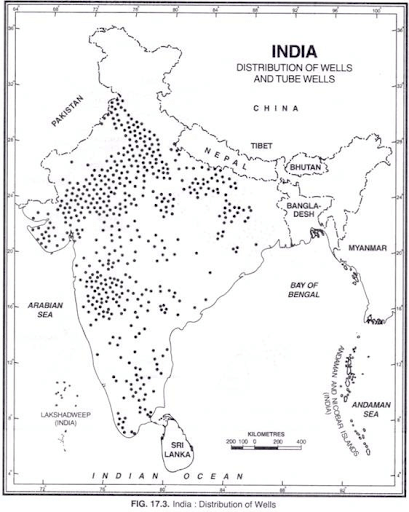
Distribution of Wells in India
Advantages of Well and Tube Well Irrigation
- The well is the most basic and cost-effective source of irrigation, and even the poorest Indian farmer can afford it.
- A well is an independent source of irrigation that can be used as needed.
- Several chemicals, such as nitrate, chloride, sulphate, and others, are commonly found mixed in well water.
- When they reach the agricultural field, they create soil fertility along with well water.
- It is more reliable during times of famine when surface water is scarce.
Disadvantages of Well and Tube Well Irrigation
- Only a small area can be irrigated with these methods. A well can normally irrigate 1 to 8 hectares of land.
- If too much water is drawn out of the well, it may dry up and become ineffective for irrigation.
- When there is a drought, the groundwater level drops, and there isn't enough water in the well when it's most needed.
- Tube wells can draw a lot of groundwater from nearby areas, leaving the ground dry and unsuitable for agriculture.
- Well and tube well irrigation are not possible in areas with salty groundwater.
Conclusion
Well irrigation is gradually being phased out in favour of energised tube wells. However, many wells continue to be used in areas where electricity is unavailable or farmers cannot afford diesel fuel. It is especially useful in areas with permeable rock structures that allow groundwater to accumulate through percolation. As a result, wells are more common in areas with alluvial soil, regur soil, and so on, and less common in rocky terrain or mountainous regions.
FAQs
Question: What is well irrigation?
Answer: Well irrigation involves drawing water from underground sources through wells. It is a common practice in areas with sufficient groundwater availability, enabling farmers to irrigate their crops efficiently throughout the year.
Question: How does tube well irrigation differ from traditional well irrigation?
Answer: Tube well irrigation employs a tube or pipe that extends deep into the ground to access water. Unlike traditional wells, which can be shallow, tube wells can reach deeper aquifers, providing a more reliable water source for irrigation.
Question: What are the advantages of using tube wells for irrigation?
Answer: Tube wells offer several advantages, including consistent water supply, the ability to irrigate larger areas, reduced dependency on rainfall, and improved crop yields. They also allow farmers to cultivate crops during dry seasons, enhancing food security.
Question: What challenges are associated with well and tube well irrigation?
Answer: Key challenges include over-extraction of groundwater, leading to depletion of aquifers, soil salinity, and contamination of water sources. Additionally, inadequate management and maintenance can hinder the efficiency of irrigation systems.
Question: How can sustainable practices be implemented in well and tube well irrigation?
Answer: Sustainable practices include monitoring groundwater levels, implementing crop rotation, using efficient irrigation techniques, and promoting rainwater harvesting. These measures help conserve water resources and ensure the long-term viability of irrigation systems.
MCQs
1. What is the primary benefit of tube well irrigation?
A) It is cheaper than surface irrigation.
B) It provides a consistent water supply from deep aquifers.
C) It requires no maintenance.
D) It is suitable for all soil types.
Answer: (B) See the Explanation
Explanation: The primary benefit of tube well irrigation is its ability to provide a consistent water supply from deep aquifers, ensuring reliable irrigation even during dry periods.
2. Which of the following is a significant challenge of well irrigation?
A) High operational costs
B) Groundwater depletion
C) Abundant water availability
D) Low crop yields
Answer: (B) See the Explanation
Explanation: Groundwater depletion is a significant challenge of well irrigation, as excessive extraction can lead to declining water tables and potential long-term sustainability issues.
3. Which technique is commonly used to enhance the efficiency of tube well irrigation?
A) Surface irrigation
B) Drip irrigation
C) Flood irrigation
D) Subsurface irrigation
Answer: (B) See the Explanation
Explanation: Drip irrigation is commonly used in conjunction with tube well irrigation to enhance efficiency by delivering water directly to the root zone of plants, minimizing wastage and maximizing crop yield.
4. What is the primary purpose of well irrigation?
A) To provide drinking water
B) To irrigate crops
C) To recharge aquifers
D) To generate hydroelectric power
Answer: (B) See the Explanation
Explanation: The primary purpose of well irrigation is to irrigate crops, ensuring that farmers have sufficient water to grow their produce, especially in arid or semi-arid regions.
5. What management practice can help prevent soil salinity in irrigated fields?
A) Continuous cropping
B) Crop rotation
C) Excessive irrigation
D) Monoculture
Answer: (B) See the Explanation
Explanation: Crop rotation can help prevent soil salinity by diversifying the types of plants grown and allowing for better water and nutrient management in the soil, reducing the buildup of salts.
GS Mains Questions and Answers
Q1: Discuss the impact of well and tube well irrigation on agricultural productivity.
Answer: Well and tube well irrigation significantly enhance agricultural productivity by providing a reliable and consistent water supply, enabling farmers to cultivate crops throughout the year, regardless of rainfall patterns. This reliable access to water facilitates the growth of high-value crops and contributes to increased crop yields. Additionally, tube wells allow for the irrigation of larger areas, making it possible to support more extensive farming operations. However, the over-reliance on groundwater can lead to challenges, such as aquifer depletion and soil salinity, which can adversely affect long-term agricultural sustainability. Therefore, balanced and sustainable water management practices are essential to maximize productivity while preserving water resources.
Q2: Evaluate the sustainability challenges associated with well and tube well irrigation.
Answer: The sustainability challenges associated with well and tube well irrigation primarily revolve around groundwater depletion, soil salinity, and water quality deterioration. Over-extraction of groundwater can lead to declining water tables, making it increasingly difficult for farmers to access water. Soil salinity becomes a concern when excessive irrigation leads to the accumulation of salts in the soil, reducing its fertility and affecting crop yields. Additionally, poor management practices can result in the contamination of groundwater sources, threatening both agricultural and human water supplies. To address these challenges, it is vital to implement sustainable practices such as regulated water extraction, crop rotation, and the use of advanced irrigation technologies to optimize water usage and maintain the health of aquifers.
Q3: Analyze the role of government policies in promoting sustainable irrigation practices.
Answer: Government policies play a critical role in promoting sustainable irrigation practices by establishing regulations and providing incentives for efficient water use. Policies that encourage the use of modern irrigation technologies, such as drip and sprinkler systems, can enhance water efficiency and reduce wastage. Financial support for farmers adopting sustainable practices, such as crop rotation and rainwater harvesting, helps to mitigate the impacts of groundwater depletion and soil degradation. Furthermore, educational programs and awareness campaigns about the importance of sustainable irrigation can empower farmers to make informed decisions about water management. By integrating sustainable irrigation practices into agricultural policy frameworks, governments can ensure long-term agricultural productivity and environmental conservation.
Previous Year Questions on Well and Tube Well Irrigation
1. UPSC CSE Prelims 2019:
Question: Which of the following is an advantage of tube well irrigation?
A) It is cost-effective for all crops.
B) It provides water from shallow aquifers.
C) It enables irrigation during dry periods.
D) It requires no energy input.
Answer: (C)
Explanation: Tube well irrigation enables irrigation during dry periods by accessing deeper aquifers, providing a reliable water source even when surface water is scarce.
2. UPSC CSE Mains 2020 (GS Paper 3):
Question: Critically assess the challenges and prospects of well irrigation in India.
Answer: Well irrigation presents both challenges and prospects in India. On one hand, it offers a crucial means of irrigation in regions with limited rainfall, contributing significantly to food production and agricultural resilience. However, challenges such as over-extraction leading to groundwater depletion, salinity issues, and the financial burden of maintaining wells hinder its sustainability. Addressing these challenges requires comprehensive policies focusing on water conservation, promoting efficient irrigation methods, and enhancing farmers' access to modern technology, which can optimize water usage while supporting agricultural productivity.
Download the PREPP App and attempt FREE IAS Exam Mock Tests and get complete study material!

Full Test - 04: UPSC CSE Prelims CSAT (Paper-II)
Full Test - 03: UPSC CSE Prelims CSAT (Paper-II)
UPSC CSE Prelims 2026 GS Paper 1 Question Paper (24-May-2026)
UPSC CSE Prelims 2026 CSAT Paper 2 Question Paper (24-May-2026)

17 February 2025 | The Hindu Must Read Articles | Current Affairs

16 February 2026 | The Hindu Must Read Articles | Current Affairs

13 February 2026 | The Hindu Must Read Articles | Current Affairs









Comments