Tank Irrigation - Agriculture Notes
An irrigation tank, also known as a tank, is a man-made reservoir of any size. They are most common in India. A natural or man-made spring can also be included as part of the structure. A tank was frequently built across a slope to collect and store water by utilizing local mounds and depressions. Tank irrigation involves building mud banks across small streams to create a small reservoir that collects excess water during the rainy season. Tank use is especially important in areas of South India where water supply replenishment is dependent on a cycle of dry seasons alternating with monsoon seasons. In this article, we will discuss Tank Irrigation which will be helpful for UPSC exam preparation.
|
Table of Contents |
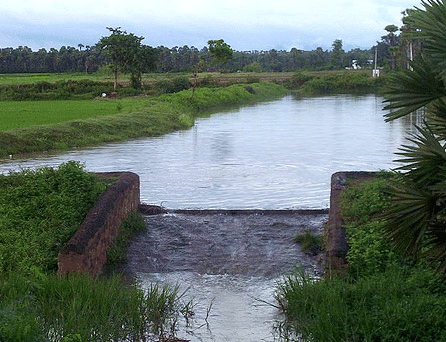
Tank Irrigation in India
What is Irrigation & Irrigation System?
- Irrigation is the process of artificially applying water to crops in order to meet their water requirements.
- Irrigation can also be used to provide nutrients to crops.
- Irrigation is typically used in areas where rainfall is irregular, dry periods are expected, or drought is predicted.
- There are various types of irrigation systems that supply water uniformly to the entire field.
- Groundwater, from springs or wells, surface water, from rivers, lakes, or reservoirs, and even treated wastewater or desalinated water can be used for irrigation.
- Irrigation provides the necessary moisture for growth and development, germination, and other related functions.
- The frequency, rate, amount, and time of irrigation differ for different crops, as well as depending on soil type and season.
- Summer crops, for example, require significantly more water than winter crops.
- Farmers must protect their agricultural water source to reduce the risk of contamination.
- As with any groundwater removal, irrigation water users must exercise caution to avoid pumping groundwater out of an aquifer faster than it is being recharged.
- It is regarded as a basic infrastructure and a necessary input for agricultural production.
- The primary goal is to maintain agricultural output while using as little water as possible, as well as to maintain landscapes and re-vegetate disturbed soils.
- Irrigation is frequently studied in conjunction with drainage, which is the natural or artificial removal of surface and subsurface water from a specific area.
What is Tank Irrigation?
- A tank serves as an irrigation storage system and is created by building a small bund of earth or stones across a stream.
- Rainwater can also be collected in these tank reservoirs and used for irrigation.
- Some tanks are constructed partially as dugouts and partially as enclosing bunds.
- Tanks vary in size, but the majority are small and built by individual farmers or groups of farmers.
- Tank irrigation is popular in the peninsular plateau region, which is led by Andhra Pradesh and Tamil Nadu.
- It is also a significant irrigation source in Karnataka, Madhya Pradesh, Maharashtra, Odisha, Kerala, the Bundelkhand region, Rajasthan, and Gujarat.
Tank Irrigation in India
- Tank irrigation is more appropriate in peninsular plateau states like Andhra Pradesh (including Telangana) and Tamil Nadu.
- Andhra Pradesh is India's largest tank irrigation state, accounting for approximately 29 percent of all tank irrigated land. Tanks irrigate approximately 16% of the state's total irrigated area.
- There are numerous tanks in the drainage areas of the Godavari and its tributaries. The main tank irrigation districts are Nellore and Warangal.
- Tamil Nadu has the second largest area, accounting for more than 23 percent of India's tank irrigated area and roughly one-fifth of the state's total irrigated area.
- In the Karnataka Plateau, eastern Madhya Pradesh, eastern Maharashtra, interior Orissa, and Kerala, tanks are an important source of irrigation.
- Tank irrigation is used outside the Peninsular plateau in West Bengal, Bihar, Bundelkhand region of Uttar Pradesh, Rajasthan, and Gujarat.
- It is primarily practiced in the peninsular region for the following reasons:
- Canals and wells are difficult to dig due to the undulating relief and hard rocks.
- Due to the hard rock structure, there is little water percolation, and ground water is scarce.
- Most rivers are seasonal; many streams become torrential during the rainy season, so the only way to use this water is to impound it by constructing bunds and tanks.
- Because of the impermeable nature of the rocks, it is also simple to collect rainwater in natural or artificial pits.
- Tank irrigation is also advantageous due to the dispersed nature of the population and agricultural fields.
Advantages of Tank Irrigation
- Since most tanks are natural, they are less expensive to build and have a longer lifespan.
- Tanks are typically built on a rocky bed and have a long lifespan.
- Fishing is also done in many tanks, which supplements both the farmer's food supply and income.
Disadvantages of Tank Irrigation
- The main issue with tanks for water storage is that they dry up during the dry season and fail to provide irrigation when it is most needed.
- Silting of the tank bed is a serious issue that necessitates tank de-silting at regular intervals.
- Much water evaporates from the large expanse of shallow water, rendering it unfit for irrigation.
- Tanks cover vast swaths of arable land. Other sources of irrigation have been used in many areas, and the dry beds of tanks have been reclaimed for agriculture.
- Furthermore, lifting water from tanks and transporting it to fields is a time-consuming and costly task that discourages the use of tanks as a source of irrigation.
Conclusion
A tank is an irrigation storage system created by building a small bund of earth or stones across a stream. The bund's impoundment of water is used for irrigation and other purposes. Some tanks are constructed partially as dugouts and partially as enclosing bunds. Tanks vary in size, but the majority are small and built by individual farmers or groups of farmers.
FAQs
Q1: What is tank irrigation?
Answer: Tank irrigation is a method of storing and utilizing rainwater in tanks or reservoirs to irrigate crops, especially in regions with seasonal rainfall.
Q2: How does tank irrigation benefit agriculture?
Answer: It helps conserve water, enhances soil moisture, and provides a reliable water source during dry periods, improving crop yield.
Q3: What are the main components of a tank irrigation system?
Answer: Key components include the tank or reservoir, distribution channels, and fields for irrigation.
Q4: In which regions of India is tank irrigation commonly practiced?
Answer: Tank irrigation is commonly practiced in southern and eastern India, particularly in Tamil Nadu, Karnataka, and Andhra Pradesh.
Q5: What are the challenges associated with tank irrigation?
Answer: Challenges include sedimentation, maintenance issues, and inadequate rainfall leading to water scarcity.
MCQs
- What is the primary purpose of tank irrigation?
a) To generate hydroelectric power
b) To store and utilize rainwater for irrigation
c) To control floods
d) To provide drinking water
Answer: (b) See the Explanation
The main purpose of tank irrigation is to capture and store rainwater to irrigate crops, particularly in areas with limited water resources.
- Which state in India is famous for its tank irrigation system?
a) Punjab
b) Haryana
c) Tamil Nadu
d) Uttar Pradesh
Answer: (c) See the Explanation
Tamil Nadu is well-known for its extensive tank irrigation systems, effectively managing water resources for agriculture.
- What is one of the major advantages of tank irrigation?
a) High installation cost
b) Conservation of water resources
c) Increased soil erosion
d) Dependence on groundwater
Answer: (b) See the Explanation
Tank irrigation conserves surface water resources by capturing rainwater, which can then be used during dry spells.
- Which of the following is a limitation of tank irrigation?
a) Accessibility to all crops
b) Dependence on rainfall
c) Low installation cost
d) Increased crop diversity
Answer: (b) See the Explanation
Tank irrigation systems rely heavily on seasonal rainfall, which can be unpredictable, posing a limitation for consistent water supply.
- What is a common maintenance issue in tank irrigation systems?
a) Water quality
b) Sedimentation
c) Excess water
d) Crop disease
Answer: (b) See the Explanation
Sedimentation can accumulate in tanks, reducing their capacity and efficiency over time, making maintenance crucial for effective irrigation.
GS Mains Questions and Model Answers
Q1: Discuss the significance of tank irrigation in Indian agriculture.
Answer: Tank irrigation plays a crucial role in Indian agriculture, particularly in regions with erratic rainfall. It aids in water conservation by storing rainwater, which can be utilized during dry spells, ensuring crop sustainability. This method supports various crops, enhances soil fertility through controlled water supply, and reduces dependence on groundwater, thus preserving aquifers. Additionally, tank irrigation can improve rural livelihoods by increasing agricultural productivity, promoting food security, and fostering community participation in water management.
Q2: Evaluate the challenges faced by tank irrigation systems in India.
Answer: Tank irrigation systems in India face several challenges, including sedimentation, which reduces storage capacity and affects water quality. Maintenance is often neglected due to lack of funds and awareness, leading to deteriorating infrastructure. Additionally, climate change impacts rainfall patterns, making it difficult to predict water availability. Socio-economic factors, such as land ownership disputes and inadequate government support, further hinder the effective management of these systems. Addressing these challenges requires integrated water management strategies and community engagement.
Q3: Analyze the role of tank irrigation in sustainable agricultural practices.
Answer: Tank irrigation contributes to sustainable agricultural practices by promoting efficient water use and enhancing soil health. By capturing rainwater, it mitigates the risks associated with droughts and reduces reliance on chemical fertilizers by maintaining soil moisture levels. The practice encourages crop diversification and rotation, which improves biodiversity and soil fertility. Furthermore, it fosters community involvement in water management, enhancing local governance and resilience against climate change impacts. Thus, tank irrigation is integral to achieving sustainable agricultural development.
Previous Year Questions on Tank Irrigation
1. UPSC CSE 2017
Question: "Evaluate the impact of irrigation methods on agricultural productivity in India."
Answer: The evaluation of irrigation methods, including tank irrigation, reveals significant impacts on agricultural productivity in India. Efficient irrigation increases crop yields by ensuring a consistent water supply, particularly in regions susceptible to drought. Tank irrigation, in particular, allows for the effective use of rainwater, reducing reliance on monsoon seasons and mitigating risks associated with water scarcity. This leads to enhanced food security and improved livelihoods for farmers. However, the sustainability of such systems hinges on proper maintenance, community engagement, and adaptation to climate variability.
2. UPSC CSE 2019
Question: "Discuss the various irrigation techniques in India and their significance in enhancing food security."
Answer: Various irrigation techniques in India, such as tank irrigation, canal irrigation, drip, and sprinkler systems, play a vital role in enhancing food security. Tank irrigation is particularly significant in arid and semi-arid regions, where it captures and stores rainwater, providing an essential water source for crops during dry periods. This technique helps to stabilize crop production, reduce the impact of droughts, and improve overall agricultural resilience. The effective implementation and management of these irrigation methods are crucial to ensuring consistent food supply and supporting rural economies.
Download the PREPP App and attempt FREE IAS Exam Mock Tests and get complete study material!

Full Test - 04: UPSC CSE Prelims CSAT (Paper-II)
Full Test - 03: UPSC CSE Prelims CSAT (Paper-II)
UPSC CSE Prelims 2026 CSAT Paper 2 Question Paper (24-May-2026)
UPSC CSE Prelims 2026 GS Paper 1 Question Paper (24-May-2026)

17 February 2025 | The Hindu Must Read Articles | Current Affairs

16 February 2026 | The Hindu Must Read Articles | Current Affairs

13 February 2026 | The Hindu Must Read Articles | Current Affairs









Comments