Canal Irrigation - Agriculture Notes
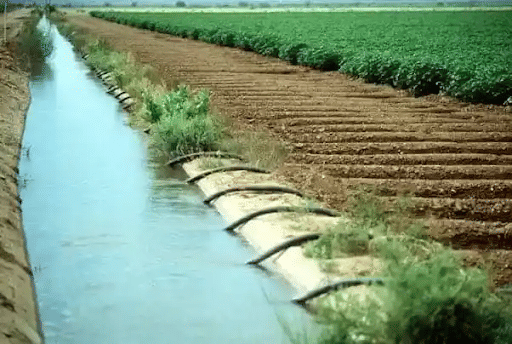
A canal is a man-made channel that is built to transport water to fields for irrigation. The water is drawn from a river, a tank, or a reservoir. Canals can be built with concrete, stone, brick, or any type of flexible membrane that solves durability issues like seepage and erosion. The canal irrigation system is a traditional irrigation method that is extremely beneficial for agricultural work at a low cost. In this article, we will discuss Canal Irrigation which will be helpful for UPSC exam preparation.
|
Table of Contents |
Canal Irrigation
What is Irrigation & Irrigation System?
- Irrigation is the process of artificially applying water to crops in order to meet their water requirements.
- Irrigation can also be used to provide nutrients to crops.
- Irrigation is typically used in areas where rainfall is irregular, dry periods are expected, or drought is predicted.
- There are various types of irrigation systems that supply water uniformly to the entire field.
- Groundwater, from springs or wells, surface water, from rivers, lakes, or reservoirs, and even treated wastewater or desalinated water can be used for irrigation.
- Irrigation provides the necessary moisture for growth and development, germination, and other related functions.
- The frequency, rate, amount, and time of irrigation differ for different crops, as well as depending on soil type and season.
- Summer crops, for example, require significantly more water than winter crops.
- Farmers must protect their agricultural water source to reduce the risk of contamination.
- As with any groundwater removal, irrigation water users must exercise caution to avoid pumping groundwater out of an aquifer faster than it is being recharged.
- It is regarded as a basic infrastructure and a necessary input for agricultural production.
- The primary goal is to maintain agricultural output while using as little water as possible, as well as to maintain landscapes and re-vegetate disturbed soils.
- Irrigation is frequently studied in conjunction with drainage, which is the natural or artificial removal of surface and subsurface water from a specific area.
What is Canal Irrigation?
- Canal irrigation is one of the most important sources of water. It accounts for about 24% of total irrigation in the country.
- It is an effective source of irrigation in low-level relief, deep fertile soil, and perennial river areas, which are mostly found in the northern plains.
- Inundation canals and perennial canals are the two types of canal systems.
- Inundation Canals are taken from rivers without any regulating system and provide irrigation primarily during the rainy season when the river is in flood and there is excess water.
- These canals primarily provide irrigation during the rainy season, when the river is flooded and there is an abundance of water.
- Perennial Canals are created by constructing a barrage across a perennial river. The majority of India's canals are perennial.
- The majority of the canals provide perennial irrigation and supply water as needed. This protects crops from drought and increases farm output.
- Inundation Canals are taken from rivers without any regulating system and provide irrigation primarily during the rainy season when the river is in flood and there is excess water.
- Canal irrigation refers to the method of transporting water by gravity from a river, reservoir, and tank via a canal to farmlands.
- The canals appear to have a trapezoidal shape and are made of reinforced concrete, brick masonry, and stone masonry.
- The canals are designed with adequate width and depth to carry enough water flow to the crop fields. Water will be distributed correctly for cultivation from the source point.
- Water flow from the source to the crop fields can be controlled by appropriate valves.
- When the water reaches its destination, it is either manually or mechanically pumped onto the crop field.
- The agricultural land will be slightly shaped in the slope to allow for natural water flow.
Canal Irrigation in India
- Canals were the most important source of irrigation until the 1960s, when wells and tube wells surpassed them to become the second most important source of irrigation in India.
- The proportion of canal irrigation area to total irrigated area in the country has decreased from approximately 39.77 percent in 1950-51 to 29 percent in 2000-01.
- Canals can be an effective source of irrigation in areas with low level relief, deep fertile soils, a perennial source of water, and a large command area.
- As a result, the northern plains of India, particularly the states of Uttar Pradesh, Haryana, and Punjab, have a high concentration of canal irrigation.
- Canal digging in rocky and uneven terrain is difficult and expensive. As a result, canals are almost non-existent on the Peninsular plateau. However, some canals for irrigation exist in South India's coastal and delta regions.
- Canal irrigation covers approximately 15.8 million hectares. The main canal irrigated areas in India are in the northern plains, where Uttar Pradesh, Punjab, Haryana, Rajasthan, and Bihar account for roughly 60% of the country's canal irrigated area.
- Andhra Pradesh, Maharashtra, Karnataka, Madhya Pradesh, Chhattisgarh, Orissa, and Tamil Nadu are important canal irrigation states in south and central India.
Distribution System of Canal Irrigation System
- The water transported from the source point will be divided into various channels that will carry the water to all required areas.
- The canal irrigation system's components are as under:
- Main Canal
- Branch Canal
- Main Distribution
- Minor Distribution
- Water Supply
- The width and depth of the canals will be determined by the amount of material to be transported to the farmlands.
- The main canal will receive a substantial amount of water from the river. As a result, the channel's depth and width will be considerable.
- The flow will then be distributed by the central canal to the branch line, sub-branch, distributor line, and minor lines and finally arriving at the crop fields.
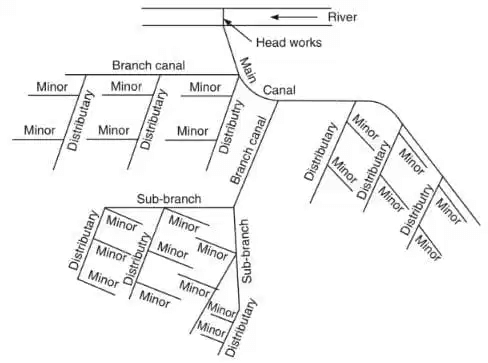
Distribution System of Canal Irrigation System
Classification of Canals
| Based on Nature of Supply | Permanent Canal |
|
| Inundation Canal |
|
|
| Based on Functions | Irrigation Canal |
|
| Power Canal |
|
|
| Feeder Canal |
|
|
| Carrier Canal |
|
|
| Navigation Canal |
|
|
| Based on Type of Surface Soil | Alluvial Canal |
|
| Non-alluvial Canal |
|
|
| Rigid Surface Canal |
|
|
| Based on Financial Output | Protective Canal |
|
| Productive Canal |
|
|
| Based on Discharge | Main Canal |
|
| Branch Canal |
|
|
| Major Distributary Canal |
|
|
| Minor Distributary Canal |
|
|
| Field Canal |
|
|
| Based on Canal Alignment | Ridge Canal |
|
| Contour Canal |
|
|
| Side-slope Canal |
|
Canal Irrigation - Advantages
- Unirrigated lands can be developed by providing canal irrigation, which will increase crop production in the area.
- Economic development can be accelerated by avoiding dangerous situations such as droughts. The development of canal irrigation can reduce reliance on rainfall.
- Canals receive rainwater from rivers or reservoirs, and the water is used for irrigation. Canals can also be used to grow crops that require extra water.
- Because an irrigation canal system is a permanent hydraulic structure, only maintenance is required to reap its benefits over time.
- When compared to un-irrigated soils, irrigation from canals results in higher productivity per hectare.
- Canals can be used for multiple purposes, including irrigation, hydroelectricity generation, navigation, drinking water supply, and fishery development.
- Groundwater levels do not fall as a result of canal irrigation; on the contrary, water levels rise, making well drilling easier.
- Canals are also becoming a tourist attraction these days.
Canal Irrigation - Disadvantages
- It renders the soil infertile or unproductive because harmful underground slats and alkalis reach the surface level as a result of waterlogging, and the land can become marshy as a result.
- Many infections are caused by the spread of mosquitoes, warms, and insects in canals due to stagnant water.
- Because of the imbalance in canal water distribution, there is scarcity in some areas and waterlogging in others due to the collection of water there.
- Crops are destroyed due to a lack of irrigation water due to water scarcity in inundation canals.
- If regular canal preservation and maintenance are not performed properly, sediments accumulate, resulting in a reduction in canal capacity.
- Canal construction also takes longer, and due to high economic investment, it is not possible to provide canal irrigation to all regions.
- During the rainy season, many canals overflow and flood the surrounding areas. Canal irrigation is only appropriate for flat land.
Conclusion
Most canals provide perennial irrigation and provide water as needed. This saves the crops from drought and helps to increase farm production. However, during the rainy season, many canals overflow and flood the surrounding areas. Canal irrigation is only appropriate for flat land.
FAQs
Q1: What is canal irrigation?
Answer: Canal irrigation is a method of watering crops through channels or canals that divert water from rivers, lakes, or reservoirs. This system helps to provide a consistent water supply to agricultural fields, especially in regions with irregular rainfall, increasing agricultural productivity.
Q2: What are the advantages of canal irrigation?
Answer: Canal irrigation ensures a reliable water supply, reduces the dependency on rainfall, increases crop yields, and supports farming in areas with inadequate natural water sources. It can also help prevent soil erosion and promote the growth of multiple crops in a year.
Q3: What are the challenges associated with canal irrigation?
Answer: Canal irrigation systems can face issues like waterlogging, salinization of soil, and the maintenance cost of canals. There can also be inefficiencies due to poor distribution of water, leading to uneven irrigation in different areas of the farmland.
Q4: How does canal irrigation affect agriculture in India?
Answer: Canal irrigation has played a pivotal role in increasing agricultural output, particularly in the arid and semi-arid regions of India. It has facilitated the growth of high-yielding crops, improved food security, and contributed to the agricultural economy of the country.
Q5: Which areas in India benefit from canal irrigation?
Answer: Canal irrigation is most commonly used in states like Punjab, Haryana, Uttar Pradesh, and Rajasthan, where large canal systems such as the Indira Gandhi Canal and the Sutlej-Yamuna Link Canal provide water to millions of hectares of land, supporting major agricultural activities.
MCQs
- What is the primary advantage of canal irrigation?
A) Reduction in crop yield
B) Improved water management
C) Increased water wastage
D) Enhanced soil erosion
Answer: (B) See the Explanation
- Which of the following is a common issue associated with canal irrigation?
A) Water scarcity
B) Waterlogging
C) Increased soil fertility
D) Reduced crop yield
Answer: (B) See the Explanation
- In which of the following states canal irrigation is extensively used?
A) Bihar
B) Punjab
C) Kerala
D) Tamil Nadu
Answer: (B) See the Explanation
- Which of the following is a major disadvantage of canal irrigation in India?
A) Over-dependence on rainfall
B) Increased evaporation
C) High maintenance costs of canals
D) Lack of water supply
Answer: (C) See the Explanation
- Canal irrigation systems are primarily used in which of the following climates?
A) Tropical rainforest
B) Arid and semi-arid
C) Mediterranean
D) Temperate
Answer: (B) See the Explanation
GS Mains Questions and Model Answers
Q1: Examine the significance of canal irrigation in enhancing agricultural productivity in India.
Answer: Canal irrigation plays a crucial role in improving agricultural productivity, especially in water-scarce regions. In India, where agriculture forms the backbone of the economy, canal irrigation ensures reliable water supply to crops, mitigating the effects of unpredictable rainfall. Regions like Punjab, Haryana, and Uttar Pradesh benefit significantly from well-established canal systems, such as the Indira Gandhi Canal and the Sutlej-Yamuna Link Canal. These systems have increased cropping intensity, enabling multiple harvests annually, and have facilitated the growth of water-intensive crops like rice and sugarcane. Furthermore, canal irrigation helps in managing water resources efficiently and supports agriculture in otherwise dry areas. However, challenges such as waterlogging, soil salinization, and the high cost of maintaining canal infrastructure remain significant concerns.
Q2: Discuss the environmental and economic implications of canal irrigation in India.
Answer: Canal irrigation has both positive and negative environmental and economic implications. Economically, it has contributed to higher agricultural yields, increased food production, and enhanced rural income. For example, the green revolution in Punjab was significantly fueled by the extensive use of canal irrigation, which transformed it into a major agricultural hub. However, the environmental costs include the risks of waterlogging and soil salinization, especially in areas where the canals are poorly managed. Additionally, the construction of large canals disrupts natural water courses and may cause ecological imbalances. Water wastage due to inefficient irrigation methods also exacerbates water scarcity in certain regions. Overall, while canal irrigation contributes to agricultural growth, its long-term sustainability depends on effective management practices that address these environmental concerns.
Q3: Analyze the challenges faced by India in improving the canal irrigation system and suggest measures to overcome these issues.
Answer: The canal irrigation system in India faces numerous challenges, including waterlogging, soil salinization, inefficiency in water distribution, and high maintenance costs. Waterlogging occurs due to poor drainage systems and over-irrigation, which adversely affects soil quality. Salinization, caused by the accumulation of salts in the soil from frequent irrigation, reduces crop yields and soil fertility. Furthermore, the maintenance of canals requires significant financial investment, which puts a strain on state resources. To address these challenges, measures such as the introduction of modern irrigation technologies like drip and sprinkler systems, regular maintenance of canals, and the construction of proper drainage systems are needed. Additionally, improving water conservation practices, adopting crop rotation techniques, and integrating rainwater harvesting can help reduce the dependency on canal water and enhance the sustainability of irrigation practices.
Previous Year Questions on Canal Irrigation
1. UPSC 2022 Prelims
Question: Which of the following is a primary advantage of canal irrigation in India?
A) Decreases water wastage
B) Prevents soil erosion
C) Increases agricultural productivity
D) Reduces reliance on groundwater
Answer: C) Increases agricultural productivity
Explanation: Canal irrigation has played a key role in increasing agricultural productivity in India by ensuring a consistent and controlled water supply. It has been particularly beneficial in arid and semi-arid regions, boosting crop yields and enabling multiple harvests annually. It has also facilitated the cultivation of water-intensive crops in areas previously unsuitable for farming.
2. UPSC 2019 Mains
Question: How can canal irrigation be made more sustainable in India, considering the challenges of waterlogging and salinization?
Answer: Canal irrigation can be made more sustainable through several measures. First, proper drainage systems should be developed to prevent waterlogging, which can lead to the deterioration of soil health. Secondly, periodic maintenance of canals to prevent siltation and water loss is essential. Adoption of water-efficient irrigation technologies such as drip irrigation can reduce the amount of water wasted. Additionally, promoting crop rotation, reducing water-intensive crops, and encouraging rainwater harvesting would lessen the strain on canal irrigation systems. Finally, policymakers should prioritize integrated water management approaches that combine canal irrigation with groundwater and rainwater harvesting systems to maintain a balance and ensure long-term sustainability of water resources.
Download the PREPP App and attempt FREE IAS Exam Mock Tests and get complete study material!

Full Test - 04: UPSC CSE Prelims CSAT (Paper-II)
Full Test - 03: UPSC CSE Prelims CSAT (Paper-II)
UPSC CSE Prelims 2026 GS Paper 1 Question Paper (24-May-2026)
UPSC CSE Prelims 2026 CSAT Paper 2 Question Paper (24-May-2026)

17 February 2025 | The Hindu Must Read Articles | Current Affairs

16 February 2026 | The Hindu Must Read Articles | Current Affairs

13 February 2026 | The Hindu Must Read Articles | Current Affairs









Comments