Irrigation Schemes in India - Agriculture Notes
Irrigation systems are an essential component of agriculture. Irrigation schemes in India provide a significant amount of public sector support for long-term growth. State governments plan, fund, execute, and maintain water resource projects based on their own resources and priorities. Agriculture is one of the most important sectors of the Indian economy, employing more than half of the country's population. There are numerous types of irrigation systems that aid in agricultural growth. Agriculture is the key to the advancement of human civilization and the lifeblood of any country's economy. In this article, we will discuss the Irrigation Schemes in India which will be helpful for UPSC exam preparation.
|
Table of Contents |
What is Irrigation & Irrigation System?
- Irrigation is the process of artificially applying water to crops in order to meet their water requirements.
- Irrigation can also be used to provide nutrients to crops.
- Irrigation is typically used in areas where rainfall is irregular, dry periods are expected, or drought is predicted.
- There are various types of irrigation systems that supply water uniformly to the entire field.
- Groundwater, from springs or wells, surface water, from rivers, lakes, or reservoirs, and even treated wastewater or desalinated water can be used for irrigation.
- Irrigation provides the necessary moisture for growth and development, germination, and other related functions.
- The frequency, rate, amount, and time of irrigation differ for different crops, as well as depending on soil type and season.
- Summer crops, for example, require significantly more water than winter crops.
- Farmers must protect their agricultural water source to reduce the risk of contamination.
- As with any groundwater removal, irrigation water users must exercise caution to avoid pumping groundwater out of an aquifer faster than it is being recharged.
- It is regarded as basic infrastructure and a necessary input for agricultural production.
- The primary goal is to maintain agricultural output while using as little water as possible, as well as to maintain landscapes and re-vegetate disturbed soils.
- Irrigation is frequently studied in conjunction with drainage, which is the natural or artificial removal of surface and subsurface water from a specific area.
Irrigation in India
- Irrigation in India includes a network of major and minor canals from Indian rivers, groundwater well-based systems, tanks, and other rainwater harvesting projects for agricultural activities.
- The largest of these systems is the groundwater system. In 2013-14, only about 36.7% of total agricultural land in India was reliably irrigated, and the remaining 2/3 of cultivated land in India is dependent on monsoons.
- Groundwater is used for 65% of irrigation in India. Irrigation currently covers about 51% of the agricultural area cultivating food grains.
- The rest of the area is reliant on rainfall, which is frequently unreliable and unpredictable.
- The Indian government launched a demand-side water management plan worth 6000 crores across 8,350 water-stressed villages in 78 districts across seven states - Gujarat, Haryana, Karnataka, Madhya Pradesh, Maharashtra, Rajasthan, and Uttar Pradesh - over five years, from 2021-2022 to 2026-27, with the goal of harvesting rainwater, improving water table, and increasing water recharge rate through village panchayat level water management plans.
- The majority of canal irrigation occurs in the Ganges-Yamuna basin canal network, primarily in the states of Punjab, Haryana, and Uttar Pradesh, with some in Rajasthan and Bihar, while small local canal networks exist in Tamil Nadu, Karnataka, and Kerala.
- Indira Gandhi Canal, which is approximately 650 kilometres long, is India's longest canal.
- India has an ambitious river linking national project in the works to increase the coverage of canal-irrigated land, reduce floods, and alleviate water scarcity.
- Irrigation in India helps to improve food security, reduce reliance on monsoons, increase agricultural productivity, and create rural job opportunities.
- Dams used for irrigation projects help generate electricity and transport facilities, as well as provide drinking water to a growing population, control floods, and prevent droughts.
Importance of Irrigation
- Consistent production: Since India's climate is predominantly monsoonal, farmers cannot rely on rain to feed them all year. Agricultural production is also hampered by irregular, insufficient, or unpredictable rain. Proper irrigation systems can ensure continuous production.
- Land Productivity: Irrigated land produces more than unirrigated land. Higher productivity, in turn, helps farmers get a better return on their produce while also controlling inflation in the economy.
- Seed Growth: Water is required for seed growth because seeds cannot grow in dry soil. The required moisture content of soil for seed growth can be ensured with irrigation supply.
- Multiple cropping: With irrigation, multiple cropping is possible throughout the year. Crop diversification is practised in many areas of India with the help of irrigation.
- Basic Nutrient: Irrigation contributes to the supply of hydrogen and oxygen to the soil, which is necessary for the proper development of plant roots.
- Cultivable land: Proper irrigation makes it possible to cultivate more land.
- Reduces poverty: Irrigation can protect people during droughts and famines. Farm households' income and employment are closely related to agricultural output. Irrigation boosts output, which boosts farmer income.
Irrigation Schemes in India
Pradhan Mantri Krishi Sinchayee Yojana
- Pradhan Mantri Krishi Sinchayee Yojana (PMKSY) was created with the goal of expanding irrigation coverage ('Har Khet ko pani') and improving water use efficiency ('More crop per drop') in a focused manner by providing an end-to-end solution for source creation, distribution, management, field application, and extension activities.
- It is being implemented to increase the cultivated area with assured irrigation, reduce water waste, and improve water use efficiency.
- PMKSY focuses not only on creating assured irrigation sources but also on creating protective irrigation by harnessing rainwater at the micro level via "Jal Sanchay" and "Jal Sinchan."
- Micro irrigation is also subsidised in order to ensure "per drop-more crop."
- In its meeting on July 1st, 2015, the Cabinet Committee on Economic Affairs, chaired by the Hon'ble Prime Minister, approved the Pradhan Mantri Krishi Sinchayee Yojana (PMKSY).
- PMKSY will be supervised and monitored by an Inter-Ministerial National Steering Committee (NSC) chaired by the Prime Minister and comprised of Union Ministers from relevant Ministries.
- A National Executive Committee (NEC) will be formed under the chairmanship of the Vice Chairman of NITI Aayog to oversee programme implementation, resource allocation, inter-ministerial coordination, monitoring and performance evaluation, addressing administrative issues, and so on.
- PMKSY was created by combining three existing schemes: the Accelerated Irrigation Benefit Programme (AIBP) of the Ministry of Water Resources, River Development, and Ganga Rejuvenation, the Integrated Watershed Management Programme (IWMP) of the Department of Land Resources (DoLR), and the On Farm Water Management (OFWM) of the Department of Agriculture and Cooperation (DAC).
- PMKSY has been approved for implementation across the country with a budget of Rs. 50,000 crore over five years.
- The programme covers all states and union territories, including the North Eastern states.
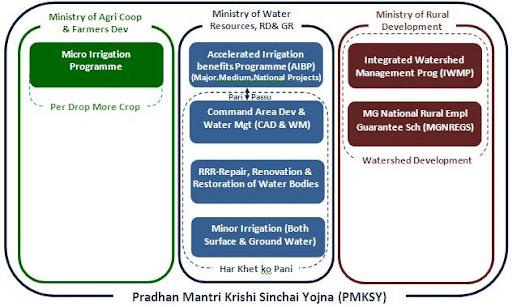
Components of PMKSY
*For detailed notes of this topic, check this link Pradhan Mantri Krishi Sinchai Yojana
Micro Irrigation Fund
- The National Bank for Agriculture and Rural Development (NABARD) has established a Micro Irrigation Fund with a corpus of Rs. 5,000 crore that will be operational in 2019-20.
- The fund's goal is to assist states in obtaining an interest-free loan to expand the coverage of micro irrigation facilities by undertaking special and innovative projects, as well as to incentivize micro irrigation beyond the provisions available under PMKSY to encourage farmers to install micro irrigation systems.
Rainfed Area Development Programme (RADP)
- The Department of Agriculture Cooperation and Farmers Welfare launched the "Rainfed Area Development Programme (RADP)" in 2011-12 as a sub-scheme under the Rashtriya Krishi Vikas Yojana (RKVY) to ensure agricultural growth in rainfed areas.
- The primary goal of this scheme is to improve the quality of life of farmers, primarily small and marginal farmers, by providing a comprehensive package of activities designed to maximise farm returns.
- The RADP scheme focuses on Integrated Farming Systems (IFS) to increase productivity while reducing risks associated with climatic variability.
- The Rainfed Area Development Programme's primary goals are as follows
- Increasing agricultural productivity in rainfed areas in a sustainable way through the use of appropriate farming system-based approaches.
- Through diversified and composite farming systems, the negative impact of crop failure due to flood, drought, or uneven rainfall distribution is reduced.
- Restore trust in rainfed agriculture by creating long-term job opportunities through improved on-farm technologies and cultivation practices.
- To increase farmer income and provide livelihood support in rainfed areas in order to reduce poverty.
- The Rainfed Area Development Programme will cover all rainfed areas with a large amount of cultivable land and the potential to increase agricultural productivity.
- Priority will be given to arid, semi-arid, and sub-humid ecosystems within rainfed areas.
- Support under RADP will be limited to a farm size of 2 hectors and all-time financial assistance of Rs. 100000 in arid and semi-arid zones and Rs. 80000 in sub-humid and humid zones.
Mission Kakatiya
- Mission Kakatiya is a flagship programme of the Telangana government aimed at restoring minor irrigation sources of water such as ponds and tanks.
- The goal is to improve the development of minor irrigation infrastructure, strengthen community-based irrigation management in a decentralized manner, and implement a comprehensive programme for tank and water source restoration in order to effectively utilise the 265 TM of water allocated for minor irrigation in the Godavari and Krishna river basins.
- Gram Sabhas were held, and the proposed plans were discussed with the villagers.
- Farmers were encouraged to cooperate and were advised to deposit the silt for field preparation.
- Several district-level coordination committees were formed. The emphasis was on improving service delivery times.
- Tank de-siltation, feeder channel restoration, irrigation channel re-sectioning, bund, weir, and sluice repair, and FTL (Full Tank Level) raising were all carried out.
Conclusion
The scarcity of irrigated agricultural land is a major problem that must be addressed more aggressively. Farmers should be made aware of and educated on the various irrigation options available to them. Vertical farming, zero-budget natural farming, urban agriculture, agroforestry, and other alternative irrigation and farming methods should be encouraged.
|
|
|
|---|---|
| Agriculture Notes | Different Types of Irrigation and Irrigation Systems |
| Crop Rotation | Watershed Management |
| Crop and its Classifications | Cropping |
| Farming Systems | Organic Farming |
| Sustainable Agriculture | Integrated Farming System |
| Important Cropping Patterns in India | Major Crops of India |
| WEEDS | Soil |
FAQs
Q1: What is the significance of irrigation schemes in India?
Answer: Irrigation schemes in India are crucial for enhancing agricultural productivity by providing a reliable water supply to farmlands, particularly in areas that experience water scarcity. These schemes help improve crop yields, ensure food security, and support the livelihoods of millions of farmers.
Q2: What are the major types of irrigation schemes in India?
Answer: Major irrigation schemes in India include surface water irrigation (such as canals and tanks), groundwater irrigation (through wells and tube wells), and micro-irrigation systems like drip and sprinkler irrigation. Each type is designed to address different agricultural and climatic conditions.
Q3: What is the Pradhan Mantri Krishi Sinchayee Yojana (PMKSY)?
Answer: The Pradhan Mantri Krishi Sinchayee Yojana (PMKSY) is a flagship irrigation scheme launched by the Government of India in 2015. Its objective is to expand the area under irrigation and promote efficient water use, thereby improving water availability for agriculture.
Q4: How does drip irrigation benefit farmers?
Answer: Drip irrigation delivers water directly to the roots of plants in a controlled manner, minimizing water wastage and reducing evaporation. This method improves water use efficiency, enhances crop yields, and is particularly effective in arid and semi-arid regions.
Q5: What challenges do Indian irrigation schemes face?
Answer: Indian irrigation schemes face challenges such as water scarcity, outdated infrastructure, inequitable water distribution, and poor maintenance of irrigation systems. Addressing these challenges requires better water management practices, modernization of irrigation infrastructure, and policies promoting efficient water use.
MCQs
- Which of the following irrigation schemes aims at enhancing water use efficiency in agriculture?
a) National Mission for Sustainable Agriculture
b) Pradhan Mantri Krishi Sinchayee Yojana (PMKSY)
c) National Food Security Mission
d) Rashtriya Krishi Vikas Yojana
Answer: (B) See the Explanation
- Which type of irrigation system delivers water directly to the roots of plants?
a) Canal irrigation
b) Drip irrigation
c) Tank irrigation
d) Flood irrigation
Answer: (B) See the Explanation
- The Command Area Development Programme (CADP) was introduced to address which issue related to irrigation?
a) Inefficient water distribution
b) Excessive use of fertilizers
c) Soil erosion in agricultural fields
d) Urbanization of agricultural land
Answer: (A) See the Explanation
- What is the primary objective of micro-irrigation schemes like drip and sprinkler systems?
a) Flood control
b) Efficient water use and conservation
c) Soil fertility improvement
d) Crop diversification
Answer: (B) See the Explanation
- Which of the following is a major challenge faced by irrigation schemes in India?
a) Abundant rainfall
b) Excessive groundwater availability
c) Water scarcity and outdated infrastructure
d) Declining agricultural land area
Answer: (C) See the Explanation
GS Mains Questions and Model Answers
Q1: Discuss the role of irrigation schemes in enhancing agricultural productivity and ensuring food security in India.
Answer: Irrigation schemes play a critical role in enhancing agricultural productivity and ensuring food security in India by providing a stable and reliable water supply to farms. In a country where agriculture is highly dependent on monsoons, irrigation schemes like canal systems, groundwater wells, and micro-irrigation techniques help mitigate the risks associated with irregular rainfall. Irrigation increases crop yield by allowing multiple cropping and improving water use efficiency. Schemes like the Pradhan Mantri Krishi Sinchayee Yojana (PMKSY) aim to expand irrigation coverage and promote water-saving technologies. By improving water access, irrigation schemes contribute to poverty alleviation, rural employment, and better crop diversification, ultimately ensuring food security.
Q2: Analyze the challenges faced by Indian irrigation schemes and suggest measures to improve their efficiency.
Answer: Indian irrigation schemes face several challenges, including water scarcity, inefficient water distribution, outdated infrastructure, and poor maintenance of systems. In many regions, over-reliance on groundwater for irrigation has led to depletion of aquifers, while canal systems suffer from water loss due to seepage and evaporation. To improve the efficiency of irrigation schemes, modernization of infrastructure, adoption of micro-irrigation techniques, and better water management practices are needed. Policies that encourage rainwater harvesting, watershed development, and equitable water distribution can also enhance efficiency. Additionally, involving local communities in the management of irrigation projects can ensure better maintenance and sustainability.
Q3: Evaluate the impact of the Pradhan Mantri Krishi Sinchayee Yojana (PMKSY) on the expansion of irrigation facilities and water management in India.
Answer: The Pradhan Mantri Krishi Sinchayee Yojana (PMKSY), launched in 2015, has made significant progress in expanding irrigation facilities and improving water management in India. By integrating various irrigation schemes under one umbrella, PMKSY has focused on providing irrigation to under-served areas and promoting water-efficient technologies like drip and sprinkler irrigation. The scheme emphasizes "Har Khet Ko Pani" (water to every farm), ensuring that irrigation reaches marginal and small farmers. PMKSY has also helped in improving water-use efficiency through its "Per Drop More Crop" component, encouraging farmers to adopt sustainable practices. However, challenges such as uneven implementation and limited infrastructure development in some regions need to be addressed to realize its full potential.
Previous Year Questions on Irrigation Schemes in India
1. UPSC CSE 2019
Question: Discuss the challenges faced by irrigation systems in India and suggest measures to improve their efficiency and sustainability.
Answer: Irrigation systems in India face several challenges, including water scarcity, poor infrastructure, inefficient water management, and uneven water distribution. Many canal systems suffer from water losses due to seepage, while groundwater depletion is a significant concern in regions dependent on wells and tube wells. The lack of modernization and maintenance of irrigation infrastructure exacerbates the problem, affecting agricultural productivity. To improve efficiency and sustainability, measures such as adopting micro-irrigation techniques like drip and sprinkler systems, modernizing canal networks, and promoting rainwater harvesting are essential. Additionally, community involvement in the management of irrigation projects and the implementation of integrated watershed management practices can ensure the sustainability of water resources in agriculture.
2. UPSC CSE 2018
Question: Analyze the significance of micro-irrigation schemes in addressing water scarcity issues in India’s agricultural sector.
Answer: Micro-irrigation schemes, including drip and sprinkler systems, are highly significant in addressing water scarcity issues in India’s agricultural sector. These systems deliver water directly to the root zone of plants, minimizing water wastage through evaporation and runoff. By ensuring precise water delivery, micro-irrigation reduces the amount of water required for crop cultivation, making it an ideal solution in water-scarce regions. Micro-irrigation also promotes sustainable water use by improving efficiency and reducing over-extraction of groundwater. In addition to conserving water, these systems enhance crop yields and allow farmers to cultivate high-value crops. Expanding the use of micro-irrigation through government schemes like PMKSY can help India tackle its growing water challenges in agriculture.
Download the PREPP App and attempt FREE IAS Exam Mock Tests and get complete study material!

Full Test - 04: UPSC CSE Prelims CSAT (Paper-II)
Full Test - 03: UPSC CSE Prelims CSAT (Paper-II)
UPSC CSE Prelims 2026 CSAT Paper 2 Question Paper (24-May-2026)
UPSC CSE Prelims 2026 GS Paper 1 Question Paper (24-May-2026)

17 February 2025 | The Hindu Must Read Articles | Current Affairs

16 February 2026 | The Hindu Must Read Articles | Current Affairs

13 February 2026 | The Hindu Must Read Articles | Current Affairs









Comments