Pradhan Mantri Krishi Sinchai Yojana (PMKSY) - Agriculture Notes
The centrally sponsored scheme Pradhan Mantri Krishi Sinchai Yojana (PMKSY) was launched in 2015 with the goal of improving physical access to water on farms and expanding cultivable area under assured irrigation, improving on-farm water use efficiency, introducing sustainable water conservation practises, and so on. PMKSY is an umbrella scheme that includes two major components being implemented by the Ministry of Jal Shakti, namely the Accelerated Irrigation Benefit Programme (AIBP) and Har Khet Ko Pani (HKKP). In this article, we will discuss Pradhan Mantri Krishi Sinchai Yojana (PMKSY) which will be helpful for UPSC exam preparation.
|
Table of Contents |

Pradhan Mantri Krishi Sinchai Yojana
What is Pradhan Mantri Krishi Sinchai Yojana (PMKSY)?
- Pradhan Mantri Krishi Sinchayee Yojana (PMKSY) was created with the goal of expanding irrigation coverage ('Har Khet ko pani') and improving water use efficiency ('More crop per drop') in a focused manner by providing an end-to-end solution for source creation, distribution, management, field application, and extension activities.
- It is being implemented to increase cultivated area with assured irrigation, reduce water waste, and improve water use efficiency.
- PMKSY focuses not only on creating assured irrigation sources, but also on creating protective irrigation by harnessing rain water at the micro level via "Jal Sanchay" and "Jal Sinchan."
- Micro irrigation is also subsidized in order to ensure "per drop-more crop."
- In its meeting on July 1st, 2015, the Cabinet Committee on Economic Affairs, chaired by the Hon'ble Prime Minister, approved the Pradhan Mantri Krishi Sinchayee Yojana (PMKSY).
- PMKSY will be supervised and monitored by an Inter-Ministerial National Steering Committee (NSC) chaired by the Prime Minister and comprised of Union Ministers from relevant Ministries.
- A National Executive Committee (NEC) will be formed under the chairmanship of the Vice Chairman of NITI Aayog to oversee programme implementation, resource allocation, inter-ministerial coordination, monitoring, and performance evaluation, addressing administrative issues, and so on.
- PMKSY was created by combining three existing schemes: the Accelerated Irrigation Benefit Programme (AIBP) of the Ministry of Water Resources, River Development, and Ganga Rejuvenation, the Integrated Watershed Management Programme (IWMP) of the Department of Land Resources (DoLR), and the On Farm Water Management (OFWM) of the Department of Agriculture and Cooperation (DAC).
- PMKSY has been approved for implementation across the country with a budget of Rs. 50,000 crore over five years.
- The program covers all states and union territories, including the North Eastern states.
Objectives of PMKSY
- Converge irrigation investments at the field level (preparation of district level and, if required, sub-district level water use plans).
- Improve physical access to water on the farm and expand cultivable land under guaranteed irrigation.
- Integration of water source, distribution, and efficient use to make the best use of water through appropriate technologies and practices.
- Improve on-farm water use efficiency to reduce waste and increase availability in both duration and extent.
- Increase the adoption of precision irrigation and other water-saving technologies.
- Increase aquifer recharge and implement long-term water conservation practises.
- Ensure the integrated development of rainfed areas through the use of the watershed approach to soil and water conservation, groundwater regeneration, runoff prevention, and other NRM activities.
- Encourage farmers and field functionaries to participate in extension activities related to water harvesting, water management, and crop alignment.
- Examine the viability of reusing treated municipal wastewater for peri-urban agriculture.
- Encourage more private investment in irrigation.
Implementation of PMKSY
- PMKSY aspires to a "decentralized State level planning and execution" structure, allowing States to create a District Irrigation Plan (DIP) and a State Irrigation Plan (SIP).
- DIP will have a holistic developmental perspective of the district outlining medium to long-term developmental plans integrating three components namely, water sources, distribution network, and district water use application to be prepared at two levels - the block and the district.
- Geotagging will be applied to all structures built under the schemes.
- The State Irrigation Plan consolidates all DIPs and oversees the agricultural plans developed under the Rashtriya Krishi Vikas Yojana.
Components of Pradhan Mantri Krishi Sinchai Yojana (PMKSY)
Accelerated Irrigation Benefit Program (AIBP)
- To focus on faster completion of continuous Major and Medium Irrigation, including National Projects.
Har Khet Ko Pani (HKKP)
- Minor Irrigation is used to create new water sources (both surface and groundwater).
- Waterbody repair, restoration, and renovation.
- Increasing the carrying capacity of traditional water sources, as well as the construction of rainwater harvesting structures (Jal Sanchay).
- Development of command area, strengthening and creation of distribution network from source to farm.
- Groundwater development in the areas where it is abundant, so that sink is created to store runoff/ flood water during peak rainy season.
- Improvements in water management and distribution systems for water bodies to take advantage of available sources that are not being used to their full potential (deriving benefits from low hanging fruits).
- Water diversion from sources in different locations where there is plenty of water to nearby water-scarce areas.
- Creating and revitalizing traditional water storage systems in feasible locations, such as Jal Mandir (Gujarat), Khatri, Kuhl (HP), Zabo (Nagaland), Eri, Ooranis (TN), Dongs (Assam), Katas, Bandhas (Odisha and MP), and others.
- HKKP is made up of four sub-components:
- Command Area Development & Water Management (CAD & WM)
- Surface Minor Irrigation (SMI)
- Repair, Renovation, and Restoration (RRR) of Water Bodies
- Groundwater (GW) Development.
Per Drop More Crop (PDMC)
- Management of the program, preparation of the State/District Irrigation Plan, approval of the annual action plan, monitoring, and so on.
- In the farm, encouraging efficient water conveyance and precision water application devices such as drippers, sprinklers, pivots, and rain-guns (Jal Sinchan).
- Increasing input costs, particularly in civil construction, beyond the permissible limit (40%), under MGNREGS for activities such as lining inlets, outlets, silt traps, distribution systems, and so on.
- Construction of micro irrigation structures to supplement source creation activities, such as tube wells and dug wells that are not supported by AIBP, PMKSY (Har Khet ko Pani), PMKSY (Watershed), and MGNREGS as per block/district irrigation plan.
- Secondary storage structures at the canal system's tail end to store water when it is abundant (rainy season) or from perennial sources such as streams for use during dry periods via effective on-farm water management.
- Water lifting devices such as diesel/electric/solar pumpsets, water carriage pipes, and underground piping systems
- Extension activities to promote scientific moisture conservation and agronomic measures such as crop alignment to make the best use of available water, including rainfall, and to reduce the need for irrigation (Jal sarankchan);
- Extension workers will be able to disseminate relevant technologies under PMKSY only after receiving the necessary training.
- ICT interventions through NeGP-A to be used in the fields of water use efficiency, precision irrigation technologies, on-farm water management, crop alignment, and so on, as well as intensive monitoring of the Scheme.
Watershed Development (WD)
- Effective runoff water management and improved soil and moisture conservation activities on a watershed basis, such as ridge area treatment, drainage line treatment, rain water harvesting, in-situ moisture conservation, and other allied activities.
- Converging with MGNREGS for full-potential water source creation in identified backward rainfed blocks, including traditional water body renovation.
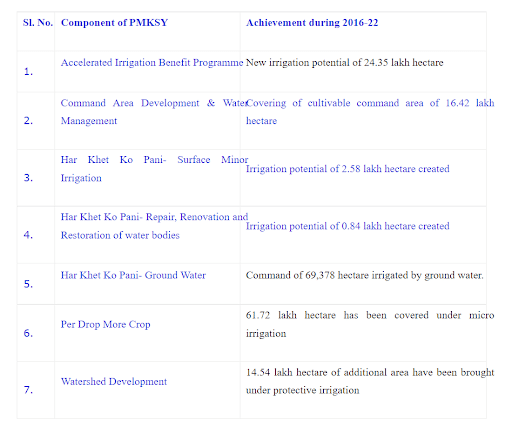
Achievement of Components of PMKSY
Analysis of PMKSY
| Progressive States | Andhra Pradesh, Gujarat, Karnataka, Madhya Pradesh, Maharashtra, Rajasthan, Tamil Nadu, Telangana |
| Underperforming States | Punjab, Jharkhand, Bihar, Chhattisgarh, Goa |
| States where Micro Irrigation is yet to pick up | Arunachal Pradesh, Manipur, Meghalaya, Nagaland and West Bengal |
Limitations of PMKSY
- According to a 2018 report by the Parliamentary Standing Committee on Rural Development, only 10% of the projects undertaken under the PMKSY watershed development component have been completed.
- Bureaucratic bottlenecks impede the process.
- Corruption is another major problem.
- Delay in project implementation.
- There is no mention of accountability when it comes to failing to meet targets.
- ‘Per Drop More Crop’ necessitates a larger investment to introduce costly sprinklers and drip irrigation, which small landowners cannot afford.
- The extent of government contribution to micro-irrigation investment on behalf of farmers, or incentives for farmers who adopt such micro-irrigation, is not mentioned in PMKSY.
- There is a scarcity of specialists. PMKSY is brimming with generalists, particularly bureaucrats.
- Inability to obtain land prior to funding. This has a negative impact on the scheme, causing it to fall short of its objectives.
- Large liabilities under AIPW and IWMP are influencing prioritisation.
- Free water and power are significant deterrents to precision irrigation adoption.
- There is a lack of cooperation and coordination among departments.
Conclusion
The government of India is committed to making water conservation and management a top priority. PMKSY aims to achieve convergence of irrigation investment at the field level. The overarching vision of the Pradhan Mantri Krishi Sinchayee Yojana (PMKSY) is to provide all agricultural farms in the country with access to some form of protective irrigation in order to produce 'per drop more crop,' thereby bringing much-needed rural prosperity.
|
|
|
|---|---|
| Agriculture Notes | Different Types of Irrigation and Irrigation Systems |
| Crop Rotation | Watershed Management |
| Crop and its Classifications | Cropping |
| Farming Systems | Organic Farming |
| Sustainable Agriculture | Integrated Farming System |
| Important Cropping Patterns in India | Major Crops of India |
| WEEDS | Soil |
FAQs
Question. What is Pradhan Mantri Krishi Sinchayee Yojana (PMKSY)?
Answer: The Pradhan Mantri Krishi Sinchayee Yojana (PMKSY) is a government initiative launched in 2015 with the aim of improving irrigation facilities in India, ensuring access to water for farmers, and enhancing the overall agricultural productivity of the country.
Question. What are the main objectives of PMKSY?
Answer: The key objectives of PMKSY include providing irrigation coverage to agricultural fields, improving water use efficiency, increasing agricultural productivity, and promoting sustainable agricultural practices. It aims to bring more areas under assured irrigation, thus reducing dependency on rainfall.
Question. What are the components of PMKSY?
Answer: PMKSY is divided into several components, including:
- Accelerated Irrigation Benefit Programme (AIBP)
- Har Khet Ko Pani (HKKP)
- Per Drop More Crop
- Watershed Development
- Command Area Development (CAD) and Water Management
Question. How does PMKSY benefit farmers?
Answer: PMKSY provides farmers with reliable access to irrigation, reducing their dependence on erratic monsoon rains. It helps improve crop yields, promotes water-use efficiency, and enhances the sustainability of farming practices.
Question. What is the role of technology in PMKSY?
Answer: PMKSY encourages the use of modern technologies like drip irrigation, sprinkler systems, and water conservation practices. These technologies help optimize water use, reduce wastage, and enhance productivity in agriculture.
MCQs
- What is the primary objective of the Pradhan Mantri Krishi Sinchayee Yojana (PMKSY)?
A) To provide loans to farmers
B) To improve irrigation facilities in the country
C) To reduce crop insurance premiums
D) To increase subsidies for fertilizers
Answer: (B) See the Explanation
PMKSY primarily aims to improve irrigation coverage and water-use efficiency in agriculture.
- Which of the following is NOT a component of PMKSY?
A) Accelerated Irrigation Benefit Programme (AIBP)
B) Har Khet Ko Pani (HKKP)
C) Per Drop More Crop
D) National Crop Insurance Scheme
Answer: (D) See the Explanation
The National Crop Insurance Scheme is not a part of PMKSY. PMKSY focuses on irrigation and water management.
- What is the purpose of the 'Per Drop More Crop' component of PMKSY?
A) To increase the number of farmers
B) To promote water-use efficiency in agriculture
C) To provide free seeds to farmers
D) To provide subsidies on fertilizers
Answer: (B) See the Explanation
The 'Per Drop More Crop' component focuses on improving water-use efficiency by adopting micro-irrigation technologies.
- Which irrigation technologies are encouraged under PMKSY?
A) Drip irrigation and sprinkler systems
B) Canal irrigation only
C) Rainwater harvesting only
D) Manual irrigation
Answer: (A) See the Explanation
PMKSY promotes the adoption of efficient irrigation technologies such as drip and sprinkler systems to optimize water usage.
- How does PMKSY help in sustainable agriculture?
A) By providing free pesticides to farmers
B) By reducing the dependency on rainfall and improving water conservation
C) By offering interest-free loans to farmers
D) By increasing subsidies on chemical fertilizers
Answer: (B) See the Explanation
PMKSY helps in ensuring reliable water supply, thus reducing dependence on unpredictable rainfall and promoting sustainable farming practices.
GS Mains Questions and Model Answers
Q1: Explain the role of PMKSY in addressing water scarcity issues in Indian agriculture.
Answer: PMKSY plays a pivotal role in mitigating water scarcity by improving irrigation infrastructure, ensuring efficient water management, and increasing water-use efficiency. Through components like "Har Khet Ko Pani" and "Per Drop More Crop," the scheme aims to provide reliable and equitable water access to farmers. PMKSY encourages the use of water-efficient irrigation technologies like drip and sprinkler systems, which not only conserve water but also reduce wastage. By expanding irrigation coverage and improving water management practices, PMKSY contributes to addressing the pressing issue of water scarcity in Indian agriculture, ensuring better crop yields and livelihoods for farmers.
Q2: Analyze the significance of technology in improving agricultural productivity under the Pradhan Mantri Krishi Sinchayee Yojana.
Answer: Technology plays a crucial role in enhancing agricultural productivity under PMKSY. The adoption of modern irrigation techniques such as drip irrigation and sprinkler systems helps optimize water use, leading to higher crop yields with minimal water wastage. The integration of precision farming tools and soil moisture sensors allows farmers to monitor irrigation schedules and optimize the application of water. These technologies not only improve water-use efficiency but also increase the sustainability of farming practices. By reducing dependency on monsoon rains and improving soil health, technology under PMKSY helps farmers boost productivity and achieve better financial outcomes.
Q3: Evaluate the impact of PMKSY on rural development and the economic welfare of farmers.
Answer: PMKSY has a transformative impact on rural development by improving irrigation infrastructure, which is crucial for agricultural productivity. By ensuring that farmers have reliable access to water, PMKSY helps reduce crop failure risks, stabilize income, and promote food security. The increased agricultural output resulting from efficient water use also stimulates rural economies by providing employment opportunities and boosting local businesses related to farming. Additionally, PMKSY encourages sustainable farming practices, which are beneficial in the long term. As a result, the scheme not only enhances farmers' welfare but also contributes to the overall development of rural areas by improving the quality of life, generating employment, and fostering community-based sustainable practices.
Previous Year Questions on PMKSY
1. UPSC CSE 2017
Question: "Discuss the objectives and components of the Pradhan Mantri Krishi Sinchayee Yojana (PMKSY) and its role in improving India's agricultural output."
Answer: The primary objective of PMKSY is to enhance irrigation coverage and improve water-use efficiency in agriculture. Its components include the Accelerated Irrigation Benefit Programme (AIBP), Har Khet Ko Pani (HKKP), Per Drop More Crop, and Watershed Development, which aim to ensure equitable and reliable water access for farmers. PMKSY contributes to increasing agricultural productivity by reducing dependency on rainfall, promoting sustainable farming practices, and improving farmers’ livelihoods through better crop yields.
2. UPSC CSE 2020
Question: "Evaluate the challenges faced in implementing PMKSY and suggest measures to overcome them."
Answer: While PMKSY has made significant strides in enhancing irrigation infrastructure, challenges such as inadequate funds, inefficient water management, and poor coordination between various stakeholders remain. The lack of awareness about advanced irrigation technologies, the high cost of installation, and limited access to financing also hinder the scheme's implementation. To overcome these challenges, there is a need for better awareness campaigns, financial incentives for farmers to adopt efficient irrigation systems, and greater collaboration between state governments, local bodies, and the private sector to ensure effective delivery and maintenance of irrigation facilities.
Download the PREPP App and attempt FREE IAS Exam Mock Tests and get complete study material!

Full Test - 04: UPSC CSE Prelims CSAT (Paper-II)
Full Test - 03: UPSC CSE Prelims CSAT (Paper-II)
UPSC CSE Prelims 2026 CSAT Paper 2 Question Paper (24-May-2026)
UPSC CSE Prelims 2026 GS Paper 1 Question Paper (24-May-2026)

17 February 2025 | The Hindu Must Read Articles | Current Affairs

16 February 2026 | The Hindu Must Read Articles | Current Affairs

13 February 2026 | The Hindu Must Read Articles | Current Affairs









Comments